Both Clerodendrum trichotomum and Clerodendrum sibiricum belong to the mint family and are sometimes cultivated for ornamental purposes. Their most significant commonality is the similar shape of their flowers. Specifically, both have very long stamens and pistils that curve downwards (curl) and protrude far from the flower. Therefore, they may sometimes be confused. However, these two species have different distributions and differ at the genus level. Specifically, there are differences in how the plants grow, the markings on the flowers, and the amount of hair on the leaves. This article will explain the differences between Clerodendrum trichotomum and Clerodendrum sibiricum.
What are Clerodendrum trichotomum and Clerodendrum frutescens?
Tripora divaricata, also known as Caryopteris erythrosora, is a perennial herb distributed in Hokkaido, Honshu, Shikoku, and Kyushu in Japan; as well as in China and the Korean Peninsula, growing in mountain foothills and fields (Kanagawa Prefecture Flora Survey Association, 2018). It is sometimes cultivated for ornamental purposes.
Rotheca myricoides, also known as Blue Elfin or Blue Wing, is an evergreen shrub widely distributed in East and South Africa, and cultivated in botanical gardens in Japan for ornamental purposes (RBG Kew, 2023). In Japan, many articles list its scientific name as Clerodendrum ugandense, but this is considered a synonym (former scientific name) overseas.
Both belong to the mint family and are sometimes cultivated for ornamental purposes. Their most significant commonality is the similar shape of their flowers.
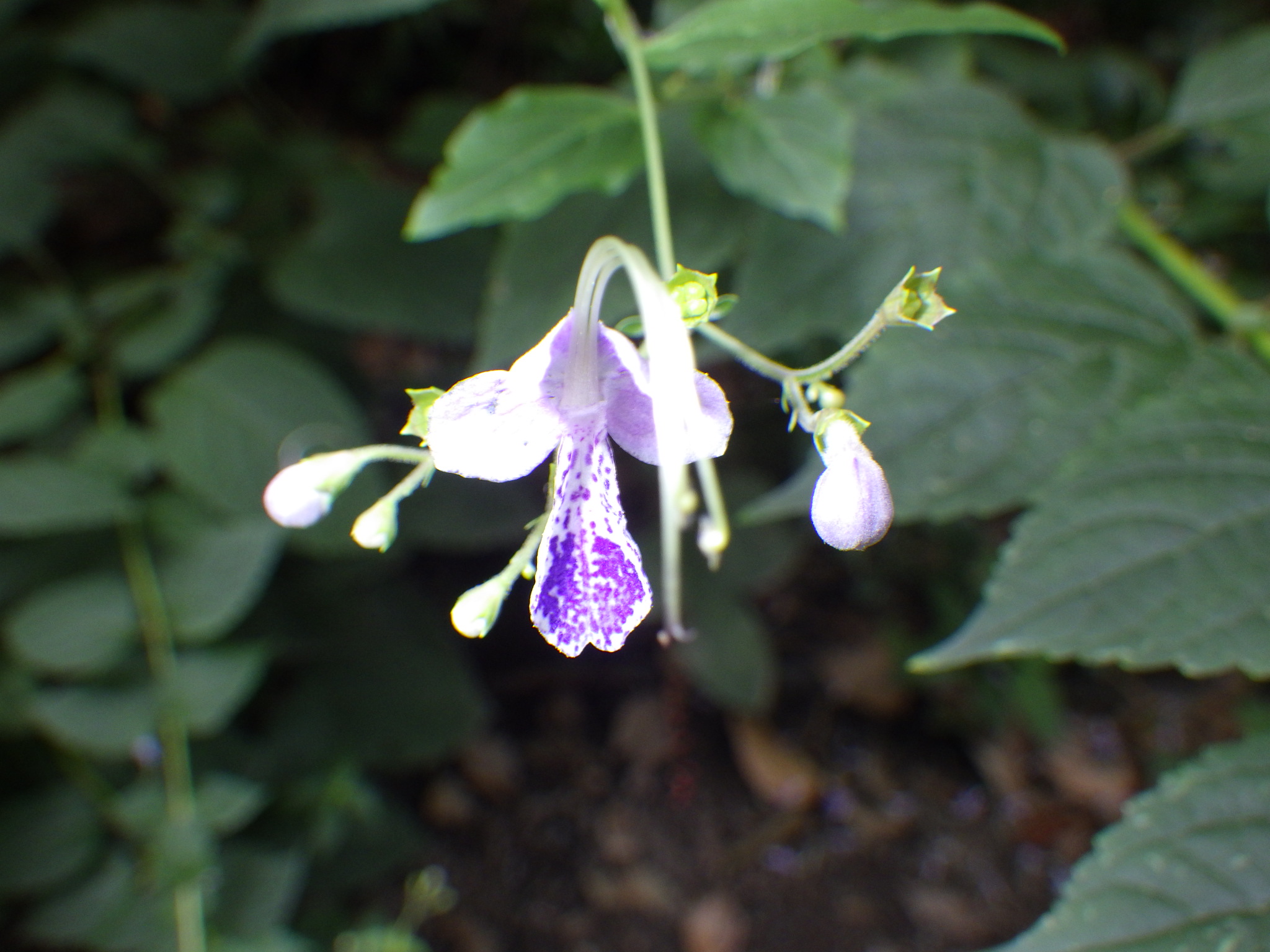
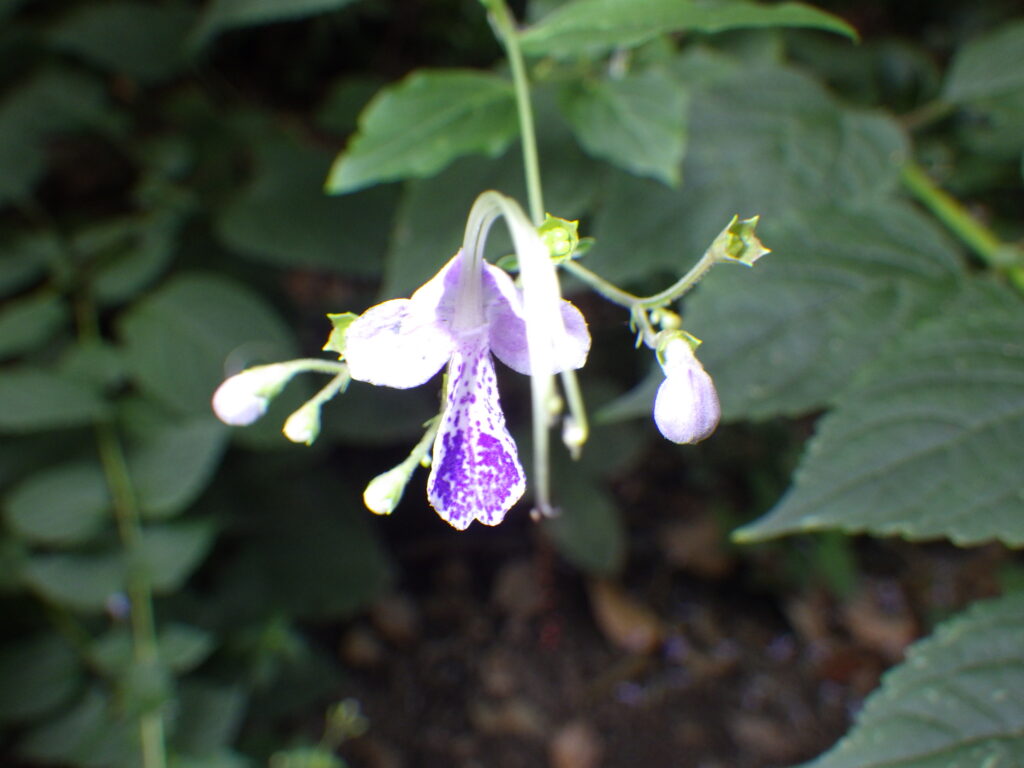
Specifically, the corolla is bluish-purple, has a long corolla tube, and is two-lipped, with the upper lip divided into two lobes and the lower lip into three lobes, appearing to be divided into a total of five parts. The central lobe of the lower lip is particularly large and recurved. The stamens and pistil are very long, curved downwards (curled), and protrude far outside the flower.
This highly unique characteristic is known to play a role in cleverly attaching pollen to the backs of bumblebees, thereby facilitating pollination (Tie et al., 2023).
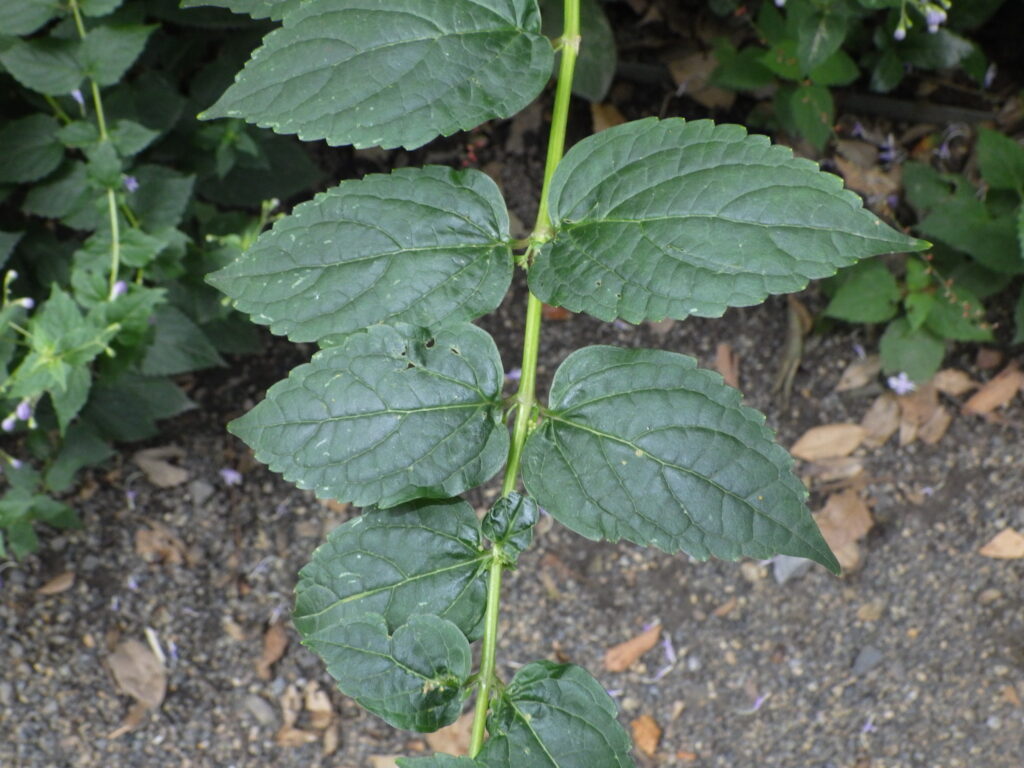
Furthermore, the leaves also have coarse serrations, and their shape is quite similar.
These characteristics may sometimes lead to confusion between cultivated and non-cultivated individuals.
What is the difference between Clerodendrum trichotomum and Clerodendrum sibiricum?
However, these two species are quite far apart taxonomically (Ohashi et al., 2017; Herman & Condy, 2017).
First, there is a major difference between these two species: Clerodendrum trichotomum belongs to the genus Clerodendrum, while Clerodendrum sibiricum belongs to the genus Clerodendrum.
Therefore, it can be expected that there will be significant differences in morphology as well.
The similarity in flower shapes is merely a coincidence, but as mentioned above, their purpose is the same, making this an interesting example of convergent evolution occurring in East Asia and Africa for the same purpose.
Specifically, the difference is that Clerodendrum trichotomum (genus Clerodendrum) is a herbaceous plant, while Clerodendrum sibiricum (genus Clerodendrum) is a shrub.
In other words, the bark of the Caryopteris plant does not become woody like that of a tree.
If we focus only on the two species, Clerodendrum trichotomum and Clerodendrum sibiricum, there are many other differences as well.
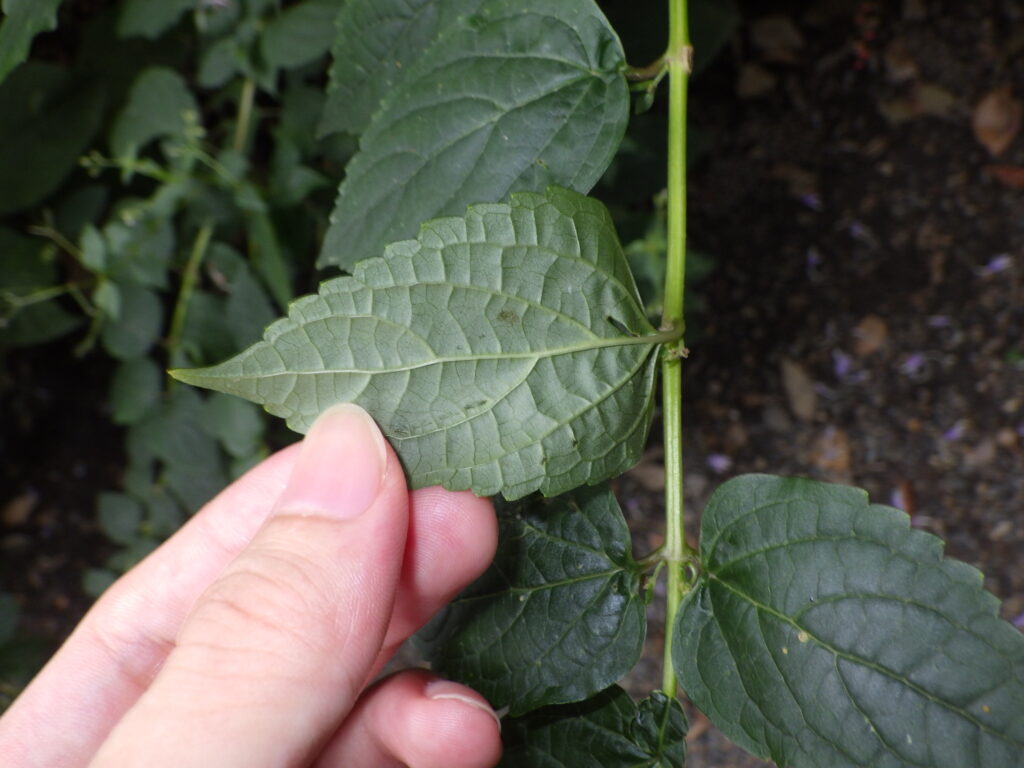
Regarding the leaves, there is a difference in that Clerodendrum trichotomum lacks long hairs on the leaf blade and petiole, and short hairs are difficult to find unless you look very carefully, whereas Clerodendrum sibiricum has many long hairs on the leaf blade and petiole, which are clearly visible in photographs.
It should be noted that the leaf shape of Clerodendrum trichotomum varies greatly; some have rounded leaf tips, unlike Clerodendrum trichotomum, while others have tail-like leaf tips, similar to Clerodendrum trichotomum.
Regarding the flowers, one difference is that Clerodendrum trichotomum has a mottled corolla, while Clerodendrum sibiricum does not.
The above should make the distinction clear. In the case of wild specimens in Japan, of course, only Clerodendrum trichotomum is the same. In fact, Clerodendrum frutescens is rarely cultivated, so you may not have many opportunities to see it.


References
Herman, PPJ, & Condy, G. 2017. Rotheca myricoides sensu lato (Lamiaceae: Ajugoideae). Flowering Plants of Africa 65: 146-152. ISSN: 0015-4504, ISBN: 9781928224204, https://www.researchgate.net/publication/318013789
Kanagawa Prefecture Flora Survey Association. 2018. Kanagawa Prefecture Flora 2018 (Electronic Edition). Kanagawa Prefecture Flora Survey Association, Odawara. 1803pp. ISBN: 9784991053726
Ohashi, Hiroyoshi; Kadota, Yuichi; Murata, Hitoshi; Yonekura, Koji; and Kihara, Hiroshi. 2017. Wild Plants of Japan (Revised New Edition, Vol. 5: Convolvulaceae to Caprifoliaceae). Heibonsha, Tokyo. 760pp. ISBN: 9784582535358
RBG Kew. 2023. The International Plant Names Index and World Checklist of Vascular Plants. Plants of the World Online. http://www.ipni.org and https://powo.science.kew.org/
Tie, S., He, YD, Lázaro, A., Inouye, DW, Guo, YH, & Yang, CF 2023. Floral trait variation across individual plants within a population enhances defense capability to nectar robbing. Plant Diversity 45(3): 315-325. https://doi.org/10.1016/j.pld.2022.11.002