Phyllanthus urinaria, Phyllanthus gracilis, and Phyllanthus longifolius all belong to the Phyllanthus genus of the Phyllanthaceae family. These annual plants grow in fields and along roadsides, and are more striking for their numerous small, orange-like green to red fruits than for their flowers. While these three species are frequently found within the Phyllanthus genus, distinguishing them requires careful observation. Specifically, the length of the flower stalks and fruit stalks is the most important factor, and the surface of the fruit and the leaves from the main stem can also be helpful. This article will explain the classification of the Phyllanthus genus.
What are *Phyllanthus urinaria*, *Phyllanthus urinaria*, and *Phyllanthus longifolius*?
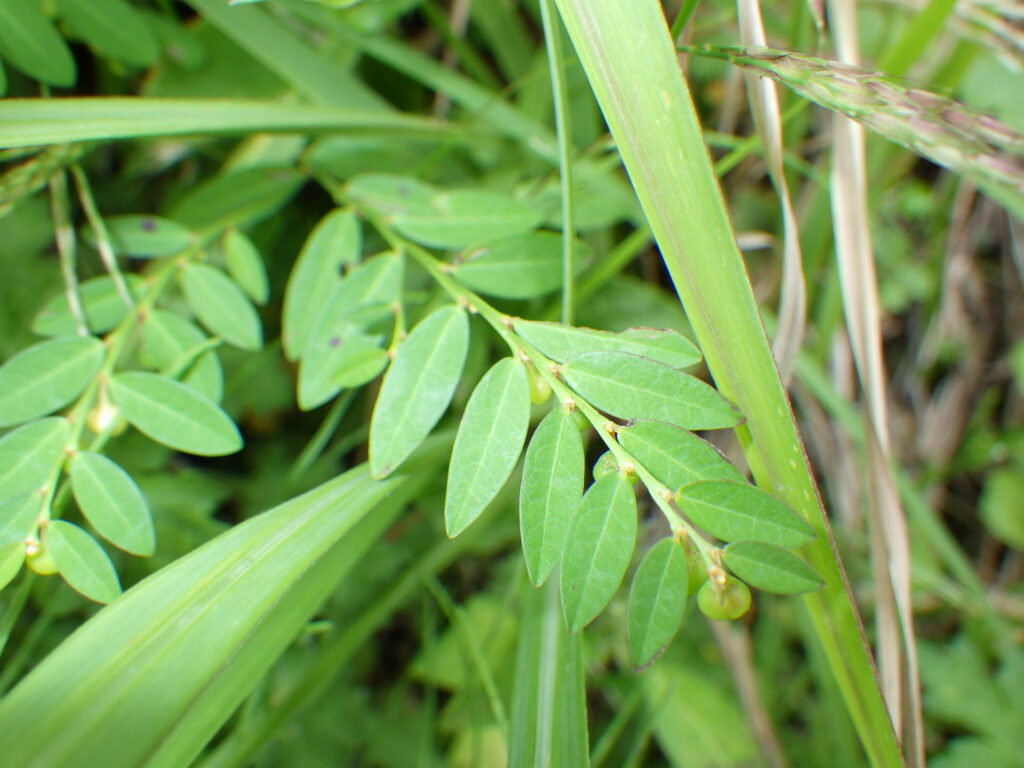
Phyllanthus lepidocarpus, also known as small mandarin orange grass, is an annual plant found in fields and roadsides, distributed throughout Honshu, Shikoku, Kyushu, and the Ryukyu Islands in Japan; as well as in East and Southeast Asia (Kanagawa Prefecture Flora Survey Association, 2018). While the Japanese Wikipedia lists it as Phyllanthus urinaria, this is a synonym (former scientific name).
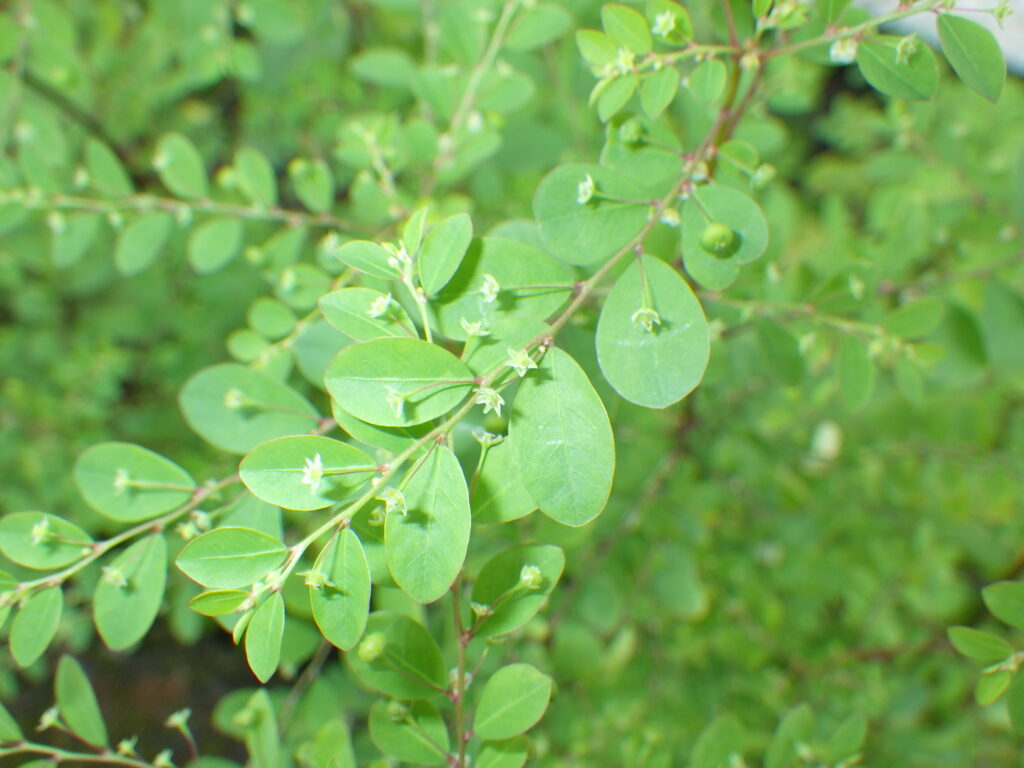
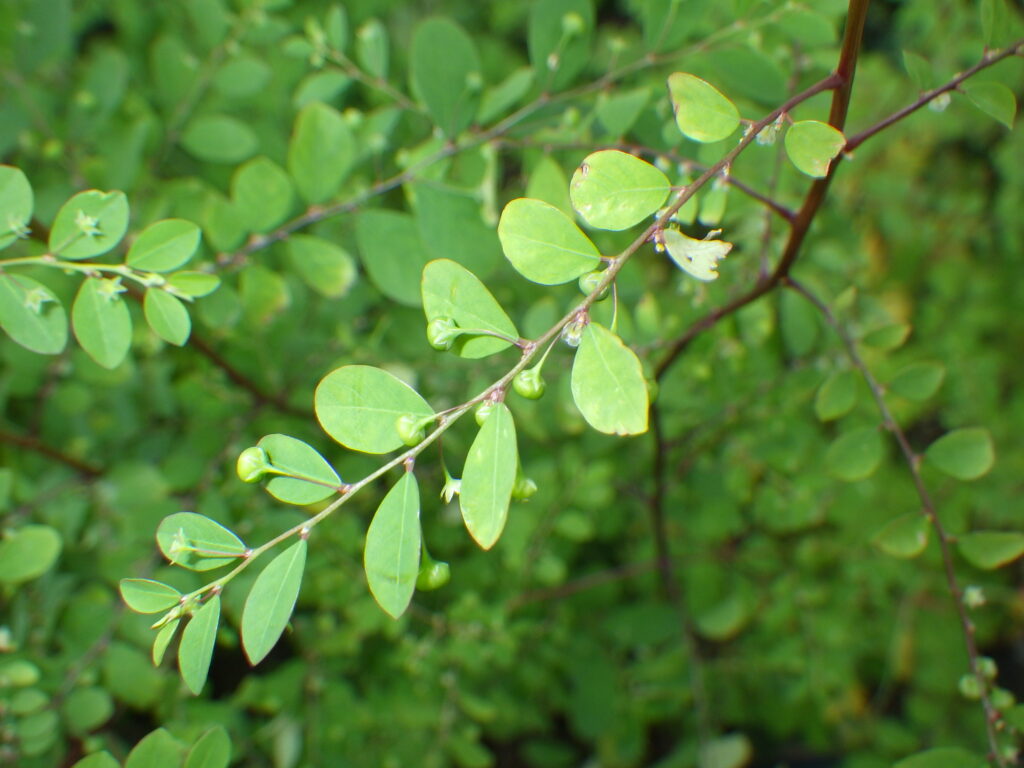
Phyllanthus ussuriensis, also known as Himemikansou (dwarf citrus grass), is an annual plant distributed in Honshu, Shikoku, Kyushu, and the Ryukyu Islands of Japan, as well as East Asia, growing in fields and along roadsides.
Phyllanthus tenellus, also known as long-stalked citrus grass, is native to the Mascarene Islands (a French overseas territory and the Republic of Mauritius) off the eastern coast of Madagascar in Africa. It is an annual plant that grows in fields and along roadsides. In recent years, its distribution has rapidly expanded, and it has become naturalized in Honshu (west of the Kanto region), Kyushu, and the Ryukyu Islands in Japan, as well as in tropical regions worldwide.
All of these plants belong to the genus Phyllanthus in the family Phyllanthaceae. They grow in fields and along roadsides, and are annual plants that are more striking for their countless small, orange-like green fruits that turn red when ripe, rather than their flowers.
Another notable feature is that the leaves have entire margins and are arranged in two rows on either side, giving them the appearance of pinnately compound leaves, which might lead one to mistakenly believe it belongs to the legume family. However, it does not actually have pinnately compound leaves like legumes.
The small, green to red fruits, similar to mandarins, are capsules that split open when dry, releasing the seeds, which are then dispersed by wind and water (Gavilán, 2022). Therefore, they are not actually edible like the fleshy berries of mandarins.
Because of these common features, they are indistinguishable from a distance, and the three species are easily confused.
What are the differences between *Phyllanthus urinaria*, *Phyllanthus urinaria*, and *Phyllanthus longifolius*?
There are 16 species of Phyllanthus native to Japan, and 4 species have naturalized, so it is not possible to describe how to distinguish all the species in Japan here. However, the three species that are frequently found on the mainland are easy to distinguish (Kanagawa Prefecture Flora Survey Association, 2018).
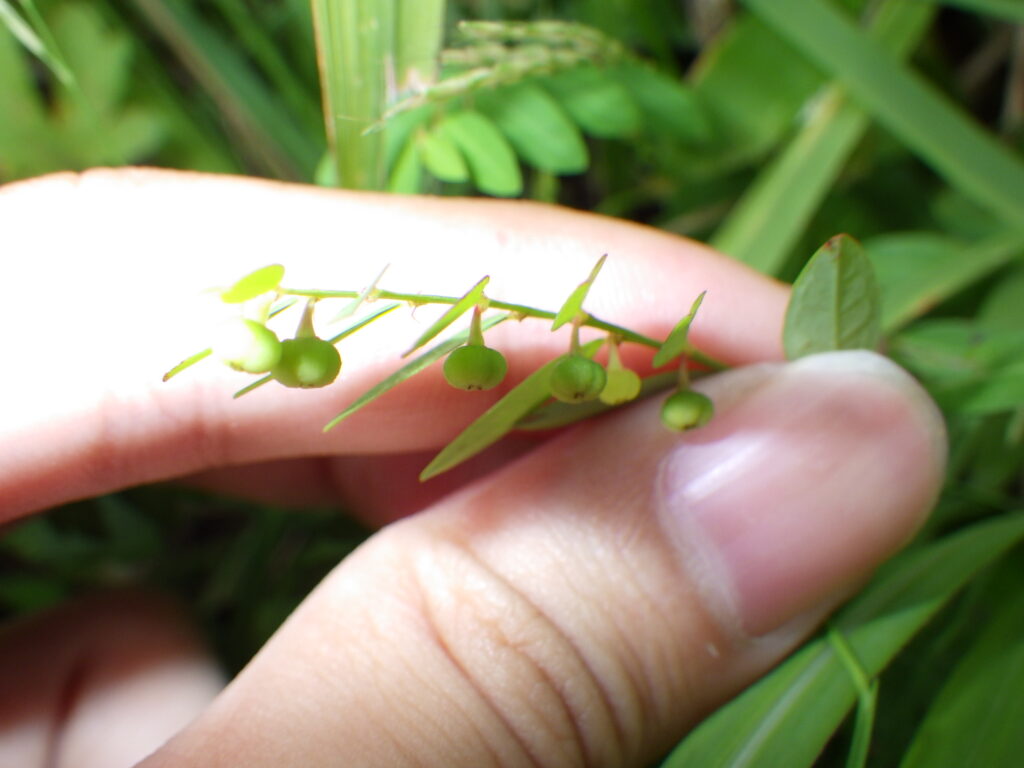
The most obvious difference is the condition of the pedicel (the thin part connecting the flower to the plant) and the fruit stalk (the thin part connecting the fruit to the plant).
While *Phyllanthus urinaria* and *Phyllanthus longifolius* have both flower stalks and fruit stalks, *Phyllanthus urinaria* has almost no flower stalks or fruit stalks.
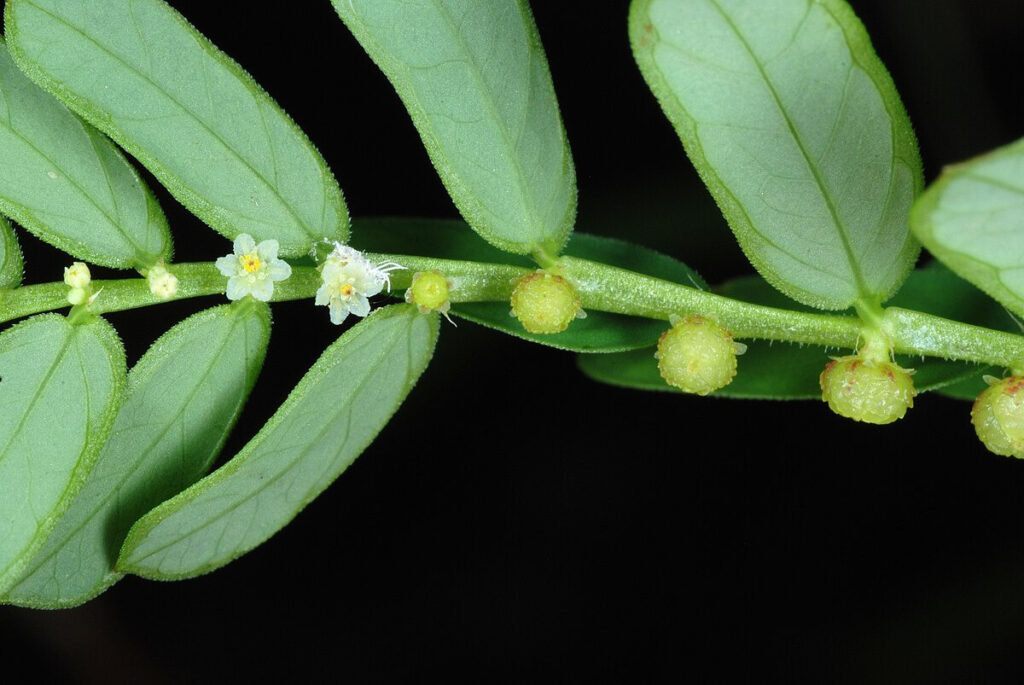
Therefore, in citrus fruits, the flowers and fruits are attached tightly to the leaf axils.
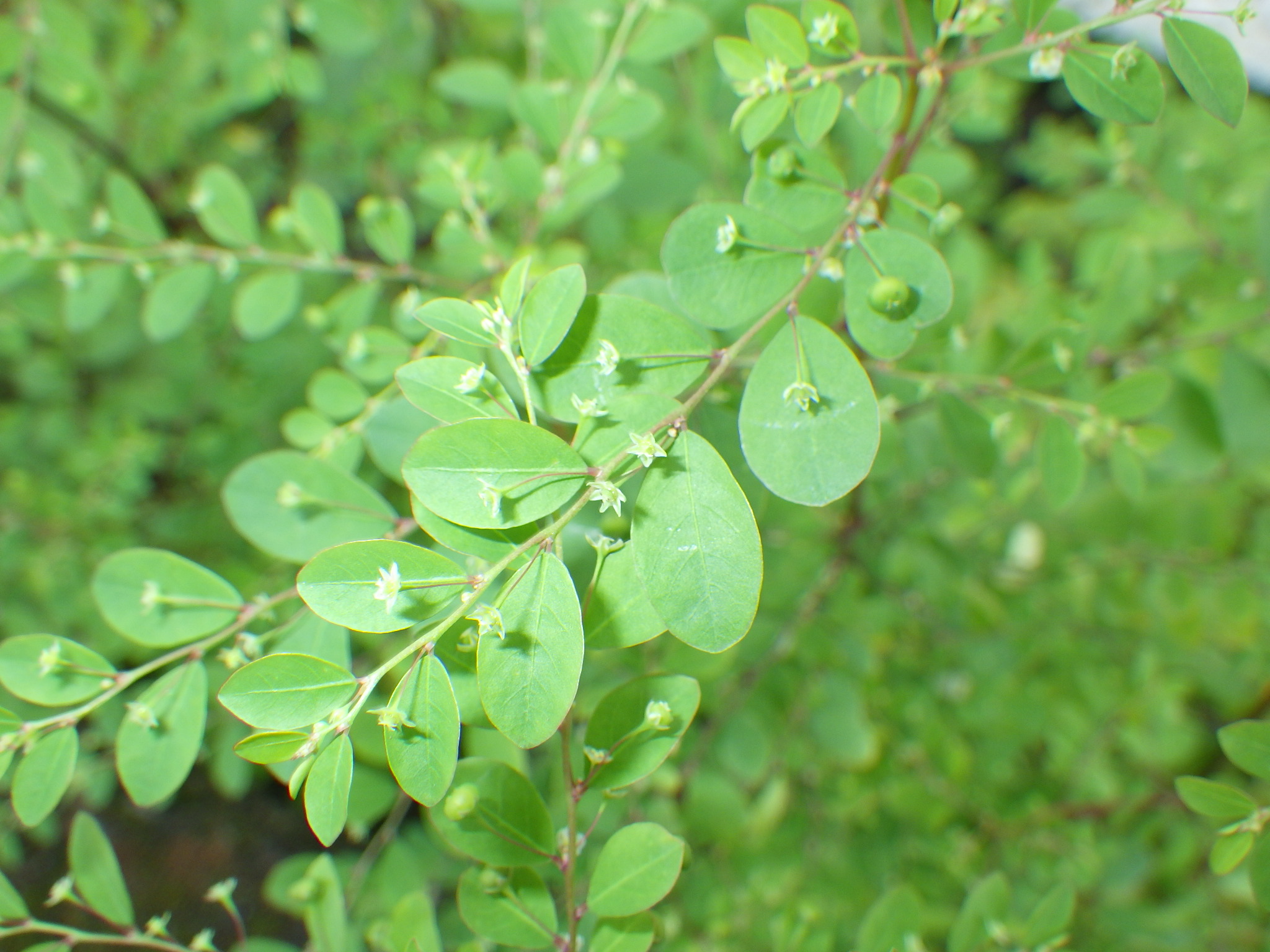
Regarding *Phyllanthus urinaria* and *Phyllanthus longifolius*, the main difference is that *Phyllanthus urinaria* has short flower stalks of 0.4–1.8 mm and fruit stalks of 1–3.5 mm in length, while *Phyllanthus longifolius* has considerably longer flower and fruit stalks of 5–8 mm in length.
This plant is easy to remember because its Japanese name, Nagaekomikansou (long-stalked small mandarin orange grass), perfectly describes it. No other species has such long flower stalks or fruit stalks.
The above should be sufficient for distinguishing them, but I will also list a few other characteristics just in case.
While *Phyllanthus urinaria* and *Phyllanthus longifolius* do not have leaves on their main stems, *Phyllanthus urinaria* has leaves on its main stem along with its twigs.
While the fruit surfaces of *Phyllanthus urinaria* and *Phyllanthus longifolius* are smooth, the fruit surface of *Phyllanthus urinaria* is densely covered with scale-like protrusions.
In addition, the species * Phyllanthus amarus*, also known as tree lily, has naturalized in Kyushu and the Ryukyu Islands, but it can be distinguished from other species by the fact that its main stem does not bear leaves, its fruit is stalked and smooth, the fruit stalk is 0.8-1.2 mm long, and the base of the leaves is rounded.

References
Gavilán, JV 2022. Phyllanthus urinaria (chamber bitter). CABI Compendium. https://doi.org/10.1079/cabicompendium.46061
Kanagawa Prefecture Flora Survey Association. 2018. Kanagawa Prefecture Flora 2018 (Electronic Edition). Kanagawa Prefecture Flora Survey Association, Odawara. 1803pp. ISBN: 9784991053726