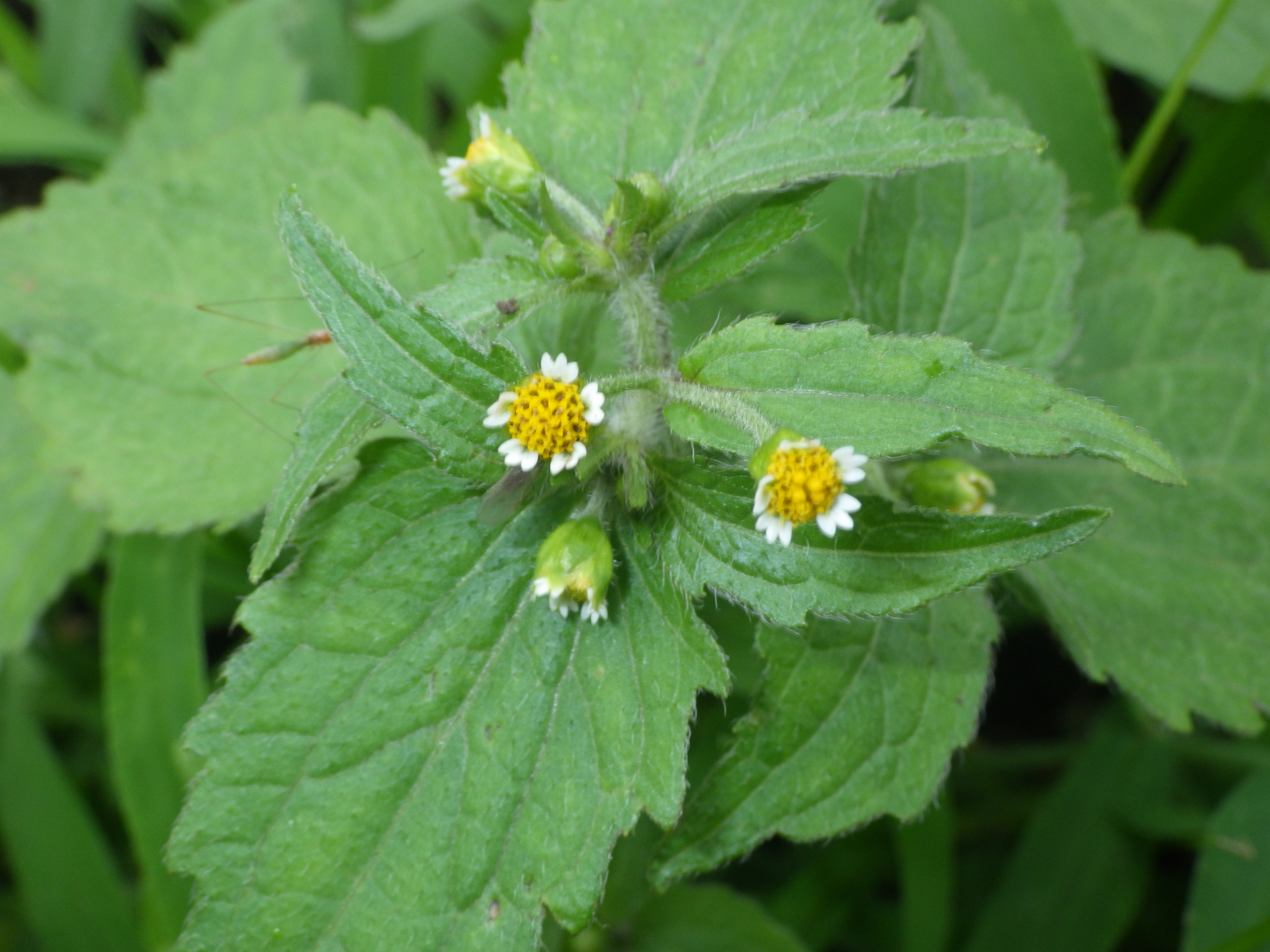
Galinsoga parviflora and Galinsoga stolonifera both belong to the genus Galinsoga in the Asteraceae family. Although native to the Americas, they are now extremely common weeds in disturbed areas of Japan. The differences in the shape of the flowers of these two species are subtle from a distance, and it may be difficult to distinguish them if you only vaguely remember them. However, these two species are relatively easy to identify with careful observation. The most important thing is to check the size of the petals and whether or not they have serrations. Two types of flowers make up the flower head, with usually five white ray florets arranged to frame the flower head and yellow tubular florets clustered in the center. Self-pollination is possible, but cross-pollination is mainly carried out by flies such as hoverflies. The fruit is an achene and is dispersed by wind with large pappus, but it has also been pointed out overseas that it adheres to animals such as humans with the bristles of the plant, and is dispersed by animal contact. This article will explain the classification, morphology, pollination ecology, and seed dispersal of the genus Galinsoga.
What are Galinsoga parviflora and Chrysanthemum reptans?
Galinsoga quadriradiata, also known as "scavenger chrysanthemum," is considered native to Mexico in American literature (Flora of North America Committee, 2006). It was discovered in Tokyo during the Taisho era and is now distributed throughout Japan west of the Kanto region (Hayashi et al., 2013). It is an annual plant that grows in fertile areas such as fields, gardens, and roadsides (Kanagawa Prefecture Flora Survey Association, 2018). Japanese literature is ambiguous, stating that it is "native to America," but the American literature is likely correct. It has spread naturally in South America and can also be found in China (Wu et al., 2011). Its Japanese name comes from the fact that it was found in a scavenger dump in Tokyo.
Galinsoga parviflora, also known as small-grained chrysanthemum, is native to North America, the West Indies, Central America, and South America. It has been introduced to Europe, Asia (including China), Africa, and Australia, and is an annual plant that grows in barren soil, fields, orchards, gardens, lawns, and roadsides (Flora of North America Committee, 2006). In Japan, it was introduced during the Taisho era and is now distributed throughout the country (Shimizu et al., 2001).
Both belong to the genus Euphorbia in the Asteraceae family, and can be said to be extremely common weeds in disturbed areas of Japan today. They are often seen growing in planted areas even in urban areas.
However, the differences in flower shape are subtle from a distance, and if your memory is hazy, it may be difficult to distinguish between the two species.
What is the difference between Galinsoga parviflora and Galinsoga stolonifera?
However, the difference between Galinsoga parviflora and Galinsoga stolonifera is relatively easy to discern with careful observation (Kanagawa Prefecture Flora Survey Association, 2018).
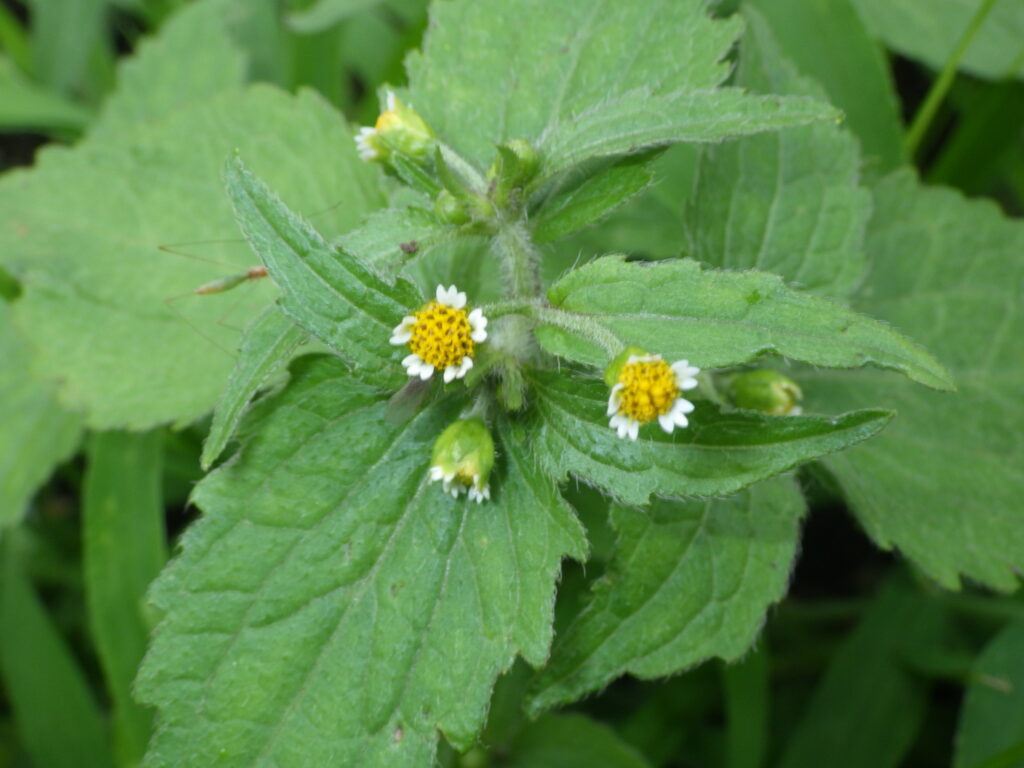
First, there is a significant difference in the flowers. In Galinsoga parviflora, the ray florets are large and conspicuous, and the space between the petals is quite narrow, whereas in Chrysanthemum camschatcense, the ray florets are small and inconspicuous, and the space between the petals is clearly wider.
Looking at even finer details, in Galinsoga parviflora, the ray florets also have pappus hairs, and the tips of the pappus hairs on the disc florets are pointed like spines, whereas in Chrysanthemum camschatcense, the ray florets lack pappus hairs, and the tips of the pappus hairs on the disc florets have tufts of hairs. However, confirming this would require dissection and observation with a magnifying glass.
Also, although it's not often pointed out in botanical guides, the cluster of yellow tubular florets in the center of *Chrysanthemum boreale* is raised and forms a dome shape.
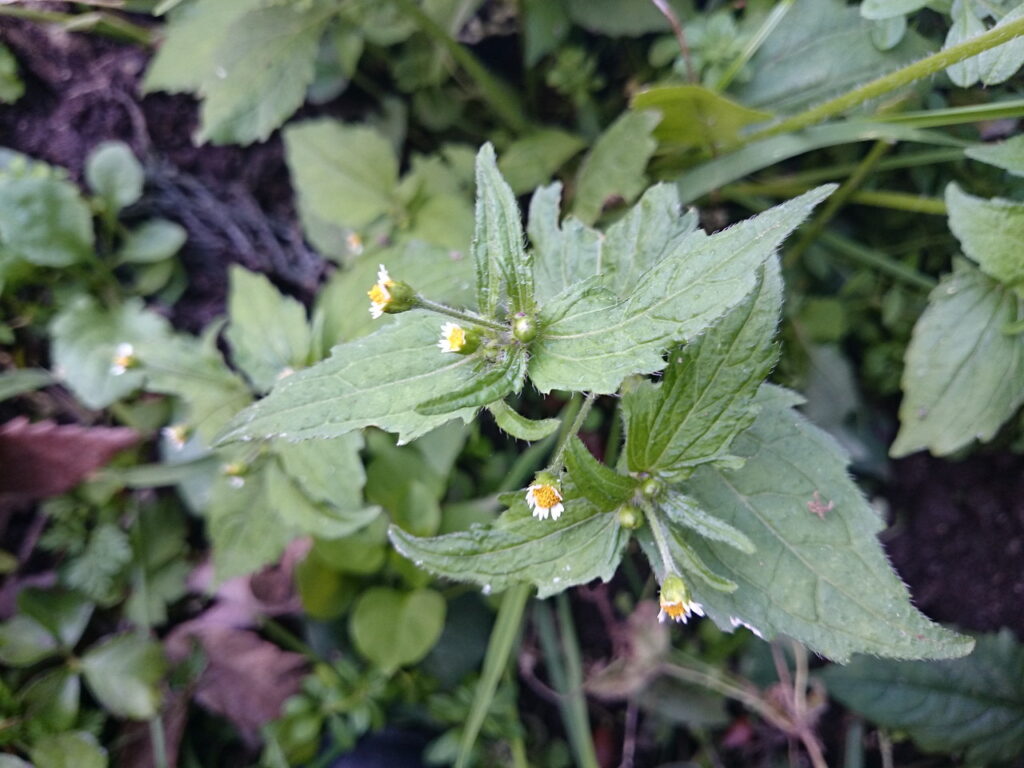
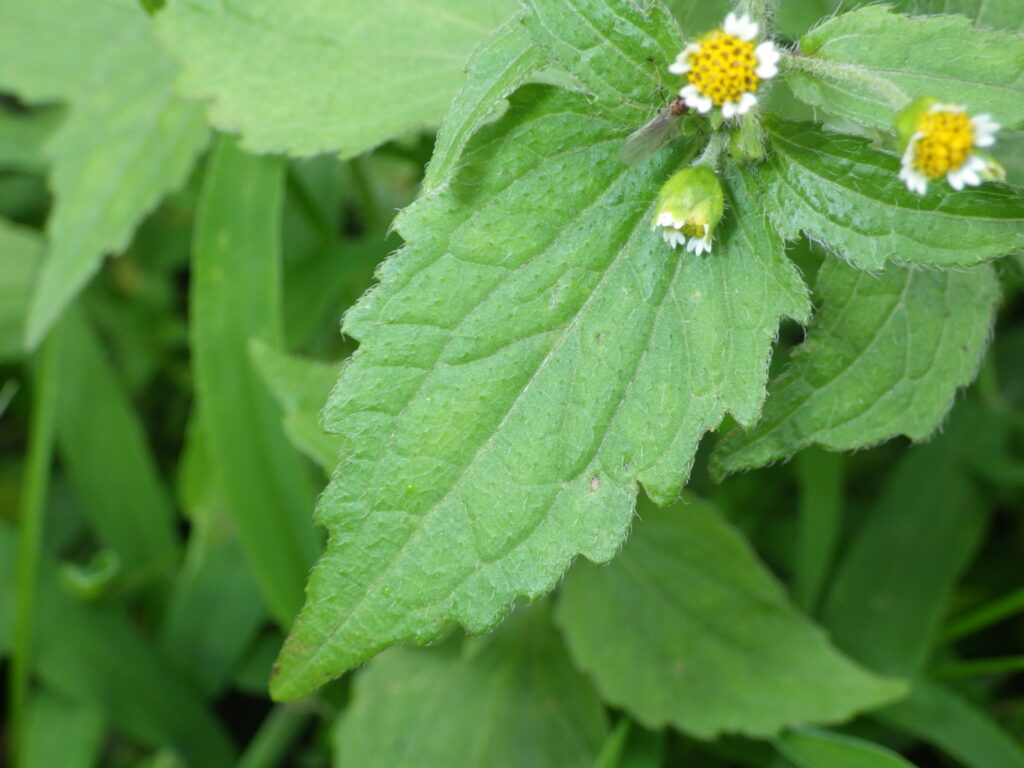
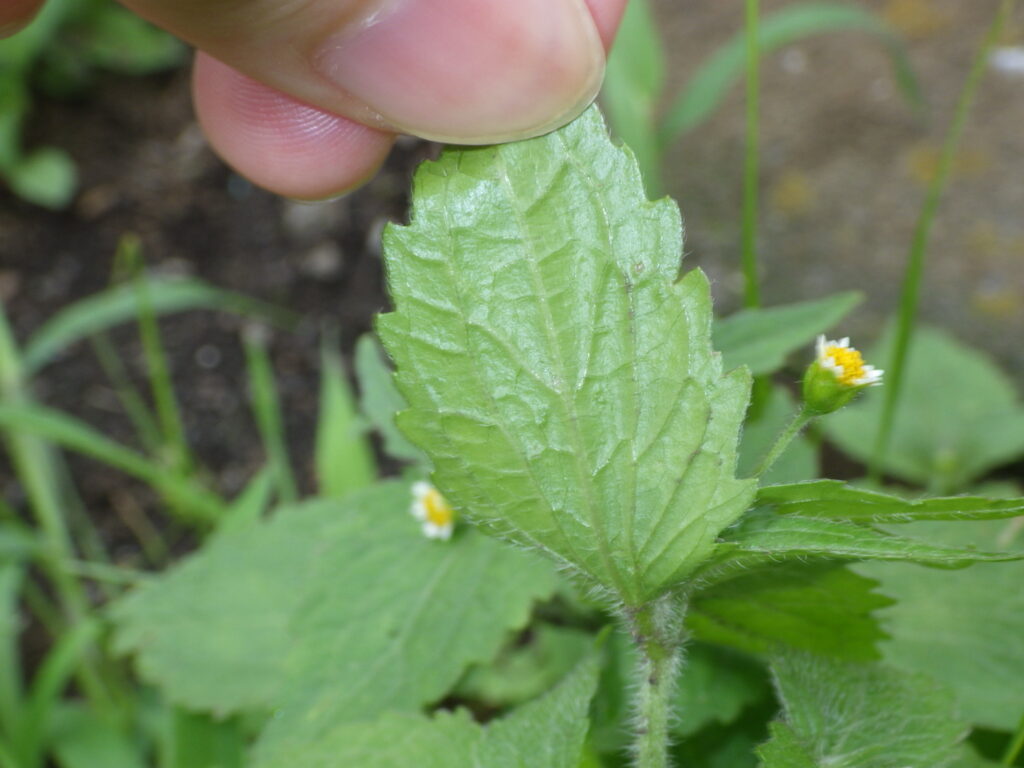
There are also differences in the leaves. In Galinsoga parviflora, the leaf serrations are distinct, with the longest serrations being 2 mm or more in length, whereas in Chrysanthemum camschatcense, the leaf serrations are indistinct, with the longest serrations being less than 1 mm.
You should be able to identify it reliably by looking at the flowers and leaves. Strangely enough, in some regions, *Chrysanthemum boreale* is quite rare; for example, only one specimen has been found in Kanagawa Prefecture.
What is the structure of a flower?
Like many plants in the Asteraceae family, the genus *Chrysanthemum* produces "flower heads" (capitulum inflorescences). Flower heads are commonly found in the Asteraceae family and are inflorescences (arrangements of flowers) that are clusters of flowers. As evidence of this, each flower has the structure of stamens and pistils, and is sometimes specifically called a "flora." Most people refer to flower heads as "flowers," but they are actually different.
The small flowers of the Asteraceae family consist of two types: "ray florets," which have a corolla that extends widely to one side, and "disc florets," which have a tubular corolla. The combination of these two types varies depending on the species of the Asteraceae family, but both types exist in the genus *Echinopsis*.
Galinsoga gracilis blooms from June to November. It bears small flower heads singly at the tips of the upper branches. The flower heads are about 5 mm in diameter, with usually five white ray florets arranged around the edge and numerous yellow disc florets inside. The ray florets also have pappus hairs, and the tips of the pappus hairs on the disc florets are pointed and spine-like. The involucre is hemispherical. The involucral bracts and pedicels have glandular hairs.
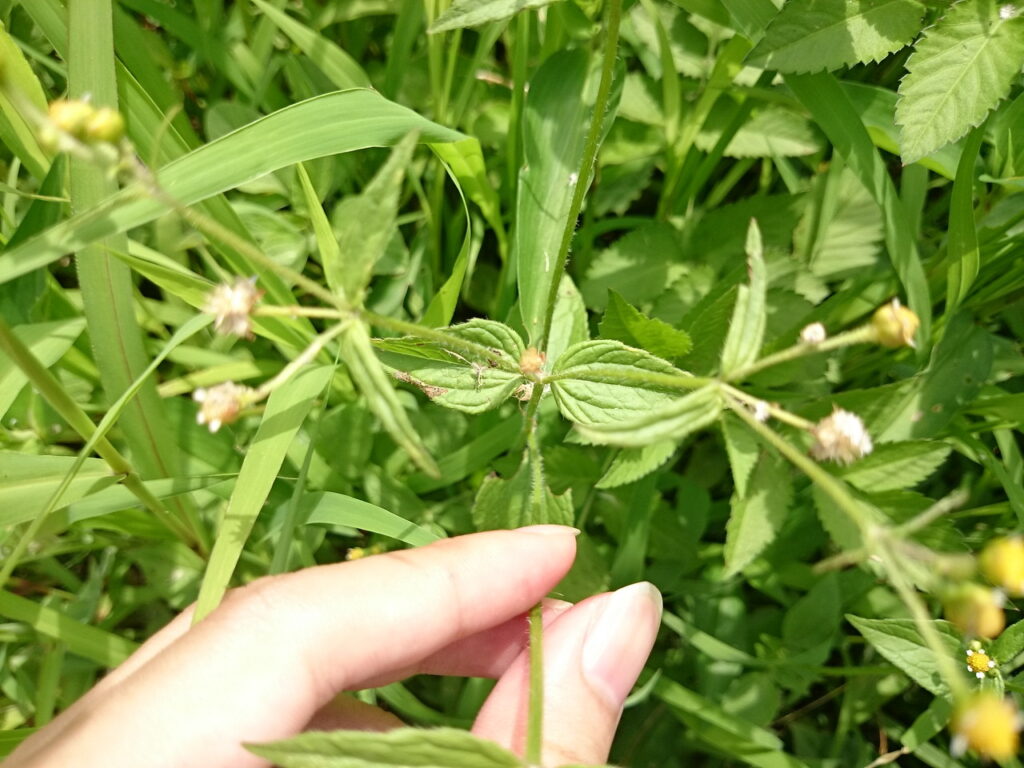
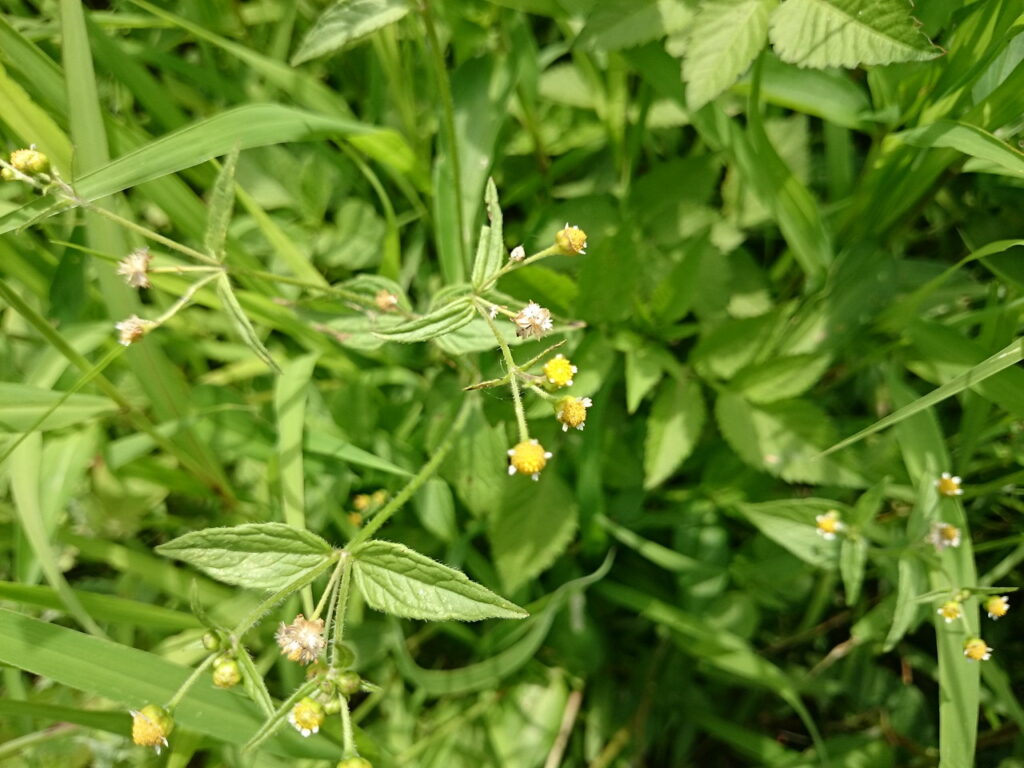
*Chrysanthemum boreale* flowers from July to October. The inflorescence stalk is elongated, measuring 1 to 40 mm in length. There are (3 to) 5 (to 8) ray florets, with petals that are usually white or pink, and the ligule is 0.5 to 1.8 mm long and 0.7 to 1.5 mm wide. There are 15 to 50 disc florets. The ray florets lack a pappus, while the disc florets have a tuft of hairs at the tip of the pappus. The involucre is bell-shaped, 2.5 to 5 mm in diameter.
How is pollination done?
Galinsoga parviflora and Galinsoga stolonifera can self-pollinate and therefore produce fruit without the need for pollinating insects (Warwick & Sweet, 1983).
However, cross-pollination by certain insects also occurs. This is likely a way to cope with changes in the natural environment and parasitic organisms.
According to research conducted in Mexico, their native habitat, both Galinsoga parviflora and Galinsoga stolonifera are visited by 0 to 15 insects every hour during the daytime (Hernández-Villa, 2020). The insects are almost entirely from the order Diptera (flies), with only a small number from the order Hymenoptera (bees and wasps).
There are no records specifying the exact type of fly, but it is likely that many of them belong to the Syrphidae family.
While there are no comprehensive records in Japan, the literature mentions that small bees such as *Anoplophora japonica*, *Anoplophora erythrosora*, *Anoplophora septempunctata*, and *Anoplophora septempunctata* have visited *Galinsea japonica* (Matsumura, 2007). Additionally, using Google Image Search, one example each of *Anoplophora septempunctata*, *Anoplophora septempunctata*, and *Anoplophora rhinoceros* were found.
The small, flat, and short flower heads of the *Epilobium* genus are ideal for insects with short mouthparts, and the white petals are also known to be a relatively favored color for flies. In many areas, hoverflies and small bees may contribute to pollination. These groups are frequently found even in urban areas, which is very convenient for the two species of *Epilobium*. Furthermore, the fact that they can produce fruit even without insects is an advantage in urban areas.
The effects that subtle differences between the two types of flowers have on pollinating insects are not well understood.
What is the structure of the fruit?
The fruit, common to the genus Euphorbia, is an achene, like many plants in the Asteraceae family. The achene has a hard, membranous pericarp that dries when ripe and contains one seed in each chamber. Although this achene is sometimes called a "seed," strictly speaking, it is a fruit. Inside this achene is the "seed," or "seed."
The achenes of Galinsoga parviflora are covered with white, scale-like pappus hairs. The main body is about 1 mm long, black, glossy, and covered with bristles on its surface.
The achenes of the ray florets of *Chrysanthemum boreale* are 1.5–2.5 mm long. They lack a pappus or have 5–10 irregularly incised scales 0.5–1 mm long. The achenes of the disc florets are 1.3–2.5 mm long, glabrous or bristle-like, lack a pappus or have 15–20 scales.
What are the seed dispersal methods?
Many achenes of the Asteraceae family, such as those of dandelions, have a pappus and are dispersed by wind.
The presence of pappus suggests that species in the genus *Echinopsis* also rely on wind dispersal.
However, overseas literature has indicated that species of the genus *Echinopsis* also disperse their seeds by other means (Warwick & Sweet, 1983). The surface of the achene has bristles, which seem to allow it to adhere to the fur of passing animals or to human clothing. In other words, it is a "burr" and disperses its seeds by "attaching to animals."
It is believed that long-distance seed dispersal is primarily through animal attachment via human clothing, while wind dispersal is considered more suitable for localized, short-distance travel.
Indoor observations have shown that Galinsoga gracilis produces an average of 29 seeds per flower head and an average of 334 flower heads per plant, while Chrysanthemum pacificum produces an average of 26 seeds per flower head and an average of 283 flower heads per plant. It is also estimated that one Chrysanthemum pacificum plant produces 13,400 flower heads in its lifetime, totaling 400,000 seeds.
The two seed dispersal methods and this seed production capacity can also be said to contribute to its strong reproductive capacity.
References
Flora of North America Committee. 2006. Flora of North America (Vol. 19 Magnoliophyta: Asteridae, Part 6: Asteraceae, Part 1). Oxford University Press, Oxford. 579pp. ISBN: 9780195305630
Hayashi, Yasaka, Kadota, Yuichi, and Hirano, Takahisa. 2013. Yamakei Handy Illustrated Guide 1: Wildflowers (Revised and Expanded New Edition). Yama-kei Publishers, Tokyo. 664pp. ISBN: 9784635070195
Hernández-Villa, V., Vibrans, H., Uscanga-Mortera, E., & Aguirre-Jaimes, A. 2020. Floral visitors and pollinator dependence are related to floral display size and plant height in native weeds of central Mexico. Flora 262: 151505. https://doi.org/10.1016/j.flora.2019.151505
Kanagawa Prefecture Flora Survey Association. 2018. Kanagawa Prefecture Flora 2018 (Electronic Edition). Kanagawa Prefecture Flora Survey Association, Odawara. 1803pp. ISBN: 9784991053726
Matsumura, Yu. 2007. Ecology of bees—Focusing on a bee survey at Senbonmatsu Ranch—. Nasunogahara Museum Bulletin 3(1): 1-18. https://doi.org/10.34372/nasunogahara.3.1_1
Shimizu, K., Morita, H., & Hirota, S. 2001. Illustrated Guide to Naturalized Plants of Japan: 600 Species of Plant Invaders (Revised). National Rural Education Association, Tokyo. 553pp. ISBN: 9784881370858
Warwick, SI, & Sweet, RD 1983. The biology of Canadian weeds: 58. Galinsoga parviflora and G. uadriradiata (= G. ciliata). Canadian Journal of Plant Science 63(3): 695-709. https://doi.org/10.4141/cjps83-087
Wu, ZY, Raven, PH, & Hong, DY (Eds.). 2011. Flora of China (Vol. 20-21 Asteraceae). Science Press, Beijing & Missouri Botanical Garden Press, St. Louis. 993pp. ISBN: 9781935641070