Ice plant (Lampranthus oleraceus) and cold-hardy ice plant (Lampranthus lanzanensis) are both native to South Africa and are extremely popular as ornamental plants in Japan. You'll see them everywhere you go. These succulent plants have plump leaves and showy pink flowers that are unlike anything you'd see in Japan, giving them an exotic feel. However, they are often confused because their leaves and flowers look very similar. Checking overseas literature clearly shows the morphological differences between the two species, and they can be distinguished by examining the shape of the leaves and the inflorescence. They perform CAM photosynthesis, and their plump, succulent leaves enhance their heat and salt tolerance. The flowers are arranged radially, and in the wild species, the flowers, composed of showy pink petals, attract the attention of many. Bees, beetles, and flies seem to visit these flowers, but detailed research is lacking. The fruit is a capsule, but it is unique in that it releases seeds when wet with rain, rather than when dry like other plants, which is thought to be an adaptation to the South African climate. This article will explain the classification, morphology, pollination ecology, and seed dispersal of ice plant and cold-hardy ice plant.
- What are ice plants and cold-hardy ice plants?
- What is the difference between ice plant and cold-hardy ice plant?
- Is photosynthesis unique? What is the role of succulents in leaves?
- What is the structure of a flower?
- How is pollination done?
- What is the structure of the fruit?
- What are the seed dispersal methods?
- References
What are ice plants and cold-hardy ice plants?
Lampranthus spectabilis, also known as ice plant, is a small shrub native to the Cape Province of South Africa, growing in grasslands. It is cultivated as an ornamental plant worldwide, including in Japan.
Delosperma cooperi, also known as Hanaranzan (花嵐山), is a perennial plant distributed in the Free State province of South Africa and Lesotho, growing in dry grasslands and rocky areas of disturbed land. It is cultivated as an ornamental plant worldwide, including in Japan. While it is commonly referred to as "Hanaranzan" in horticulture, Ylist, the most comprehensive list of Japanese names and scientific names in Japan, lists it as Hanaranzan. The origin of this name is unknown, but it is thought to be due to the appearance of its flowers and leaves. From here on, we will refer to it as Hanaranzan.
Both belong to the Aizoaceae family and are distributed in South Africa. In Japan, they are two species that are extremely popular as ornamental plants. You can see them almost everywhere you walk in town. They are succulents, and their plump leaves and showy pink flowers have a shape that is rarely seen in Japan, giving them an exotic feel.
These two species are often confused because their leaves and flowers look very similar at first glance. It seems there are few Japanese websites that properly understand and describe the differences between these two species.
What is the difference between ice plant and cold-hardy ice plant?
A review of overseas literature clearly shows the morphological differences between *Lampranthus japonica* and *Lampranthus sanguineus* (cold-hardy *Lampranthus japonica*) (Spencer & Thompson, 1997). It took me a long time to find this literature, so I highly recommend you take a look.
First of all, while ice plants (Lampranthus) belong to the genus Lampranthus, *Delosperma* belongs to the genus Delosperma. Therefore, although the flowers are very similar, there are relatively significant differences from a taxonomic perspective.
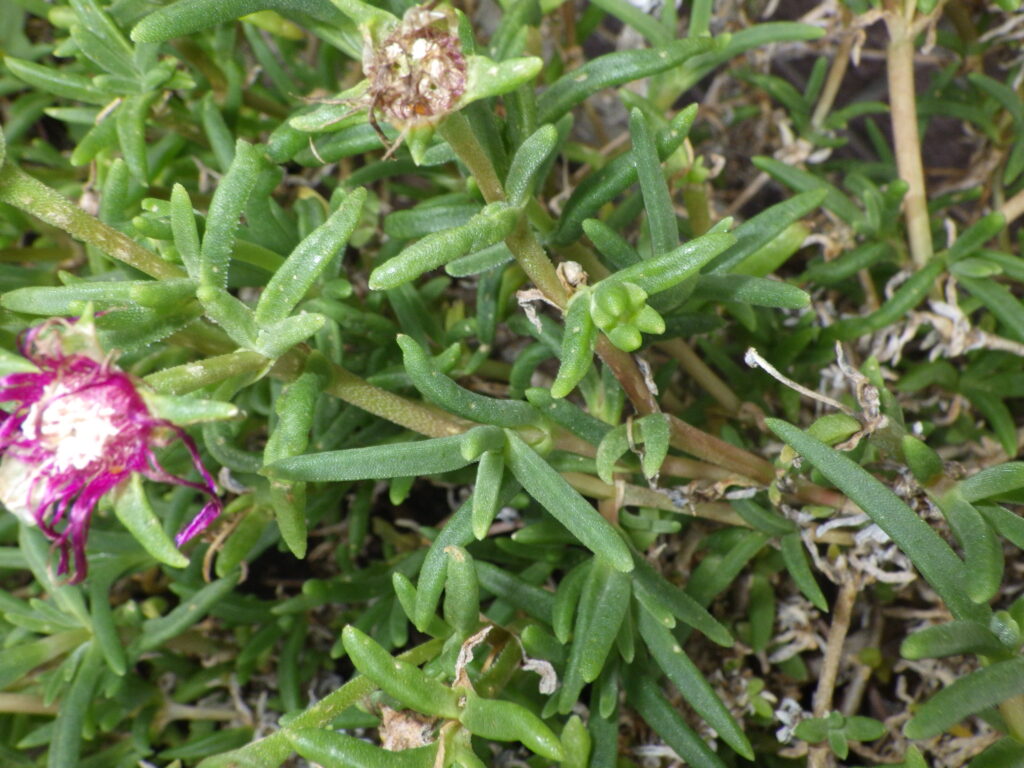
First, there is a difference in that the surface of the leaves of ice plants (Lampranthus genus) is rough and has some inconspicuous protrusions, while that of Delosperma genus has distinct granular, milky protrusions on the surface of its leaves.
The term "mammary protrusions" might be difficult to understand, but essentially, the leaves of *Hanaranzan* have large "bumps." This is an important characteristic that defines the genus.
Although the exact mechanism is unclear, plants with high cold and salt tolerance often have special structures to store sugars and water, and it's likely that *Lampranthus japonica* also achieves its cold and salt tolerance through these "bumps." Its ability to withstand temperatures as low as -29°C and cultivate in relatively cold regions is another difference from *Lampranthus japonica*.
Even flowers can be different.
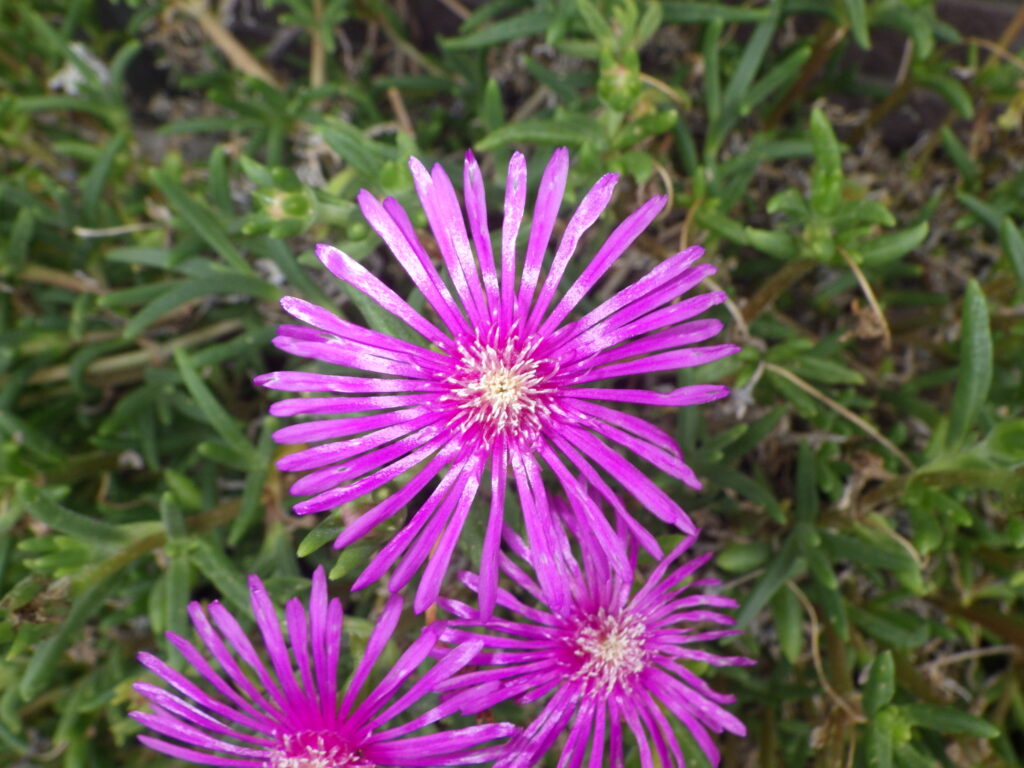
In ice plants, the petals are somewhat sparse with gaps between them, while in lilacs, the petals are somewhat denser with fewer gaps. However, this difference is subtle.
Some Japanese websites state that while *Lampranthus* generally forms upright cymose inflorescences, *Lampranthus japonica* is solitary and does not form inflorescences.
While photographs taken in Japan do seem to show this tendency, descriptions on overseas websites also suggest that *Hanaranzan* sometimes forms cymose inflorescences, so this might not be a reliable indicator.
Basically, use the shape of the leaves as a guide and try to find both species around town.


Is photosynthesis unique? What is the role of succulents in leaves?
Physiologically, both plants perform sedum-type organic acid metabolism (CAM) photosynthesis (Yoshimura, 2021).
CAM photosynthesis is generally considered a physiological adaptation for securing water in high-temperature, semi-arid environments where terrestrial succulents are exposed to harsh moisture conditions, as it absorbs carbon dioxide (CO2) at night and suppresses transpiration during the day. It is advantageous for growing in places where it is difficult to absorb water directly from the soil or in soils with high salinity. In addition, the succulent nature of the tissue has evolved to enhance water storage capacity.
In fact, it has been shown that ice plants can grow even in soil containing a 600 [mmol/L] sodium chloride (NaCl) solution, demonstrating strong salt tolerance (Kondo et al., 2019). The ice plant, Mesembryanthemum crystallinum, which has a salty taste and a crunchy texture, is also known as a close relative belonging to the Aizoaceae family.
This was likely an adaptation to survive in the dry, harsh environment of its native South Africa. This probably also contributes to its ease of cultivation. The soft, squishy texture of the leaves is interesting, but it's also worthwhile to reflect on its life in its native habitat.
What is the structure of a flower?
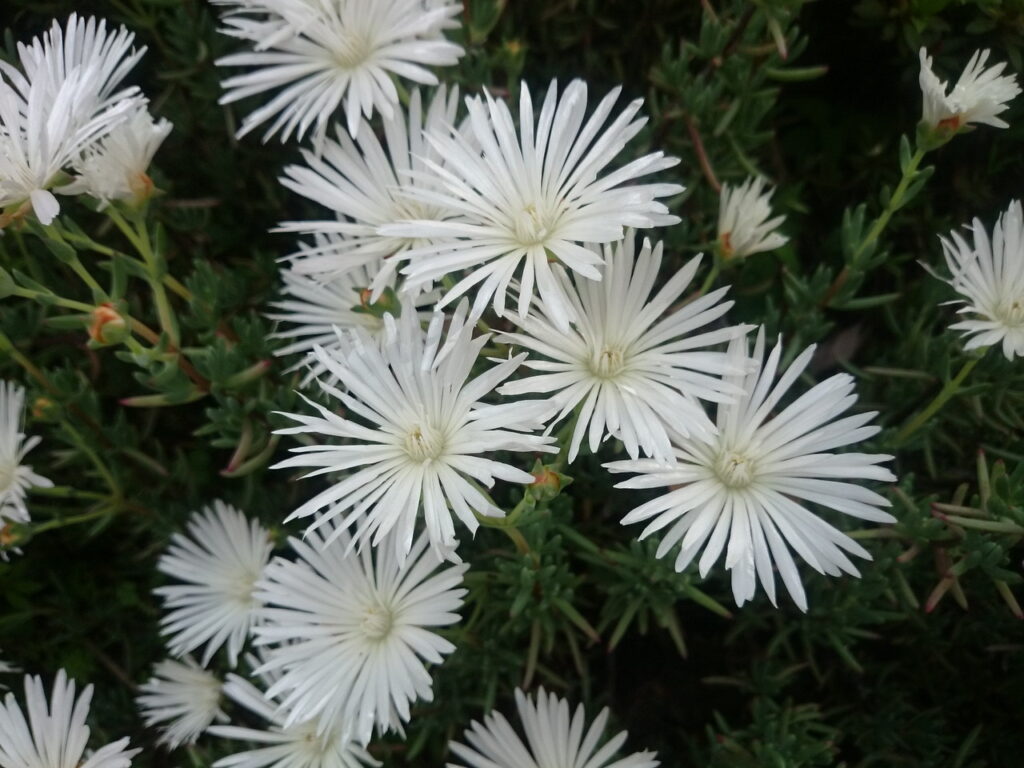
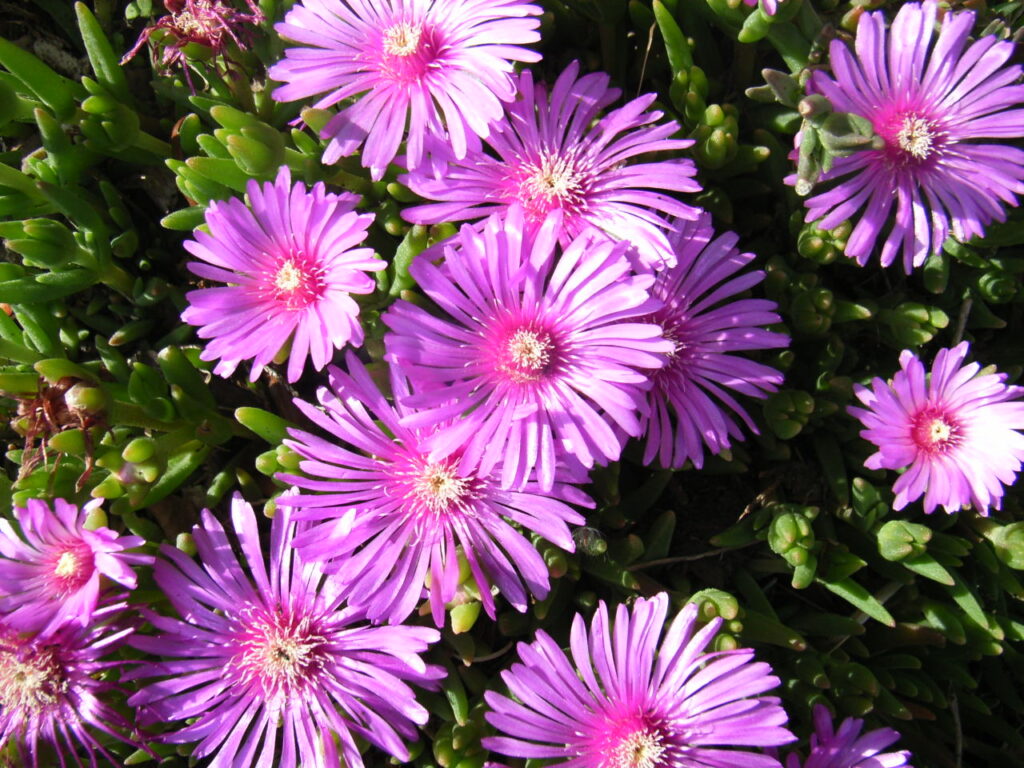
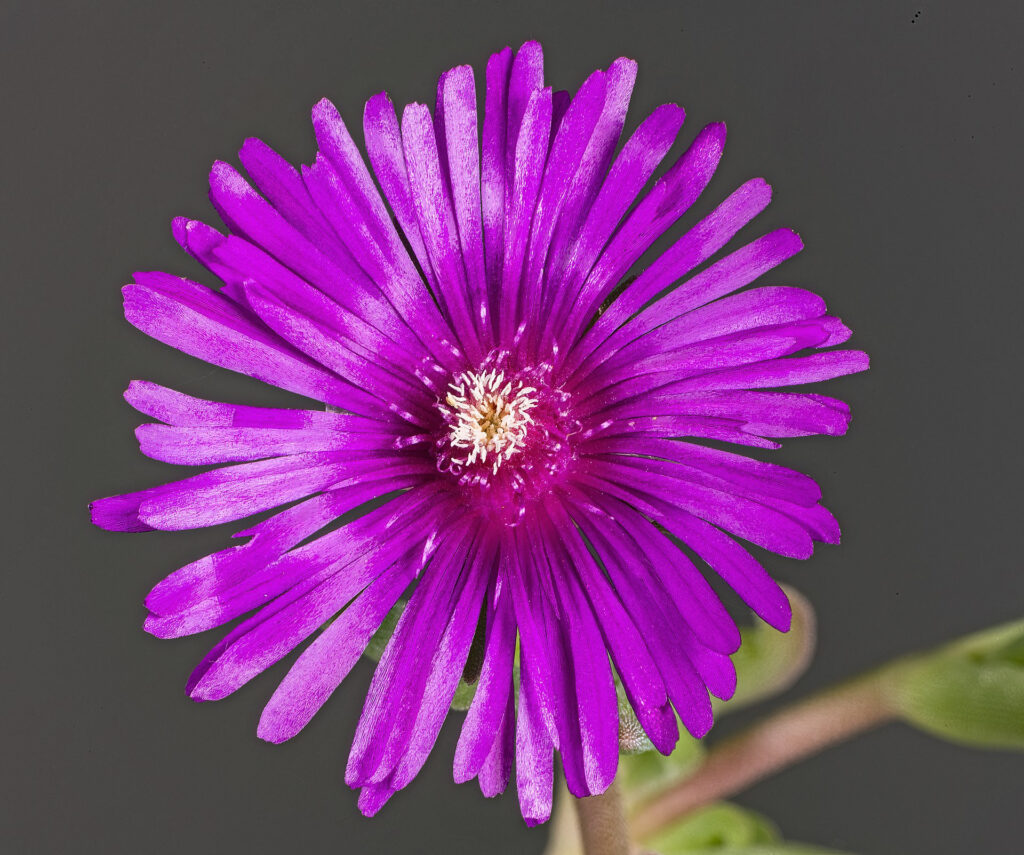
Although ice plants and ice plants belong to completely different genera, they are quite similar. The glossy, radially arranged petals of the wild species, with their showy pink coloration, attract the attention of many.
In Japan, ice plants (Lampranthus oleraceus) bloom from April to May. The flowers are arranged in terminal cymes, with 1 to 7 (up to 10) blossoms, and are (4-) 5-6 (up to 7) cm in diameter (Webb et al., 1988). The calyx is glabrous. The sepals are 8-15 mm long. The petals spread out, and the upper surface of the petals is pinkish-purple in the wild species, but there are also horticultural varieties with red, pink, and purple petals. The lower surface of the petals is pale, without the stripe in the middle, and is 15-30 mm long. The stamens are 2-6 mm long. The filaments are white and hairy at the base. The anthers are pale yellow.
In Japan, *Hanaranzan* blooms from June to September. The flowers are solitary, and the corolla is 3-6 cm in diameter (Retief & Meyer, 2017). In the wild species, the petals are bright pink to purple, but there are also horticultural varieties with yellow or white petals. The base is often white, the stamens are pink to purple or white, and the anthers are yellow.
How is pollination done?
Since both *Lampranthus* and *Lampranthus japonica* are self-incompatible, cross-pollination by insects is essential for fruit production (Braun, 2016).
It's intriguing to wonder what kind of pollinating insects visit these striking pink flowers, but unfortunately, there doesn't seem to be any specific research on that.
However, regarding *Hanalanzan*, the website of a research institute in South Africa has published photographs showing flower beetles, flies, and bees visiting the flowers (Burgoyne, 2005).
In addition, Google Image Search also confirmed similar images of honeybees and bumblebees visiting flowers.
The overall flat shape of the flowers is thought to be an adaptation for insects with short mouths, such as beetles, small bees, and syrphidae, but it may be surprising that flies with long mouths, such as those of the Bryoptera family, visit them. A survey of the overall ratio of visiting insects may reveal some interesting findings.
What is the structure of the fruit?
Both the ice plant (Lampranthus oleraceus) and the lilac (Lampranthus japonica) have capsules. A capsule is a type of dry fruit (a dry fruit) in which a single fruit consists of multiple fused, sac-like pericarps.
The capsule of the ice plant is about 1 cm in diameter. The capsule has (4-) 5 (-7) chambers, a spreading and dispersing keel, wings, a lid (roof) over the chambers, and no warts. The seeds are obovate, slightly flattened, wrinkled, rough, and dark in color, but seeds may not be found outside of its native habitat.
The capsules of *Hanaranzan* have distinct wings, and the seeds are usually shorter than 1 mm.
What are the seed dispersal methods?
The capsules of the genera *Lampranthus* and *Delosperma* share a common and interesting method of seed dispersal (Parolin, 2001).
Like the capsules of other plants, these plants' capsules dry out as they ripen, but their pericarp is hygroscopic. When humidity rises, the inside opens, and when wet with rain, the seeds are released. This is known as ombrohydrochory (or hydrochasty), and it is a rather unique method of dispersal.
However, not all seeds are released at once. In regions with irregular rainfall, such as South Africa, where rain triggers both dispersal and germination, it seems that an effective dispersal strategy is to not release all seeds at once, but to leave some for later rainfall opportunities.
References
Braun, P. 2016. Characterization of reproductive and cytological features of midday flowers (Aizoaceae) for breeding purposes [Doctoral dissertation, Leibniz University Hannover]. https://doi.org/10.15488/8651
Burgoyne, P. 2005, October. Delosperma. PlantZAfrica. https://pza.sanbi.org/delosperma
Retief, E. & Meyer, NL 2017. Aizoaceae. In: E. Retief, & NL Meyer (Eds.), Plants of the Free State: Inventory and identification guide (Strelitzia 38) (pp. 156-177). South African National Biodiversity Institute. ISBN: 9781928224150, http://hdl.handle.net/20.500.12143/6592
Kondo, A., Ito, A., & Funakuma, T. 2019. NaCl accumulation ability of *Lampranthus* in high-salinity soils. Japanese Journal of Soil Science and Plant Nutrition 90(2): 138-146. https://doi.org/10.20710/dojo.90.2_138
Parolin, P. 2001. Seed expulsion in fruits of Mesembryanthema (Aizoaceae): a mechanistic approach to study the effect of fruit morphological structures on seed dispersal. Flora 196(4): 313-322. https://doi.org/10.1016/S0367-2530(17)30060-9
Spencer, R., & Thompson, A. 1997. Aizoaceae. In: R. Spencer (Ed.), Horticultural Flora of South-eastern Australia: The identification of garden and cultivated plants (Vol. 2 Flowering plants. Dicotyledons. Part 1). University of New South Wales Press. Sydney. ISBN: 9780868403038, https://hortflora.rbg.vic.gov.au/taxon/4b971937-95ad-4049-8150-572341e3e032
Webb, CJ, Sykes, WR, & Garnock-Jones, PJ 1988. Flora of New Zealand (Vol. 4 Naturalised Pteridophytes, Gymnosperms, Dicotyledons). Botany Division DSIR, Christchurch. 1365pp. ISBN: 9780477025294
Yoshimura, Yasuyuki. 2021. CAM plants distributed in Japan and their growing environments. Journal of the Crop Science Society of Japan 90(3): 277-299. https://doi.org/10.1626/jcs.90.277