This article contains the full text of "A Record of the Visit of the Striped Soft Bee to the Ixora in Naruto City, Tokushima Prefecture," which was published in the following magazine. Printed and PDF versions are available for purchase via the link below. Please report any identification or information errors so we can correct them in subsequent issues.
What is a striped soft bee?
Amegilla florea (Smith, 1879), formerly known as the striped-bodied soft bee (formerly called the striped-bodied thick-bodied bee), is distributed in Japan (Honshu, Shikoku, Kyushu, and the Osumi Islands), the Russian Far East, China, the Korean Peninsula, and Taiwan (Tadauchi and Murao, 2014). It is characterized by its yellow mandibles, clypeus, and inner margins of the compound eyes, and its reddish-brown antennae, legs, and abdominal sternum (Kyoto Prefecture Natural Environment Conservation Division, 2015). It is designated as an endangered species in the Kyoto Prefecture Red Data Book (Kyoto Prefecture Natural Environment Conservation Division, 2015) and is also listed as a noteworthy Hymenoptera in Kobe City (Yoshida and Yagi, 2016). It is also known to be a labor parasite of Thyreus decorus (Smith, 1852), which is listed as Data Deficient in the Ministry of the Environment's 4th Red List (Tadauchi and Murao, 2014). Nesting behavior and other aspects are largely unknown (Kyoto Prefecture Natural Environment Conservation Division, 2015). While the author's research has not revealed any records in Tokushima Prefecture, it is believed to be commonly distributed there. On Awaji Island, there was a record at Mt. Mikuma in Sumoto City (Okada, 1982).
Records of flower visits by the striped soft bee confirmed by the author
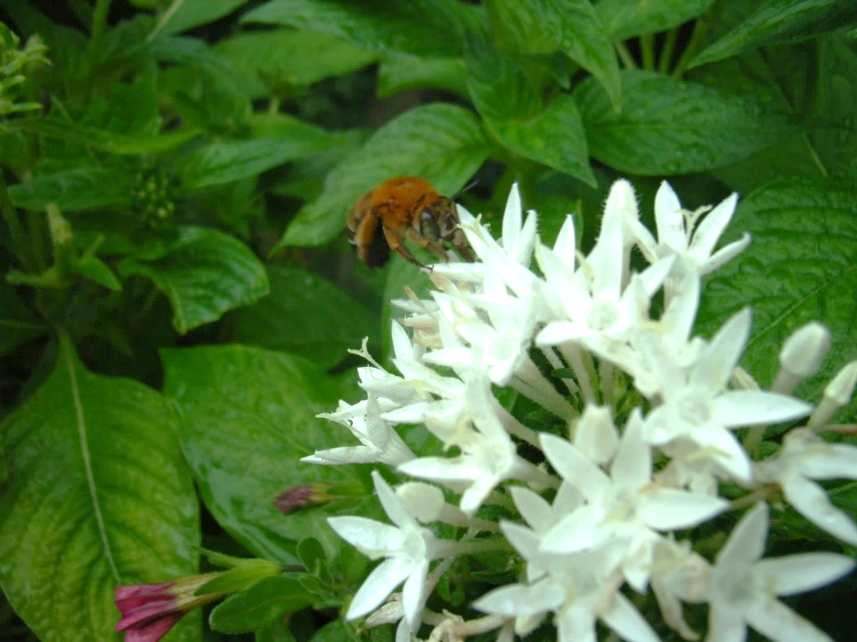
On August 14, 2010, at approximately 5:00 PM, I photographed this species visiting a flowerpot of Pentas lanceolata subsp. cymosa (Klotzsch) 'Carnea' in the Naruto Bridge Memorial Museum, located within Fukuchi Naruto Park in Tosadomariura, Naruto-cho, Naruto City, Tokushima Prefecture. I report this observation here (Figure 1).
Literature records of flower visits by the striped soft-bodied bee
While the following are known flower sites visited by the striped soft bee: Japanese mint, Tsushima melon (Kato, 2006), myrtle (Wei et al., 2009), balloon flower (Ichikawa, 2011), hosta, ginger lily, daisy, jujube (Tadauchi & Murao, 2014), impatiens (Tadauchi & Murao, 2014; Kyoto Prefectural Natural Environment Conservation Division, 2015), red spider lily (Yamaji & Ohsawa, 2015; 2016), Impatiens platypetala Lindl. (Priawandiputra et al., 2017), white vine (Sugawara et al., 2016), and Lamiaceae (Kataoka et al., 2019), visits to Ixora japonica could not be confirmed in the literature. It is believed that these insects have co-evolved with cylindrical flowers that are well-suited for nectar collection using their long central tongues (Kyoto Prefecture Natural Environment Conservation Division, 2015), and it is thought that such plants are associated with the flowers they visit.
References
Ichikawa, S., Kurahashi, T., & Ikutome, S. 2011. Possibility of a novel pollination mode by flower-visiting bees and yellow-breasted bumblebees collected in Kagawa Prefecture. Bulletin of the Faculty of Agriculture, Kagawa University 63(116): 43-59. ISSN: 0368-5128
Yoshikata Kataoka, Shigenobu Akiyama, Rumiko Kaneko, Masaomi Sakurai, Ojin Takekawa, Minoru Nishioka, Toshiko Hirata, Yukiko Yamamoto, and Masami Yoshikawa. 2019. Insect fauna of Arima Fuji Park - Insect survey of 2018 -. Kiberihamushi 42(1): 57-73. ISSN: 1884-9377
Kato, Makoto. 2006. Insect fauna of coastal plants on Nagashima Island in Suo-nada. Bulletin of the Chugoku-Shikoku Branch of the Ecological Society of Japan 60: 21-27.
Osamu Tadauchi and Tatsuki Murao. 2014. Illustrated Guide to Japanese Bees. Bun-ichi Sogo Shuppan, Tokyo. 479pp. ISBN: 9784829988428
Kyoto Prefecture Natural Environment Conservation Division. 2015. Kyoto Prefecture Red Data Book 2015, Volume 1: Wild Animals. Kyoto Prefecture Natural Environment Conservation Division, Kyoto.
Okada, Kiyotaka. 1982. Collection records of bees from Awaji Island (II). Parnassius 26: 13-16.
Priawandiputra, W., Kasagi, T., & Nakamura, K. 2017. Variation in Flowering Plant-Bee Linkages Following Experimental Restoration of Satoyama Paddy Fields. International Proceedings of Chemical, Biological and Environmental Engineering 107: 1-9. ISSN: 2010-4618, https://www.doi.org/10.7763/IPCBEE.2017.V102.1
Sugawara, T., Watanabe, K., Takaso, T., Tabata, M., & Shimizu, A. 2016. Incompatibility and pollination of distylous Psychotria serpens (Rubiaceae) in the Ryukyu Islands, Japan. Acta Phytotaxonomica et Geobotanica 67(1): 37-45. ISSN: 1346-7565. https://www.doi.org/10.18942/apg.KJ00010238485
Wei, MS, Chen, ZH, Ren, H., & Yin, ZY 2009. Reproductive ecology of Rhodomyrtus tomentosa (Myrtaceae). Nordic Journal of Botany 27(2): 154-160. ISSN: 0107-055X, https://www.doi.org/10.1111/j.1756-1051.2009.00137.x
Yamaji, F., & Ohsawa, TA 2015. Breaking-bud pollination: a new pollination process in partially opened flowers by small bees. Journal of Plant Research 128(5): 803-811. ISSN: 0918-9440, https://www.doi.org/10.1007/s10265-015-0741-8
Yamaji, F., & Ohsawa, TA 2016. Field Experiments of Pollination Ecology: The Case of Lycoris sanguinea var. sanguinea. Journal of Visualized Experiments 117: e54728. ISSN: 1940-087X, h ttps://www.doi.org/10.3791/54728
Yoshida, Hiroshi & Yagi, Tsuyoshi. 2016. Notable Diptera and Hymenoptera records in Kobe City. *Kiberihamushi* 38(2): 21-25. ISSN: 1884-9377