This article contains the full text of the article "Examples of Nesting in Decaying Wood by *Polygonum cuspidatum*", which was published in the following magazine. For those wishing to purchase the printed or PDF version, please use the link below. Please report any errors in identification or information so that we can correct them in subsequent issues.
What is the Japanese long-legged ant?
Aphaenogaster japonica Forel, 1911 is found from Hokkaido to Yakushima Island and is said to nest in the soil at forest edges and within forests, as well as in crevices in rocks (Japanese Ant Database Group, 2003; Terayama et al., 2014).
Nesting conditions of *Polygonum cuspidatum* observed by the author
The author previously reported on the ant fauna of Nara Prefecture, including this species (Ikeda et al., 2020). While reviewing photographs afterward, the author found a photograph (Figure 2) taken around 3:00 PM on May 22, 2014, showing a colony of this species and what appeared to be tunnels created by the colony inside a split-open decaying tree in a forest northwest of the Kinki University Nara Campus in Nakamachi, Nara City. The tree species is not clearly remembered due to the long history of the records, but given that it was in a deciduous broadleaf forest and white rot fungi were present, it is highly likely to be a deciduous broadleaf tree such as Quercus serrata or Quercus acutissima.
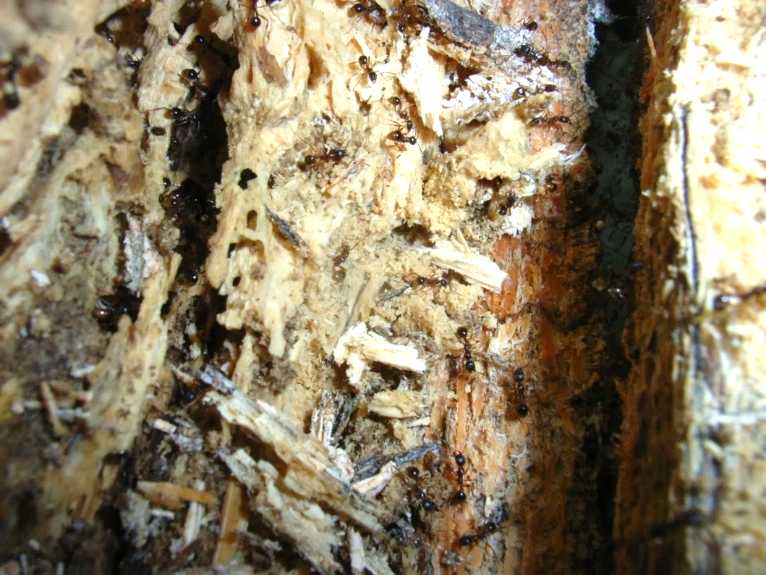
Literature records on nesting of the Japanese long-legged ant (Polygonum cuspidatum)
Although this species is not listed in the Japanese Ant Database Group (2003) or Terayama et al. (2014), in a survey of Asiatic black bear foraging resources in Tono City, Iwate Prefecture, nesting in dead wood (a general term for remaining wood, fallen trees, and dead trees) was commonly confirmed in coniferous forests mainly composed of Japanese red pine, Japanese larch, and Japanese cedar, as well as deciduous broad-leaved forests mainly composed of sawtooth oak, Mongolian oak, and white birch at altitudes of approximately 400 to 1200m (Sato et al., 2014; Yasue et al., 2015). Yasue et al. (2015) found that the species was more frequently found in dead wood than on the surface or in the soil. The photographed dead wood was found in a satoyama forest mainly composed of sawtooth oak and Japanese oak, which are common in lowlands (Sakuradani, 1999), suggesting that nesting in dead wood is more common for this species. There may be other similar reports regarding this species, but since this appears to be a relatively unknown case, I am reporting it here.
References
Ikeda, K., Kasai, H., Goda, A., Murakami, K., Ishihara, T., Nakamura, K., and Sawabatake, T. 2020. Ant fauna around Kinki University Nara Campus. Kinki University Faculty of Agriculture Bulletin 53: 46-70. ISSN: 2189-6267
Japanese Ant Database Group. 2003. Complete Illustrated Guide to Japanese Ants. 196pp. Gakken Co., Ltd., Tokyo. ISBN: 9784054017924
Sakuraya, Yasuyuki. 1999. An overview of the ecosystem at Kinki University Nara Campus. Kinki University Faculty of Agriculture Bulletin, 32: 69-78. ISSN: 0453-8889
Sato, Aiko; Aoi, Toshiki; and Yasue, Yuma. 2014. Ant population in Tono City, Iwate Prefecture: From the perspective of their role as a food source for Asiatic black bears in summer. Bulletin of the Iwate University Faculty of Agriculture, 45: 81-97. ISSN: 0286-4339
Terayama, Mamoru; Kubota, Satoshi; and Eguchi, Katsuyuki. 2014. An Illustrated Guide to Japanese Ants. viii, 278 pp., 48 pp. (illustrations). Asakura Shoten, Tokyo. ISBN: 9784254171563
Yasue, Y., Aoi, T., Kunisaki, T., Harashina, K., Takahashi, H., & Sato, A. 2015. Relationship between the use of coniferous forests by Asiatic black bears in summer and dead wood as nesting substrate for ants. Mammalian Science, 55(2): 133-144. ISSN: 0385-437X, https://doi.org/10.11238/mammalianscience.55.133