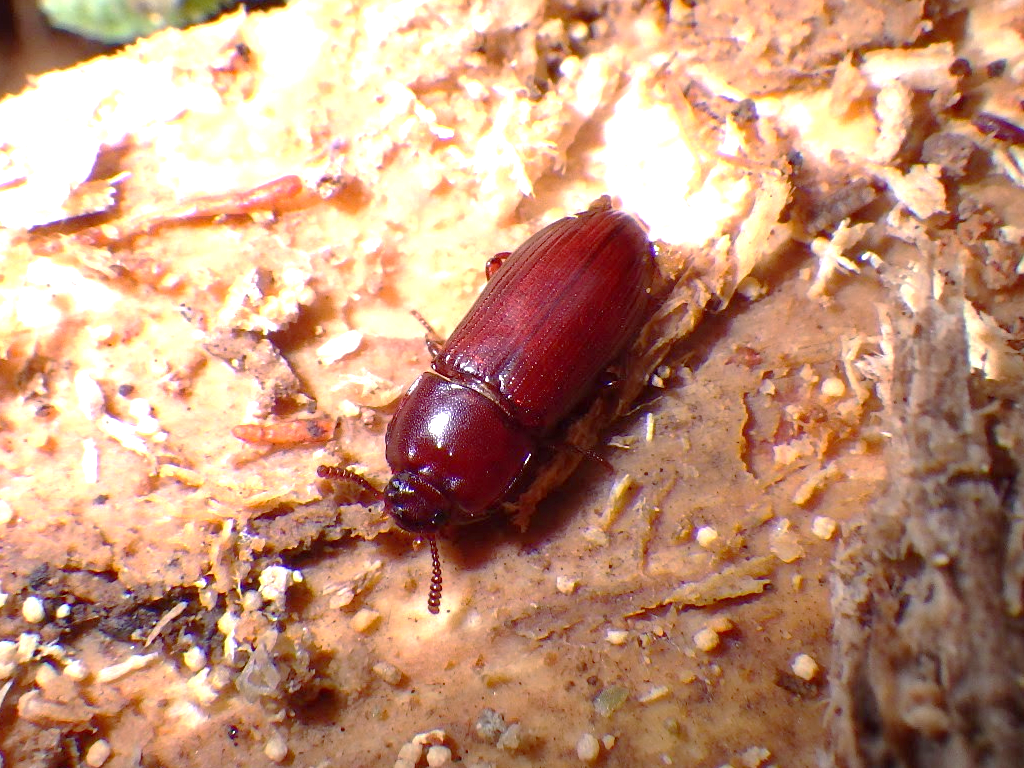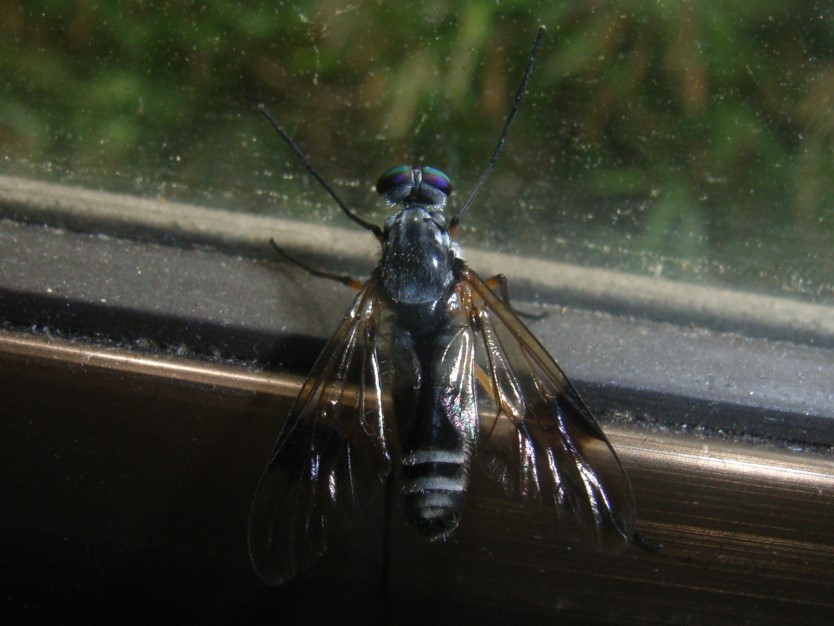
This article contains the full text of the article "Woodlice Prey on Plasmodium Plasmodium in Kyoto Prefecture," which was published in the following magazine. Printed and PDF versions are available for purchase via the link below. Please report any errors in identification or information so we can correct them in subsequent issues.
Slime molds are preyed upon by various arthropods.
Slime molds are preyed upon by various arthropods, and it has been suggested that the fruiting bodies, in particular, are not only consumed but also simultaneously serve as one of several methods of spore dispersal (Hagiwara et al., 1995; Sugiura et al., 2001; Yamamoto, 2003; Matsumoto and Izawa, 2007). Coleoptera, Diptera, Hymenoptera, Acari, and Collematoria have been obtained from slime mold fruiting bodies overseas, and these orders have also been confirmed in Japanese cases (Sugiura et al., 2001). The role of Coleoptera is considered to be particularly significant (Sugiura et al., 2001; Yamamoto, 2003), and there are even species of fungus beetles, such as the Hymenoptera, whose mandibles are specialized for spore transport and are found only in slime molds (Hayashi, 1989). In fact, there have been cases in the wild where Coleoptera accounted for 84% of the population (Sugiura et al., 2001).
On the other hand, there is little mention of plasmodiums (Sugiura et al., 2001), and beetles such as those in the families Cetacea and Lithomycetes are considered to be plasmodium predators (Murayama, 2004), while slugs and snails, which belong to the gastropod mollusks, are said to sometimes eat plasmodiums, but this is considered to be accidental (Yamamoto, 2003).
Thus, the animals identified in the literature are limited to six taxonomic groups, but the author could not find any mention of the order Isopoda (woodlice).
An example of woodlice preying on slime molds, as observed by the author.
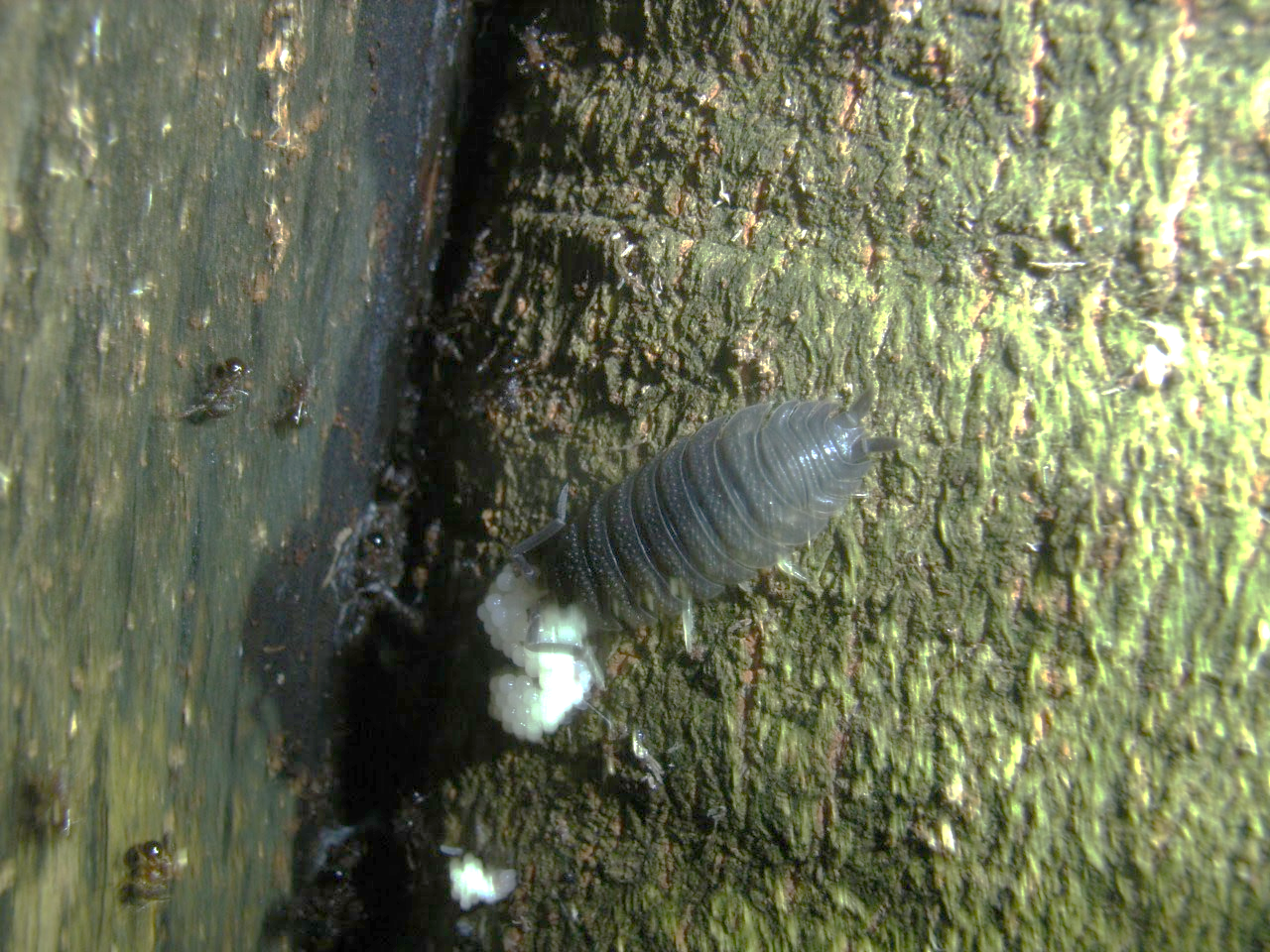
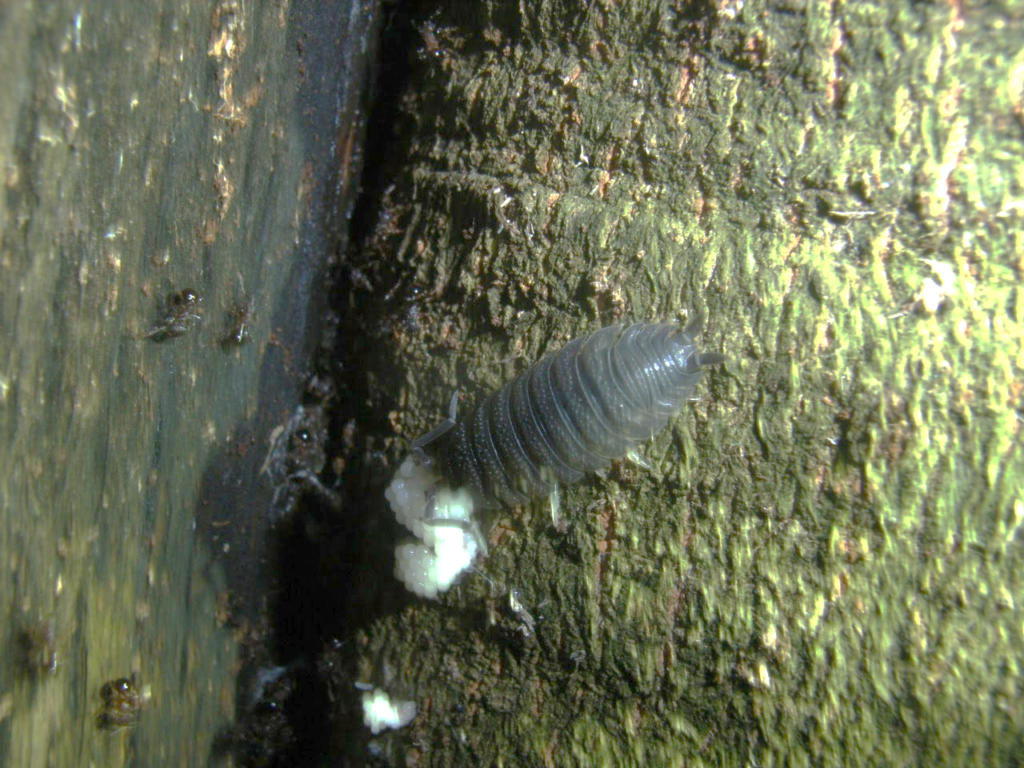
On July 8, 2014, at approximately 9:30 PM, the author photographed a woodlouse, Porcellio scaber Latreille, 1804, preying on the plasmodium of a species of the genus Stemonitis sp. at Takakura Shrine in Nagahama, Maizuru City, Kyoto Prefecture, and reports the findings here (Figure 9). It is believed that the woodlouse was preying during the nocturnal period when it is most active. Although no records could be found in the literature, the following images were found online: a pill bug preying on slime in Someya, Minuma Ward, Saitama City, Saitama Prefecture on June 19, 2003 (Yokoyama, 2005 post); a woodlouse preying on Fuligo septica (L.) at an unknown date and location (Hori, 2016 post); and a pill bug Armadillidium vulgare (Latreille, 1804) preying on Tubifera ferruginosa (Batsch) at Jindaiji Motomachi, Chofu City, Tokyo (Useless Mushrooms, 2020 post). Based on these findings, it appears that this interaction is fairly common, at least in Japan.
Although predation of plasmodiums, which do not form spores, differs from spore dispersal, it may affect the population of slime molds, and further quantitative research is expected.
Regarding the distribution of the two species in Kyoto Prefecture, while the genus *Dictyophora* has been recorded in Kyoto City (Matsumoto and Kobayashi, 2000), there are no records of *Isopod* in Fujita and Watanabe (1999), who surveyed isopoda in Kyoto City, nor in the catalogs Saito et al. (2000) and Karasawa (accessed 2021), suggesting this may be a first record.
References
Fujita, Yuki & Watanabe, Hiroyuki. 1999. Distribution and habitat of terrestrial isopods, mainly in the Kyoto City area. Forest Research 71: 1-7. ISSN: 1344-4174, https://repository.kulib.kyoto-u.ac.jp/dspace/handle/2433/192826
Hagiwara, Hiromitsu, Yamamoto, Yukinori, and Izawa, Masana. 1995. Illustrated Guide to Japanese Myxomycetes. Heibonsha, Tokyo. 163pp. ISBN: 9784582535211
Hayashi, Nagataka. 1989. *Himekinokomushi* (a type of beetle) and *Slime Mold*. *Kotechu News* 85: 3-5. ISSN: 0910-8785, https://coleoptera.sakura.ne.jp//ColeoNews/ColeoNews085.pdf
Shigetaka Karasawa. Accessed February 9, 2021. Distribution Database of Japanese Isopoda. http://isopoda.sakura.ne.jp/warajimushi/Map/map.php
Matsumoto, Jun & Izawa, Masana. 2007. Slime Molds: The Mystery of Their Amazing Vitality. Seibundo Shinkosha, Tokyo. 143pp. ISBN: 9784416207116
Matsumoto, Jun and Kobayashi, Hisayasu. 2000. "Mushroom" Field Survey Report - Part 2: Myxomycetes. Inochi no Mori 5: 43-43. https://inochinomori.sakura.ne.jp/report/inochi5.pdf
Murayama, Shigeki. 2004. Sap-sucking soil insects as predators of slime mold plasmodiums. Insects and Nature 39 (7): 13-16. ISSN: 0023-3218.
Saito, Nobuhiro; Itani, Yuki; and Nunomura, Noboru. 2000. Checklist of Isopoda Crustaceans from Japan (Preliminary Report). Bulletin of the Toyama Science and Culture Center 23: 11-107. ISSN: 0387-9089, https://repo.tsm.toyama.toyama.jp/?action=pages_view_main&active_action=repository_view_main_item_detail&item_id=744&item_no=1&page_id=13&block_id=82
Sugiura, Shinji; Fukazawa, Yu; and Yamazaki, Kazuo. 2001. Arthropod communities on slime mold fruiting bodies. Joint Research Reports of the Institute of Tropical Medicine, Nagasaki University 2001: 184-186. https://www.tm.nagasaki-u.ac.jp/020316syukai/yousi.pdf
Yamamoto, Yukinori. 2003. Ecological overview of slime molds. Plants of Kochi Prefecture 17: 99-136. ISSN: 1349-0974
Quoted site
Shigehisa Hori. Posted August 6, 2016. https://twitter.com/kuma5364/status/761679336621510656
Useless mushrooms. Posted May 31, 2020. https://twitter.com/at384/status/1267023154779615233
Hajime Yokoyama. Last updated June 16, 2005. 320. Mycophagous animals/Slime molds/Pill bugs. http://tititake.sakura.ne.jp/gen1/myceto_html/myceto411.htm