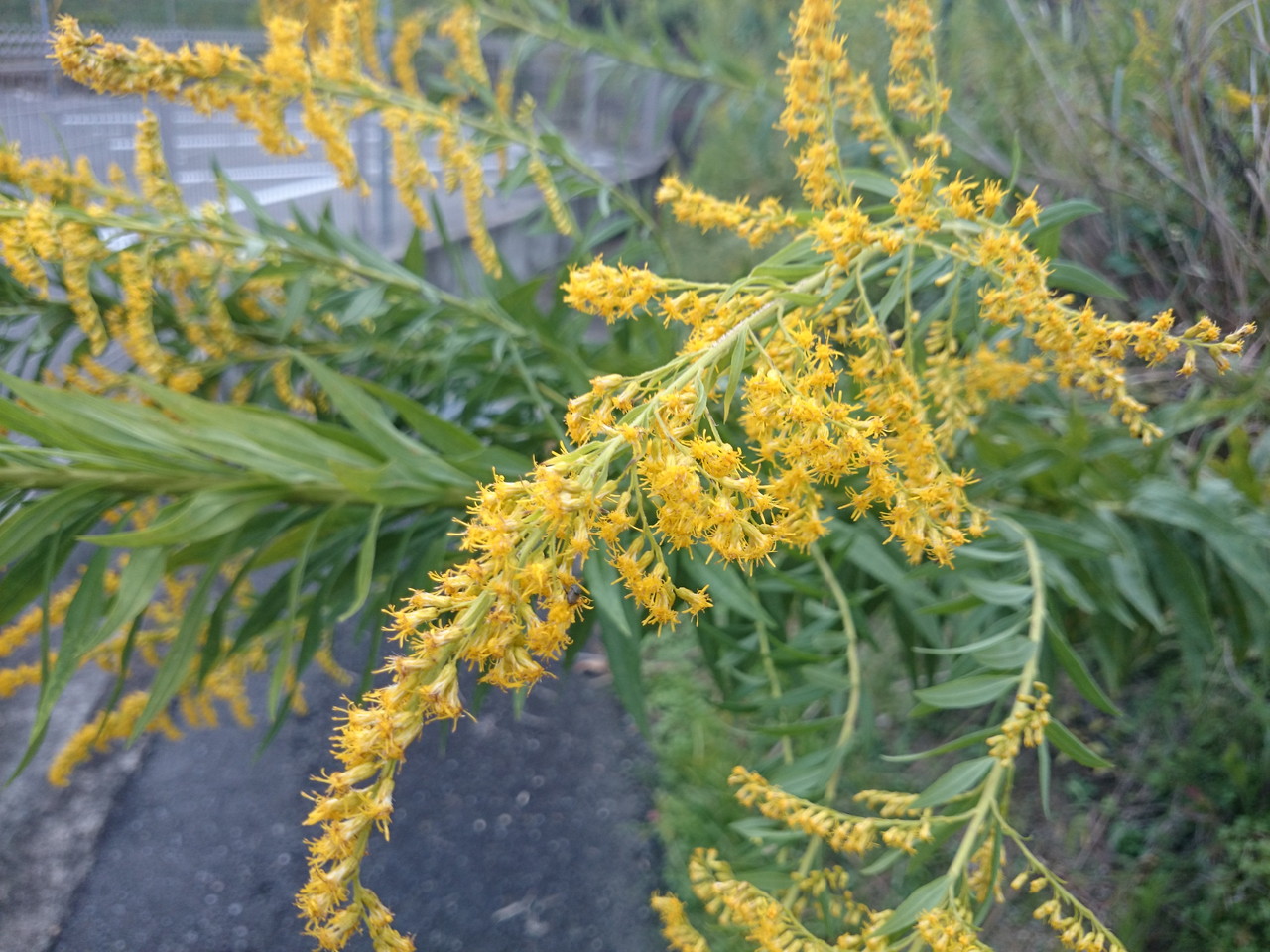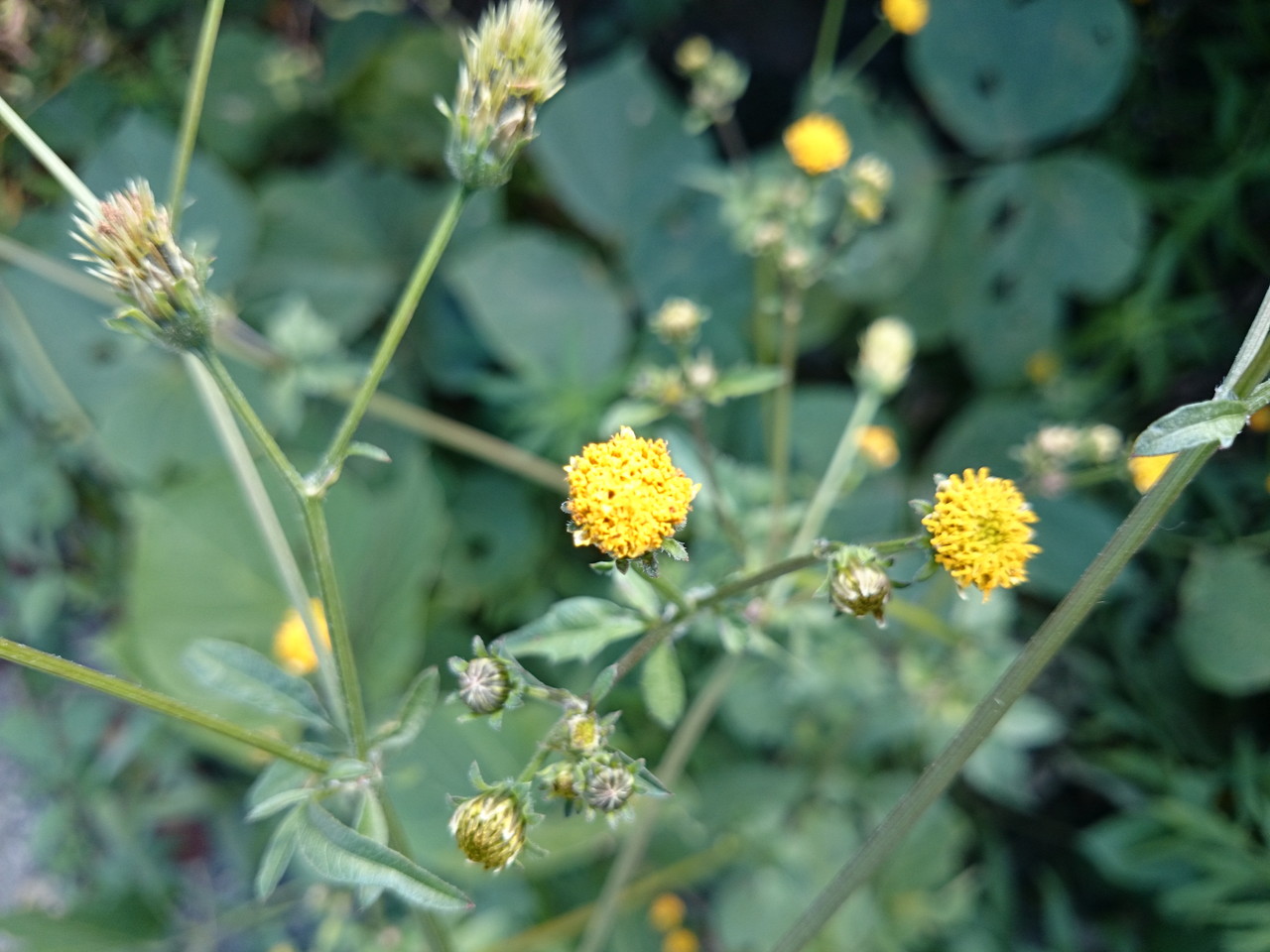
Bidens pilosa, Bidens frondosa, Bidens pilosa, and Bidens serrata are all annual plants belonging to the Bidens genus of the Asteraceae family. In relation to humans, their most distinctive feature is that their fruits are "burrs." They grow along roadsides and around bodies of water, and their tendency to stick to animal fur and human clothing is also annoying. However, some people may not be able to distinguish between these four species. These can be distinguished by carefully observing the presence or absence of bracts longer than the involucre on the flower head, and the shape of the flowers and leaves. It is also possible to distinguish them to some extent just by the burrs. This article will explain the classification of Bidens pilosa, Bidens frondosa, Bidens pilosa, and Bidens serrata.
What are Bidens pilosa, Bidens frondosa, Bidens pilosa, and Bidens serrata?
Bidens biternata, also known as sandalwood grass, is widely distributed in Honshu (west of the Kanto region), Shikoku, and Kyushu in Japan; as well as in Eurasia and Africa. It is an annual plant that grows in fertile, slightly damp, barren land (Kanagawa Prefecture Flora Survey Association, 2018). In Japan, it is considered to be an ancient naturalized plant.
Bidens pilosa var. pilosa, also known as small sandalwood grass, is native to North America and is widely distributed in Honshu, Shikoku, and Kyushu in Japan, as well as in tropical regions worldwide. It is an annual plant that grows in clusters in dry environments such as riverbanks, urban vacant lots, and reclaimed land.
Bidens frondosa, also known as American beggar-ticks, is native to North America and has become very widespread and common in Japan. It is an annual plant that grows in fertile ditches, riverbanks, and other similar locations.
Bidens tripartita, also known as taukogi (rice paddy tree), is an annual plant found in rice paddies, ditches, and riverbanks. It is distributed throughout Hokkaido, Honshu, Shikoku, and Kyushu in Japan; Eurasia and North Africa; and has naturalized in North America and Australia. Currently, it is far less common than Bidens frondosa.
Both are annual plants belonging to the genus Bidens in the Asteraceae family. In relation to humans, their most notable characteristic is that their fruits are dispersed by animal attachment, meaning they are "burrs" (Miura et al., 2007; Abdullah et al., 2025; Qureshi & Anwar, 2025). They grow along roadsides and around bodies of water, and their tendency to stick to animal fur and human clothing makes them particularly unpleasant.
From a taxonomic perspective, these characteristics are important in defining the genus Bidens, as the fruit develops into an achene with long, spine-like awns (pointed parts) that allow it to stick to surfaces.
However, the four species within the Bidens genus mentioned above all have fruits that stick to the ground, similar names, and yellow flower heads (the part that looks like a single flower, formed by a cluster of small florets characteristic of the Asteraceae family), so they may often be confused with each other.
What are the differences between Bidens pilosa, Bidens frondosa, Bidens frondosa, and Bidens pilosa?
While there are thought to be three native species of the genus Bidens in Japan, more than six naturalized species are known, and it is impossible to list all the distinguishing features here. However, if we narrow it down to the four species mentioned above, which have entirely yellow flower heads and are fairly common, they can be distinguished relatively easily (Kanagawa Prefecture Flora Survey Association, 2018).
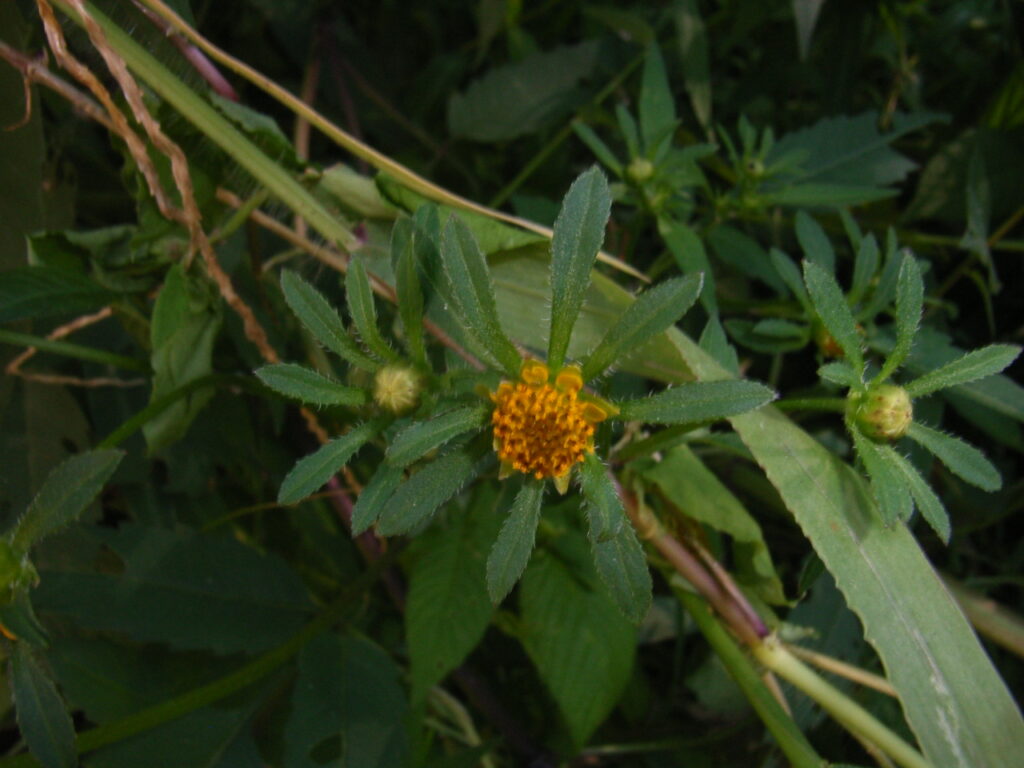
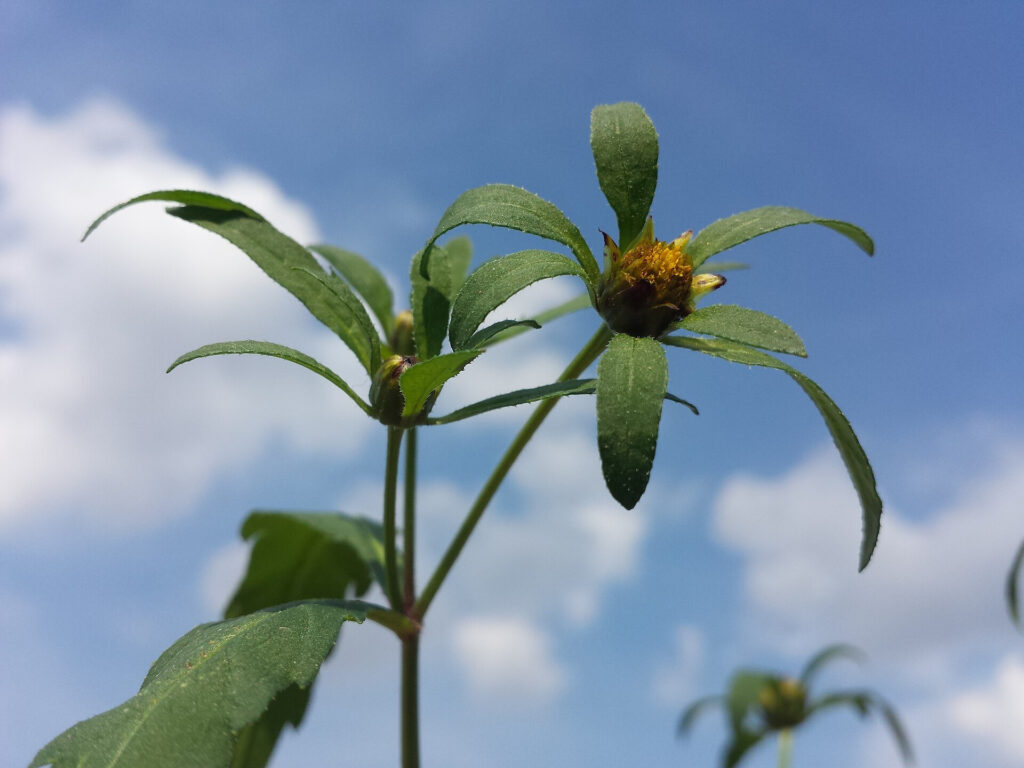
First, the four species can be broadly distinguished by the fact that in American beggar-a-kind and sedge, the flower heads have bracts that are longer than the involucre, while in beggar-a-kind and common beggar-a-kind, these are absent.
The term "bracts" might be unfamiliar, but in Bidens frondosa and Bidens pilosa, they refer to the thin, green parts that radiate around the flower head. They look almost like green petals. Bidens pilosa and Bidens pilosa do not have these.
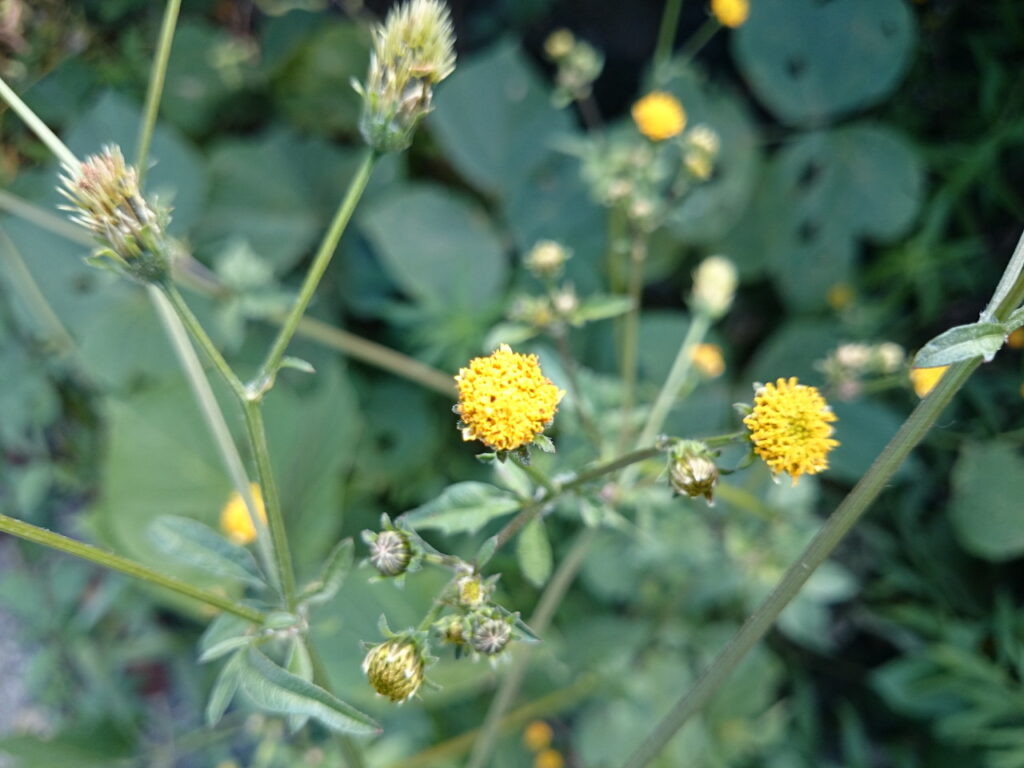
The difference between Bidens pilosa and Bidens pilosa lies in the fact that Bidens pilosa has ray florets, resulting in yellow petals (more precisely, a corolla), while Bidens pilosa lacks ray florets and therefore has no petals.
The small flowers of the Asteraceae family consist of two types: "ray florets," which have a large, tongue-shaped tip that extends and spreads out to one side, and "disc florets," which have a tubular corolla. The combination of these two types varies depending on the species of the Asteraceae family, but in the Bidens genus, it varies depending on the species. This should also be obvious at a glance.
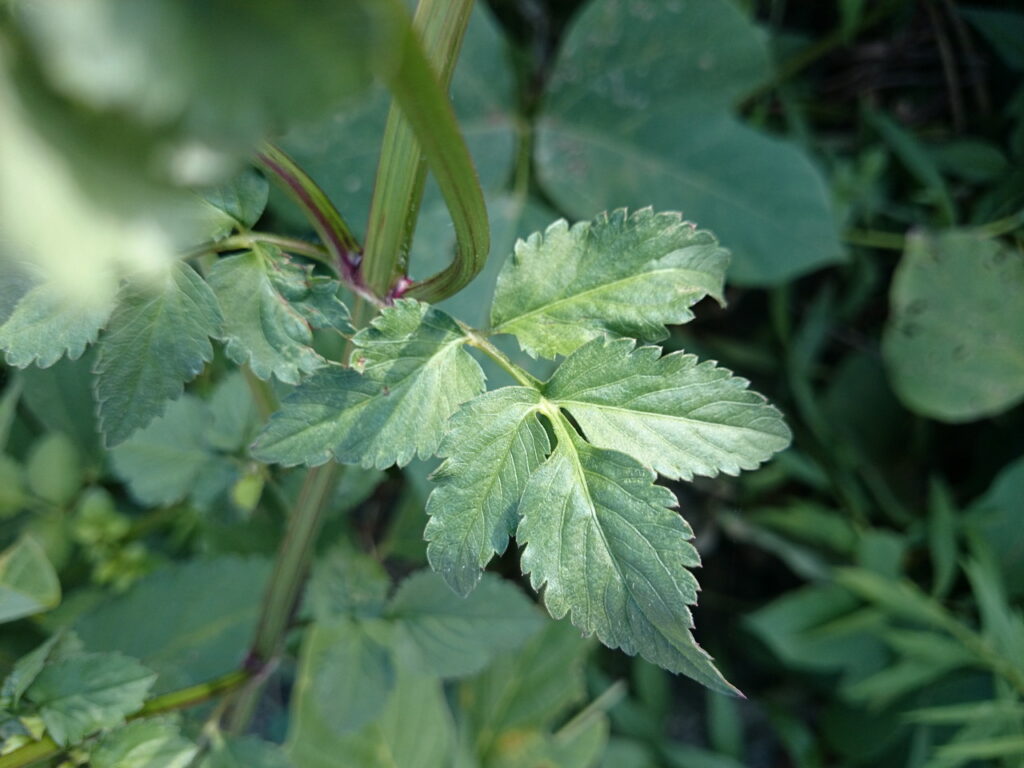
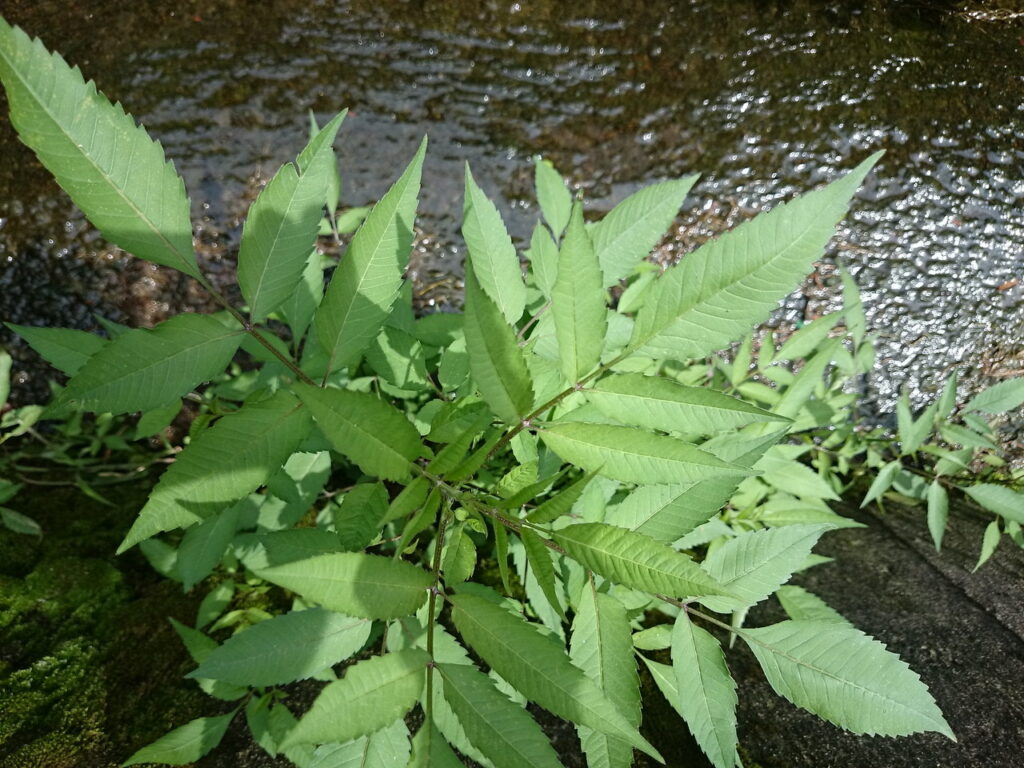
Regarding Bidens frondosa and Bidens pilosa, the difference is that Bidens frondosa has slender, distinct petioles on its leaflets and a slender, purplish stem, while Bidens pilosa has winged petioles on its leaflets and a thick, green stem.
"Wings" is a general term for thin, flat structures that grow on plants. In the case of *Taucogi*, the leaf portion covers the petiole, so the thin part is almost invisible. It might be easier to see this with your own eyes.
It's also worth noting that Bidens pilosa and Bidens serrata have decreased significantly in number and are now rarely seen.
Occasionally, the fruit of the Japanese angelica tree loses its awns (Miura et al., 2007).




What's the difference between "sticky bugs"?
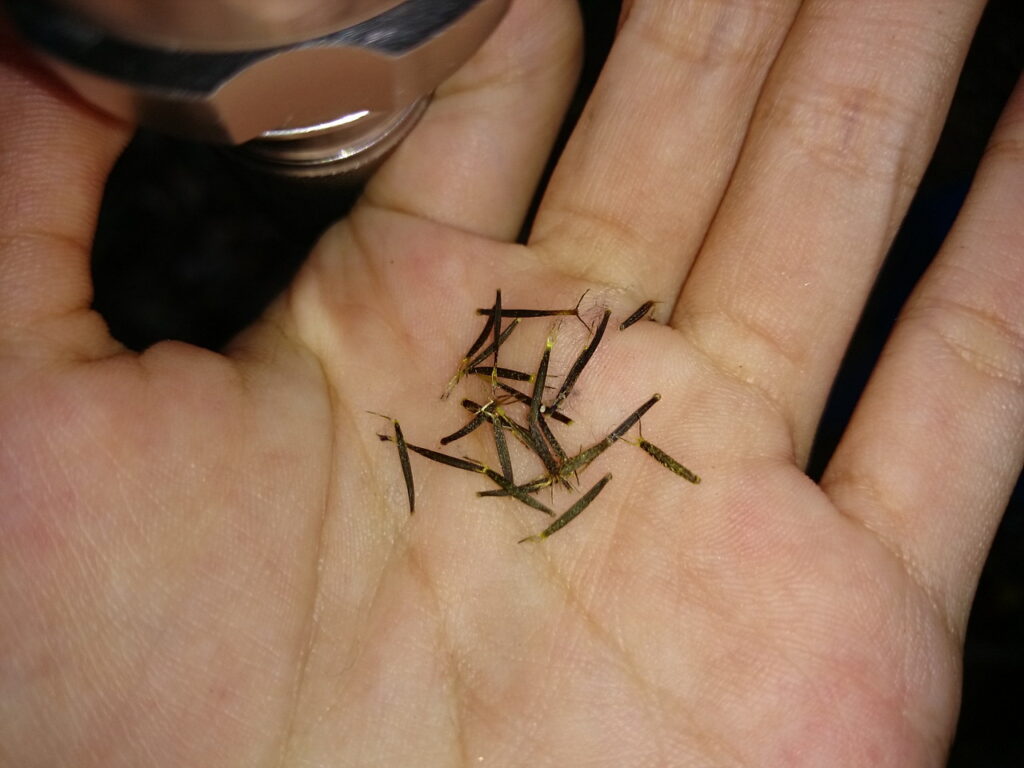
If the plant is present, checking the above should be sufficient to determine its identity. Furthermore, even just looking at the fruit (burrs) can provide some degree of distinction.
They can be broadly classified by the difference that Bidens pilosa and Bidens pilosa have long, linear achenes, while Bidens frondosa and Bidens serrata have short, trapezoidal achenes.
While Bidens pilosa and Bidens pilosa are quite similar and difficult to distinguish, Bidens pilosa has 3-4 awns (pointed parts) with long, spine-like, backward-pointing spines, whereas Bidens pilosa has slightly fewer, at 2-4.
Regarding Bidens frondosa and Bidens pilosa, the difference is that in Bidens frondosa, the two awns are sharply angled outwards, while in Bidens pilosa, the two awns are only slightly angled outwards and are nearly parallel.
References
Abdullah, S., Munir, M., Javed, B., Ahmad, M., Abbasi, BA, Dawood, S., & Zhang, L. 2025. The Systematics and Biogeography of Genus Bidens. In Y. Bibi, K. Zahara, A. Qayyum, & MA Jenks (Eds.), The Genus Bidens: Chemistry and Pharmacology (pp. 3-20). Springer Nature Singapore. ISBN: 9789819642564, https://doi.org/10.1007/978-981-96-4257-1_1
Kanagawa Prefecture Flora Survey Association. 2018. Kanagawa Prefecture Flora 2018 (Electronic Edition). Kanagawa Prefecture Flora Survey Association, Odawara. 1803pp. ISBN: 9784991053726
Miura, Reiichi, Makoto Hosoya, and Misako Ito. 2007. A variant of *Thuja orientalis* that has lost its thorns for seed dispersal. Weed Research 52(3): 130-136. https://doi.org/10.3719/weed.52.130
Qureshi, H., & Anwar, T. 2025. Morphological Characteristics of Bidens Species: Generative Morphology. In The Genus Bidens: Chemistry and Pharmacology (pp. 35-54). Singapore, Springer Nature Singapore. ISBN: 9789819642564, https://doi.org/10.1007/978-981-96-4257-1_22