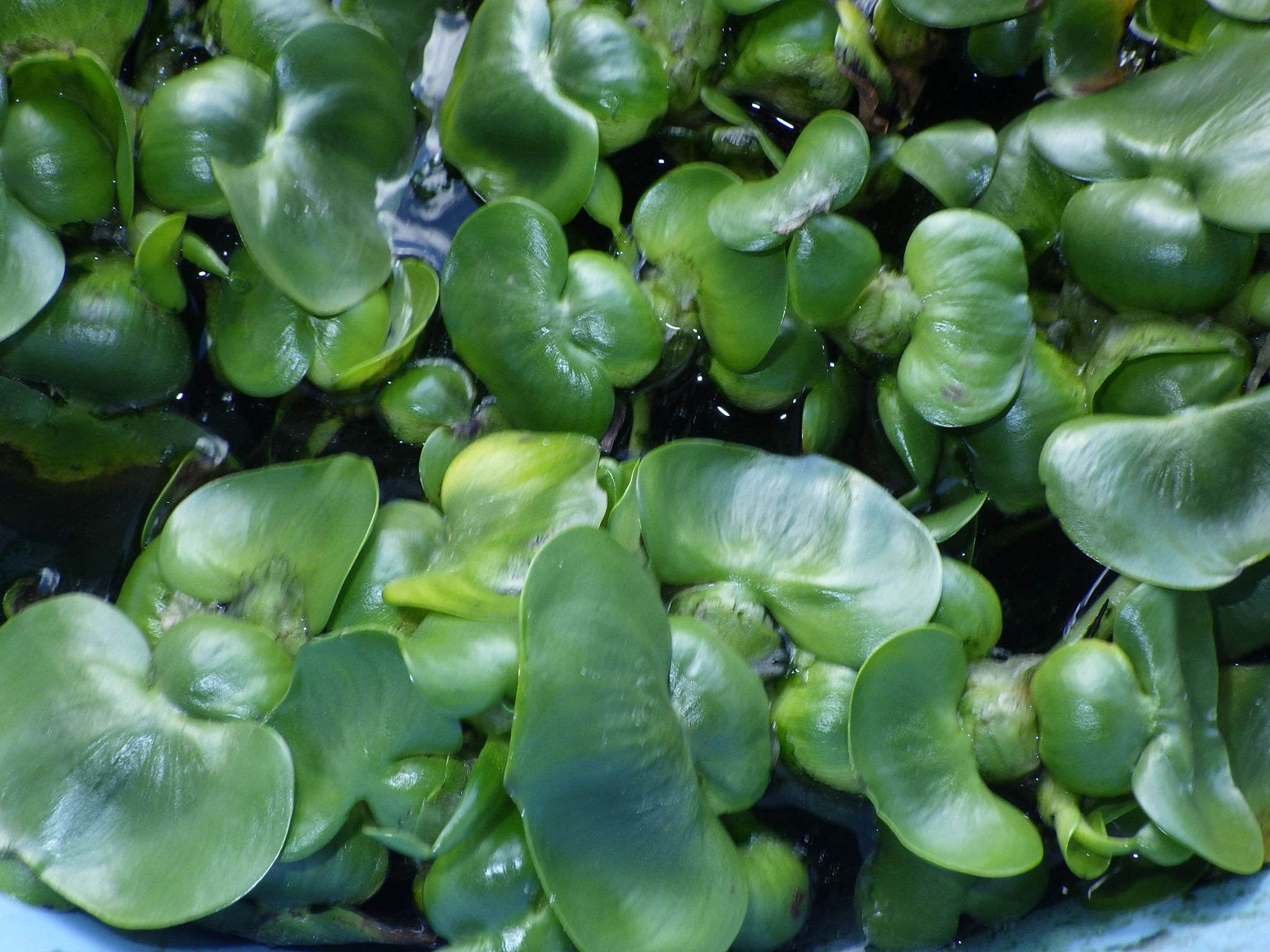
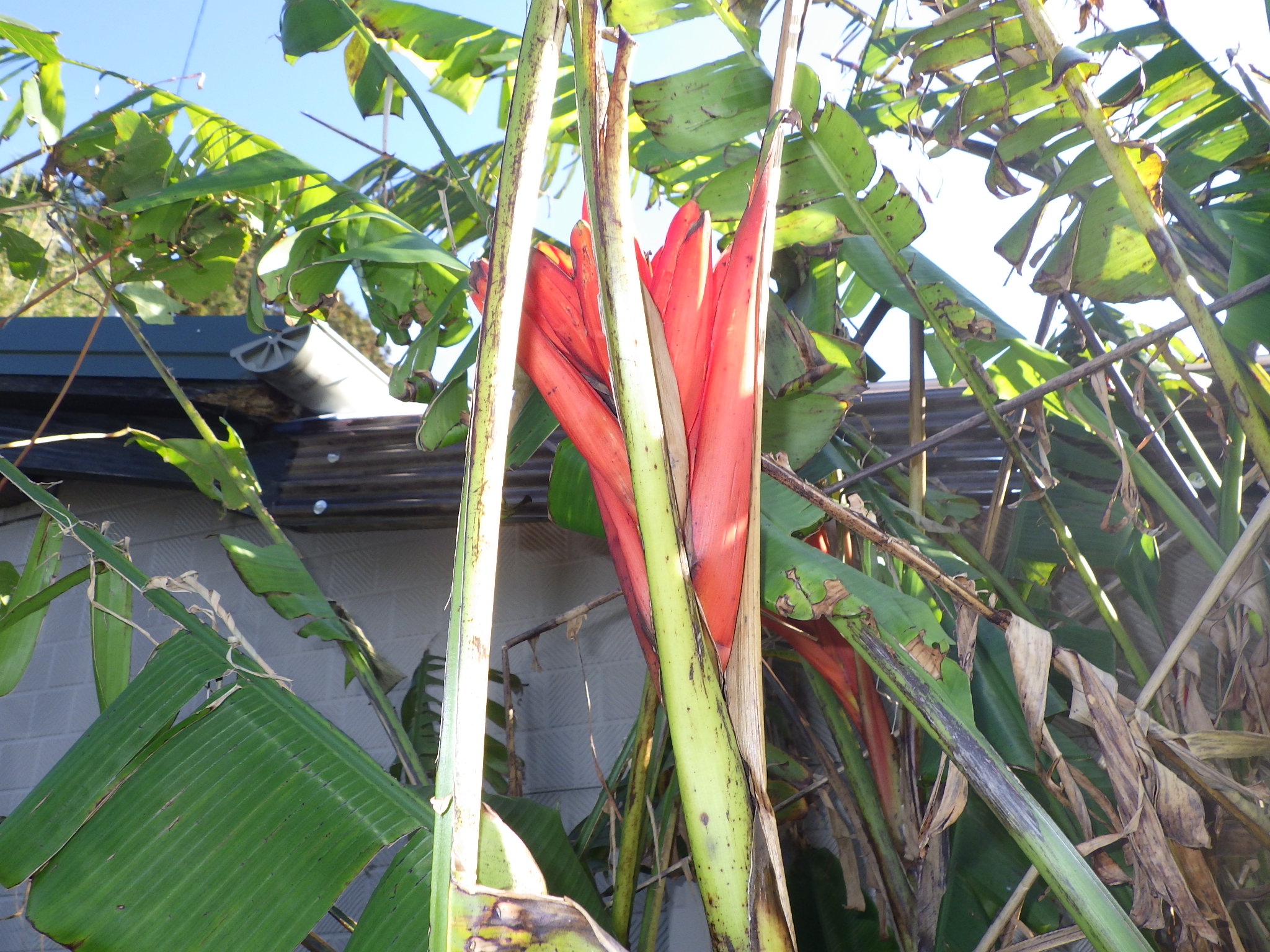
The Strelitziaceae family encompasses a wide range of plants, from perennial herbs to tall trees. They are characterized by large flowers surrounded by bracts, with both leaves and bracts arranged in two vertical rows. Most species have simple, large, paddle-shaped leaves, though the edges may fray with age. A distinctive feature is the long petioles (petioles) on which the flowers are attached. The family consists of 3 genera and 7 species found in tropical and subtropical regions: 5 species of Strelitziaceae in southern Africa, 1 species of Ravenala in Madagascar, and 1 species of Phenakospermum in northern South America. In Japan, they are cultivated only for ornamental purposes.
This article provides a comprehensive, field guide-style introduction to plants belonging to the Strelitziaceae family.
The photos are replaced as soon as better ones are taken. Also, while the identification is done by the author, please note that if there are any misidentifications, they may be changed without notice.
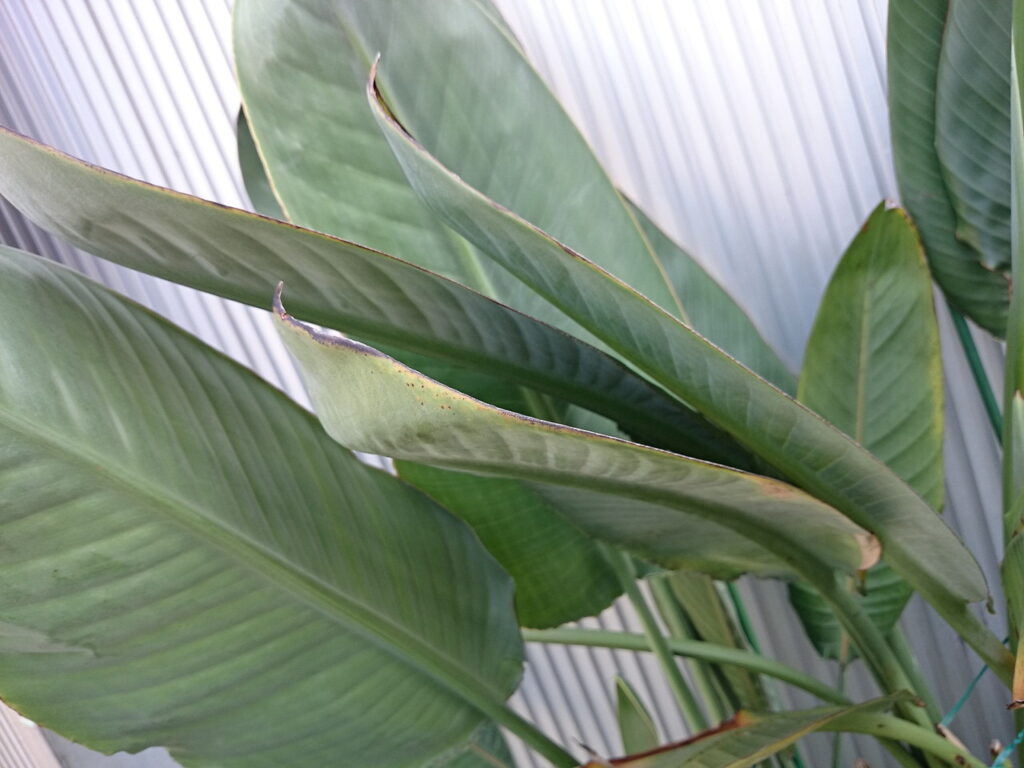
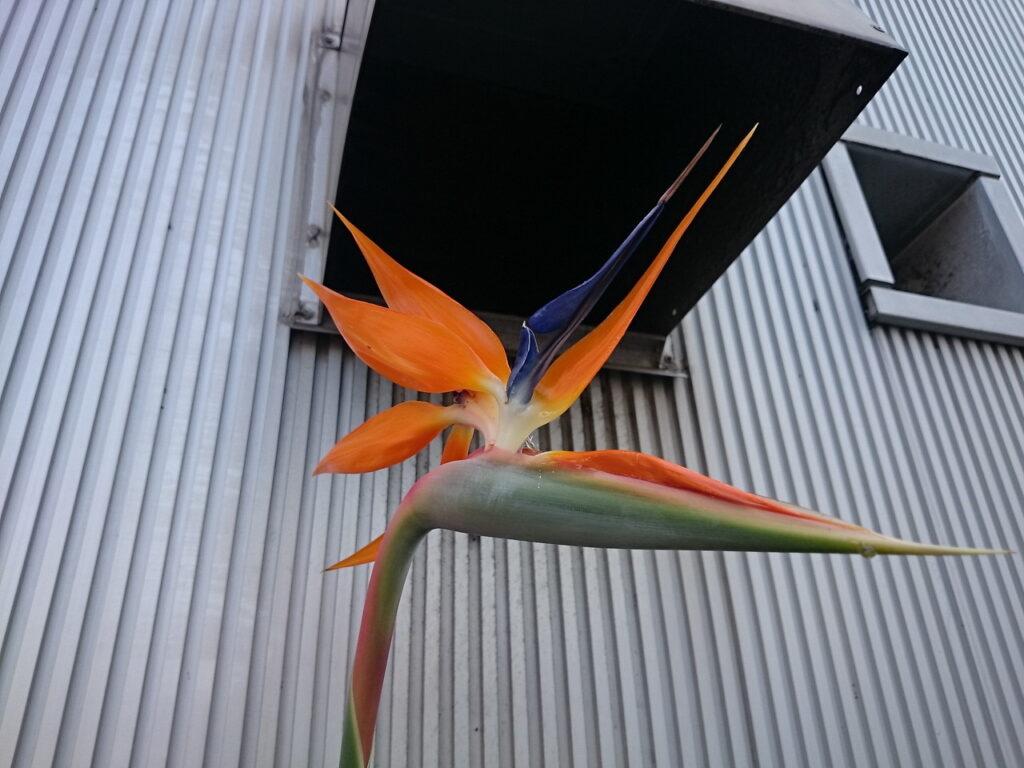
No. 0638 Bird of Paradise (Strelitzia reginae)
This evergreen perennial herb grows to 2 meters tall. It has large, strong, broadly ovate, grayish-green leaves 25-70 cm long and 10-30 cm wide, produced on petioles up to 1 meter long. The leaves are evergreen and arranged in two rows, forming a fan-shaped crown. In Japan, it flowers from May to October. The flowers stand upright on the leaves at the end of long stems. The hard, beak-like sheath from which the flowers emerge is called a bract. It is positioned perpendicular to the stem and resembles a bird's head and beak. It provides a durable perch for sunbirds (birds distributed in the tropical regions of the Old World) that pollinate the flowers. The flowers, which emerge one by one from the bracts, consist of three orange parts. They have sepals and three purplish-blue or white petals. Two petals are joined together to form an arrow shape. When a sunbird sits and drinks nectar, the third petal opens, releasing its anthers and covering its legs with pollen (Gibbs Russell et al., 1987). The fruiting period is from August to February. The fruit is a hard, woody capsule containing numerous small seeds, which splits open from the tip in summer. The seeds are spherical, black to brown, and the plant is native to South Africa. Because of its conspicuous flowers, it is cultivated as an ornamental plant in various countries, including Japan.
No.0638.a Strelitzia alba
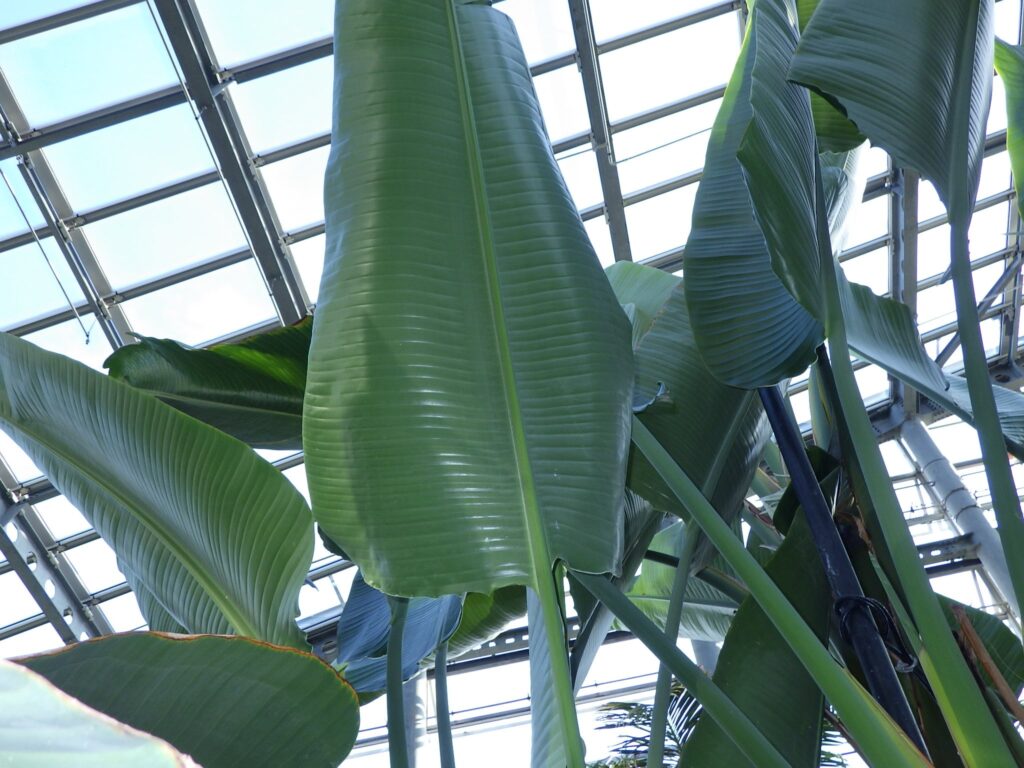
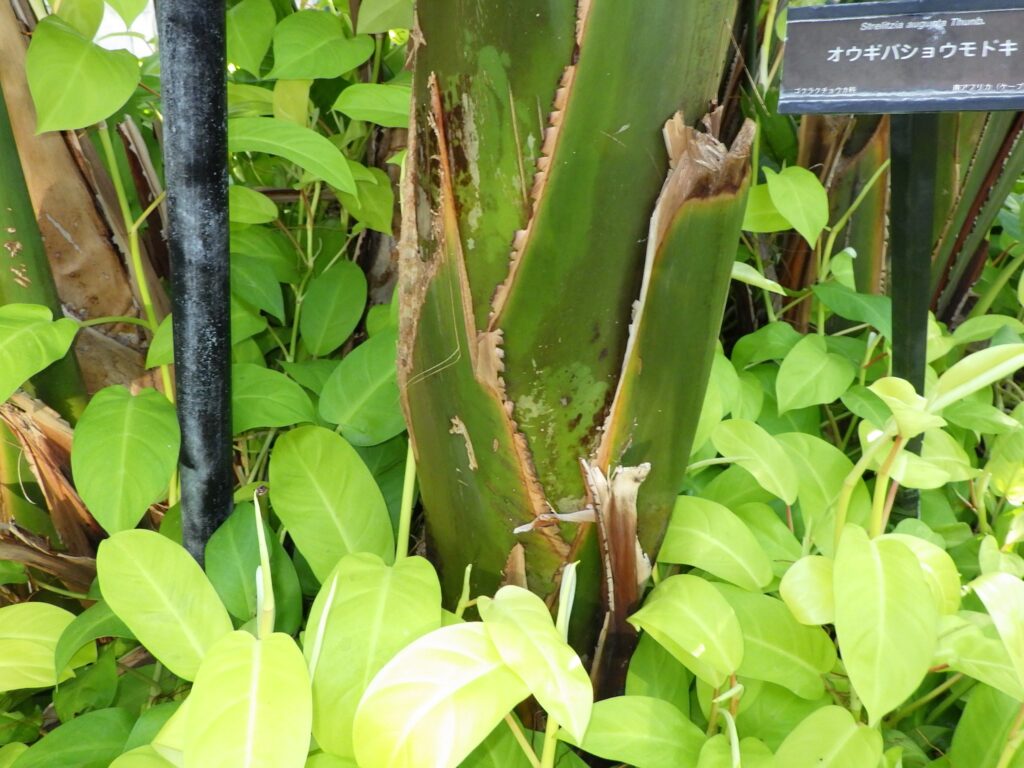
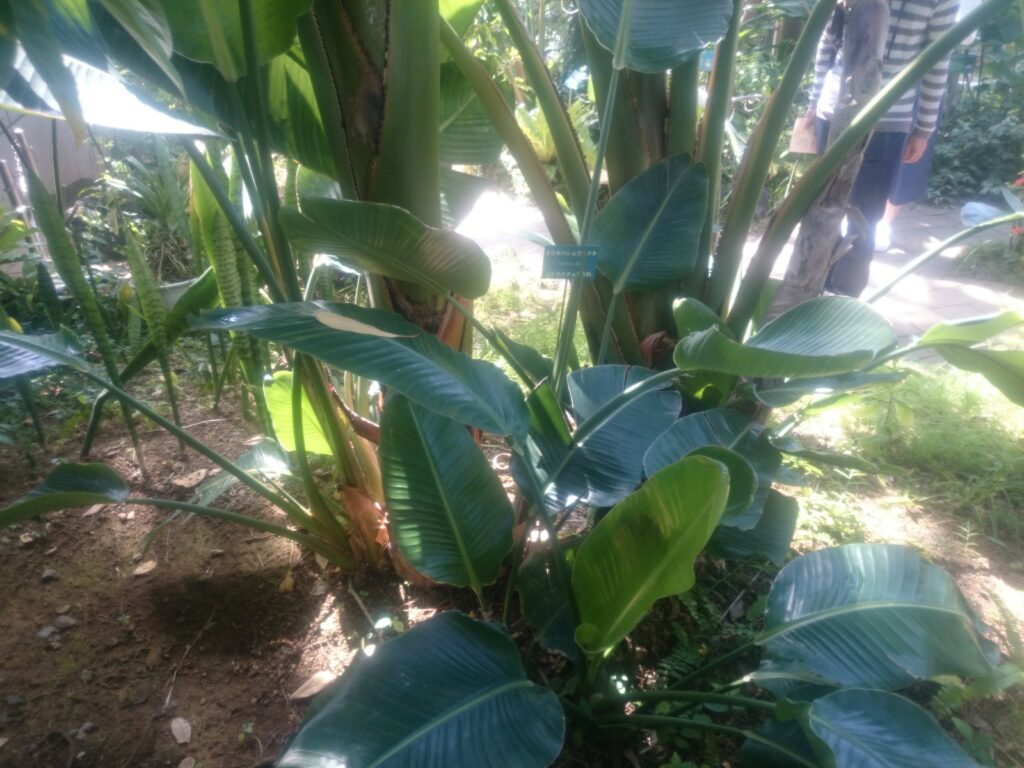
This is an evergreen perennial herb. It can grow up to 10m tall, with leaves measuring 2 x 0.6m. Strong winds and hail often tatter the leaves. It forms dense, Holstein-like clumps from branched rhizomes. Leaf scars are visible through the unbranched, somewhat woody stems. Distributed spirally along the stem, older plants have clearly defined nodes with long petioles and leaf blades only at the top of the crown of leaf-forming species. The leaf blades are simple, with smooth edges, elongated, leathery, glossy green to grayish in color, 2m long and 40-60cm wide. The leaf blades tear in the wind over time. Healthy stems retain scars from the base of old leaves. Flowering is possible at any time of year, but usually occurs between July and December. The flowers are pure white, as the name "alba" suggests, without the blue color seen in other species. The inflorescence is simple. The bracts are boat-shaped, about 30 cm long, and enclose 5 to 10 flowers, which bloom sequentially. The hermaphroditic flowers are fused and triple-layered. The three bracts are two circular structures that differ greatly in shape and color. The fruit is a woody capsule that splits into three sections, revealing black to brown spherical seeds, along with a cluster of yellow or orange arils. The fruit is present year-round, but ripens most often in the summer from October to February. Native to South Africa, it is distributed along the Garden Route in the eastern Hummansdorp district of the Western Cape and the southernmost coastal area of the Knysna district, growing in evergreen forests, canyons, and riverside slopes.
No.0638.b Ravenala madagascariensis
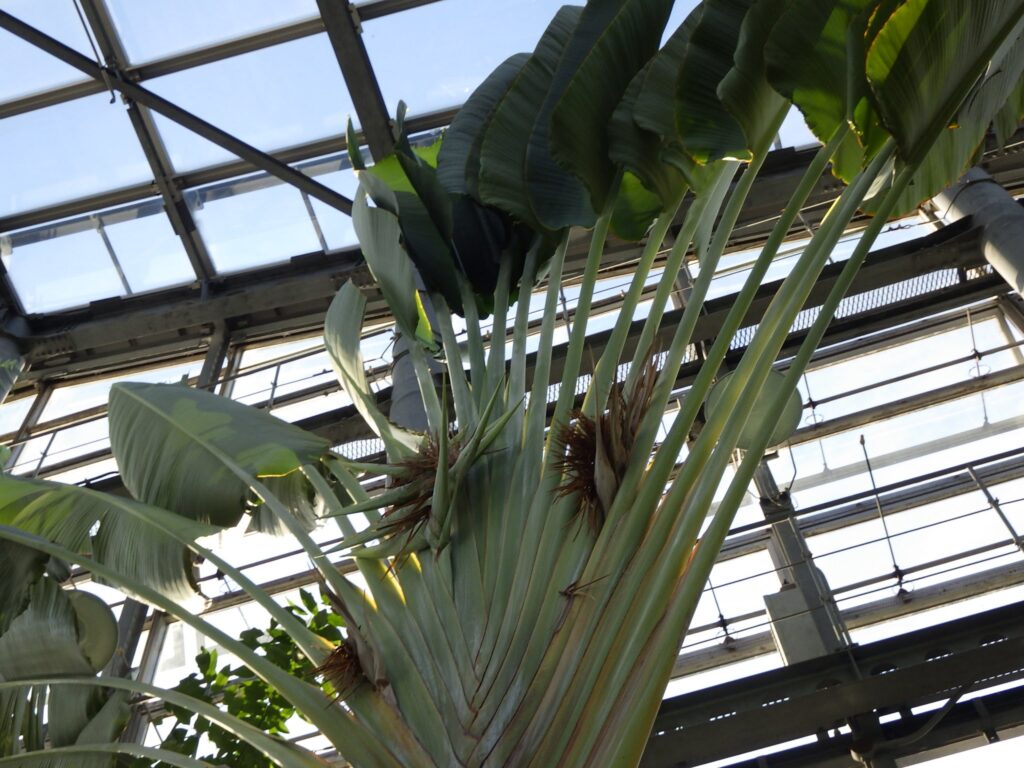
This evergreen tree, also known as the traveler's tree, grows to a height of 10-20 meters. Its pseudostem is erect, bearing 20-35 oblong leaves on long petioles in two alternate rows from its tip. The enormous, paddle-shaped leaf blades rest on long petioles, forming a distinctive fan shape (distichous). As the plant matures, it gradually loses its lowest or oldest leaves, revealing its sturdy gray trunk. Inconspicuous, small, yellowish-white flowers bloom year-round. It is structurally similar to its close relative, the 'Burning Bird', but possesses green bracts. The origin of its alternative name is said to come from travelers quenching their thirst with the water collected at the base of the leaves, or from the fan-shaped leaves indicating direction. Endemic to Madagascar, it is found in humid forests, grasslands, and rocky areas at altitudes of 0-1500 meters. It has been introduced to Mauritius, Bangladesh, and Mexico, and is cultivated for ornamental purposes in other countries as well. Ring-tailed lemurs are known pollinators, and considering the size and structure of the inflorescence, as well as the lemurs' selectivity, feeding methods, and nasal length, it is thought that co-evolution occurred among them (Garbutt, 2007). The seeds of Ravenala have a unique, vivid ultramarine blue color, with a fatty substance attached to the aril, which is thought to be adapted to nocturnal lemurs in Madagascar, such as the aye-aye, which can only see blue and green (Haevermans et al., 2021).
References
Garbutt, N. 2007. Mammals of Madagascar, A Complete Guide. Yale University Press, New Haven. 304pp. ISBN: 9780300125504
Gibbs Russell, GE, WGM Welman, E. Retief, KL Immelman, G. Germishuizen, BJ Pienaar, M. Van Wyk & A. Nicholas. 1987. List of species of southern African plants. Memoirs of the Botanical Survey of South Africa 2(1-2): 1-152(pt. 1), 1-270(pt. 2).
Haevermans, T., Hladik, A., Hladik, CM, Razanatsoa, J., Haevermans, A., Jeannoda, V., & Blanc, P. 2021. Description of five new species of the Madagascan flagship plant genus Ravenala (Strelitziaceae). Scientific Reports 11(1): 1-15. https://doi.org/10.1038/s41598-021-01161-1