The family Cercidiphyllaceae consists of deciduous trees. The leaves are simple and opposite. The flowers are small, lack a perianth, and are dioecious (having separate male and female plants). Male flowers have very short stalks and are accompanied by four bracteoles, which are membranous and fall off quickly. There are numerous stamens. Female flowers have somewhat elongated stalks, and the fruit is a follicle, stalked, narrowly cylindrical, curving outward, with a sharp ridge on the dorsal side and a groove on the inner suture. The seeds are arranged in two rows, are small and winged. There is only one genus in East Asia.
This article provides a comprehensive, illustrated guide to plants belonging to the Katsura family.
The basic information is based on the Kanagawa Prefecture Flora Survey Association (2018). Photos are replaced as better ones become available. While the identification is done by the author, please note that misidentifications may be corrected without notice.
No. 1347 Katsura tree (Cercidiphyllum japonicum)
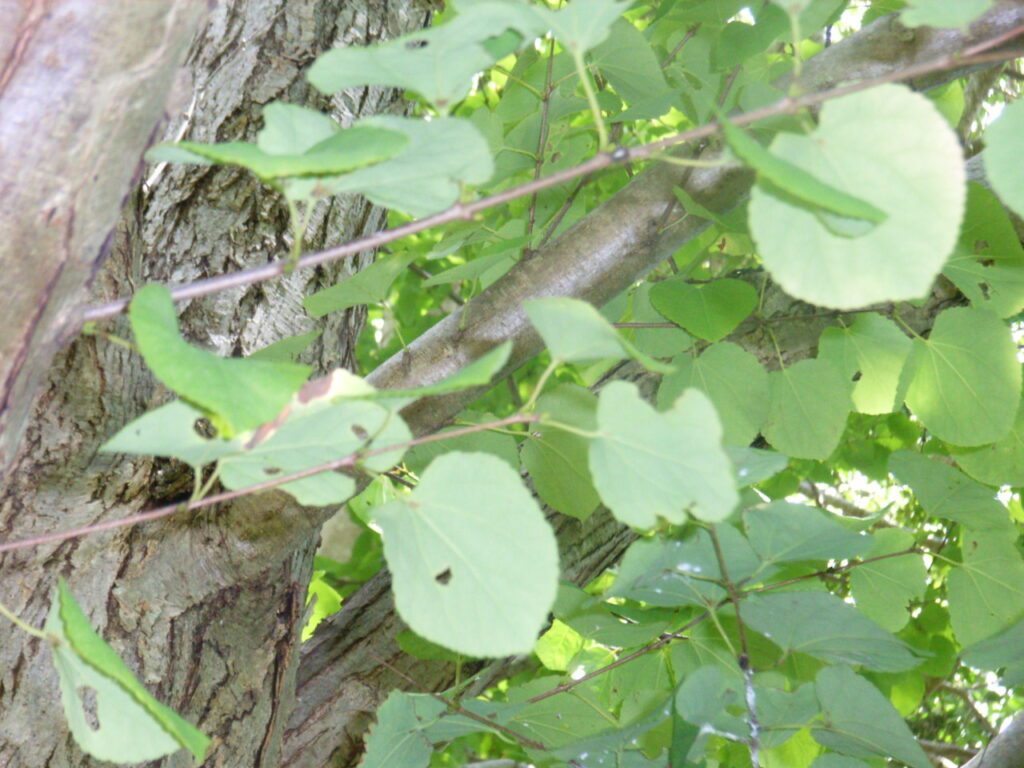
Deciduous tree (Kubo, 2009; Kanagawa Prefecture Flora Survey Association, 2018). Dioecious. Tree height 30m. Trunk diameter over 1m. Forms a huge clump consisting of many sprouts. Leaves are opposite on long branches, and the internodes are long. Short branches bear 3 bud scales, 1 leaf, and 1 flower each year. The leaf blade is orbicular-cordate (heart-shaped), 3-7cm long, and turns yellow in autumn. The fallen leaves have a sweet, caramel-like scent (the origin of the Japanese name, Kazu). It grows into a large tree and has strong sprouting ability. The trunk undergoes generational change through sprouting, and it is said that a single individual can survive for several hundred years or more. It flowers in early spring, around March to May, before the leaves open. The flowers are red. It is wind-pollinated and has no perianth. Male flowers have 8-13 stamens with red anthers, and female flowers have only one pistil. It bears fruit every year. The seeds are small, about 2mm in size. Dispersed by wind. Formation of buried seeds. Germination occurs in areas with exposed soil. Seedlings are extremely small, only about 1 cm tall when they have cotyledons. Distributed in Hokkaido, Honshu, Shikoku, Kyushu, and the temperate regions of China. Grows in disturbed locations such as riparian areas and landslide sites with moderately bright light. Pollen fossils have been found in Cretaceous strata. Near human settlements, giant katsura trees exist throughout Japan as sacred trees of temples and shrines, and are also used as street trees. In America, they are also used as park trees and street trees. Due to their long lifespan, there is a legend in Niigata and Fukushima prefectures that "wherever there is a giant katsura tree, a person is buried," and there was a custom of using katsura trees as burial markers. The flowers have long filaments, and it is generally believed that this is an adaptation for situations where pollen can be carried by strong winds and reach the stigmas of other individuals by traveling only short distances (Tanaka, 2000).
References
Kanagawa Prefecture Flora Survey Association. 2018. Kanagawa Prefecture Flora 2018 (Electronic Edition). Kanagawa Prefecture Flora Survey Association, Odawara. 1803pp. ISBN: 9784991053726
Tanaka, Hajime. 2000. Pollen grain size and dispersal mode of wind-pollinated angiosperms. Journal of Plant Research 75(2): 116-122. https://doi.org/10.51033/jjapbot.75_2_9406
Kubo, Masako. 2009. Katsura. Journal of the Japanese Society of Landscape Architecture 34(4): 658. http://www.jsrt.jp/pdf/dokomade/34-4katsura.pdf