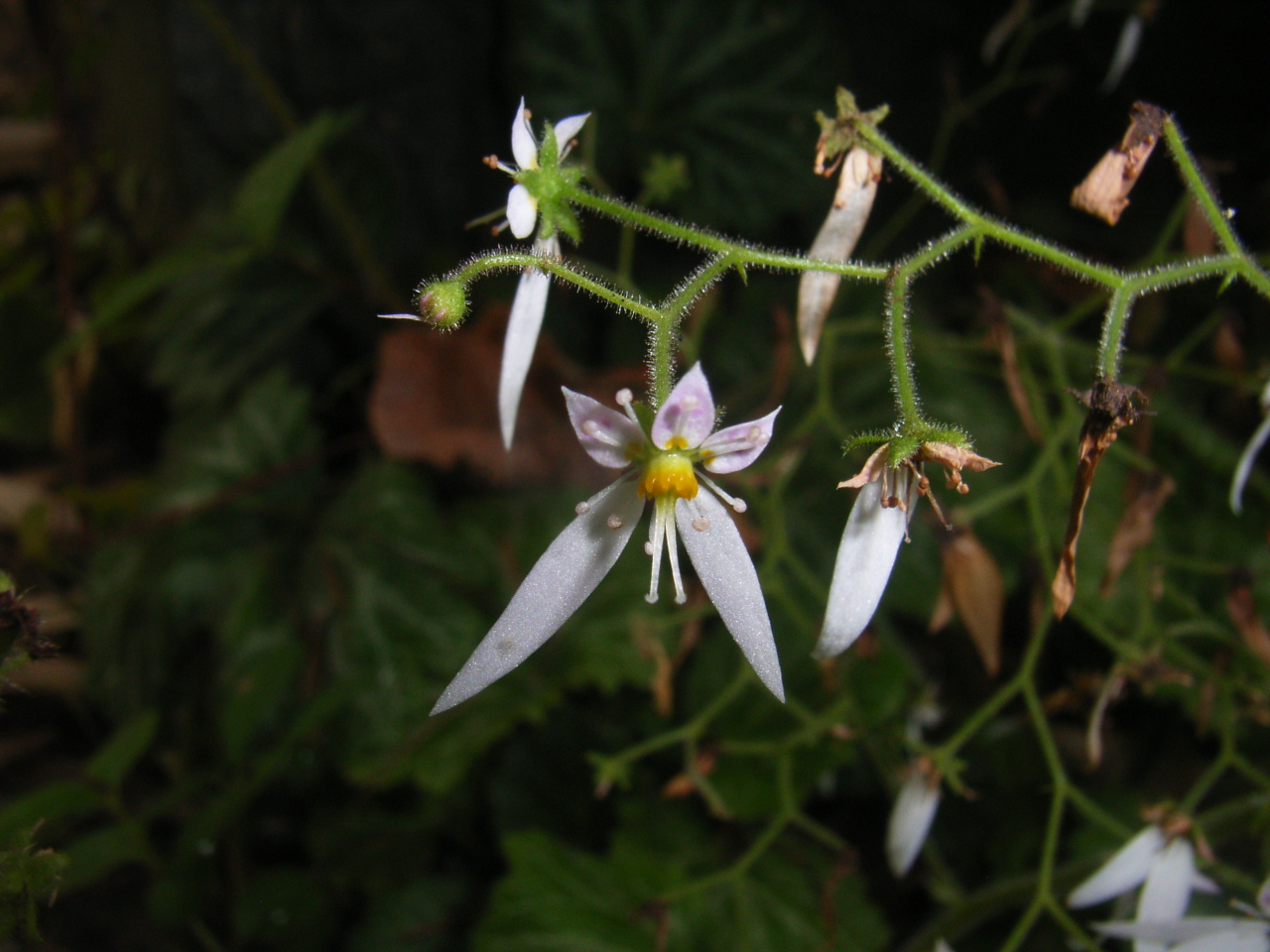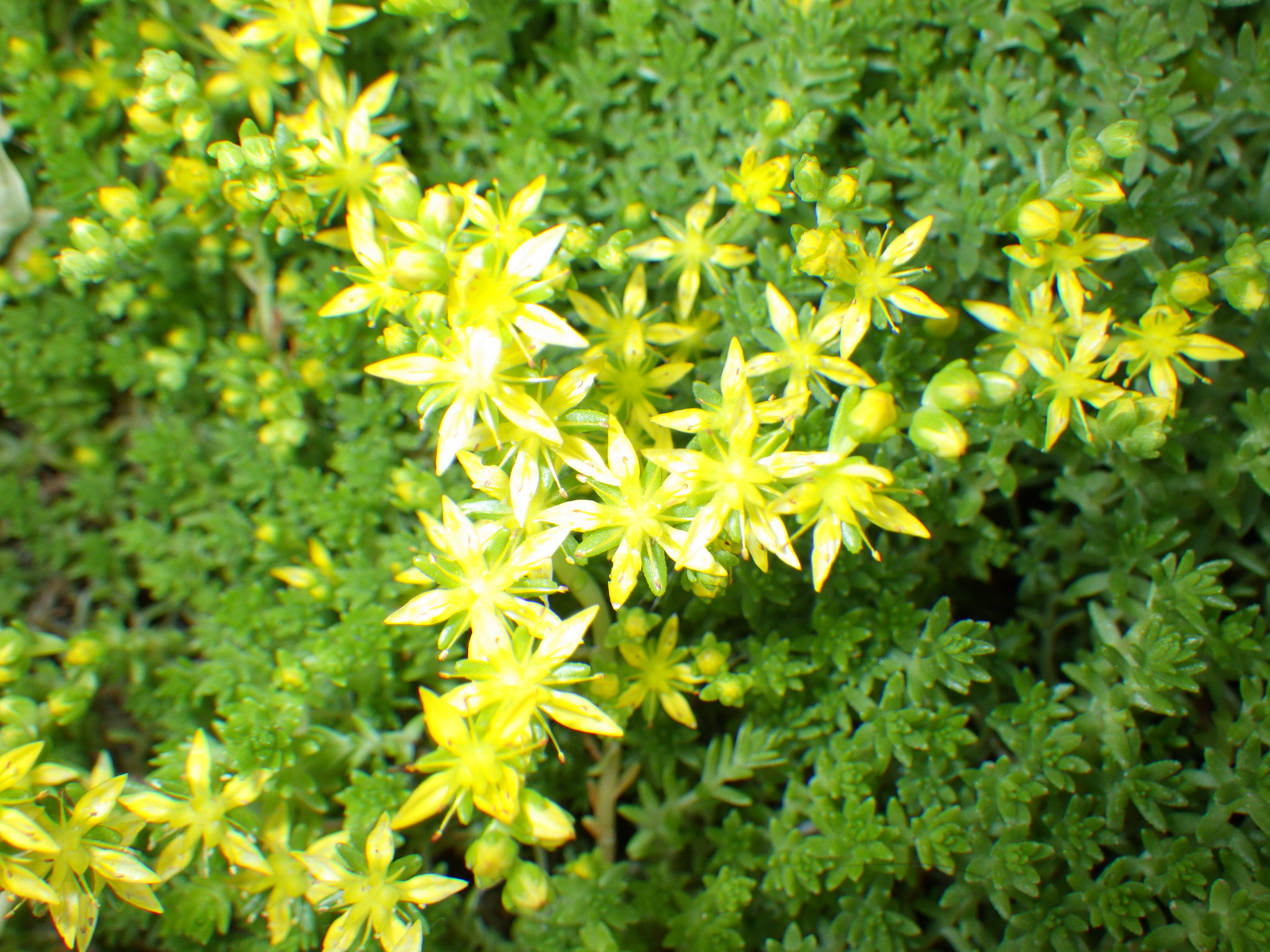
The Crassulaceae family consists entirely of succulent herbs or shrubs, many of which have thickened rhizomes or roots. The leaves are simple. The flowers are radially symmetrical, and most are bisexual, although some genera are unisexual and monoecious or dioecious. The calyx is somewhat fleshy, green (sometimes tinged with red), and persists after flowering. The petals are mostly free, but in some genera, more than half of their length is fused. The stamens are arranged in two whorls; the inner stamen is alternate with the petals, and the outer stamen is opposite, usually partially fused with the petals. The ovary is superior, rarely medull, and has scale-like nectaries at its base. The fruit is a follicle. The leaves lack stipules and are mostly simple with entire margins. The family is widely distributed throughout the world, with approximately 33 genera and 1400 species known, and 8 genera and 44 species found in Japan. They are divided into three subfamilies: Sempervivoideae, Kalanchoideae, and Crassuloideae. They are a representative group that performs sedum-type organic acid metabolism (CAM) photosynthesis. CAM photosynthesis generally absorbs CO2 at night and suppresses transpiration during the day, so it is considered a physiological adaptation to secure water in high-temperature, semi-arid environments where terrestrial succulents are exposed to harsh moisture conditions, and is advantageous for growing in places where it is difficult to absorb water directly from the soil or in soils with high salinity (Yoshimura, 2021). In addition, traits such as fleshy tissue, thick cuticle, and low stomatal density are often possessed to enhance water storage capacity.
This article provides a comprehensive, field guide-style introduction to plants belonging to the Crassulaceae family.
The basic information is based on the Kanagawa Prefecture Flora Survey Association (2018). Photos are replaced as better ones become available. While the identification is done by the author, please note that misidentifications may be corrected without notice.
- No. 1396 Sedum sarmentosum
- No. 1397 Mexican Stonecrop (Sedum mexicanum)
- No.1400.a Yokohama Stonecrop Sedum sp.
- No.1401.1 Sedum japonicum subsp. oryzifolium var. pumilum
- No.1404.a European Sedum acre
- No. 1405 Sedum makinoi
- No.1413.a Aeonium arboreum var. atropurpureum
- No. 1415 Sedum aizoon var. floribundus (evergreen variety)
- No. 1416 Phedimus aizoon var. aizoon
- No.1418.1 Hylotelephium sieboldii var. ettyuense
- No. 1421 Hylotelephium spectabile
- No.1432.a Crassula ovata (Fuchibeni Benkei)
- No.1432.b Red Red Crassula pubescens ssp. radicans
- No. 1433 Kalanchoe spathulata
- No.1433.a Kalanchoe blossfeldiana
- No. 1435 Kalanchoe pinnata
- References
No. 1396 Sedum sarmentosum
The stems are reddish, creeping along the ground and reaching a height of 10-20 cm. The leaves are somewhat flattened and arranged in whorls of three. The flowers bloom in May and June, yellow with orange-red anthers. It does not produce fruit. Native to Korea and China, it is not found growing wild in Japan but is cultivated and has escaped cultivation, growing in clusters between stone walls, on riverbanks, and around houses.
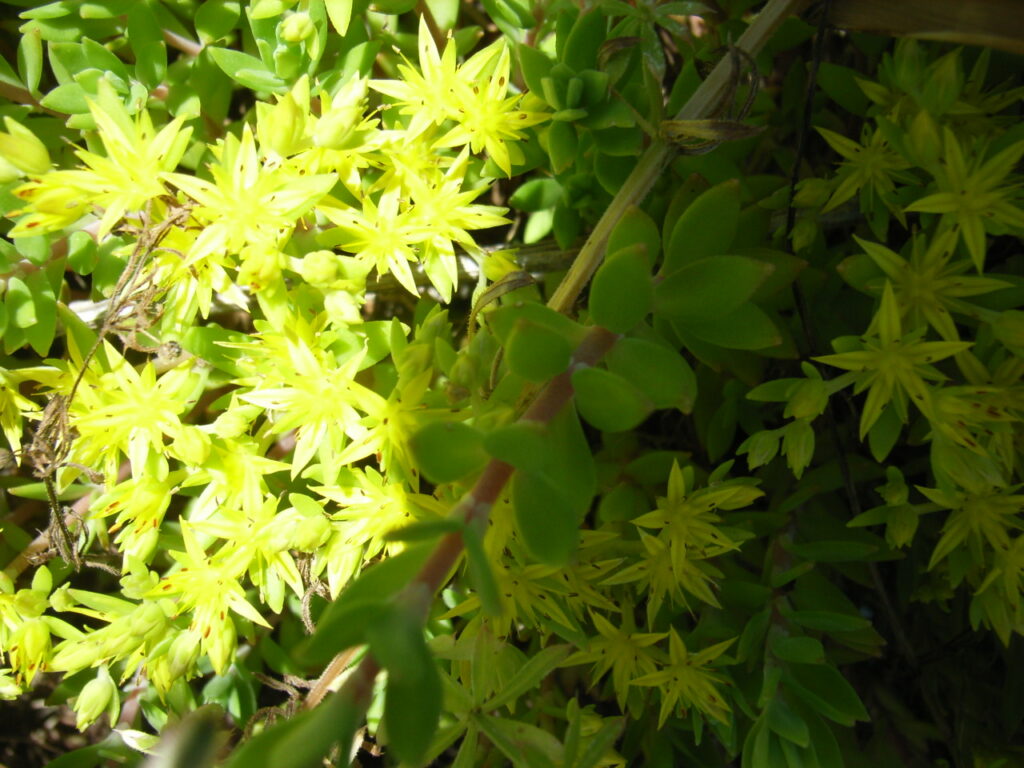
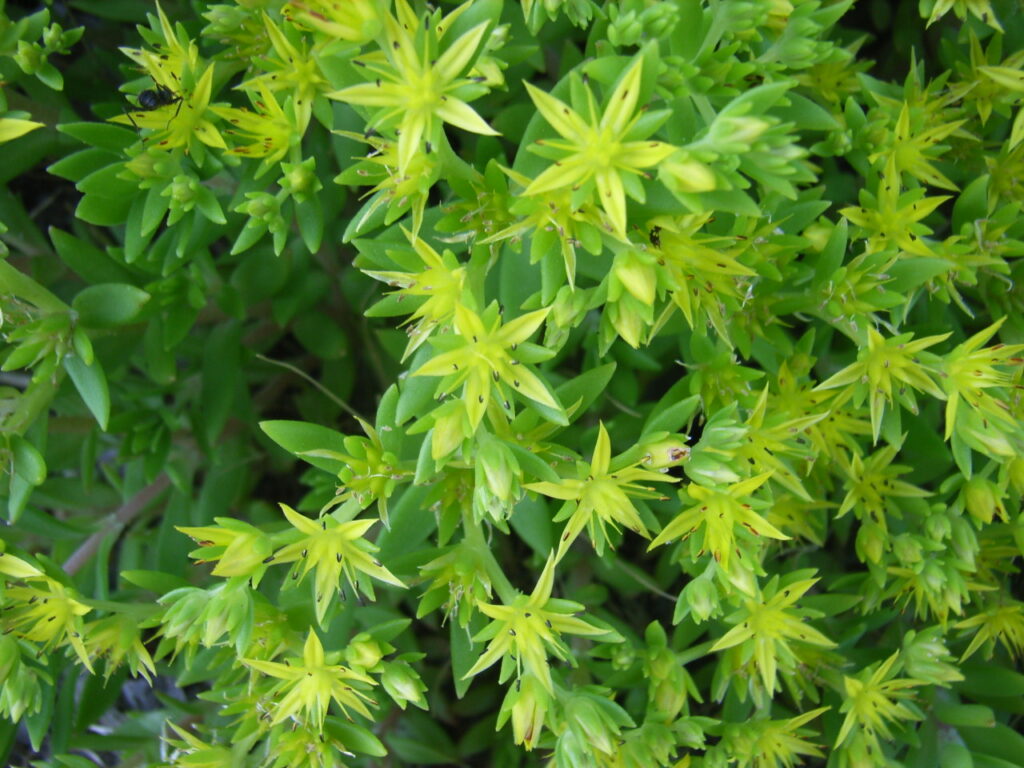
No. 1397 Mexican Stonecrop (Sedum mexicanum)
It grows to a height of about 25 cm. The leaves are arranged in whorls of four, broadly linear, acute at the apex, 10-17 mm long, and flattened to oblate in cross-section. The flowers bloom in April and May, yellow with orange-red anthers, with 7-8 flowers clustered on each branch. The flowers are 10-12 mm in diameter. The sepals are 2-3 mm long. The stamens are almost the same length as the petals. The species was described after germinating seeds sent from Mexico and cultivating the plant, hence the specific epithet "from Mexico." However, it is not native to Mexico and is not said to be distributed in neighboring America, so its origin is unknown. It is cultivated in gardens and has naturalized, growing in clusters along roadsides and in vacant lots in urban areas. "Flora of North America" states that it is distributed in North America (Florida); Mexico; Central America; South America (Colombia); Europe (France, Spain); and Asia (Japan, Taiwan), including introduced species, and points out the possibility that it is native to East Asia.
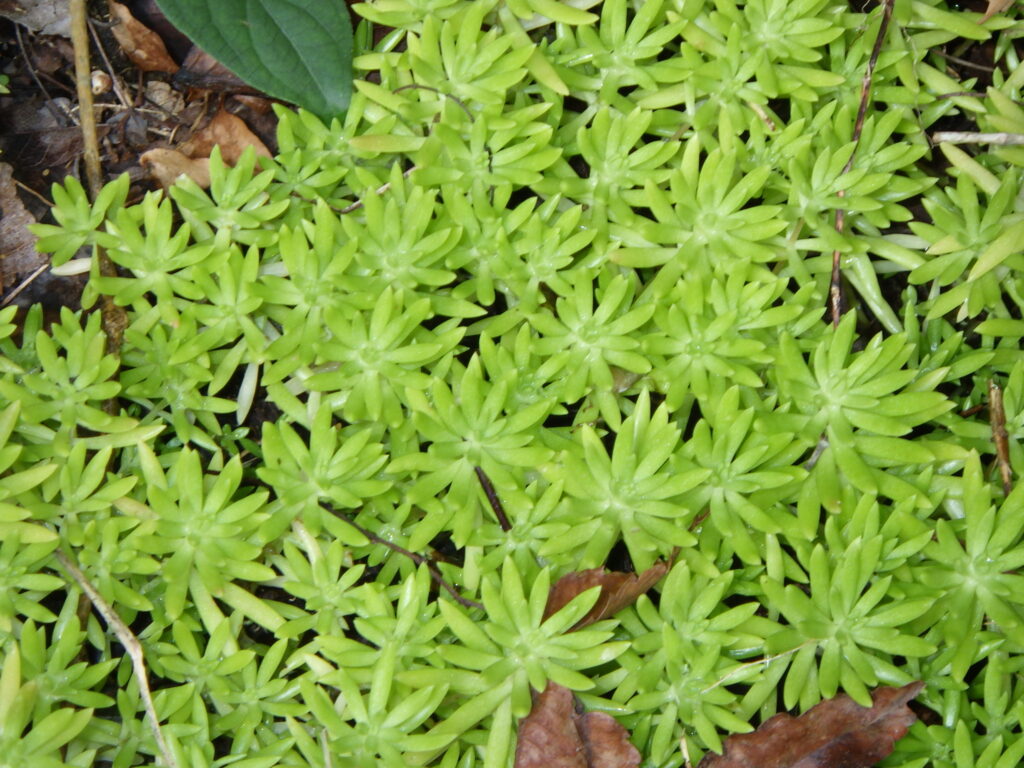
No.1400.a Yokohama Stonecrop Sedum sp.
The book " Wildflowers of Mikawa " explains that *Sedum japonicum* subsp. * japonicum* f. *morimurae * may be a synonym, but the author has not verified the source, nor has been able to find any paper describing *Sedum japonicum*. The "Flora of Kanagawa Prefecture 2018" also makes no mention of this. In this article, we will use the definitive Japanese name *Sedum yokohamaense*. Further verification and information are needed. The flower stalk is 3-10 cm tall, creeping and then rising at the base. The leaves are oblate in cross-section, arranged in whorls of three and densely packed together, 3-6 mm long and 1.8 mm wide, with fine projections on the edges and upper surface, making them rough. The flowers are 8 mm in diameter, pale yellow, with 5 petals 3-4 mm long, 10 stamens about 2-3 mm long, and an ovary 5 mm long. It closely resembles *Sedum sarmentosum*, but its leaves are longer and arranged in whorls of three, which is a key difference. It grows in clusters along roadsides and in vacant lots, and its numbers have been increasing recently. It is considered an introduced plant, but its species name and origin have not been identified. In "Kanshokushi 01," it was given the provisional Japanese name *Yokohama Mannengusa*, but its true identity remains unknown.
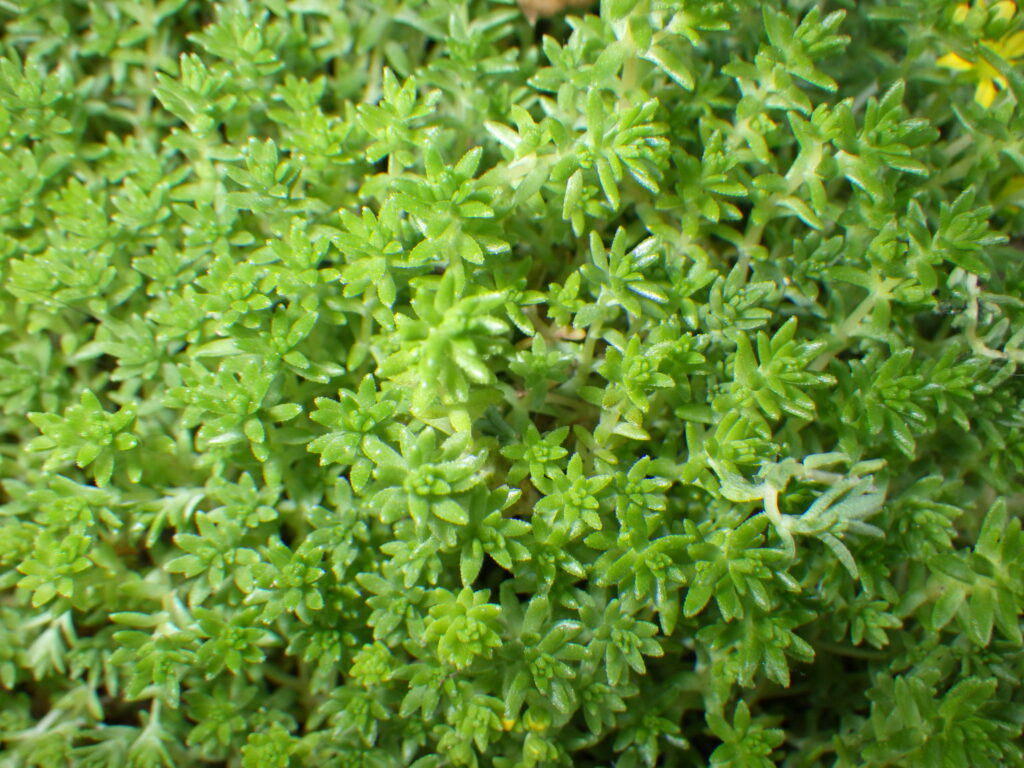
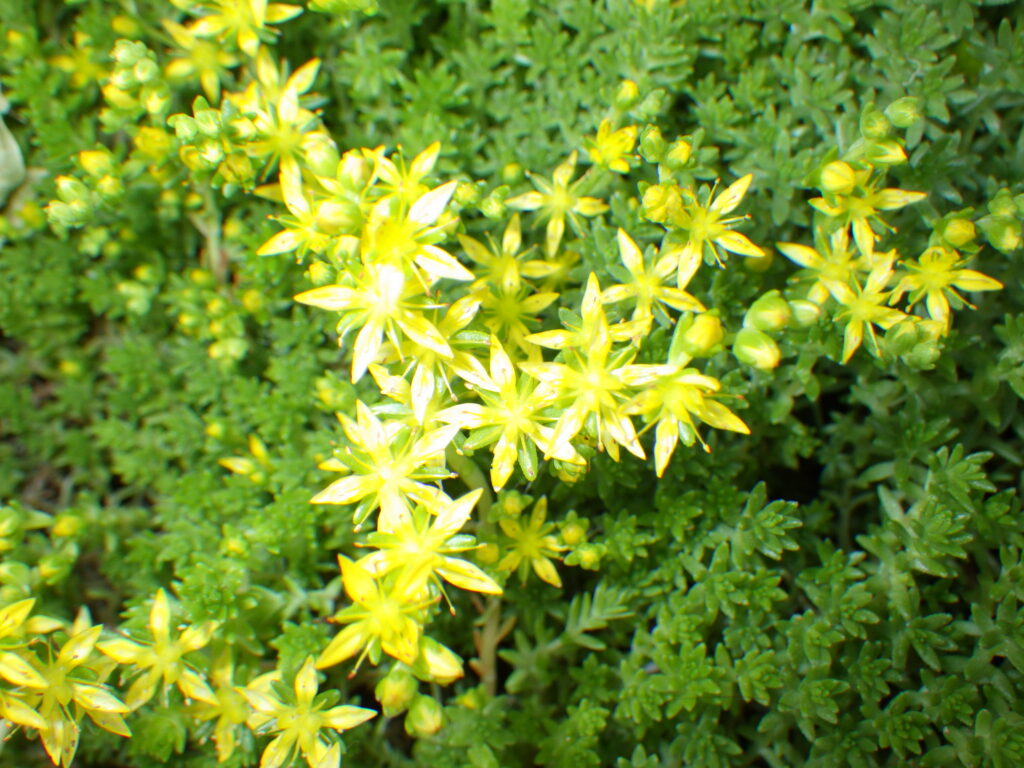
No.1401.1 Sedum japonicum subsp. oryzifolium var. pumilum
Also known as Himekomatsu, the stems are 4-8 cm tall, the leaves are oblong and densely arranged alternately, about 3 mm long and 1.5 mm wide, with rounded tips, a semicircular cross-section, and minute projections visible on the edges when viewed under magnification. The flowers bloom in June and July, are yellow, 8 mm in diameter, and have yellow anthers. The flowers in the center of the flower stalk are pentamerous, while the subsequent flowers are tetramerous. The petals are broadly lanceolate, 4 mm long, and the stamens are shorter than the petals. It grows in clusters along roadsides, vacant lots, and around houses, and is increasing in suburban areas and roadsides. Some varieties of this species are called 'Yellow Queen' and are treated as horticultural varieties. It is highly tolerant of heat, cold, and drought, grows vigorously, changes color throughout the seasons, and is used as ground cover and in gardens.
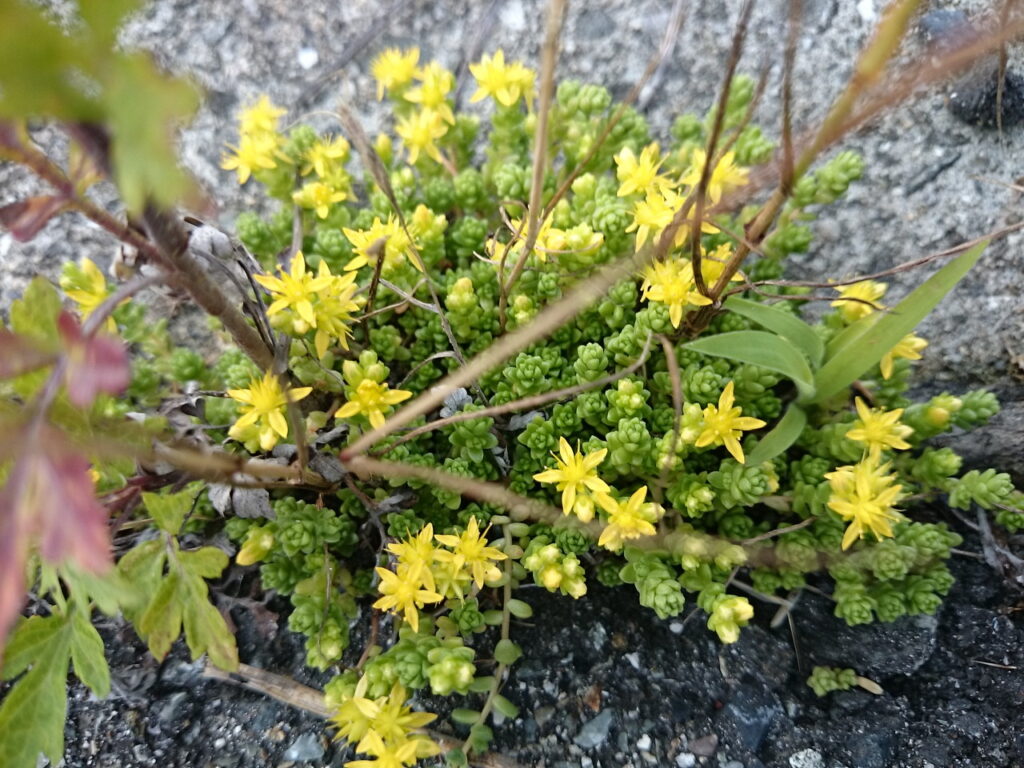
No.1404.a European Sedum acre
This is a perennial herb. The stems branch densely at the base, growing upright to a height of 1.5–6 cm. The leaves are alternate and sometimes reddish. In June, 5–10 flowers bloom in cymose inflorescences at the top of the stem, with pentamerous flowers on short stalks. The petals are yellow, sometimes tinged with pale red. Native to Europe, it is used for horticultural purposes such as ground cover. It was collected in Kushiro in 1999, and the species 'FJIIb' reported its naturalization in Japan. It grows in sunny vacant lots and along the coast.
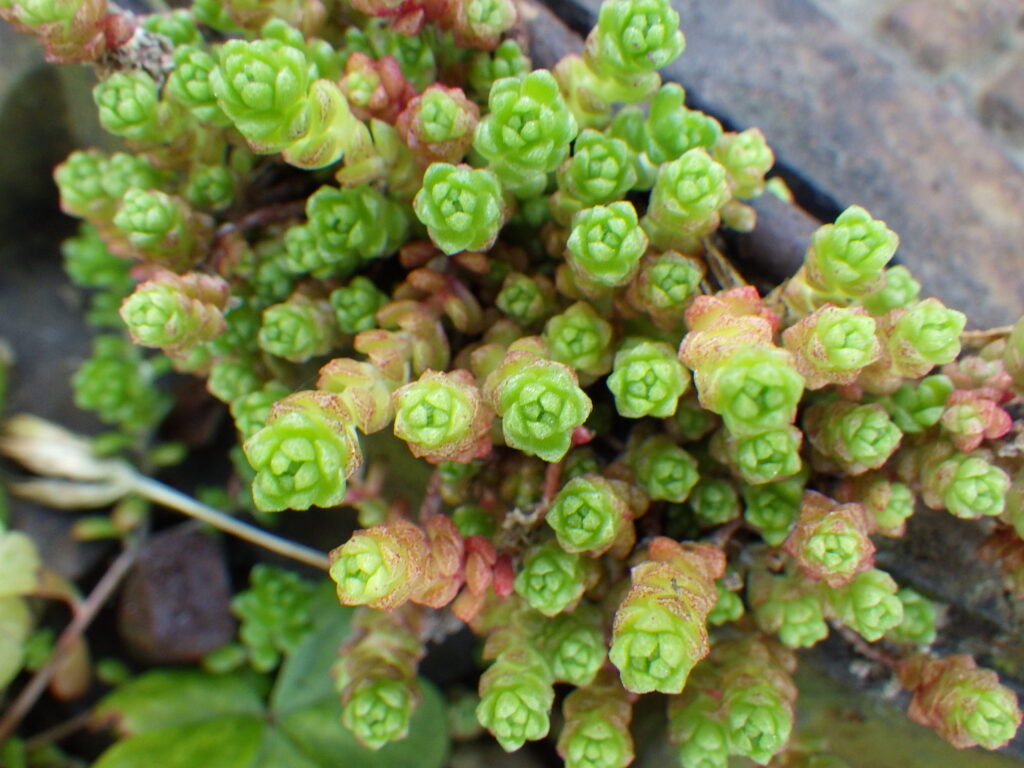
No. 1405 Sedum makinoi
The stems grow to about 15 cm in height and are tinged with reddish-purple. The leaves are obovate or obovate-spatulate, arranged oppositely, thick in texture, and glossy. They are 10-15 mm long and 1 cm wide, narrowing at the base into a petiole. The flowers bloom in June and July, are yellow, 10-15 mm in diameter, with petals 6 mm long, sepals 3.5 mm long, and red anthers. It is distributed in Honshu, Shikoku, and Kyushu. While some grow wild, many are cultivated plants that have escaped cultivation. It grows wild on rocks along riverbanks, and is often found cultivated or escaped plants among stone walls near houses.
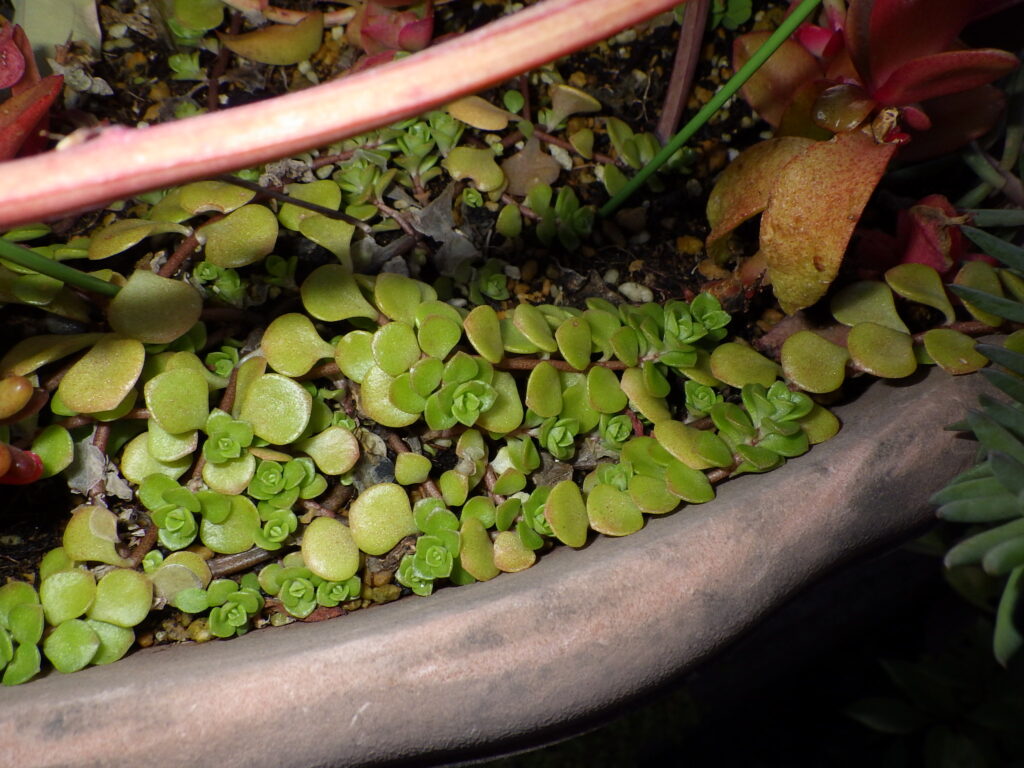
No.1413.a Aeonium arboreum var. atropurpureum
The classification is confusing, but it is listed as above on ' llifle.com '. The author has not been able to verify the source. It is a branching succulent shrub. It has magnificent rosette-shaped leaves that are almost blackish-purple at the tips of its branches. The stem trunk is grayish-green and spreads to 25-60 (up to 100) cm. It forms a rosette at the tip of the stem. It flowers in summer. It produces pale yellow flowers in long clusters. The original species has green leaves, but var. atropurpureum is considered a horticultural variety that produces rosette leaves with blackish-purple leaves. Some refer to it as Aeonium arboreum 'Atropurpureum'. 'Schwarzkopf' is a variety that has been bred to have tall, arching stems and a large head with deeper purple-black leaves. 'Zwartkop' is a synonym, and Schwarzkopf means "black head" in German, so 'Schwartzkopf' is probably a misspelling. The wild species Aeonium arboreum var. arboreum is native to the Atlantic islands (Canary Islands) and North Africa (west coast of Morocco). An unpublished study on Tenerife showed that 62% of the species (Coleoptera, Hymenoptera, Diptera, Lepidoptera) observed visiting plants in this species' habitat visited its flowers, as did birds (Valido & Olesen, 2010). This is thought to be due to selective pressure to enlarge flowers and inflorescences because it lives on an island with a scarcity of insects.
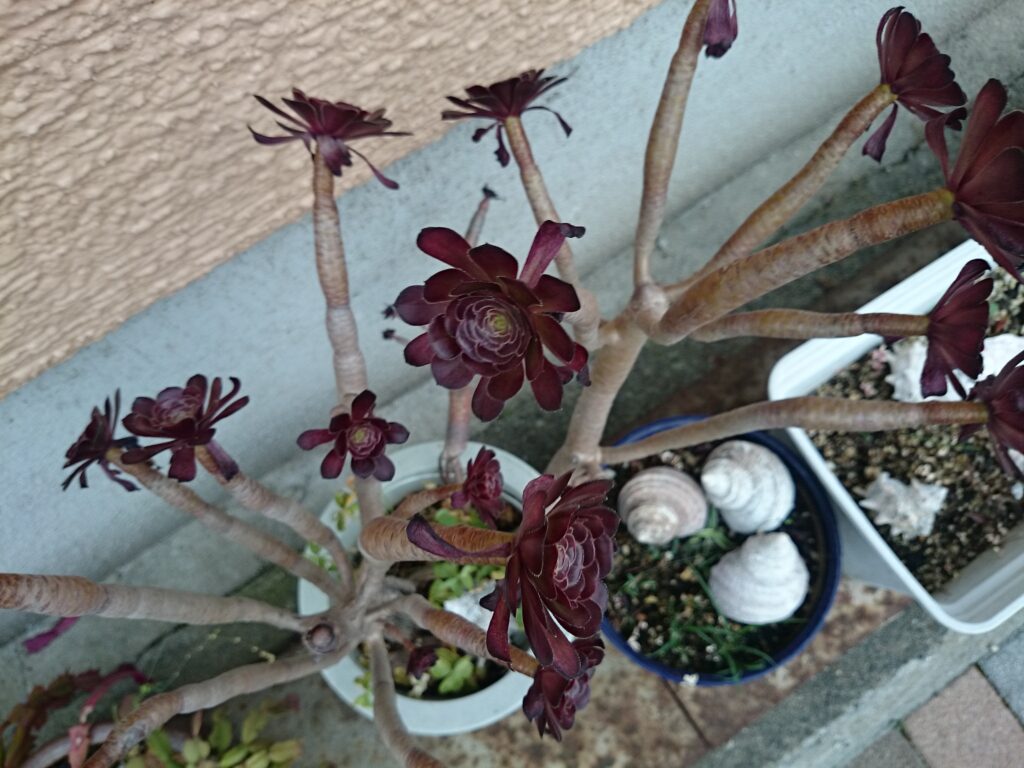
No. 1415 Sedum aizoon var. floribundus (evergreen variety)
This is a perennial herb. The flower stalks grow in clusters. The leaves are alternate, oblanceolate, 2.5-5.0 cm long and 1.5-2.5 cm wide, gradually narrowing at the base and having serrations on the upper half. The flowers bloom from July to September, are yellow, and about 15 mm in diameter. The petals are 7 mm long, the filaments are about 4 mm long, and there are nectaries at the base. It is distributed in Hokkaido, Honshu, Shikoku, Kyushu; Korea, China, and Siberia. It grows on cliffs and can also grow epiphytically on tree trunks. The evergreen variety (evergreen sedum) was developed by Fujita Corporation (Iwami-cho, Iwami-gun, Tottori Prefecture) to retain more greenery above ground during winter. It is resistant to various environmental stresses such as drought, humidity, high temperatures, and low temperatures, and can grow even in harsh environments with only natural rainfall, thus eliminating the need for irrigation equipment and making it suitable for greening (Koji et al., 2018). On the other hand, another species used for greening is Sedum takesimense, which also overwinters with its leaves intact (Iijima, 2011). Therefore, it seems that species used in horticulture cannot be distinguished simply by the fact that they bloom in winter. Iijima (2011) states that the stems of Sedum takesimense develop in a semi-creeping manner, so this point should be noted. The Japanese Wikipedia also states that "the stems are woody."
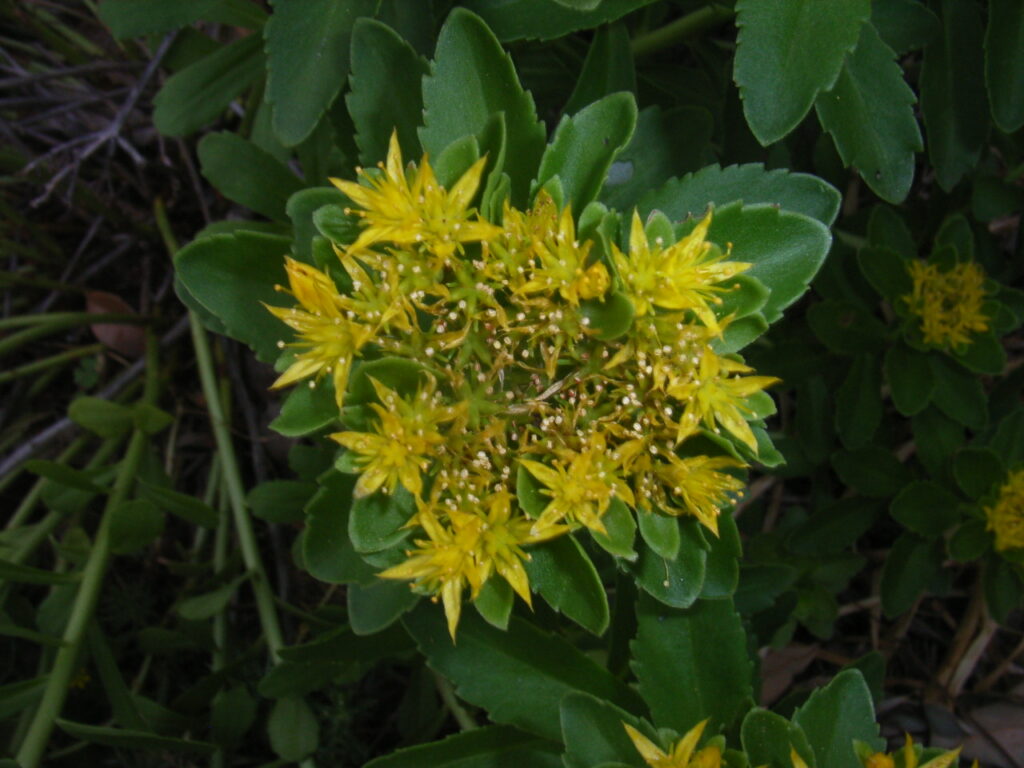
No. 1416 Phedimus aizoon var. aizoon
This perennial herb grows in mountain grasslands and forests (a flower that blooms in the mountains). It resembles Sedum sieboldii, but its leaves are narrower, lanceolate to obovate-lanceolate, 3-6 cm long, with serrations extending to the base, and the flowers are densely packed. It has 5 petals. The stamens are shorter than those of Sedum sieboldii. It produces a cymose inflorescence with three petals at the top of the stem, bearing numerous yellow flowers. It has 5 petals.
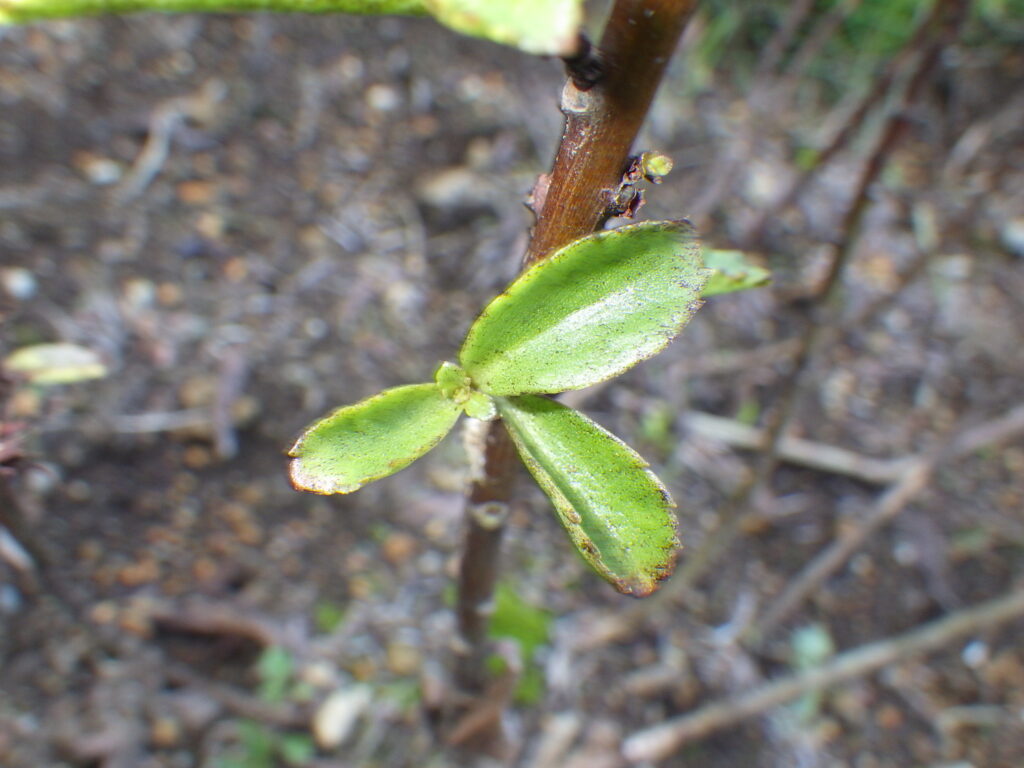
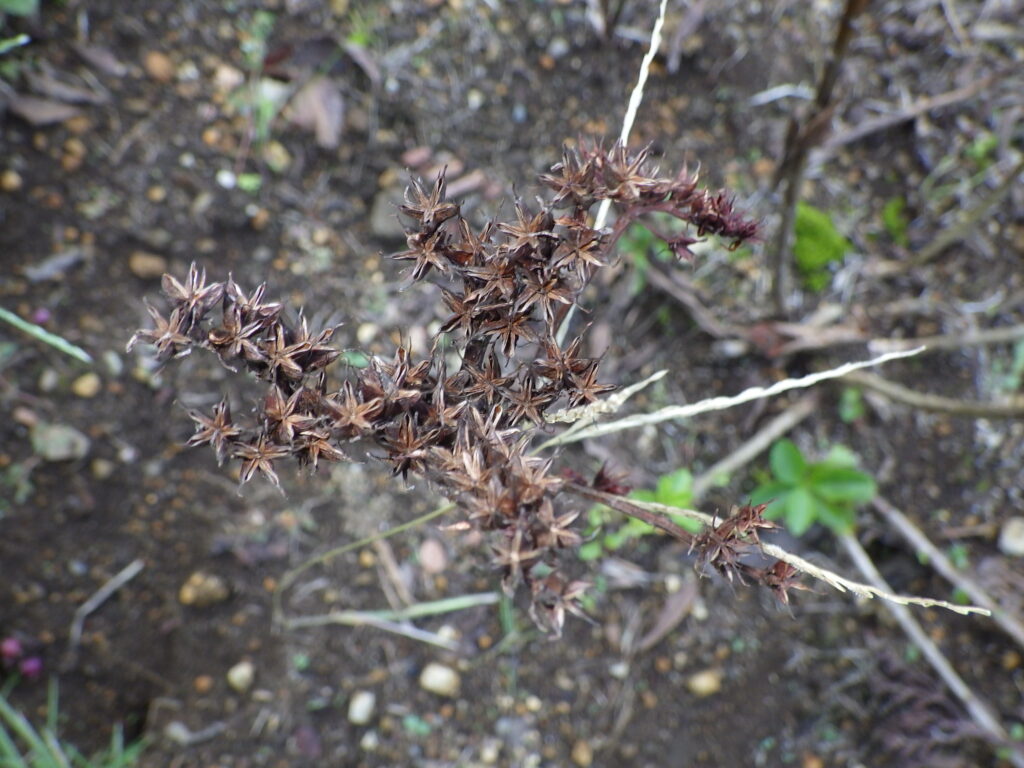
No.1418.1 Hylotelephium sieboldii var. ettyuense
This succulent perennial herb is larger overall than Sedum sieboldii (approximately 50 cm tall). Compared to Sedum sieboldii, it has several differences: while Sedum sieboldii has three leaves per node, this species has two to three or four; the leaves are ovate to rhomboid in shape; and the inflorescence is generally hemispherical (Tomita, 1973). Ovate leaves have entire margins, while rhomboid leaves have very shallow serrations and a reddish border. It flowers from October to November. It produces corymbose inflorescences at the top of the stem, bearing numerous pale pinkish-purple flowers. The flowers are 5-petaled, about 8-10 mm in diameter, with 10 darkly colored stamens that extend beyond the corolla. It grows wild on cliffs in Toyama Prefecture and is cultivated for ornamental purposes.
Identifying cultivated varieties is difficult, but the following specimen was identified as this species based on its opposite flower arrangement (compared to three whorls in *Sedum sieboldii*), lack of serrations (compared to *Sedum hidakaense*), and flowering period in November (compared to August-September for *Sedum sieboldii*). The flower color appears to be uncommon.
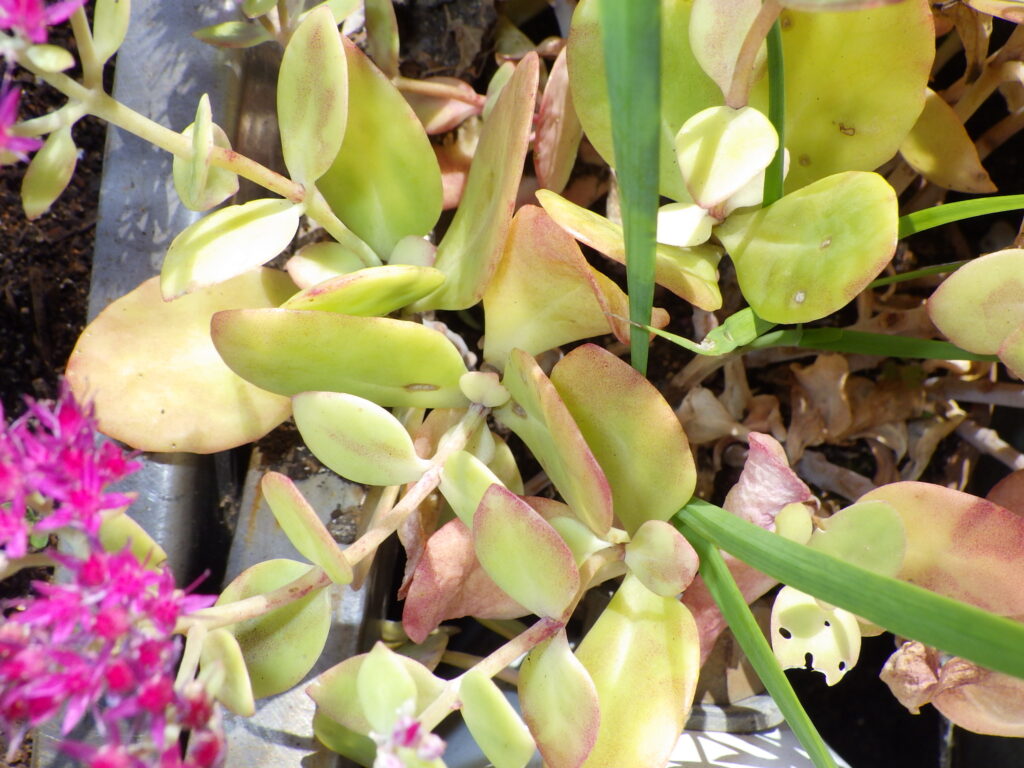
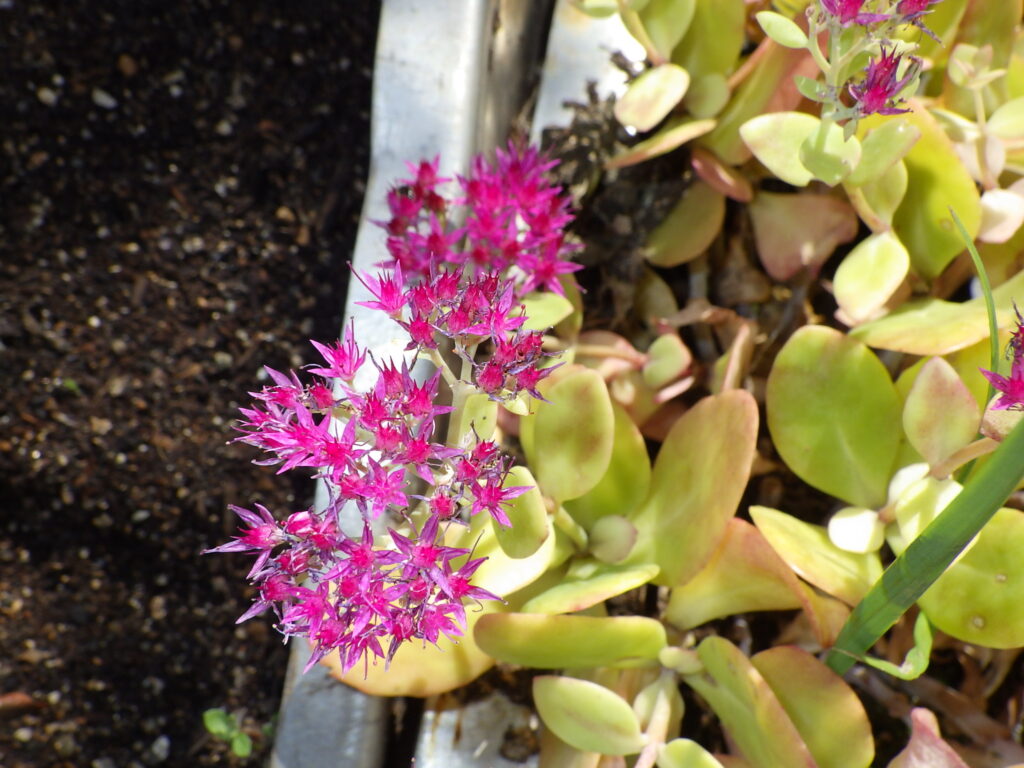
No. 1421 Hylotelephium spectabile
Perennial herb (Flora of China). Stems are erect, 30-70 cm tall. Leaves are opposite or in whorls of three. Leaf blades are narrowly elliptic-oblong to oblong-ovate to ovate to broadly ovate, 2.5-10 cm long × 0.8-5 cm wide, with a tapering base, entire to ±wavy-toothed to toothed margins, and an obtuse to acute apex. Cymes are flat-headed, densely covered with flowers, 7-11 cm wide. Flowers are about 1 cm in diameter. Sepals are linear-lanceolate to broadly lanceolate, about 1 mm long, with acute apex. Petals are purplish-red. Nectary scales are square, 1-1.2 mm long, with a notched apex. Carpels are narrowly elliptic, about 3 mm long. Style is about 1.2 mm long. Follicles are erect. Flowering occurs from August to September. Fruiting occurs from September to October. It is distributed in Korea and China, and in Japan it is cultivated for ornamental purposes. It grows in forest edges and rocky areas of low mountains.
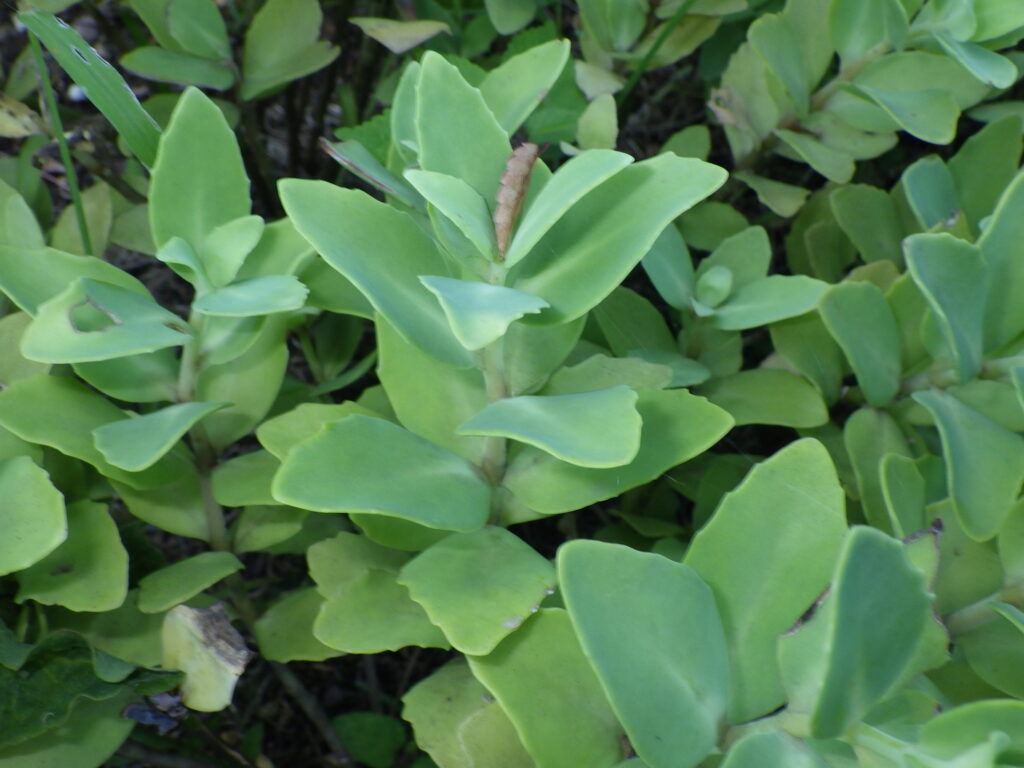
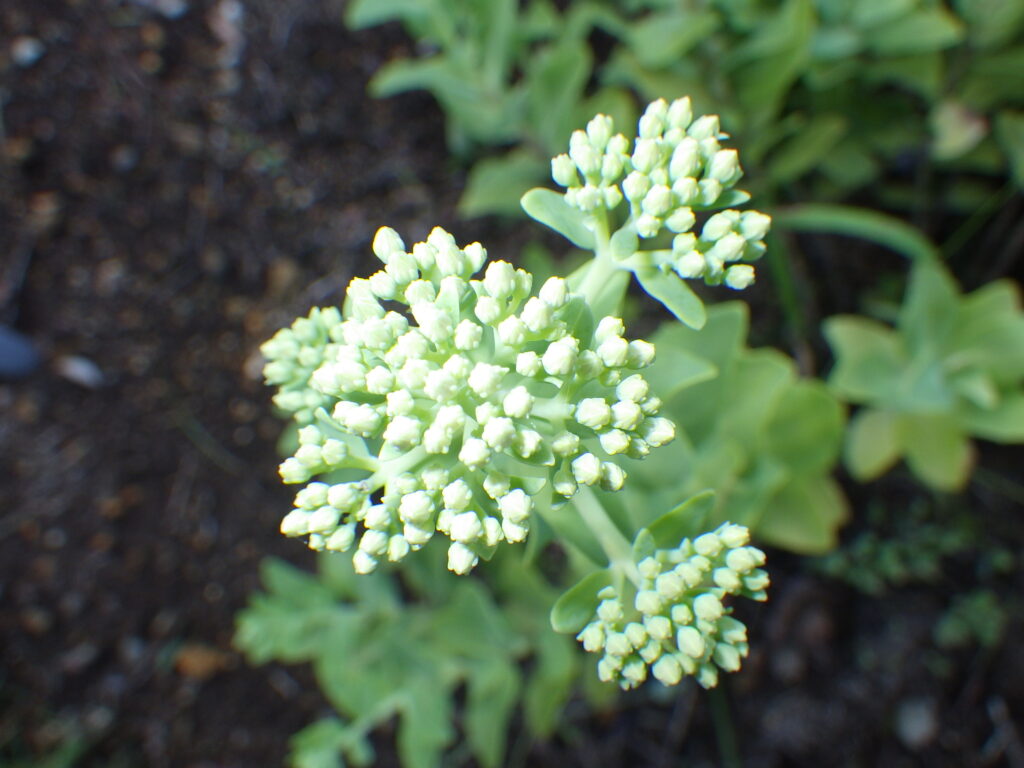
No.1432.a Crassula ovata (Fuchibeni Benkei)
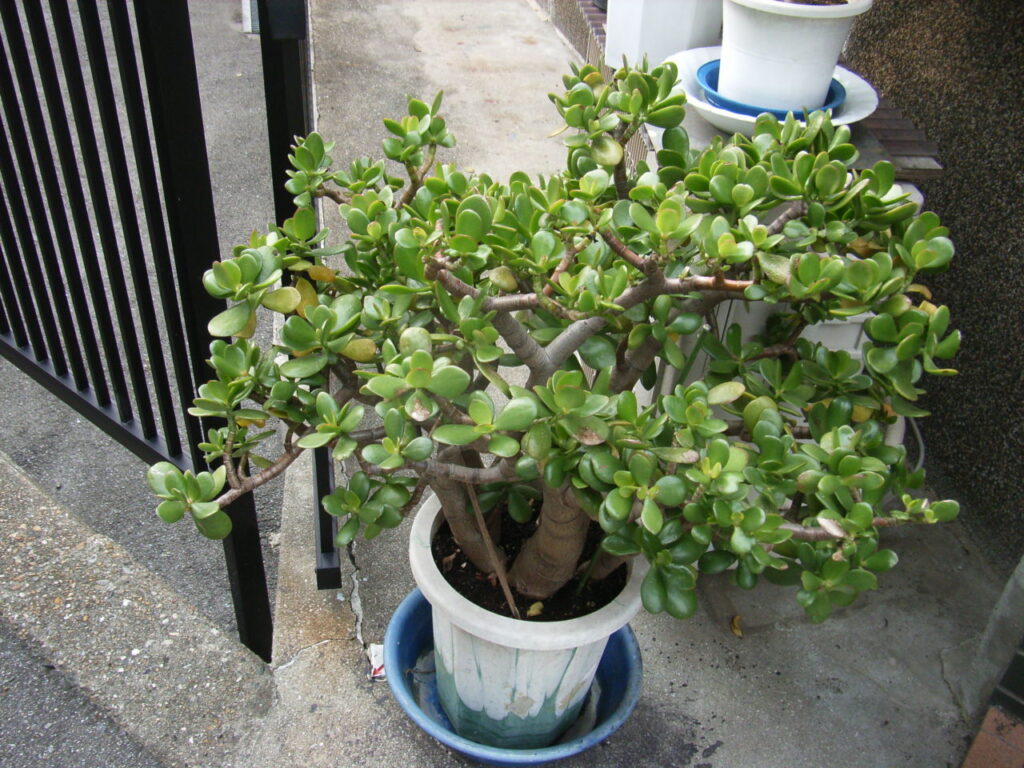
Its alternative name is Kanenonaruki (Money Tree) (Tsuchihashi, 1992). The alternative name is originally a Japanese translation of "dollar plant," and the name comes from the fact that its leaves resemble coins. It is an evergreen shrub. When cultivated outdoors in frost-free areas, it can grow to a height of over 3m. The leaves are succulent, obovate, with a blade length of 3-4cm, bright green with a metallic sheen, and the edges are reddish, becoming particularly vibrant in color from autumn to winter. There are also varieties with variegated leaves. It flowers in winter. When the plant matures, it produces cymose inflorescences at the top of the stems, bearing numerous small white to pale pink flowers about 1.2cm in diameter. It is native to eastern South Africa and is distributed in Namibia, East Africa, and Madagascar. It was introduced to Japan in the early Showa period. In Japan, it is said that growers would insert the hole of a five-yen coin through the apical bud and fix it in place, allowing the young branch to grow while passing through the hole in the coin, thus making it appear as if the plant had a coin attached to it. This was a kind of lucky charm sales method.
No.1432.b Red Red Crassula pubescens ssp. radicans
This is a perennial herb (Toelken, 1985). The plant is more or less erect, but the lateral branches droop and root where they touch the ground, with internodes of 2–5 (–10) mm visible between the leaves. The leaves are oblong, 10–25 (–30) × 2–5 mm, glossy or downy. The inflorescence has a rounded or flattened apex (partial inflorescences emerge from 1–2 nodes of the central axis), and the pedicel has 3–5 (–7) bracts, with no flowers in the axils. The petal lobes, with their dorsal attachments, are ovate to nearly spherical, 0.4–0.6 mm long and almost the same length as their width. It is naturally distributed in South Africa's Eastern Cape province, roughly midway between Port Elizabeth and King Williamstown, and is cultivated as an ornamental plant in various countries. It grows in valleys and forms widespread colonies under shrubs and trees.
No. 1433 Kalanchoe spathulata
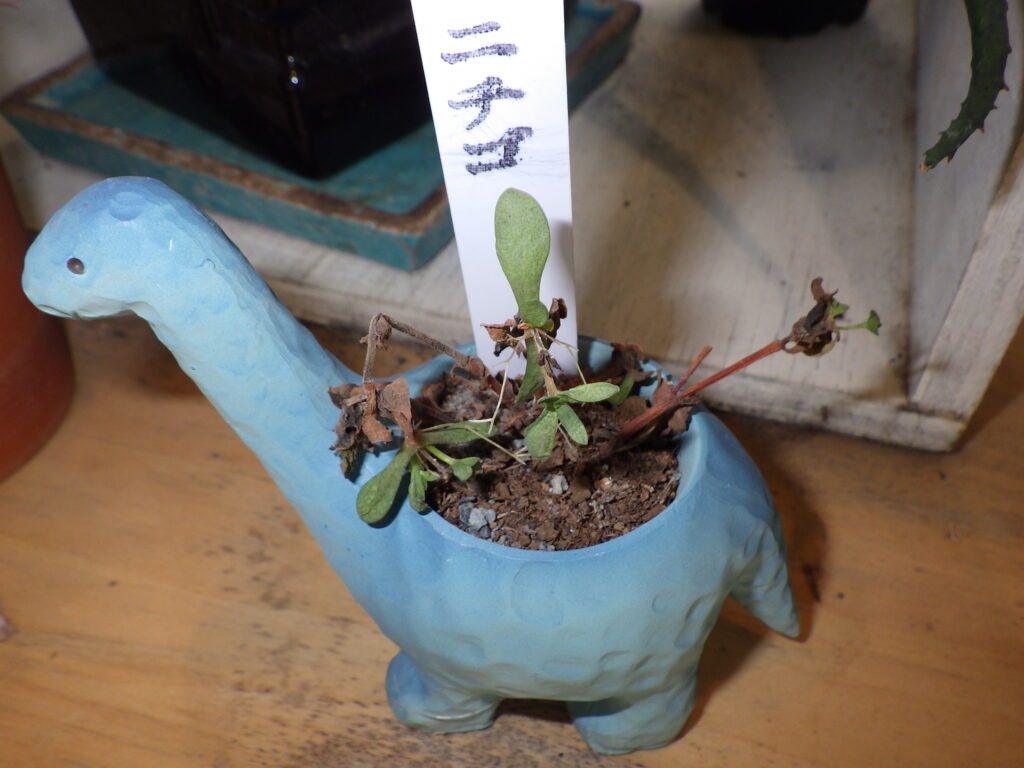
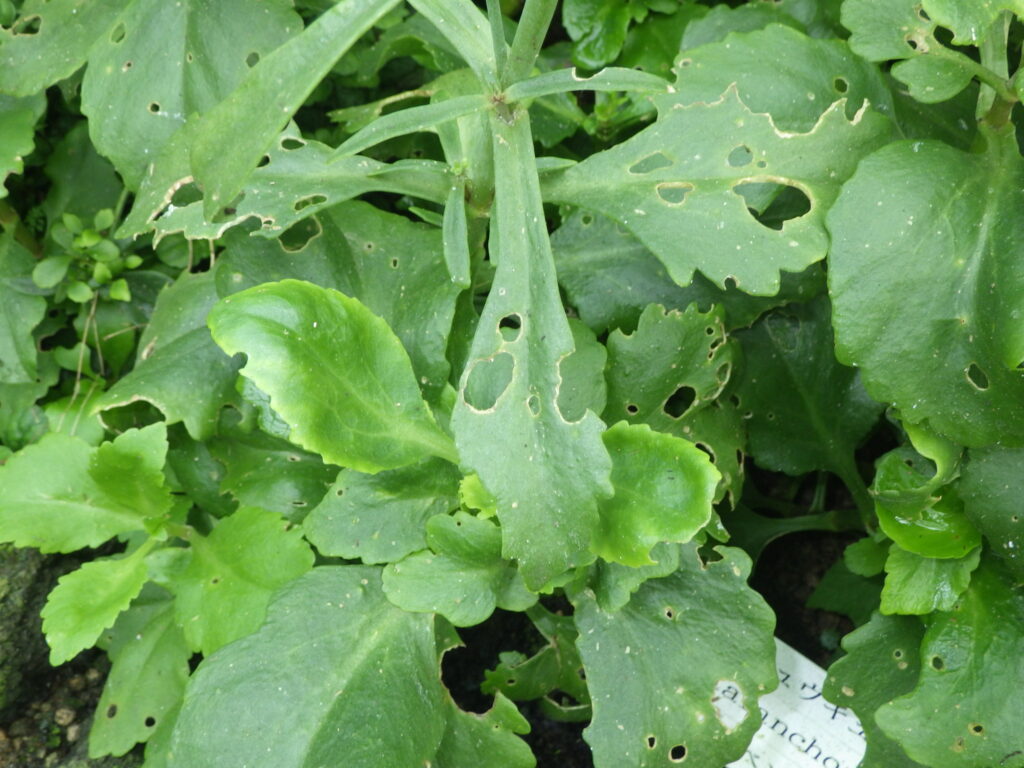
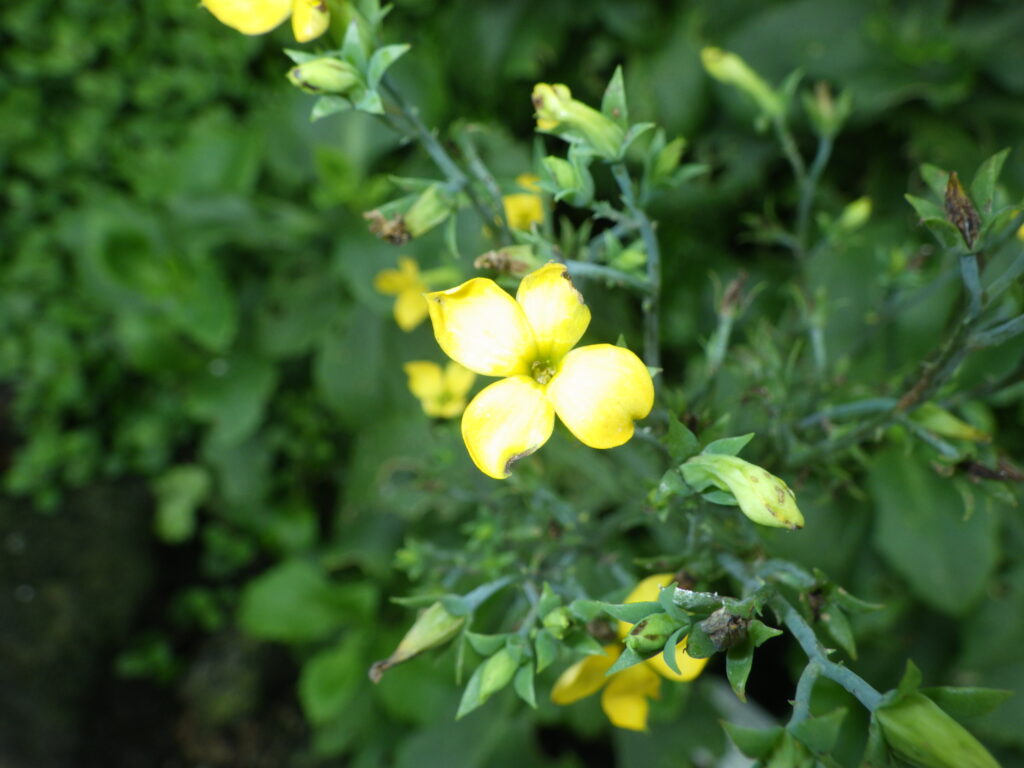
This succulent perennial herb (Okinawa Prefectural Government, Department of Culture and Environment, Nature Conservation Division, 2006). It grows to a height of 30-100 cm, with stems that are obliquely ascending or erect. The leaves are opposite, spatulate-oblong, 5-20 cm long, succulent, with blunt serrations on the margins, and sometimes three-lobed. It has petioles. It flowers from January to April. The inflorescence is a corymbose inflorescence attached to the top of the stem. The flowers have four petals, and the corolla is urn-shaped or goblet-shaped, yellow to orange in color, but green only at the base. In Japan, it is naturally distributed in the Ryukyu Islands (Okinoerabu Island, Yoron Island, Okinawa Island, Ie Island, Miyako Island, Irabu Island, and Tarama Island), and outside of Japan, it is distributed in Taiwan, southern China, and Southeast Asia. However, the current status in Japan other than Irabu Island is unknown, and the population on Irabu Island may be an escaped cultivated individual. Cultivated individuals can be seen not only in its natural habitat but also in various other places. In its natural habitat, this species grows in sunny coastal areas, rocky areas, and on rocks. Wild populations of this species are thought to have become extinct due to collection for horticultural purposes and habitat development, and individuals found in the natural environment are believed to be escaped cultivated plants. For this reason, it is classified as "extinct in the wild" in the Ministry of the Environment Red List and the Kagoshima Prefecture Red Data Book, but in the Okinawa Prefecture Red Data Book, it is classified as "critically endangered" because it is unclear whether the population on Irabu Island mentioned above is wild or escaped cultivated plants.
No.1433.a Kalanchoe blossfeldiana
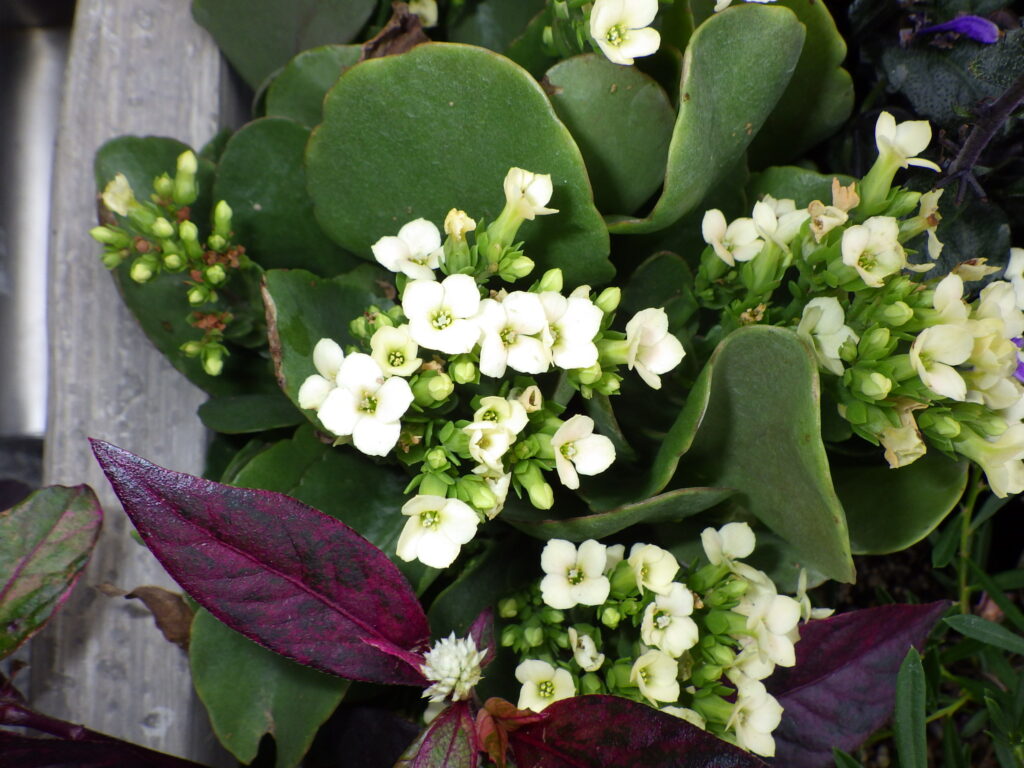
This succulent perennial (Flora of North America) grows to 40-50 cm. The leaves are elliptic to ovate or oblong, 3-10 cm long, with wavy or nearly entire margins and obtuse or nearly acute apex. The inflorescence is dense, compound, glossy, and glandless. The pedicels are 0.5-2 cm long. The flowers are fragrant, with upward-pointing, triangular-lanceolate sepals 4-10 mm long, scarlet, cylindrical petals, a corolla tube about 8 mm long, and widely spreading lobes about 4 mm long. It grows in barren land. Native to Madagascar, it is cultivated for ornamental purposes in various countries. It was bred in Germany and is now widely grown worldwide as a potted plant. Many varieties have been developed through breeding, including tall cut flower varieties and dwarf potted varieties, with flower colors ranging from deep red, orange, pink, and yellow.
No. 1435 Kalanchoe pinnata
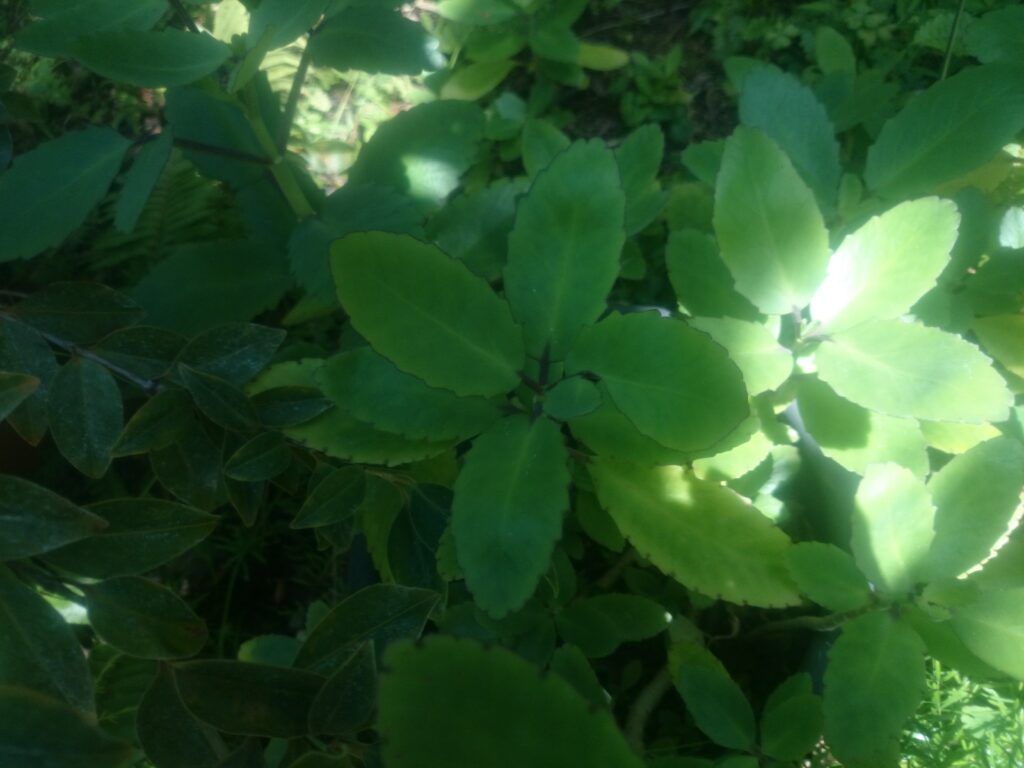
Also known as Kalanchoe pinnata or Kalanchoe pinnata, this succulent perennial herb grows to a height of 40-140 (up to 200) cm. The stems can be as thick as 2 cm, and the base is somewhat woody. The leaves are pinnately compound with 3-5 lobes in the middle section, while the upper leaves are simple. The leaflets are oval, 5-20 cm long and 2-10 cm wide. They are succulent with blunt serrations along the edges and sometimes produce bulbils. The flowers bloom in a conical cyme, sometimes reaching up to 80 cm in length, hanging downwards in large numbers. The calyx is cylindrical and reddish-yellow, with a tube 2.5-4.5 cm long. The corolla is pale green in the lower half and red in the upper half. The corolla tube is 2-4 cm long with 8 folds, and the lobes are ovate-lanceolate with an acute apex, 1-1.5 cm long, and recurved when in flower. The stamens are located near the base of the corolla and are 3.5-4 cm long. The nectaries are yellow. The pistil is about 4 cm long and green. It reproduces simply by placing its leaves on the ground, producing adventitious buds from the ends of the leaf veins. It is native to South Africa (northern Madagascar), but is now naturalized in various tropical regions (CABI, 2013). It is cultivated for medicinal purposes for hypertension, kidney stones, heatstroke, and headaches, as well as for its interesting appearance. It is possible that it was introduced to other islands and lands adjacent to the Indian Ocean by Malayo-Polynesian language speakers from the Indo-Malay Archipelago who visited and colonized Madagascar after the 1st century AD, using it for medicinal purposes. It may have been introduced to the Caribbean and South America after early European traders arrived in the Indian Ocean, or perhaps during the slave trade from West Africa. The exact date of its arrival in Japan is unknown, but it is believed to have arrived in Okinawa quite a long time ago, and has escaped cultivation and become naturalized in Miyazaki, Kagoshima, the Ryukyu Islands, and the Ogasawara Islands (Uemura et al., 2015). It grows on bare ground and roadsides in coastal and mountainous areas, and in Okinawa, it has invaded and proliferated from rocky areas near human settlements to mountaintops in limestone regions. In the Ogasawara Islands, it forms colonies in rocky areas, competing with and displacing native species in barren vegetation.
References
CABI. 2013. Kalanchoe pinnata (cathedral bells). CABI Compendium. https://doi.org/10.1079/cabicompendium.29328
Koji, Taeko; Fujita, Michiaki; and Tsujimoto, Hisashi. 2018. Development of DNA markers for variety protection and development of the rooftop greening plant "Evergreen Sedum" (Phediomyces sp.). Japanese Journal of Plant Breeding 20(1): 11-15. https://doi.org/10.1270/jsbbr.17J08
Iijima, Kentaro. 2011. Evergreen Sedum takesimense NAKAI. Journal of the Japanese Society of Landscape Architecture 36(3): 446. http://www.jsrt.jp/pdf/dokomade/36-3Kirin.pdf
Kanagawa Prefecture Flora Survey Association. 2018. Kanagawa Prefecture Flora 2018 (Electronic Edition). Kanagawa Prefecture Flora Survey Association, Odawara. 1803pp. ISBN: 9784991053726
Okinawa Prefectural Government, Department of Culture and Environment, Nature Conservation Division. 2006. Revised Edition: Endangered Wildlife of Okinawa Prefecture (Fungi and Plants). Red Data Okinawa. Okinawa Prefectural Government, Department of Culture and Environment, Nature Conservation Division.
Tölken, HR 1985. Crassulaceae. pp.1-229. In: Leistner, OA (Ed.), Flora of southern Africa 14. Department of Agriculture and Water Supply, Botanical Research Institute, Pretoria. 244pp. ISBN: 9780621096798, https://doi.org/10.5962/bhl.title.119879, http://www.worldfloraonline.org/taxon/wfo-0000625372
Tomita, Mikio. 1973. A new species of Sedum 'Etchu' native to Toyama. Journal of Japanese Plant Research 48(5): 138-141. https://doi.org/10.51033/jjapbot.48_5_6264
Tsuchihashi, Yutaka. 1992. 1000 Houseplants. Yasaka Shobo, Tokyo. 279pp. ISBN: 9784896946116
Uemura, Shuji; Katsuyama, Teruo; Shimizu, Norihiro; Mizuta, Mitsuo; Morita, Hirohiko; Hirota, Shinichi; and Ikehara, Naoki. 2015. Illustrated Guide to Naturalized Plants of Japan: 500 Species of Plant Invaders (Revised and Expanded Edition, Vol. 2). National Rural Education Association, Tokyo. 595pp. ISBN: 9784881371855
Valido, A., & Olesen, J. M. 2010. Pollination on Islands: examples from the Macaronesian archipelagoes. pp.249-283. In: Terrestrial arthropods of Macaronesia: biodiversity, Ecology and Evolution. ISBN: 9789729724121, https://digital.csic.es/bitstream/10261/64654/1/Chapter%2012.pdf
Yoshimura, Yasuyuki. 2021. CAM plants distributed in Japan and their growing environments. Journal of the Crop Science Society of Japan 90(3): 277-299. https://doi.org/10.1626/jcs.90.277