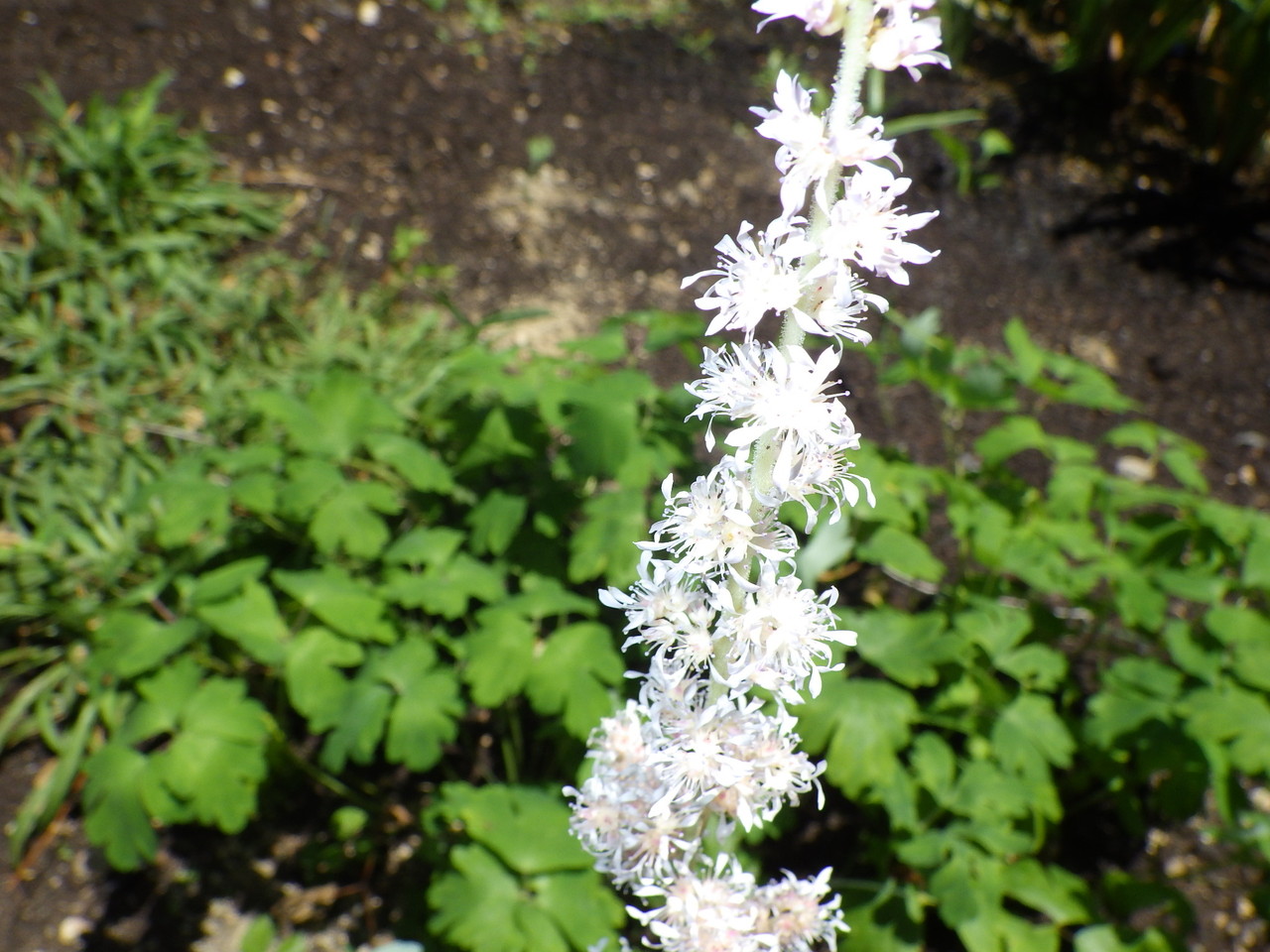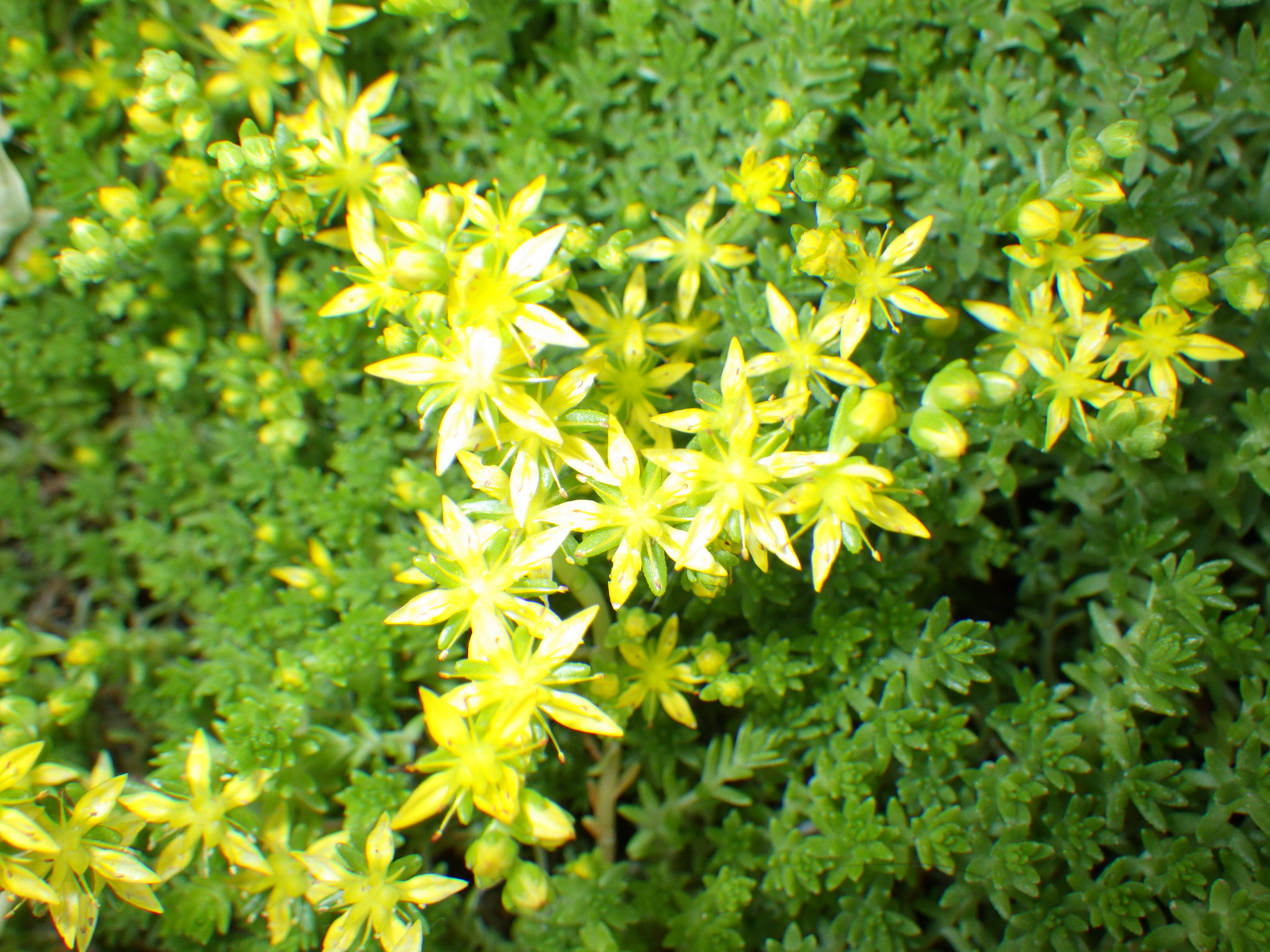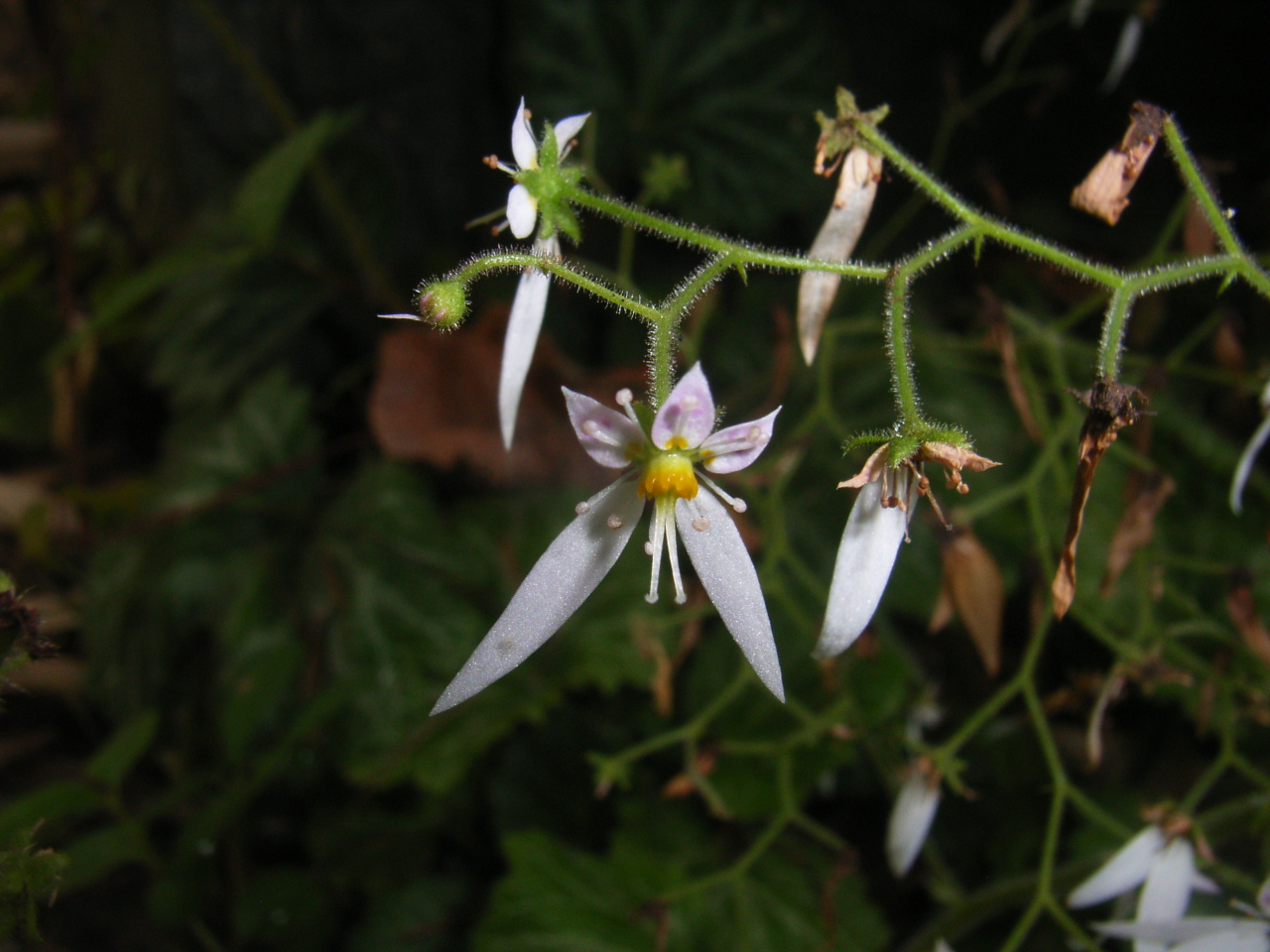
The family Saxifragaceae consists of herbaceous plants. Leaves are alternate or opposite, simple or compound. Most are deciduous, but some are evergreen. Stipules are present or absent. Inflorescences are cymose, sometimes racemes or panicles. Flowers are bisexual, dioecious, or dioecious, radially or bilaterally symmetrical, pentamerous, rarely tetramerous. Sepals number 4-5, and petals are the same number or absent. Stamens are the same number as sepals, or twice as numerous. Staminodes are absent. Carpels and styles are usually 2, rarely 3. The base of the ovary is a unilocular paramembrane placenta or a 2locular axial placenta. Fruit is a capsule. Seeds are small, numerous, and contain endosperm. Species within the genus Saxifragaceae are often similar, but intergeneric species are often dissimilar. This family underwent a major reorganization in the APG system. Of the herbaceous plants formerly belonging to the Saxifragaceae family, the genus Penthorum became the independent family Penthoraceae, and the genus Parnassia became the family Celastraceae. Globally, it is abundant in the Northern Hemisphere, particularly in North America, East Asia, and the Himalayas, and is also distributed in South America. The APG system recognizes 33 genera and 640 species, with approximately 60 species in 10 genera found in Japan. The pollinating insects of this family are mainly flies, especially members of the Empididae and Syrphidae families, but honeybees, solitary bees, bumblebees, butterflies, ants, and beetles are also said to visit (Konarska, 2014). Tanaka (1983) has researched pollinating insects in Japan, but I have not yet seen it.
This article provides a comprehensive, field guide-style introduction to plants belonging to the Saxifragaceae family.
The basic information is based on the Kanagawa Prefecture Flora Survey Association (2018). Photos are replaced as better ones become available. While the identification is done by the author, please note that misidentifications may be corrected without notice.
- No. 1371 Saxifraga stolonifera
- No. 1372 Haruyukinoshita (Saxifraga nipponica)
- No. 1373.1 Saxifraga fortunei var. jotanii
- No. 1373.2 Saxifraga fortunei var. obtusocuneata f. minima
- No. 1374 Saxifraga cortusifolia
- No. 1374.1 Purple Saxifraga cortusifolia f. atropurpurea
- No. 1375 Saxifraga sendaica
- No. 1390 Chrysosplenium japonicum
- No.1392.a Heuchera sanguinea
- No.1392.b Heuchera micrantha 'Palace Purple'‘
- References
No. 1371 Saxifraga stolonifera
This perennial herb propagates by sending out long, thread-like red stolons in all directions, each bearing new shoots at its tip. The leaves and stems are covered in coarse reddish-brown hairs. It flowers from May to June. The flower stalks grow upright in conical cymes, reaching a height of 20-50 cm. The flowers consist of five white petals. Of the five petals, the three upper ones are ovate, about 3 mm long, tinged with pale pink, and have dark red markings and dark yellow spots at the base. The two lower petals are unspotted and 1-2 cm long. They have a dark yellow floral disc. It is distributed in Honshu, Shikoku, Kyushu, and China. It grows in clusters in shady areas near human settlements, on stone walls and rocks near water. It is a useful plant and has been cultivated since ancient times. The asymmetrical flowers are characterized by pink anthers and a diverse distribution of dark yellow and dark red flavonoid pigments on the petals, forming symmetrical spots on the petals known as nectar guides that lead pollinating insects to the nectar (Konarska, 2014). The stamens are initially arranged almost parallel to the petals (Tanaka and Hirano, 2000). However, upon maturation and entering the male phase, they stand upright, move forward, and release pollen. They move in a fixed order, releasing pollen one after another, and once they have finished releasing pollen, they enter the female phase, and the pistil begins to elongate. Tanaka and Hirano (2000) include a photograph of a hoverfly (Syrphidae japonica) visiting the flowers, and it is believed that syrphidae and bees also visit them.
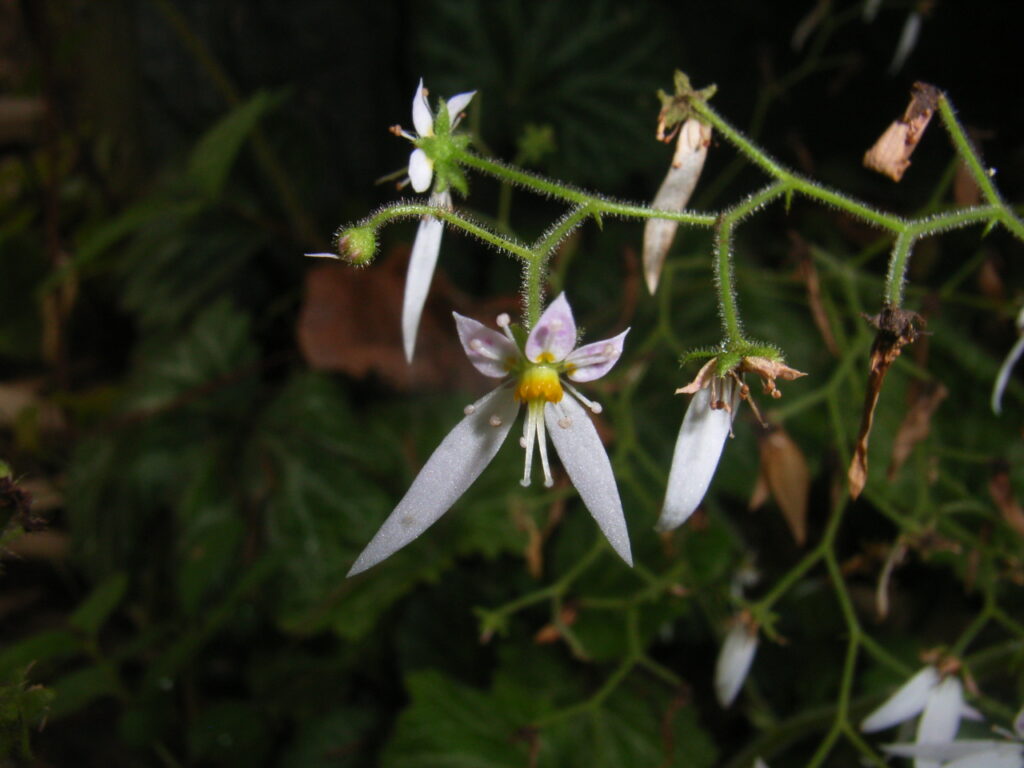
No. 1372 Haruyukinoshita (Saxifraga nipponica)
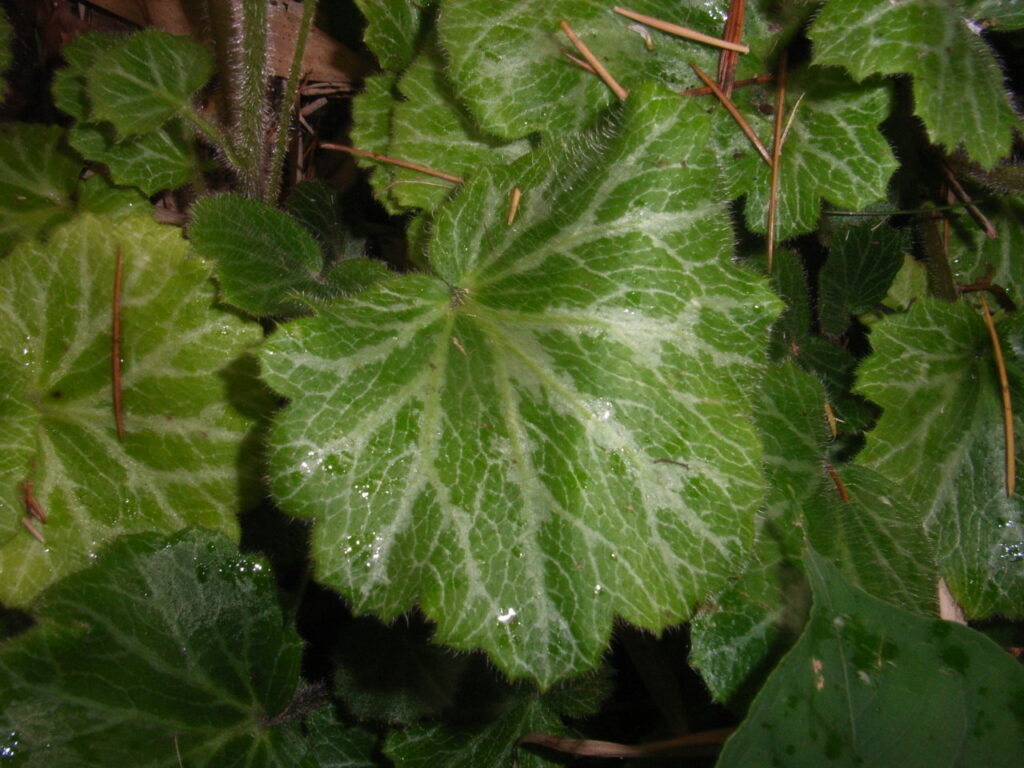
This is a perennial herb. The leaves are circular with a heart-shaped base and shallowly lobed margins (13-17 lobes). The petioles and both sides of the leaves are covered with white glandular hairs. The flower stalks are 20-30 cm tall, and the flowering period is from April to May. The petals are white, with the three upper petals being ovate with yellow spots at the base, while the two lower petals are unspotted, 1-2.5 cm long, and acute at the tip. There is a dark yellow floral disc. It is distributed in Honshu (Kanto, Chubu, and Kinki regions). It grows on slightly damp rocks along streams in lowlands to lower mountainous areas, sometimes forming colonies. Fudōjiri on Mt. Ōyama marks the easternmost point of its distribution in Japan. This species is distributed in the Hokuriku region, isolated from the Tanzawa Mountains, and lacks distribution inland, exhibiting a discontinuous distribution. Those found in the Tanzawa Mountains are smaller than those on the Sea of Japan side.
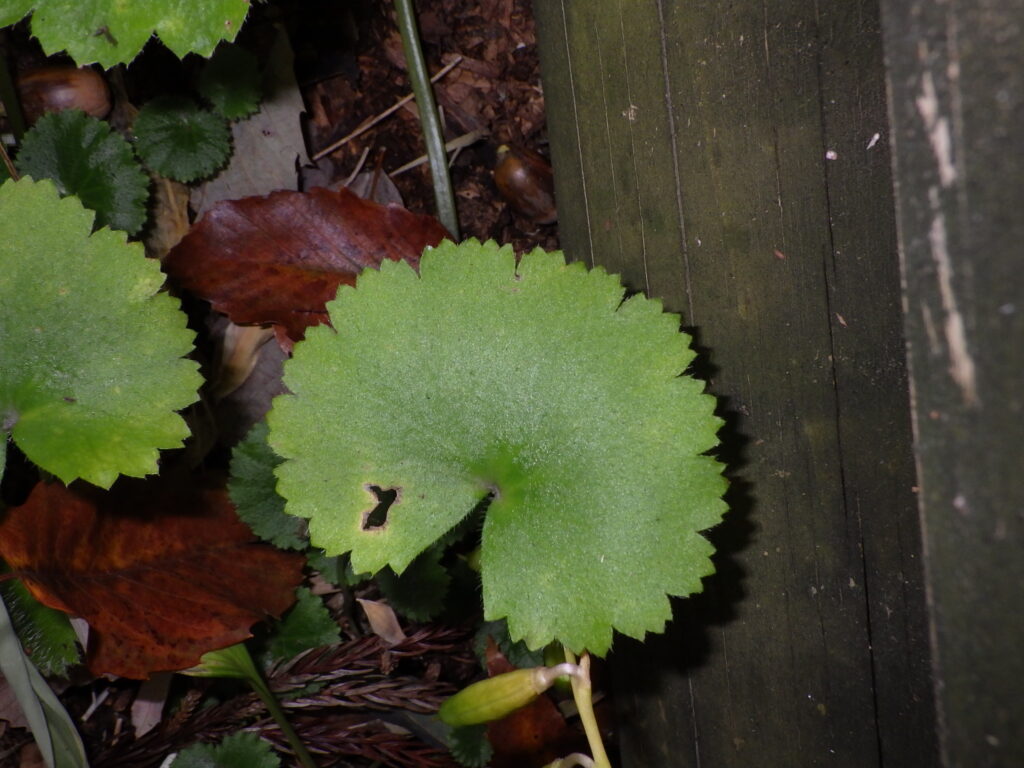
No. 1373.1 Saxifraga fortunei var. jotanii
This is a perennial herb. The leaves are shallowly lobed, thick in texture, and have many hairs on the leaf blade and petiole. It flowers from October to January. The flower stalks and stems have long glandular hairs. It is distributed only in Chiba Prefecture and the Izu Islands. In Kanagawa Prefecture, there is a specimen that was collected in Zushi a long time ago, but it has not been confirmed in subsequent surveys, and it is classified as extinct in the "Kanagawa Red Data Book 06".
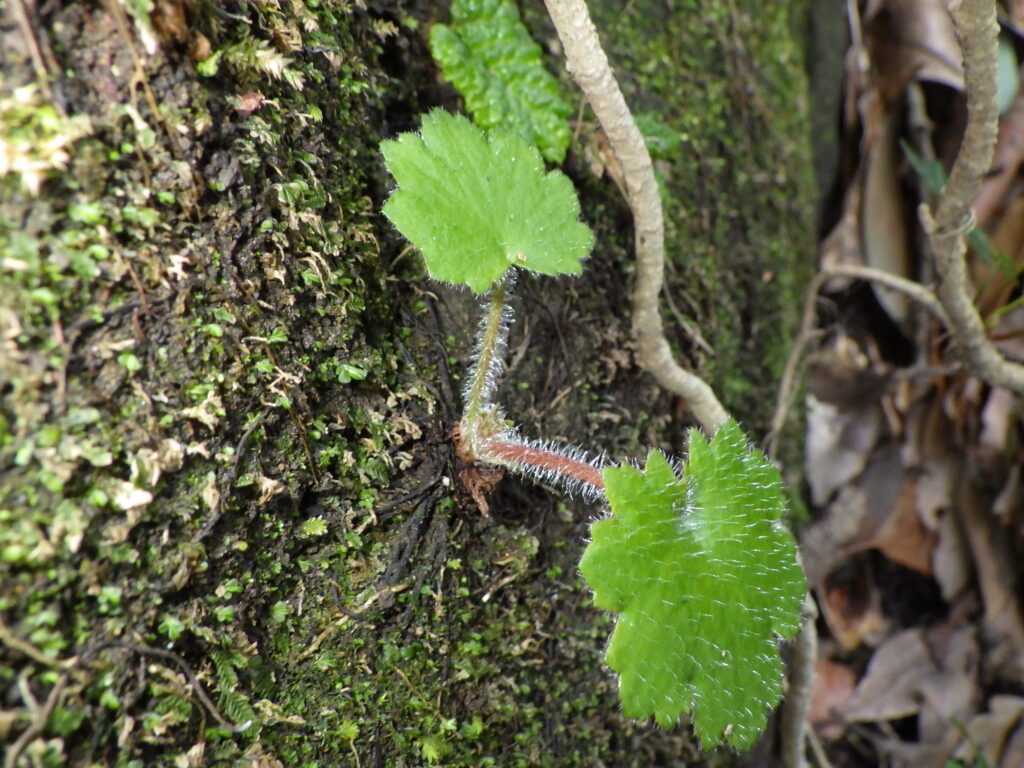
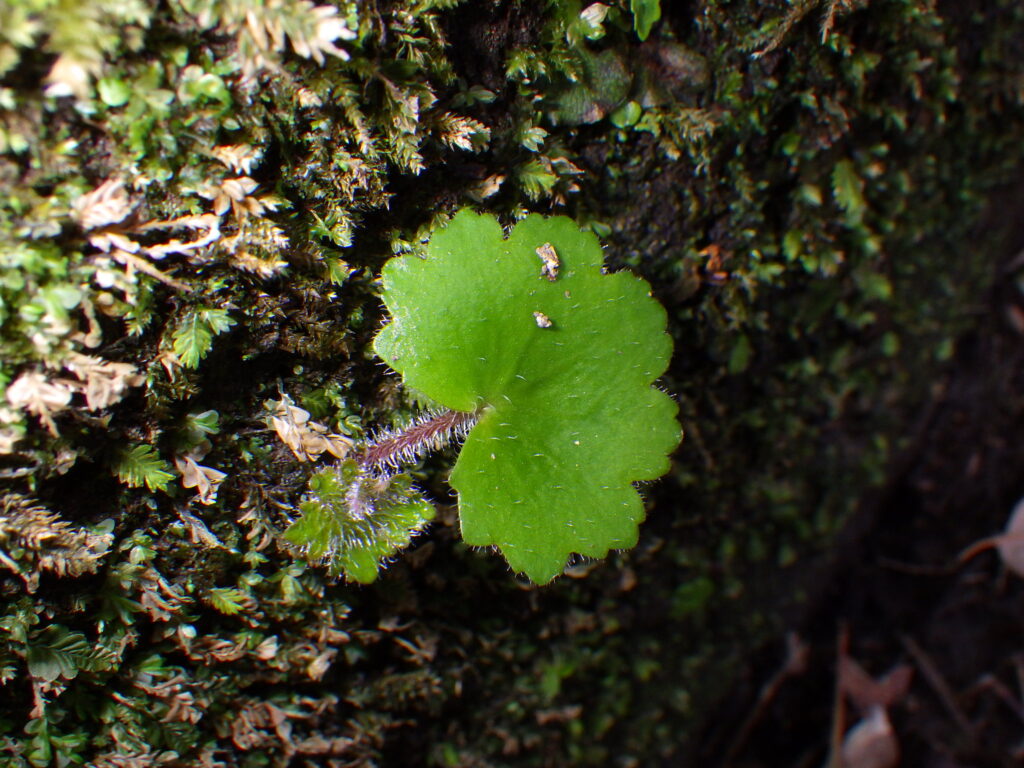
No. 1373.2 Saxifraga fortunei var. obtusocuneata f. minima
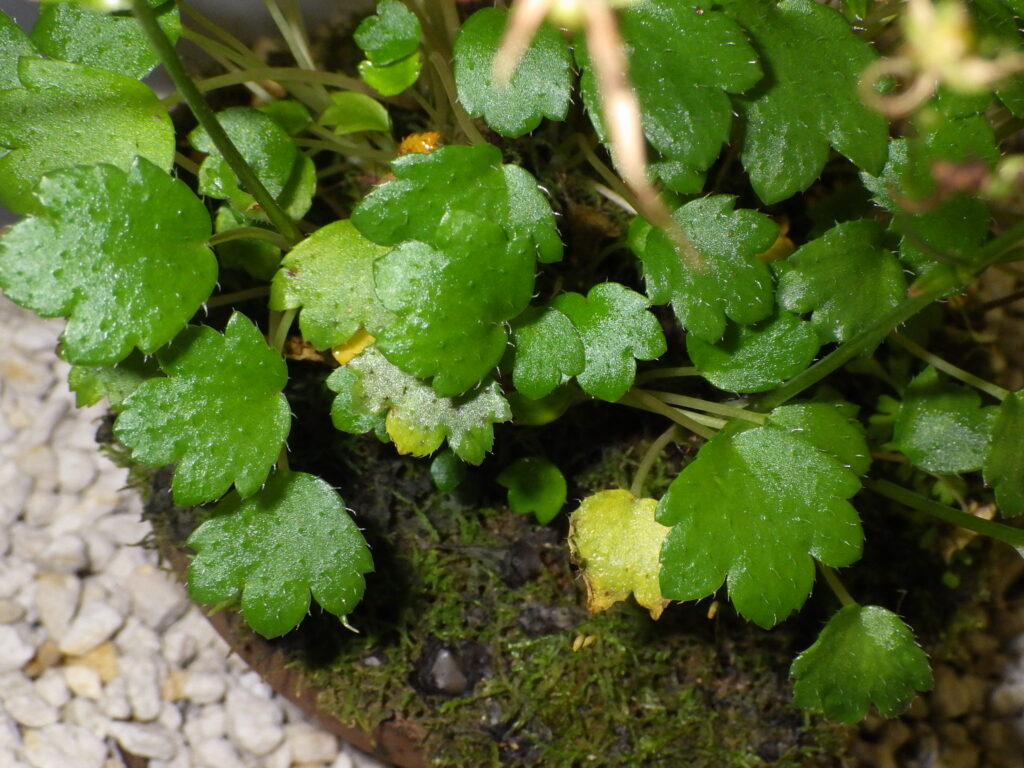
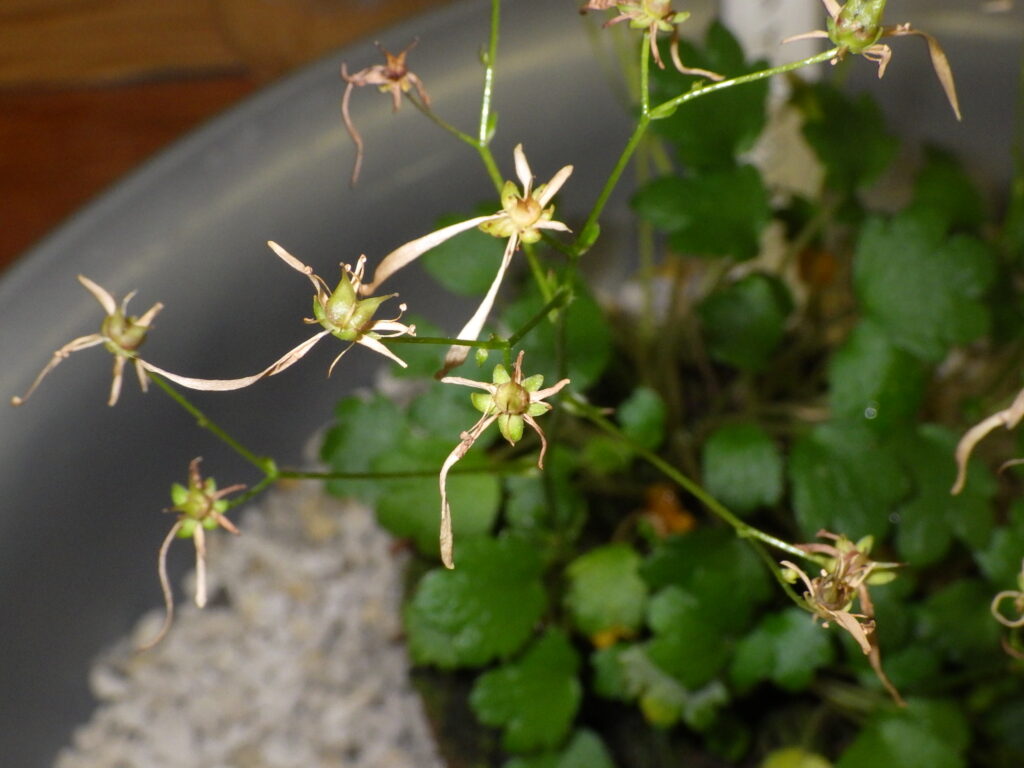
This is a dwarf variety of Saxifraga fortunei var. obtusocuneata. Its leaves are very small, measuring 4-15 mm in length and 5-16 mm in width. It flowers from August to October. It is an endemic species of Japan, distributed in Kyushu (Yakushima), and grows on damp rocks in high-altitude areas.
No. 1374 Saxifraga cortusifolia
This is a perennial herb. The leaves are 7 to 10 lobes and somewhat palmate. Needle-shaped oxalate crystals are present in the leaf tissue. It flowers from September to November. The petals resemble those of Saxifraga stolonifera, with yellow spots on the three upper petals and long, unspotted petals on the two lower petals. The anthers are orange-yellow. It has a yellow floral disc. It is distributed in Honshu (west of Kanto), Shikoku, and Kyushu. It grows on rocky cliffs in mountainous areas.
No. 1374.1 Purple Saxifraga cortusifolia f. atropurpurea
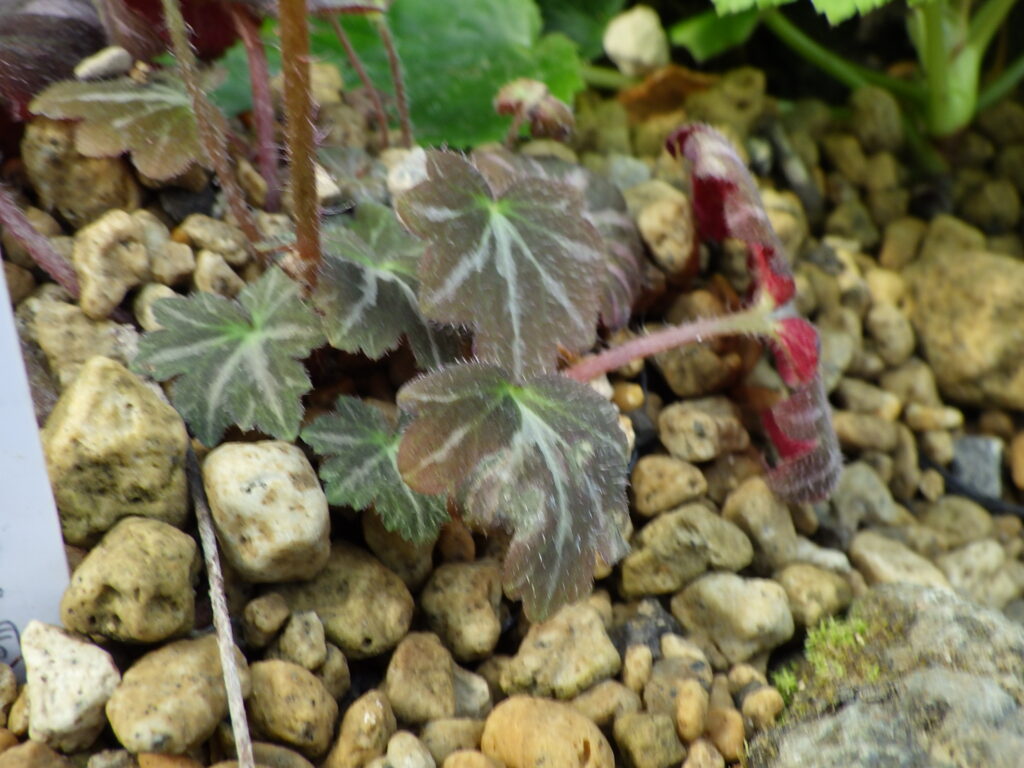
A variety of Saxifraga fortunei with dark purple leaves.
No. 1375 Saxifraga sendaica
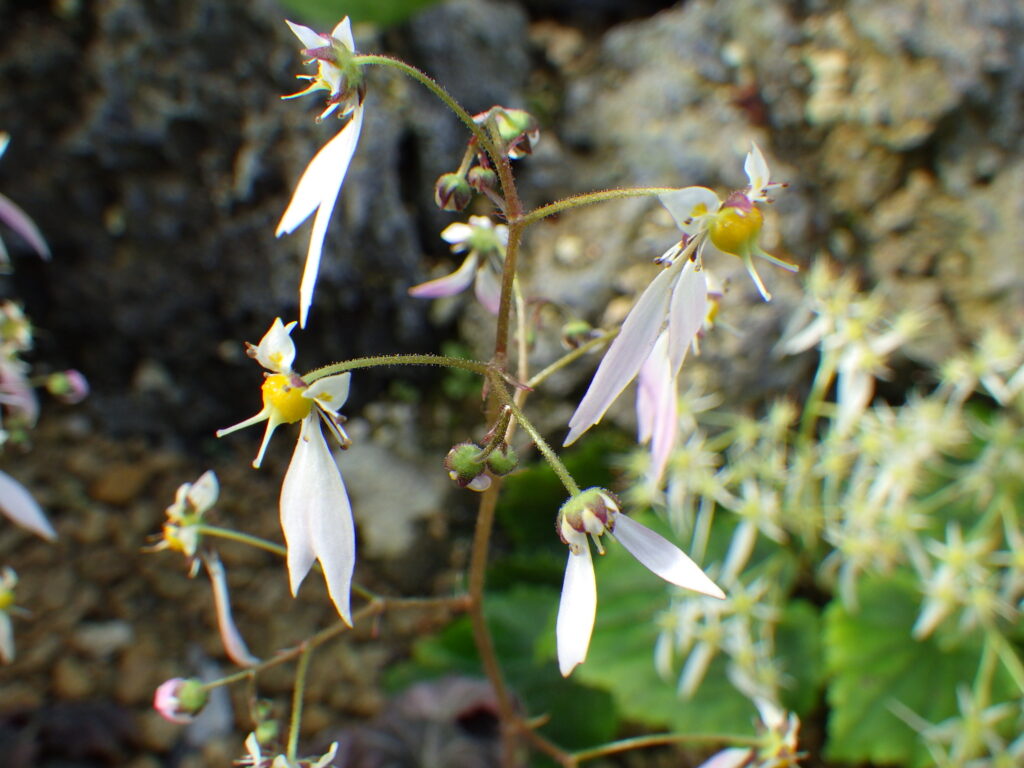
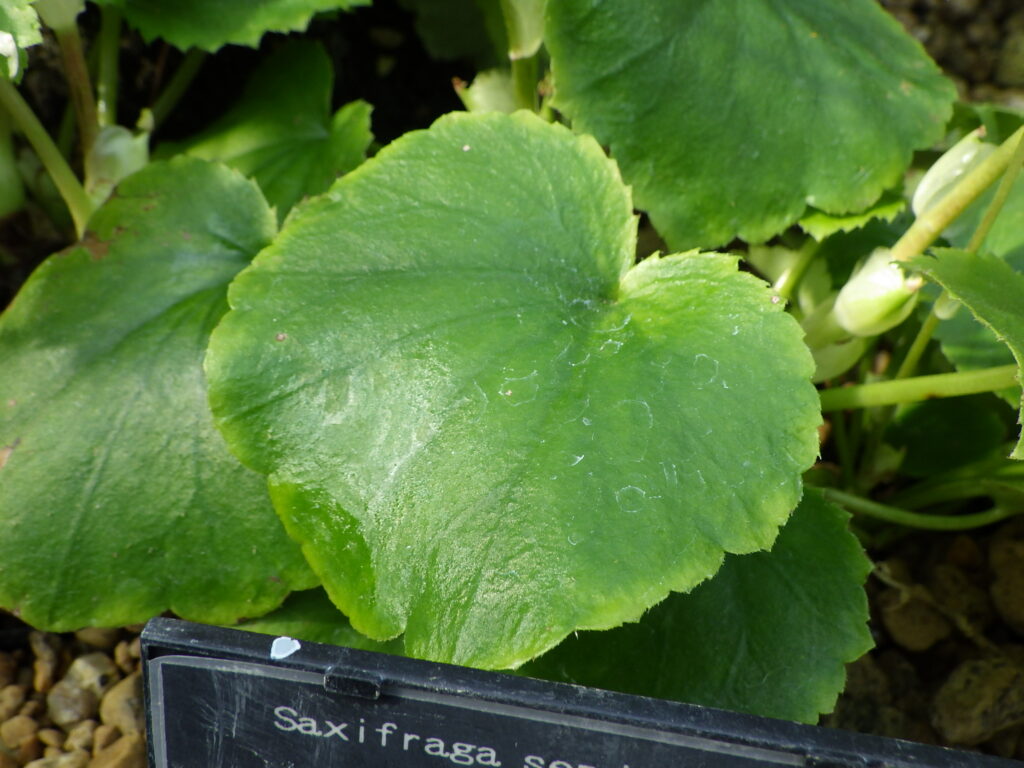
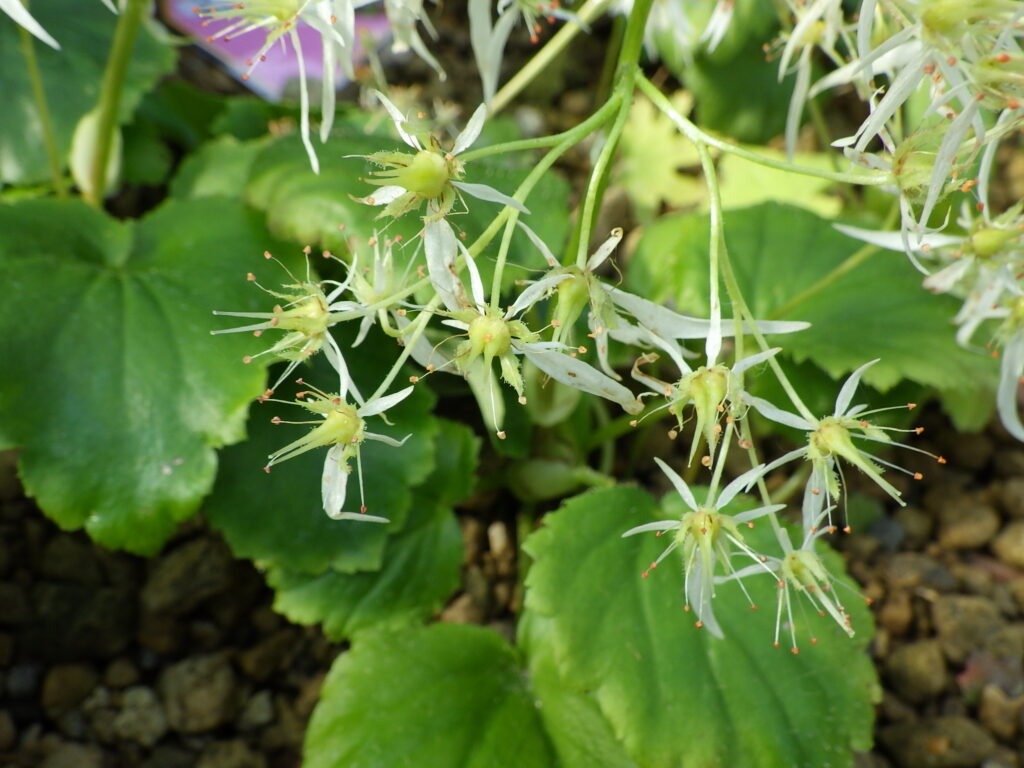
This perennial herb (Fukuoka Prefecture Red Data Book 2014) has stems 5-15 cm tall with several leaves at the top. The leaves are thick and glossy, with ovate to ovate-circular blades reaching 12 cm in length and shallowly lobed edges. The petioles are long and have stipules at the base. It flowers in October in corymbose inflorescences 7-10 cm in diameter, with five white petals, the lower one or two of which are longer than the others. It is distributed in Honshu (Nara, Wakayama), Shikoku (Tokushima), and Kyushu (Nagasaki, Kumamoto, Miyazaki), growing on rocky cliffs in deep mountains. It is listed as Endangered II in the Ministry of the Environment's Red Data Book.
No. 1390 Chrysosplenium japonicum
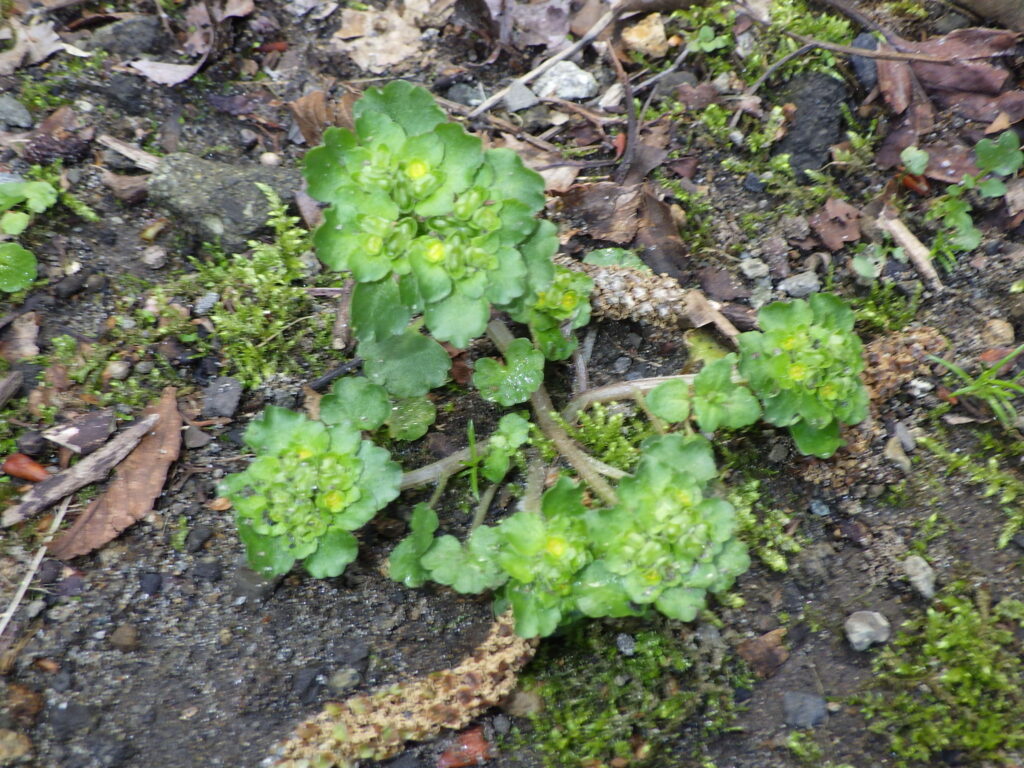
This is a perennial herb. It does not produce stolons. After flowering, bulbils form at the base of the stem. The basal leaves are round with 7 to 11 flattened serrations along the margin. The flowering stems are 10 to 20 cm tall and pale yellowish-green. The stem leaves are alternate and round with long petioles. It flowers from March to April. The calyx lobes are green, spreading, semi-circular, and erect after flowering. There are 4 to 8 stamens. The anthers are yellow. The seeds are ovate, 0.6 to 0.7 mm long, with one ridge. The surface appears smooth to the naked eye, but under magnification with a microscope, minute papillary projections can be seen. It is distributed in Hokkaido (southwest), Honshu, Shikoku, Kyushu; Korea; and China (northeast), growing in clusters in moist woodlands, forest edges, and rice paddy ridges in lowlands to lower mountainous areas.
No.1392.a Heuchera sanguinea
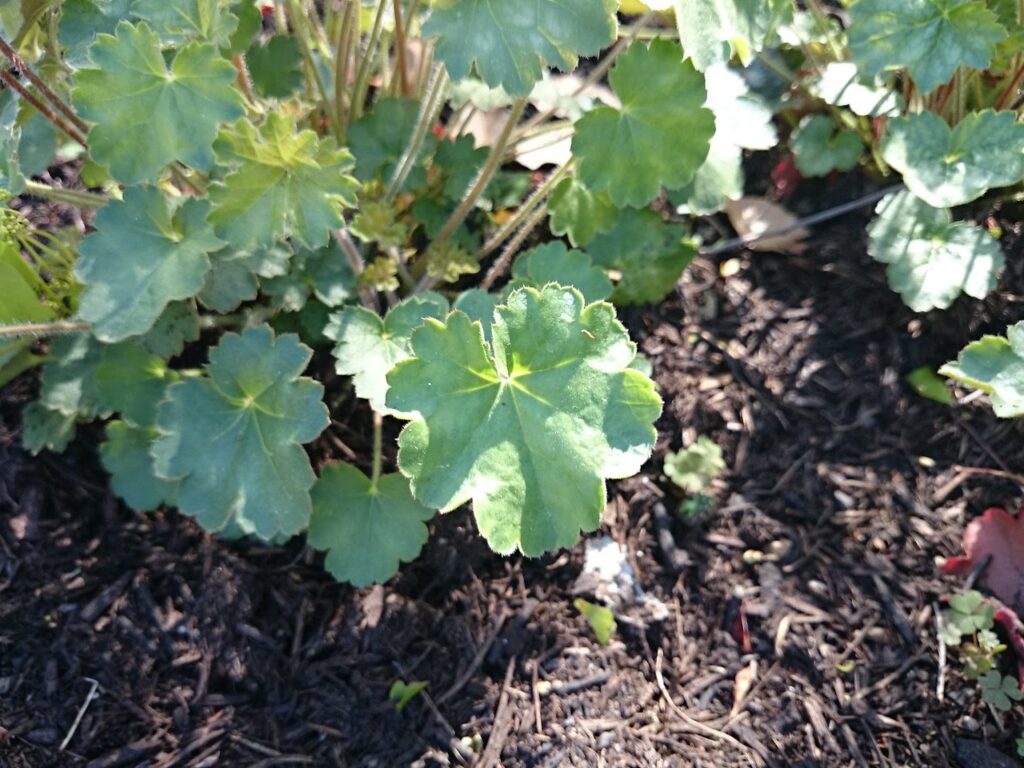
Perennial herb (Flora of North Ameica). Stemless, with branched stumps. Flower stalks are 20–40 cm long, sometimes with long-stalked glands. Petioles have long-stalked glands. Leaf blades are kidney-shaped to orbicular, shallowly 5–7-lobed, 2–5.5 cm long, with a cordate base, rounded lobes, toothed margins, and an acute to obtuse apex. The underside has long-stalked glands on the veins, while the upper surface is glabrous or sparsely covered with long-stalked glands. Flowering occurs from March to October. Inflorescences are moderately dense to diffuse. The hypanth is weakly bilateral to radially symmetrical, 2.5–2.8 mm separated, dark pink to red, broadly bell-shaped or urn-shaped, 4–8 mm long, with short-stalked glands at the base and sparsely covered with long-stalked glands at the top. Sepals are spreading, dark red at the apex, equal in length, 2–3 mm long, with oblong or rounded apex. The petals are spreading, pink or cream-colored, narrowly oblanceolate, undivided, 1.2–1.8 mm long (shorter than the sepals), and entire. The stamens are not protruding, 1.5–3 mm long. The style is not protruding, 1.5–3 mm, 1.5–2 mm long, and 0.1 mm in diameter. The capsule is ovate, 4.5–6 mm long, with a spreading beak and no papillae. The seeds are dark brown, elliptical, 0.5–0.6 mm long, and have blunt spines. It is distributed in southwestern North America and northern Chihuahua, Mexico, growing on rocks in moist, shady places. It is cultivated as an ornamental plant in various countries, including Japan.
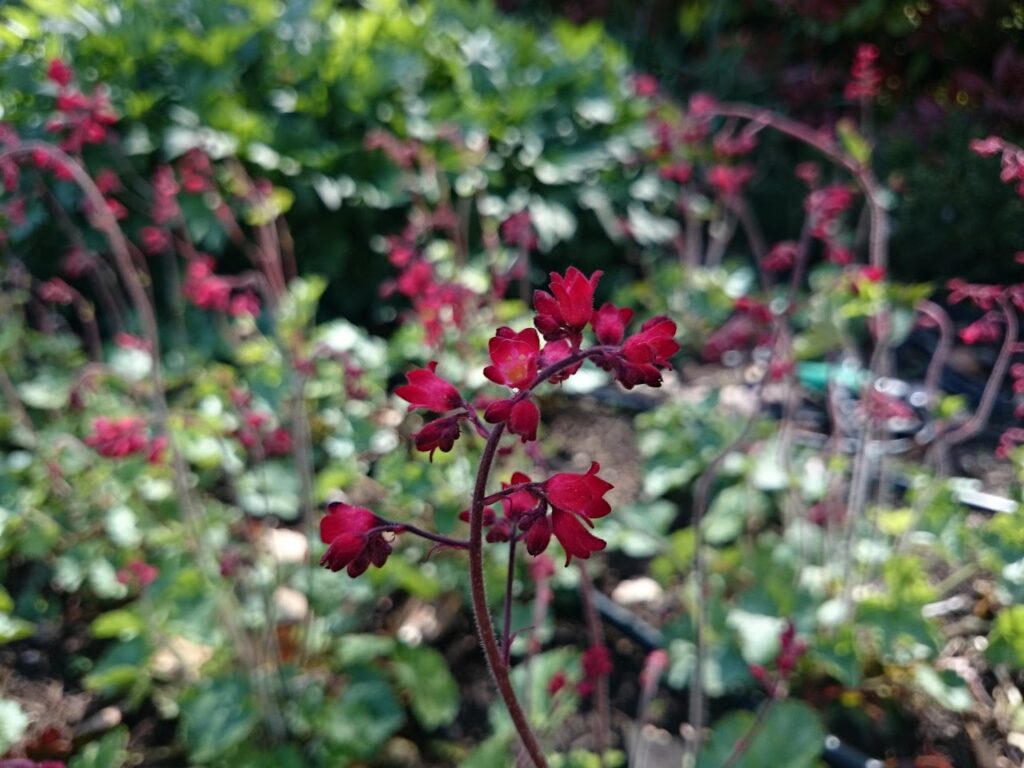
No.1392.b Heuchera micrantha 'Palace Purple'‘
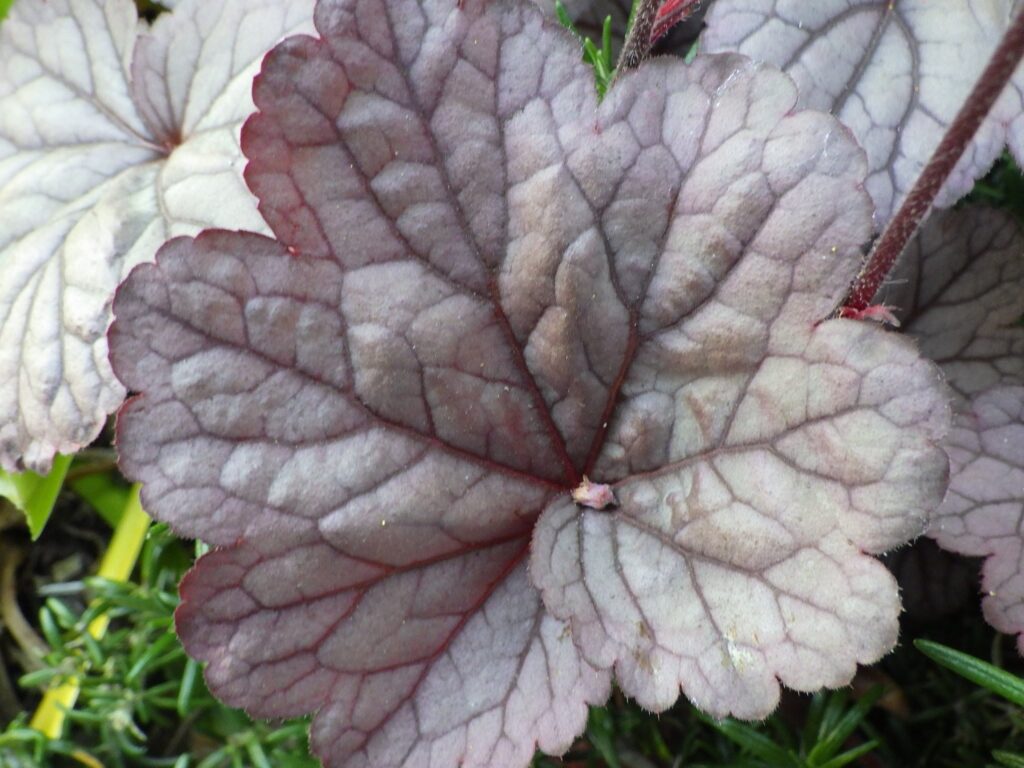
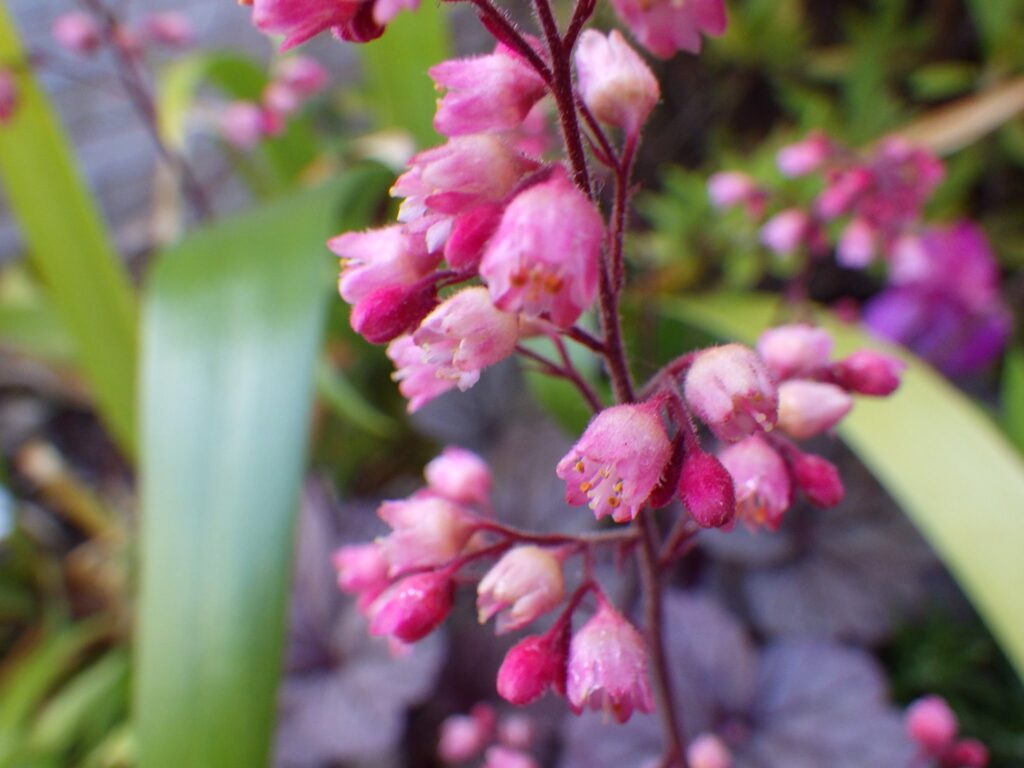
As its scientific name suggests, it is Heuchera micrantha. It is a perennial herb (Flora of North America). It is stemless, with branched stumps. The flower stalks are 6–570 cm long, with short to long stalked glands or glabrous and sticky. The petioles are glabrous or sparsely to densely with short to long stalked glands. The leaf blades are orbicular to polygonal, 5–7 (–9) shallow to deeply lobed, 2.5–10 cm long, with a cordate base, rounded lobes, toothed margins, an orbicular to obtuse apex, glabrous or with short to long stalked glands and sticky. The inflorescence is diffusive. The hypanth is radially symmetrical, with separate parts less than 1.5 mm, greenish-white, often tinged with red, obconical to hemispherical to broadly conical to campanulate, 1–4.9 mm long, with long stalked glands, sometimes with short stalked glands at the base. The sepals are spreading to nearly erect, with green or red tips, equal in length, 0.5–1.8 mm, and rounded to acute to mucronate at the apex. The petals are often coiled, white or pale pink, oblanceolate (with narrow claws), undivided, 1.6–3.3 mm long (2–3 times the length of the sepals), and entire. The stamens are protruding, less than 3 mm long. The style is protruding, less than 2 mm long, 0.2–4.2 mm in length, and less than 0.1 mm in diameter. The capsule is ovate, 3–8.5 mm long, with a spreading beak and no papillae. The seeds are black, broadly elliptical (uncurved), and 0.5–0.8 mm long. There are 5 varieties. In Japan, it is often confused with Heuchera bells, but while Heuchera bells has red calyxes and stamens and pistils shorter than the petals, this species has milky white calyxes and stamens and pistils that protrude beyond the petals. It can be distinguished from Heuchera villosa by its rounded leaf lobes. 'Palace Purple' is a horticultural variety with purple leaves. It is distributed in North America, and many varieties grow in mixed evergreen forests with limestone or serpentine soil. It is cultivated as an ornamental plant in various countries, including Japan.
References
Kanagawa Prefecture Flora Survey Association. 2018. Kanagawa Prefecture Flora 2018 (Electronic Edition). Kanagawa Prefecture Flora Survey Association, Odawara. 1803pp. ISBN: 9784991053726
Konarska, A. 2014. Micromorphology and anatomy of flowers and nectaries of Saxifraga stolonifera L. Acta Agrobotanica 67(4): 3-12. ISSN: 0065-0951, https://doi.org/10.5586/aa.2014.054
Tanaka, Hajime & Hirano, Takahisa. 2000. The Face of Flowers: Wisdom for Bearing Fruit. Yama-kei Publishers, Tokyo. 191pp. ISBN: 9784635063043
Tanaka, Tadatsugu. 1983. Insects that visit flowers of plants in the Saxifragaceae family. Journal of the Toyama Prefectural Biological Society 23: 13-29.