The family Welwitschiaceae includes only one extant species found in southwestern Africa. Fossil evidence indicates that plants of the Welwitschiaceae family existed in South America during the Early Cretaceous (Mesozoic) period, with one species known each from the Late Aptianist (Lower Cretaceous) strata in the Araripe Basin of northeastern Brazil and the Early Cretaceous (Cenomanian-Turonian) Akraboo Formation in Morocco. The extinct † Welwitschiophyllum brasiliense is known for its thick, triangular to linear leaves measuring 8.9–70 cm in length and 2.8–5 cm in width, while † Welwitschiostrobus murili resembles the extant Welwitschia but is known for having several long, thin cones. It has been suggested that the early habitat was not the current desert but a mesic habitat (a habitat with a moderate or balanced supply of water), and that the current fragmented and isolated population distribution is due to the fact that the aridification of the Paleogene, Neogene, and Quaternary periods limited the plants to areas where they could provide sufficient water (Jacobson & Lester, 2003).
This article provides a comprehensive, illustrated guide to plants belonging to the Welwitschiaceae family.
The photos are replaced as soon as better ones are taken. Also, while the identification is done by the author, please note that if there are any misidentifications, they may be changed without notice.
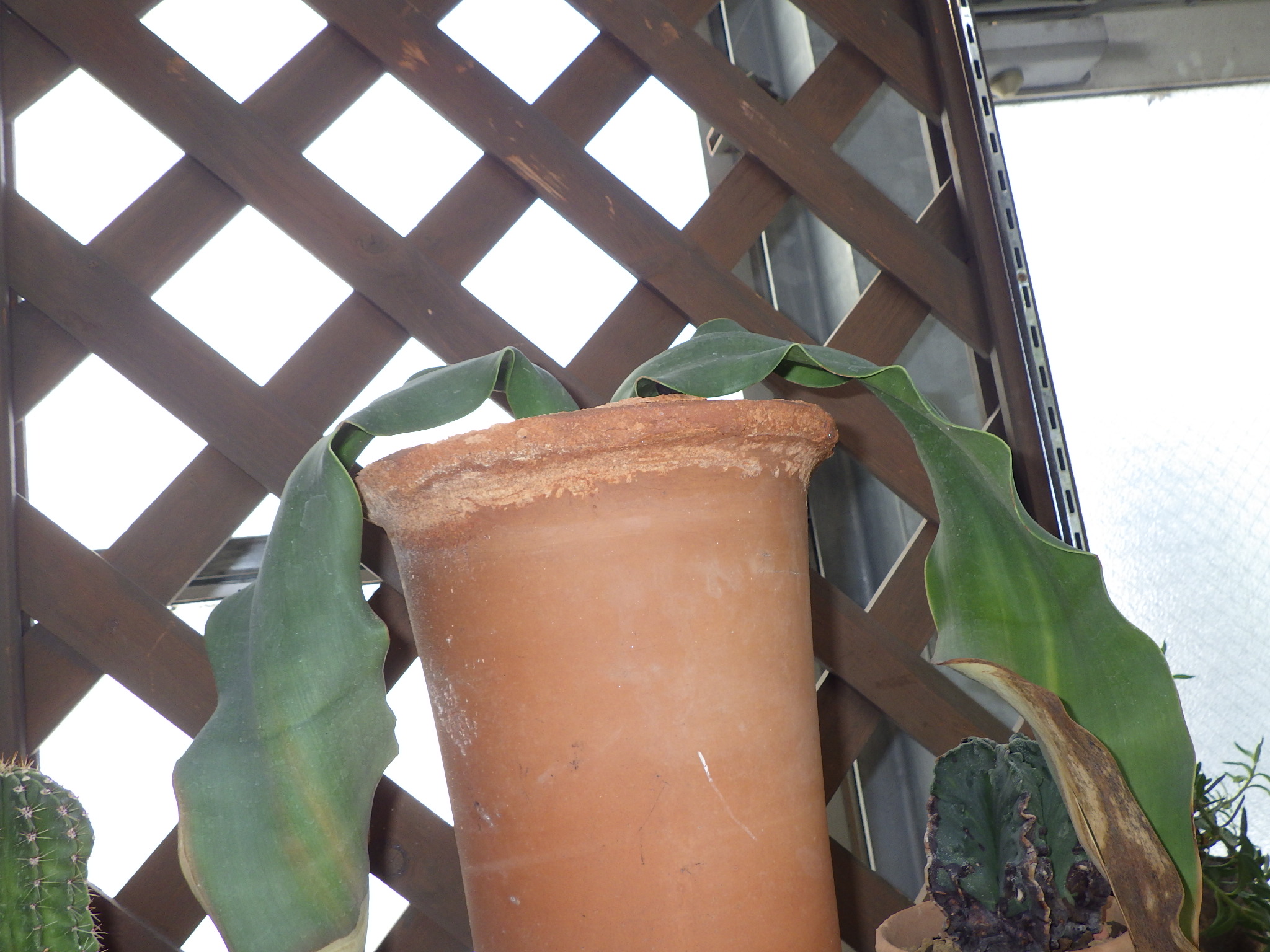
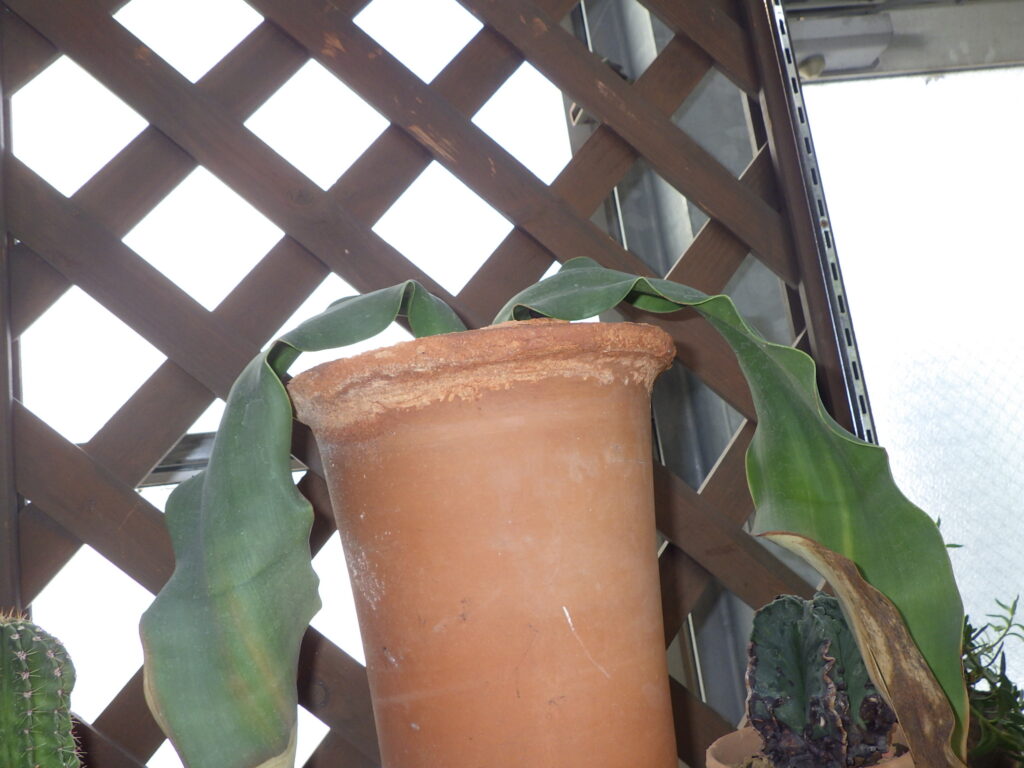
No.0003.b Welwitschia mirabilis
Also known as desert omoto, it is a perennial herb. The stem is woody and unbranched, and even the largest individuals do not exceed 1.5m in height, but the diameter of the plant can reach 8m. The stem itself is tubular and its diameter is about 1m. The tip of the stem is disc-shaped and deeply divided into two lobes, each bearing a single band-like leaf. These two leaves grow from the meristem in the groove at the end of the stem. When the leaves reach 2-4m in length, they begin to fray and split due to external factors such as twisting of the woody tissue and wind, making it appear as if there are many leaves. The leaf tips gradually wither. Because it has only one pair of functional leaves, it was once thought that the morphology of this species might be due to larval evolution, but its anatomical characteristics are completely different from those of seedlings, and it is now known that it is actually due to the loss of the growth point in the early stages of growth. There is a depression in the middle of the stem from which fine branches emerge, bearing inflorescences (sporangia cones). This plant is dioecious, with female inflorescences larger than male inflorescences, both being grayish-green or deep red in color. Female flowers are cone-shaped (like pine cones in other gymnosperms), about 2-8 cm long. Male flowers are 1.5-4 cm long and have one vestigial ovule and six microsporangiostalks. Seeds are 5-6 mm in diameter, black, with a thin, 2 cm diameter membrane and wings. Fertilization is carried out by insects such as flies and true stink bugs. The true stink bug most commonly found on this plant is Probergrothius angolensis of the family Pentatomidae, but the hypothesis that it is involved in pollination has not yet been proven (Wetschnig, 1999). Occasionally, wasps and bees also play a role as pollinators. At least some pollinators are attracted to the "nectar" produced in both male and female flowers. While it is difficult to determine the age of individual plants, radiocarbon dating suggests that many may be over 1,000 years old. The largest known specimen has a diameter of 2.77m and a circumference of 8.7m. It is endemic to the Kaocoberd Desert in the Namib Desert of Africa. It is distributed from the Bentiaba River in southern Angola southward to the Kuiseb River in Namibia, and up to 100km inland from the coast. This region is extremely dry, with records indicating almost no rainfall along the coast, and less than 100mm of rain per year during the rainy season from February to April. Therefore, it is thought to depend on groundwater in addition to precipitation from fog.
References
Jacobson, KM, & Lester, E. 2003. A first assessment of genetic variation in Welwitschia mirabilis Hook. Journal of Heredity 94(3): 212-217. https://doi.org/10.1093/jhered/esg051
Wetschnig, W., & Depisch, B. 1999. Pollination biology of Welwitschia mirabilis Hook. f. (Welwitschiaceae, Gnetopsida). Phyton 39(1): 167-183. https://www.zobodat.at/pdf/PHY_39_1_0167-0183.pdf