The Ephedraceae family generally consists of shrubs, sometimes vines, and rarely small trees. It includes only the genus Ephedra. It is distributed in southwestern North America, southern Europe, northern Africa, southwestern and central Asia, northern China, and western South America, and is widely found in arid regions. In temperate regions, it often grows in sunny locations on coastlines and sandy areas. Its Chinese name is Ma Huang. Ephedra is the origin of the name of the stimulant ephedrine, and this plant contains ephedrine at considerable concentrations. It spreads frequently through the use of its rhizomes. The stems are green and perform photosynthesis. The leaves are opposite or spiral. The scale-like leaves fuse at the base to form a sheath and often fall off soon after unfolding. There are no resinous tubes. Most are dioecious, and the male sporophylls have 1 to 10 spiral-shaped pollen grains, each consisting of a series of cruciate bracts. The pollen grains have grooves. The female sporophylls are formed by the fusion of bracts around a single ovary, creating a spiral. The fleshy bracts are white (e.g., Ephedra frustillata) or red. Typically, there are one or two yellow to dark brown seeds in each ovary. The oldest known species of Ephedra lived in the Early Cretaceous period, 125 million years ago, with records dating back to the Aptian and Albian stages of Argentina, China, Portugal, and the United States. Fossil records other than pollen have disappeared since the Early Cretaceous. Molecular clock estimations suggest that they did not exist in the Early Cretaceous. Molecular clock estimations also suggest that the last common ancestor of extant species lived more recently, around 30 million years ago, in the Early Oligocene epoch of the Paleogene period. However, based on the evolutionary state of pollen, some believe this common ancestor existed in the Late Cretaceous period.
This article provides a comprehensive, illustrated guide to plants belonging to the Ephedra family.
The photos are replaced as soon as better ones are taken. Also, while the identification is done by the author, please note that if there are any misidentifications, they may be changed without notice.
No.0003 Ephedra sinica
This is a herbaceous evergreen shrub. It is dioecious (having separate male and female plants). It is a herbaceous evergreen shrub, reaching a height of 30-70 cm. The rhizome is woody, thick, and curved. The stem is slender, branched, somewhat flattened, and multi-noded. The leaves are small, scale-like, and opposite at the nodes, fused at the base, forming a bract-like sheath. Flowers bloom around May, with small inflorescences at the tips of branches or treetops. Female flowers are solitary, becoming reddish and fleshy when mature, and the nuts are dark brown and oblong-ovate. Male flowers are borne in small spikes, and the pseudocarps are fleshy and ripen red in summer. The greenish above-ground stems are used medicinally. It is distributed in northeastern China and Mongolia, growing in dry areas such as fields and sandy soils. The leaves have been transformed into small, membranous, sheath-like scales to suppress water transpiration from the leaves, and the stems now perform photosynthesis in place of the leaves, adapting it to grow in arid regions. Because it grows in arid regions, the reduction of green spaces and desertification due to unplanned harvesting are becoming serious problems, and the Chinese government has begun to restrict the export of this species in order to prevent desertification in inland areas. Its herbal name is Ma Huang, and in traditional Chinese medicine prescriptions, it is used in formulas such as Kakkonto and Ma Huang Tang, which are known as cough suppressants and expectorants. The active ingredient is the alkaloid ephedrine, which was isolated by Nagai Nagayoshi in 1885 (Saito, 2012; Funayama, 2013). It is unclear whether the "Ma Huang" that Nagai Nagayoshi used for extraction was this species, Ephedra sinica, but since Nagai wrote that he "took Ma Huang imported from China and sold in Japanese herbal medicine shops" (Saito, 2012), we will treat it as this species for now. Ephedrine and its derivatives have a similar structure to the neurotransmitters adrenaline and noradrenaline, and easily pass through the blood-brain barrier, which normally prevents substances from entering the brain, thus entering the brain and acting on the central nervous system. In modern medicine, they are important drugs that are frequently used as asthma treatments, cough suppressants, and bronchodilators. On the other hand, they are also misused for recreational purposes and doping (Saito, 2012). Later, methamphetamine and amphetamine were chemically synthesized as derivatives of ephedrine, and although these were originally for medicinal purposes, it has been found that they act as stimulants because they increase dopamine concentration in the cytoplasm of presynaptic cells, causing the release of dopamine, noradrenaline, and serotonin from nerve endings and exciting the central nervous system (Saito, 2012). During World War II, Nazi Germany recognized the stimulant effect of methamphetamine on the nervous system and promoted its use nationwide, with Hitler himself reportedly using it (Ohler, 2015=2018). In the Japanese Empire, which was part of the Tripartite Pact with Germany and Italy, methamphetamine was sold as Hiropon and amphetamine as Zetrin in 1941. Hiropon, in particular, is famous; its name is of Greek origin, and it was used by the Japanese military as a drug, with claims that it would "quickly relieve fatigue" (Tachitsu et al., 1956). It is also famous for being used by kamikaze pilots. Even after the war, there were many addicts, and Musubi, who becomes addicted to Hiropon in the manga "Barefoot Gen," is a symbolic example. In 1948, it was designated as a highly toxic substance under the Pharmaceutical Affairs Law, and in 1950, a recommendation was made to stop production. In 1951, the Stimulant Control Law was enacted and enforced, restricting its use to medical and research purposes. However, it is highly addictive and continues to circulate today under names such as Shabu and Speed, becoming a social problem.
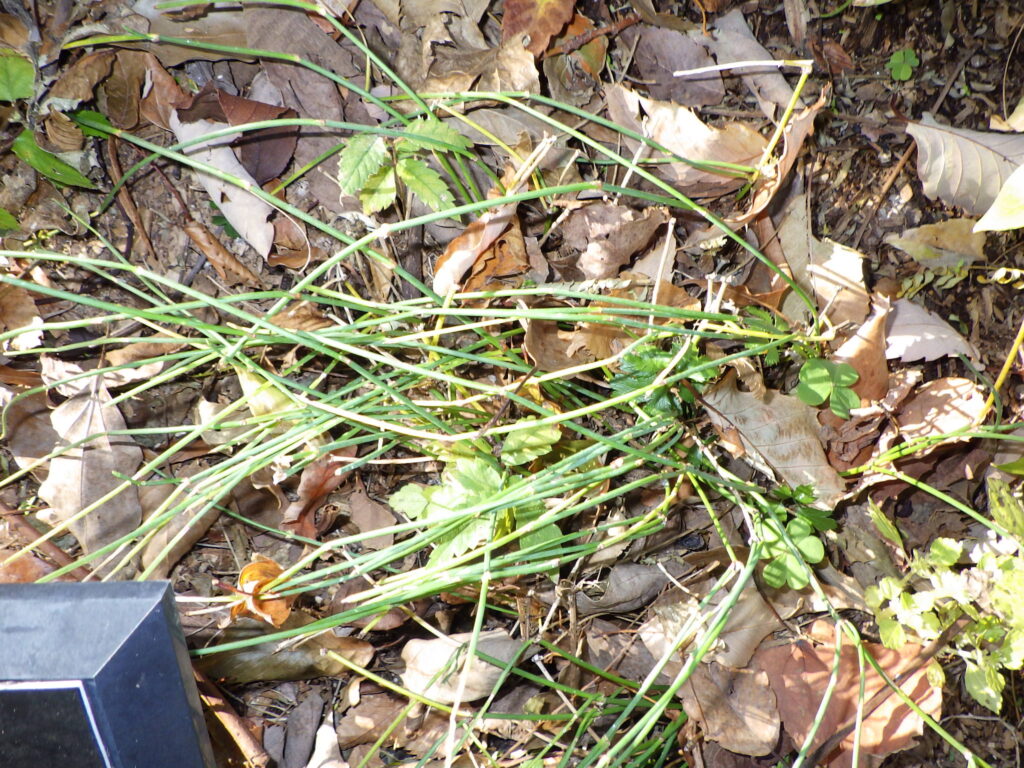
No.0003.a Ephedra distachya subsp. distachya
This is an evergreen shrub. In this species, the stem is forked. The shrub grows to a height of about 50 cm. The stem has nodes, and the leaves are reduced scale leaves that grow opposite each other from the nodes. It is dioecious (having separate male and female plants). The flowers are small and yellow. It flowers in spring. It is native to desert and semi-desert areas of central Eurasia (subsp. distachya in Central, Southern Europe, Southwest, and Central Asia; subsp. helvetica in Switzerland, France, Italy, Slovenia, and Austria). It is used to relieve acute muscle pain and rheumatic pain (known as Teamster's Tea), as a stimulant, and as a cardiac stimulant in Ayurveda. It is sometimes identified with "Soma," a legendary drug described in the Zoroastrian and Hindu scriptures, the Avesta and the Rigveda. It contains ephedrine, a type of alkaloid.
References
Funayama, Shinji. 2013. The Science of Poison: The Relationship Between Poison and Humans - A Cultural and Historical Approach to How Poisons Have Been Used and Understood. Natsume Publishing, Tokyo. 239pp. ISBN: 9784816354090
Ohler, N. 2015. Der totale Rausch: Drogen im Dritten Reich. KiWi-Taschenbuch, 368pp. ISBN: 9783462050356 [=2018. Hitler and Drugs: Drug Addiction in the Third Reich. Hakusuisha, 310pp. ISBN: 9784560096512]
Saito, Shigeru. 2012. The History of Ephedrine: Historical Heritage and its Impact on Modern Society. Journal of the Japanese Society for Medical History 58(3): 321-329. http://jsmh.umin.jp/journal/58-3/58-3_321-329.pdf
Tachitsu, Masayoshi, Akio Goto, and Go Fujiwara. 1956. Methamphetamine Addiction. Igaku-Shoin, Tokyo. 311pp. https://www.doi.org/10.11501/1375804