
The Alismataceae family consists of submerged or wetland herbs. All leaves are basal, and the veins are parallel as well as reticulate. Flowers are bisexual or unisexual. Inflorescences are racemes or panicles, with three flowers or branches arranged in whorls at each node. Sepals and petals are three in number and white, and the calyx is persistent. Stamens range from three to many. Pistils are numerous. Fruits are achenes. They are widely distributed throughout the world, comprising 15 genera and approximately 90 species. In Japan, 3 genera and 8 species are native, and 1 species has naturalized.
This article provides a comprehensive, illustrated guide to plants belonging to the Alismataceae family.
The basic information is based on the Kanagawa Prefecture Flora Survey Association (2018). Photos are replaced as better ones become available. While the identification is done by the author, please note that misidentifications may be corrected without notice.
No.0218 Kwai Sagittaria trifolia 'Caerulea'‘
Sagittaria trifolia has linear submerged leaves. Leaves that emerge above the water surface have long petioles and triangular-arrowhead-shaped leaf blades. They closely resemble the leaves of Sagittaria trifolia, but the tips of the lateral lobes are sharply pointed. Flowers bloom from August to October. In autumn, it produces stolons, which overwinter bearing tubers at their tips. It is widely distributed in Hokkaido, Honshu, Shikoku, Kyushu, and the Ryukyu Islands; and in temperate to tropical regions of Asia. It commonly grows on the edges of ponds and in rice paddies. A form with narrow leaves is called Sagittaria longiloba f. longiloba, but the variation is continuous. When the tubers at the end of the stolons reach a diameter of 3-5 cm, it is called Caelulea, and is rarely cultivated, sometimes being left unattended. Its origin is China, and the time of its introduction to Japan is unknown, but it is believed to have arrived during the Nara period. In Japan, it is especially regarded as an auspicious food associated with "sprouting" or "coming up," and is eaten in stews as part of Osechi ryori (New Year's dishes).
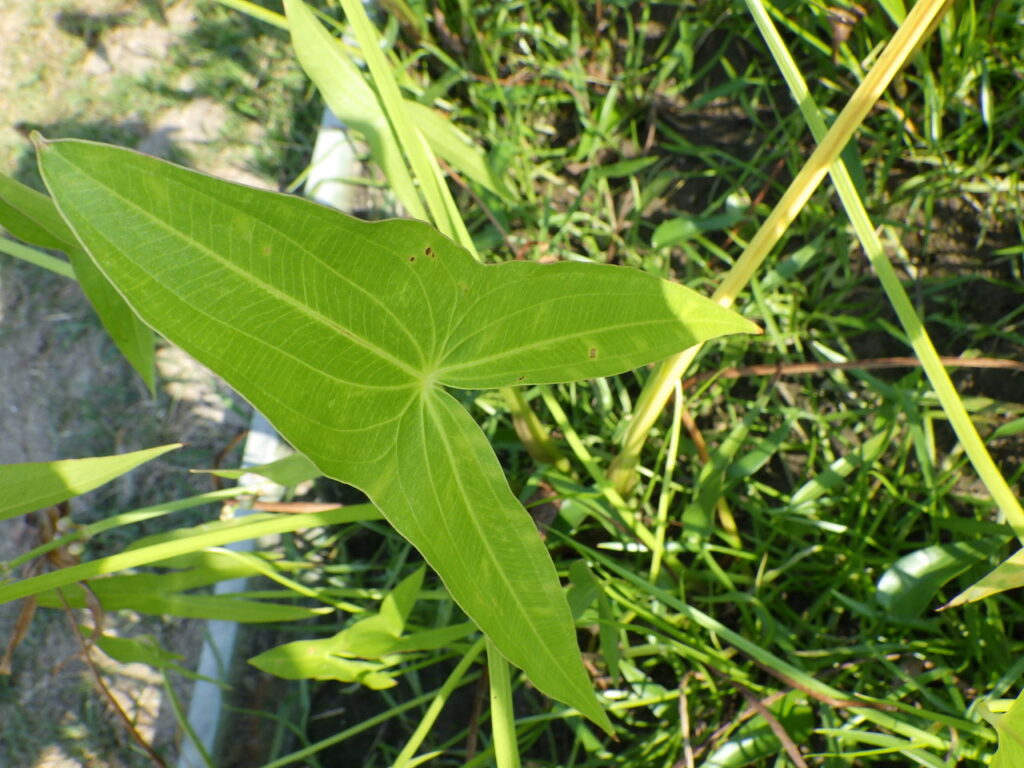
No.0223 Alisma plantago-aquatica var. orientale
This is a perennial herb, a wetland or emergent aquatic plant. The leaf blade is highly variable, narrowly lanceolate to elliptic, with 3 to 7 parallel veins, and the base gradually narrows into the petiole. It flowers from July to September. The panicle has 3 to several branches in each whorl. The individual parts of the flower are smaller than those of Sagittaria trifolia, with the calyx about 1.5 mm long, the petals about 3 mm long with wavy margins, the anthers yellowish-green and 0.5 mm long, the filaments 1 mm long, the ovary 0.8 mm long and 1.2 mm wide, and the stigma 0.5 mm long. The achene has a single deep groove on the back and is about 2.5 mm long. It does not produce overwintering tubers like Sagittaria trifolia. It is distributed in Hokkaido, Honshu, Shikoku, Kyushu, and the Ryukyu Islands; as well as Korea and China. It grows in shallow water such as rice paddies and wetlands. A variety with brownish-purple anthers and narrow leaves with only three veins is distinguished as *Alisma plantago-aquatica* var. *harimense *.
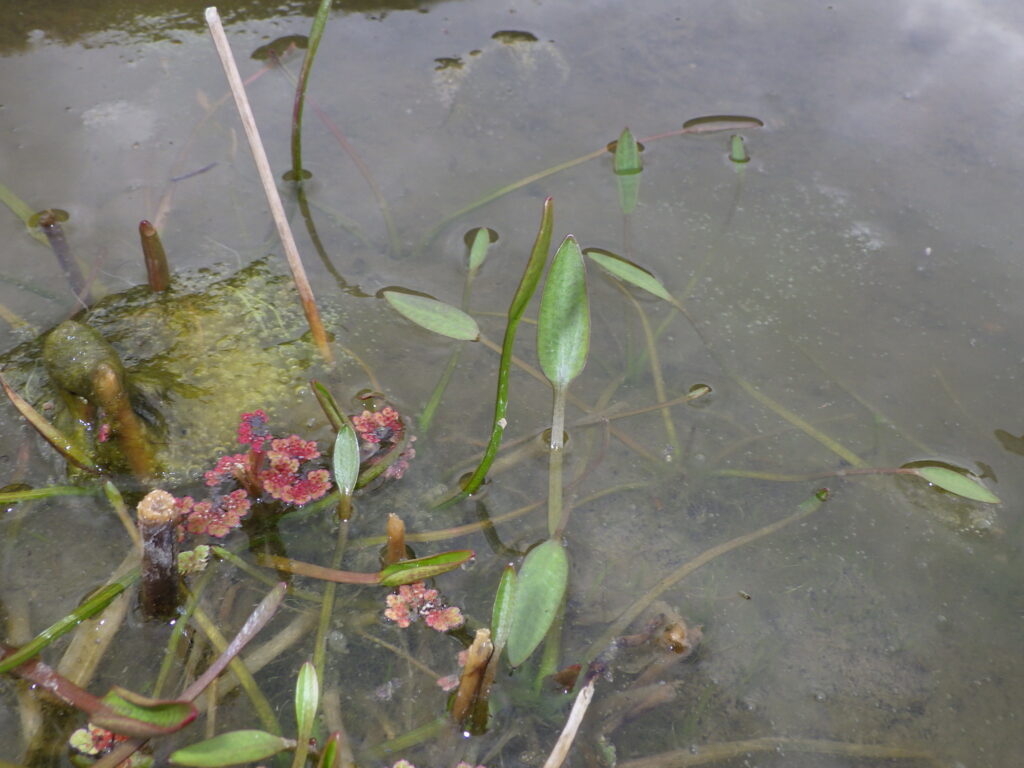
No.0224 Caldesia parnassifolia
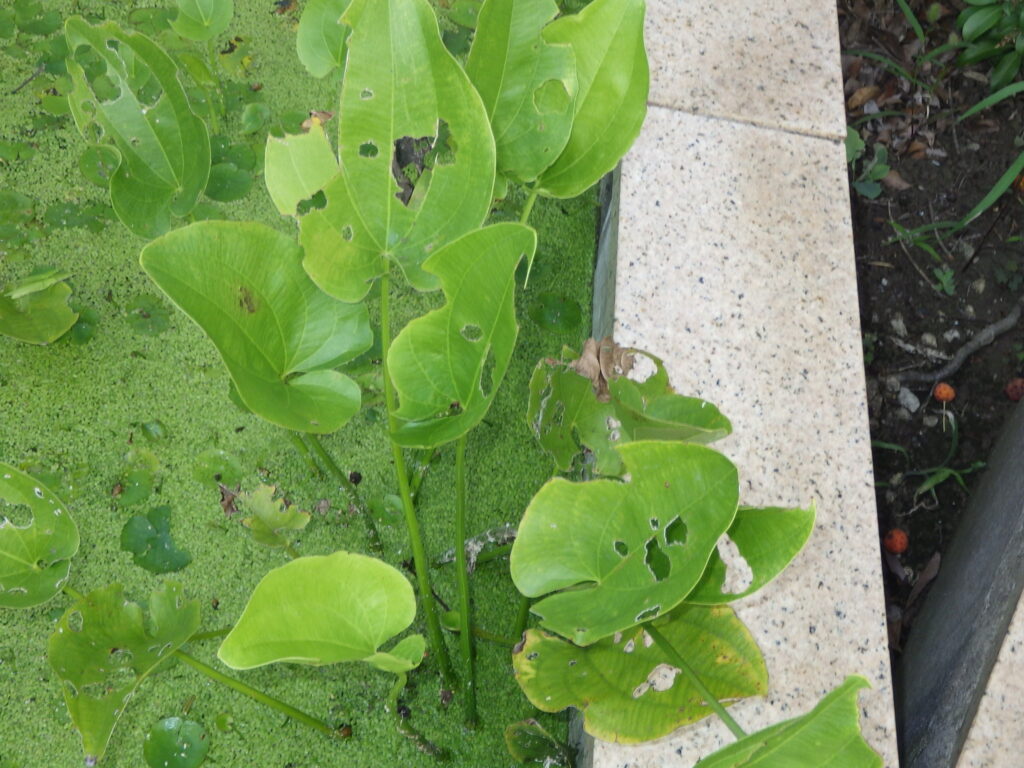
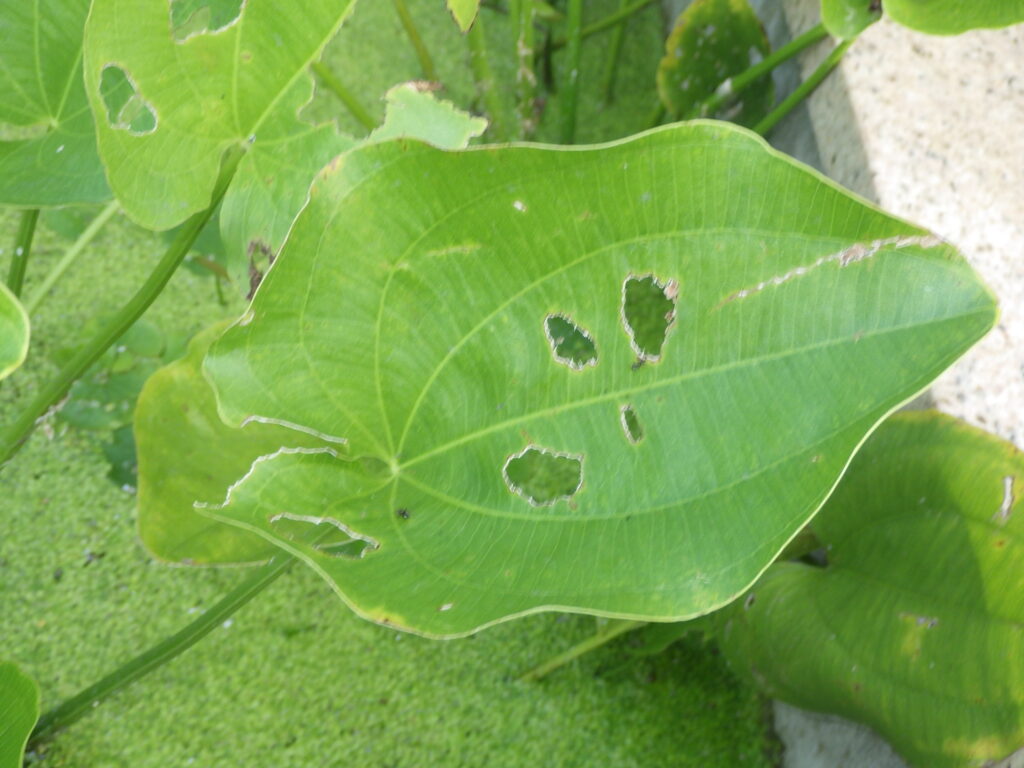
This is a floating-leaved or emergent perennial herb (Red Data Book Aichi 2020). The stems are short, and the leaves are clustered with long petioles. The leaf blades are ovate or kidney-shaped, 5-10 cm in diameter, with a blunt apex, a heart-shaped base, and an entire margin. It flowers from August to September, and the flower stalks, depending on the water depth, can reach 30-100 cm in length, forming a large panicle inflorescence with three branches arranged in whorls at the top. The flowers are arranged in whorls of 3-5 on each branch, are bisexual, have 3 sepals, and 3 white, ovate petals about 4 mm long, with small tooth-like notches on the upper margin. Bulbils develop in the submerged inflorescences, which fall off and become organs for vegetative reproduction and overwintering. It is distributed in Japan, mainland China, India, Australia, Madagascar, etc., and grows in clean ponds and lakes. It is listed as Endangered II in the Ministry of the Environment's Red Data Book. Pollination relies on pollinators such as Asian honeybees, Apidae, Polistinae, and Syrphidae, and the fruit set rate through self-pollination and neighbor pollination is lower compared to cross-pollination (Robert et al., 2003).
References
Kanagawa Prefecture Flora Survey Association. 2018. Kanagawa Prefecture Flora 2018 (Electronic Edition). Kanagawa Prefecture Flora Survey Association, Odawara. 1803pp. ISBN: 9784991053726
Robert, GW, Qing-feng, W., Yong, W., & You-hao, G. 2003. Reproductive biology and prospects for conservation of Caldesia parnassifolia (Alismataceae)—A threatened monocot in China. Wuhan University Journal of Natural Sciences A 8(1): 117-124. https://doi.org/10.1007/BF02902079

