This article contains the full text of "First Records of *Rubus parvifolius* in Nara and Tokyo Prefectures," which was published in the following magazine. Printed and PDF versions are available for purchase via the links below. Please report any identification or information errors so we can correct them in subsequent issues.
What is *Rubus parvifolius* gall?
The gall known as * Phyllocoptes carilubi * Keifer, 1938, or a closely related species, is thought to be a gall (insect gall) formed on the leaves of *Rubus hirsutus * Thunb. by the raspberry leaf miner *Phyllocoptes carilubi* Keifer, 1938 (Tokuda et al., 2015). Although it had been reported on the internet for some time, it was first reported in literature from Saga Prefecture by Tokuda et al. (2015), and a new name was proposed. Prior to the formal proposal of the new name, there was a record from Kanagawa Prefecture (Oura, 2014) that used the same name in a journal without an ISSN, but there appear to be no further literature records since then.
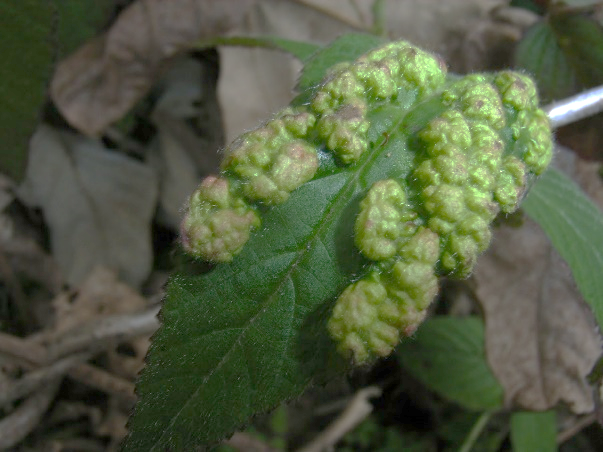
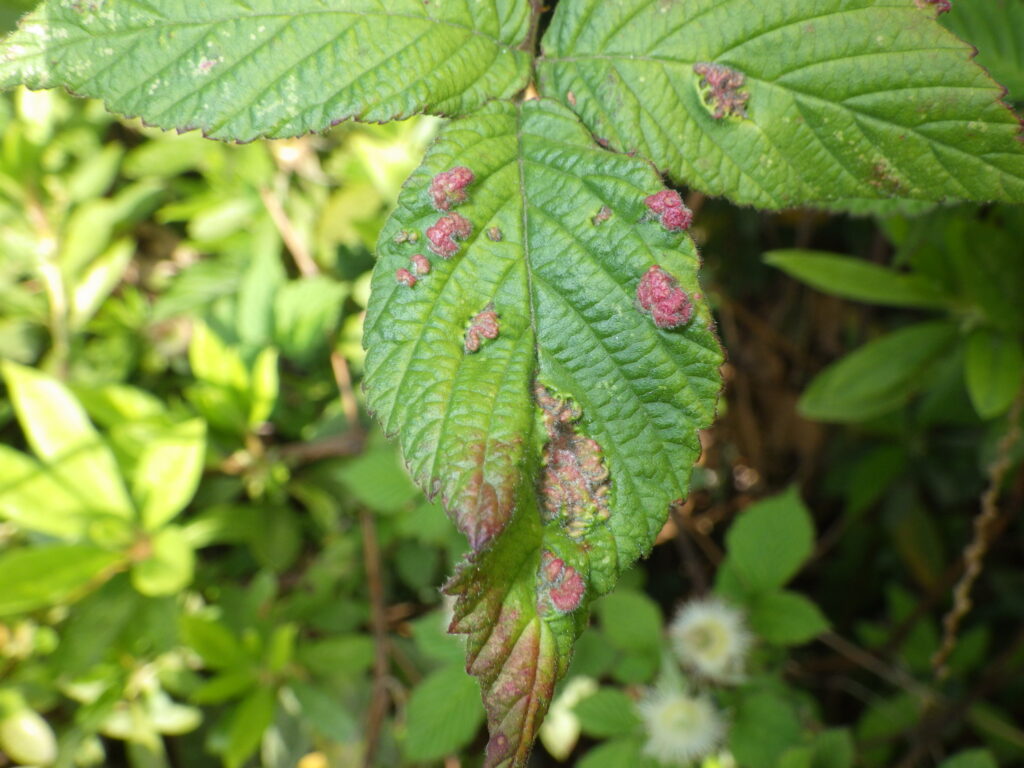
The author's record of the gall of the wild strawberry.
I have confirmed the presence of these galls in Nara Prefecture and Tokyo, and I report it here.
Numerous galls, Kinki University Nara Campus, Nakamachi, Nara City, Nara Prefecture, 10. I. 2013, photographed by the author (Figure 3).
Numerous insect galls, Yoyogi Park, Yoyogi Kamizono-cho, Shibuya-ku, Tokyo, March 22, 2020, photographed by the author (Figure 4).
Because insect galls receive little attention, there are few literature reports by non-experts, and the reports found on the internet are considered valuable, so I will summarize them here.
Data on the galls found on the internet
- Gunma Prefecture (Date of photograph unknown, K. Koizumi) (Koizumi, accessed 2021)
- Tamagawa Aqueduct, Kugayama, Suginami Ward, Tokyo (Date of photo unknown, hiro1803) (hiro1803, posted 2015)
- Rinshi-no-Mori Park, Meguro Ward, Tokyo (November 13, 2010, Hooker S) (Hooker S, posted 2015)
- Jindai Botanical Garden, Jindaiji Motomachi, Chofu City, Tokyo (June 10, 2012, wombat) (wombat, last updated 2020)
- Southern area of Tachikawa City, Tokyo (December 7, 2019, Takuma Nakano) (Tachikawa City Environmental Measures Division, Insect Exploration Team, Tachikawa, accessed 2021)
- Aikawa Prefectural Park, Aikawa Town, Kanagawa Prefecture (Date of photo unknown, Aikawa Prefectural Park) (Aikawa Prefectural Park, posted in 2020)
- Shido Inagawa Natural Forest, Amagasaki City, Hyogo Prefecture (November 7, 2019, Nature and Culture Forest Association) (Nature and Culture Forest Association, submitted 2019)
- Akiyoshidai, Akiyoshi-cho, Mine City, Yamaguchi Prefecture (January 18, 2015, Heike Crab) (Heike Crab, posted in 2015)
- Location unknown (Date of photo unknown, Kurama) (Kurama, posted 2015)
These records suggest that it is distributed at least in the Kanto and Chubu regions of Honshu and Kyushu, and since Rubus parvifolius itself is a common species, it is highly likely to be found in a fairly wide area.
Are raspberry leafminers the gall-formers of the raspberry leafminer mites?
Until Tokuda et al. (2015) reported on it, the galls were widely identified, at least on the internet, with those formed by the raspberry leafminer mite that parasitizes Rubus palmatus Thunb. var. palmatus. The raspberry leafminer mite has been identified in North America as a wandering inhabitant of the underside of Rubus vitifolius Cham. & Schltdl. leaves (Keifer, 1938), and Huang (1971) identified the leafminer mite parasitizing R. vitifolius and the leafminer mite parasitizing Rubus palmatus as the same raspberry leafminer mite, leaving the factors behind the differences in damage to be left to future research. It has also been identified in Taiwan as a wandering inhabitant of Rubus croceacanthus H.Lév. leaves (Huang & Wang, 2009). In addition, in Japan, the formation of galls caused by gall mites of unknown species (Rubus parvifolius, Rubus crataegifolius, and Rubus rosifolius) has been confirmed on Rubus parvifolius, Rubus crataegifolius, and Rubus rosifolius (Yukawa and Masuda, 1996). It is considered necessary to examine, from a taxonomic perspective, whether Rubus crataegifolius and the gall mites that form the above-mentioned galls are the same species as Rubus japonica leafminer.
Acknowledgments
Although I was unable to contact them directly, the excellent observation records on the internet deepened the considerations in this paper. I would like to express my sincere gratitude to the photographers of the sites from which I have cited. I cited these due to the lack of information on this insect gall, but the right to report each record in literature belongs to the respective photographer, and I would like to ask anyone who intends to make a formal record, including the circumstances of the photograph, to submit it again.
References
Huang, KW, & Wang, CF 2009. Eriophyoid mites (Acari: Eriophyoidea) of Taiwan: thirty-seven species from Yangmingshan, including one new genus and twenty-two new species. Zootaxa 1986(1): 1-50. ISSN 1175-5326, https://doi.org/10.11646/zootaxa.1986.1.1
Huang, T. 1971. Records of Ten Eriophyid Mites Associated with Plants in Japan (With 64 Text-figures). Journal of the Faculty of Science, Hokkaido University. Ser. 6, Zoology 18(1): 256-276. ISSN: 0368-2188
Keifer, HH 1938. Eriophyid Studies II. Bulletin of the Department of Agriculture, State of California 27(3): 301-323. ISSN: 0096-0691
Oura, Haruhisa. 2014. A survey of insect galls found in Yokohama Nature Observation Forest. Yokohama Nature Observation Forest Survey Report 20: 42-53.
Tokuda, M., Nakahara, M., Yamazaki, T., & Kamiaka, H. 2015. Galls confirmed at the 58th observation meeting of the Saga Natural History Research Society at Kinryuyama, Saga City, "The Wonders of Insects that Manipulate Plants: Let's Go Gall Hunting." Saga Natural History Research 20: 25-35. ISSN: 1341-5689
Yukawa, Junichi and Masuda, Osamu. 1996. Illustrated Guide to Japanese Insect Galls in Color. National Rural Education Association, Tokyo. 826pp. ISBN: 9784881370612
Quoted site
Heike Crab. Posted 2015-01-30. Flower Thief's Flower Diary. Wild Strawberry.https://hananusubito.blog.fc2.com/blog-entry-6884.html?all
hiro1803. Posted 2015-05-16. Finding solace in flowers... A gall on a wild strawberry? Viburnum flowers, *Shizuka* (a type of lily), and marigolds from self-seeded plants in the garden (28). https://plaza.rakuten.co.jp/hiro1803/diary/201505160000/
Hooker S. Posted 2015-10-25. Insects in Tokyo's 23 Wards 2. Raspberry Leaf Gall (Gall of the raspberry leafminer mite). http://tokyoinsects2.blog.fc2.com/blog-entry-2501.html
Aikawa Prefectural Park. Posted March 7, 2020. Aikawa Park Nature Observation Guide. Strange things on leaves and buds, Part 2.https://aikawa-park.hatenablog.com/entry/2020/03/07/080000
Koizumi, K. 2021-01-02閲覧. かわ遊び・やま遊びのページ. 奇妙な植物:虫えい(虫こぶ)など・121種. http://www9.wind.ne.jp/matu-ko/omosiro2.htm#%E3%82%AF%E3%82%B5%E3%82%A4%E3%83%81%E3%82%B4%E3%83%8F%E3%82%B1%E3%83%95%E3%82%B7
Kurama. Posted 2015-04-20. My hobby is nature observation; I take walks with my digital camera. Galls that form on raspberry leaves. Raspberry leaf gall. http://shizensanpo.seesaa.net/article/417605299.html
Nature and Culture Forest Association. Posted 2019-12-05. Nature and Culture Forest Association. Creatures of Inano Village 95. Galls: Strawberry galls - galls of the raspberry leafminer mite. http://morikyoukai.sblo.jp/article/186884426.html
立川市環境対策課・ムシムシ探検隊・立川. 2021-01-02閲覧. みんなでつくろう!立川いきものデータベース. クサイチゴハケフシ. https://www.ikimono-tachi.jp/mu_wamei.php?sr=photo&ad=asc&of=0&tx=ALL&aks=ALL&wamei=%E3%82%AF%E3%82%B5%E3%82%A4%E3%83%81%E3%82%B4%E3%83%8F%E3%82%B1%E3%83%95%E3%82%B7
wombat. Last updated 2020-03-01. Let's walk slowly through Montagne. Galls. http://wombat.moo.jp/iroiro/kobu/kobu.html