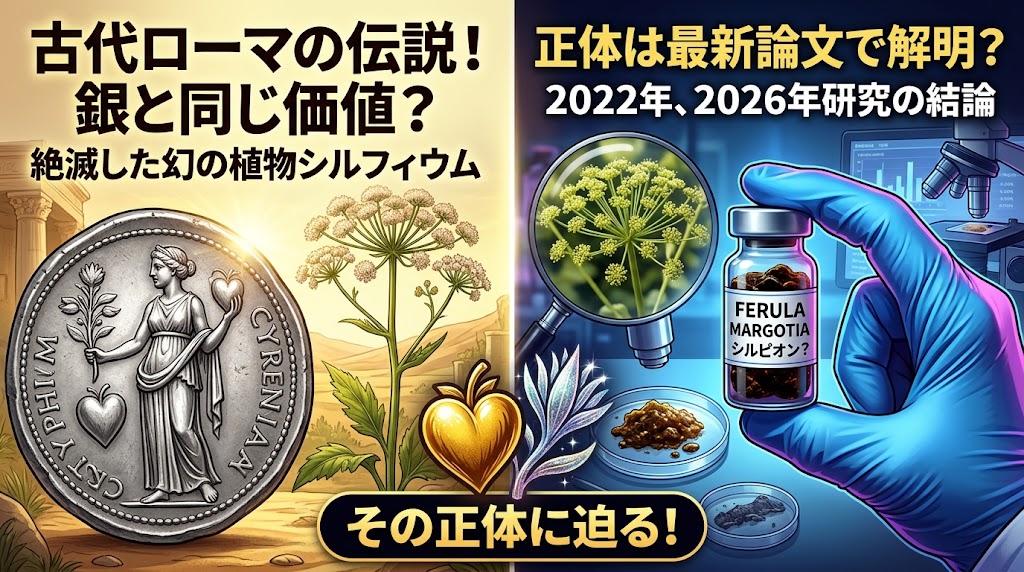
There were plants that the ancient Greeks and Romans considered to be as valuable as silver.
Its name is "Silphium".
This plant, native to the Cyrenaica region of North Africa (present-day Libya), was highly valued in the ancient world as a premium spice and medicine. Its value was so great that it was even depicted on silver coins in the city-state of Cyrene, where it was grown.
However, this plant disappeared during the time of ancient Rome, and no wild specimens can be found today. Silphium is currently considered one of the earliest documented cases of plant extinction due to human activity.
Why did Silphium become extinct?
Furthermore, was it a plant of the genus *Fennel* that is still alive today? Or was it an unknown plant that has already disappeared from the Earth?
Furthermore, there is a theory that silphium was used as a contraceptive and aphrodisiac, which continues to attract considerable interest today.
This article explores the history, botanical characteristics, causes of extinction, and true identity of Silphium, focusing on the 2022 review article "Searching for Silphium: An Updated Review" by Lisa Briggs and Jens Jakobsson, and the 2026 study "The enigmatic Silphion: A phytochemical perspective" by Giovanni Appendino.
- What is Silphium? A legendary plant highly prized in the ancient world.
- What kind of plant was Silphium?
- History and remarkable value in ancient Greece and Rome
- Why did Silphium become extinct?
- What is Silphium? A leading candidate plant.
- Was Silphium a contraceptive or aphrodisiac? Examining ancient legends.
- What did the latest research from 2026 reveal?
- Is there a possibility that Silphium could be revived in modern times?
- Summary: The true identity of Silphium remains shrouded in mystery.
- References
What is Silphium? A legendary plant highly prized in the ancient world.
Silphium is a plant native to North Africa, closely related to the Apiaceae family, that was highly valued in the ancient Greek and Roman world.
In ancient texts, it was also called "Silphion," and its resin and stems were used as spices and medicine.
Its main natural habitat is the Cyrenaica region, located in what is now eastern Libya.
In particular, the area around Cyrene, a city built by the ancient Greeks, was known as an important source of silphium.
The reason this plant was special wasn't simply because of its superior fragrance or medicinal properties.
Its rarity and economic value were extremely important to the people of that time.
According to a 2022 study by Briggs and Jakobsson, silphium played a significant role in the export economy of ancient Cyrene.
While the region produced a variety of agricultural products, including wheat and olives, silphium was a particularly symbolic export (Briggs & Jakobsson, 2022).
Was silphium worth the same as silver?
In his book "Natural History," the ancient Roman naturalist Pliny noted that silphium resin was traded at the same price as silver.
The resin extracted from silphium was called "Laser" and was used for various purposes, including medicinal and edible applications.
Specifically, it is described as having therapeutic properties that can mitigate the adverse effects of almost any type of disease, from skin diseases to respiratory diseases, from dog bites to epilepsy, and as will be discussed later, its role as a contraceptive has also attracted attention.
In other words, silphium was not just a wild plant, but a very important luxury commodity in the ancient world.
In today's terms, it could be described as something that combined rare spices, high-quality natural medicines, and local specialties that supported the regional economy.
What kind of plant was Silphium?
When considering the true identity of Silphium, the depictions of the plant found in ancient texts and coins are crucial.
Unfortunately, no living specimens of Silphium or definitively identified plant specimens have been confirmed to date.
Therefore, the descriptions and illustrations left behind by ancient people are important clues for understanding the characteristics of plants.
It resembled a large plant from the Apiaceae family.
The ancient Greek botanist Theophrastus recorded the characteristics of Silphium, including its roots, stems, and leaves.
Based on that description, it has been thought that Silphium was a plant belonging to the Apiaceae family, particularly closely related to the genus Ferula.
The genus *Fennel* includes plants with enormous stems.
Even today, they are distributed around the Mediterranean Sea and in West Asia, and species that contain resin are also known.
The Apiaceae family is a group of plants that includes carrots, parsley, celery, coriander, and other similar plants.
However, there is no evidence to identify Silphium with any specific modern plant.
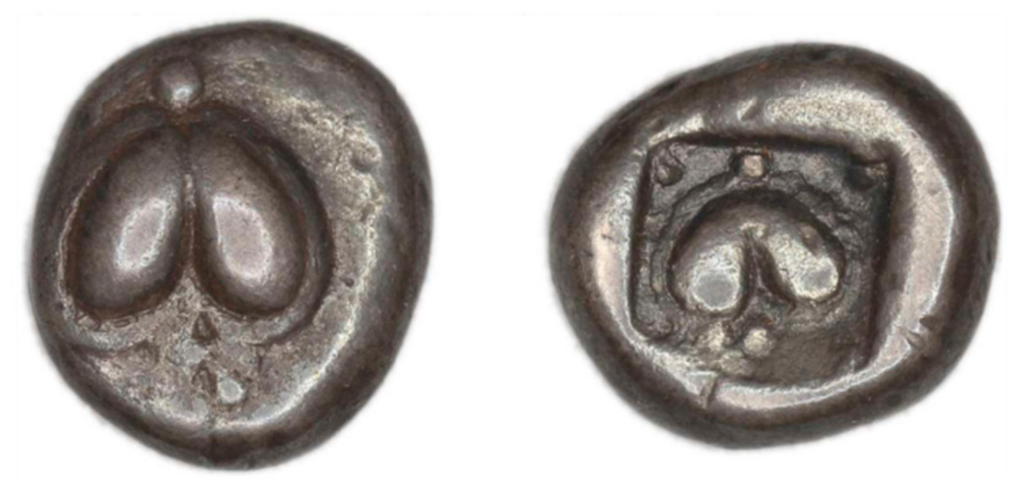
Heart-shaped fruit depicted on ancient silver coins
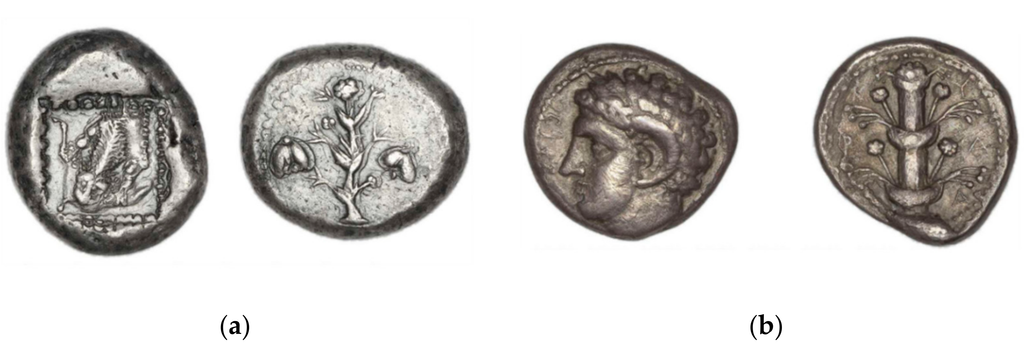
Of particular interest in understanding Silphium are the ancient silver coins minted in Cyrene.
These coins depict the fruits, stems, and leaves of a plant that appears to be Silphium.
Among them, the most famous is the design featuring a fruit that resembles a heart.
Due to its distinctive shape, some theories suggest that silphium may be related to the origin of the modern heart symbol. Modern narratives that it was an aphrodisiac further support this theory.
However, despite various theories, there is no evidence that ancient heart-shaped designs directly correspond to the modern heart symbol that originated in the Victorian era (1837-1901) (Kiehn, 2007). There are also no ancient records suggesting that it was an aphrodisiac.
Furthermore, the depictions of plants on coins have changed over time, and it's possible they are artistically stylized.
Briggs and Jakobsson (2022) suggest that plants depicted on relatively older coins may exhibit characteristics closer to those of modern fennel species.
Thus, while ancient images are important sources of information, they alone cannot determine the identity of the plants.
History and remarkable value in ancient Greece and Rome
The history of Silphium is deeply intertwined with the ancient Greeks' expansion into North Africa.
The plants that supported the prosperity of Cyrene
Cyrene was a city founded by the Greeks in what is now eastern Libya around the 7th century BC.
This region had land suitable for agriculture, and the production of grains and olives was thriving.
Among these, silphium was a particularly important local product.
Cyrene gained significant economic benefits from the trade in Silphium, and its importance is reflected in the city's currency.
In fact, the silver coins issued in Cyrene repeatedly depict the silphium plant.
This indicates that silphium was not merely a commodity, but also a symbol of the city.
Why couldn't Silphium be cultivated?
One possible reason why Silphium was expensive is that it was difficult to cultivate artificially.
Ancient records suggest that silphium grew in the wild and was not easily transplanted or propagated.
Briggs and Jakobsson (2022) suggest that these characteristics may have limited supply and increased scarcity.
If it only grew naturally in limited areas and humans couldn't easily propagate it, it would have been difficult to increase supply even if demand increased.
As a result, it is believed that silphium became an extremely valuable commodity in the ancient world.
Why did Silphium become extinct?
Silphium is generally believed to have almost completely disappeared from its natural habitat around the 1st century AD.
However, the reason for their extinction is still not fully understood.
The 2022 study examined several factors.
Excessive harvesting and damage caused by livestock.
One of the most likely causes of extinction is excessive use by humans.
Because silphium was an expensive export commodity, it's possible that it was continuously extracted over a long period of time.
Furthermore, livestock farming, including sheep and goats, was also practiced in the area around Cyrene at that time.
Ancient records indicate that grazing livestock in areas where silphium grew was considered beneficial for agricultural managers.
Pliny explains that one reason the plants were lost was that the land managers prioritized sheep grazing over the growth of silphium.
In other words, it's possible that not only human harvesting, but also damage caused by livestock and changes in land use were involved.
Changes in the growing environment due to climate change
Another factor being considered is climate change.
The Cyrenaica region, where Silphium grew, was an arid area.
The ancient geographer Strabo also described the arid land of this region.
Briggs and Jakobsson (2022) investigated the possibility that rising temperatures during the Roman Warm Period around the turn of the millennium affected the growing environment of Silphium.
Rising temperatures can increase moisture evaporation from the soil.
Furthermore, since plant growth is also related to microorganisms and fungi in the soil, changes in climate can alter the soil environment itself, potentially worsening growing conditions.
However, it has not been proven that climate change directly caused the extinction of Silphium.
Reduced genetic diversity and reproductive problems
Problems with the reproduction of Silphium are also being considered as a possible cause of its extinction.
If the natural habitat is limited and the population size decreases, genetic diversity may decline.
Furthermore, if they possessed unique reproductive characteristics, environmental changes or a decline in population may have made reproduction even more difficult.
Briggs and Jakobsson (2022) also examine the identity and extinction of Silphium from a plant genetics perspective, including ploidy, hybridization, and apomycosis.
However, since the actual genetic information of Silphium has not yet been obtained, these are hypotheses that are still under consideration.
What is Silphium? A leading candidate plant.
This is where the core of the mystery of Silphium lies.
What modern plant is Silphium most similar to?
Several plants have been suggested as candidates so far.
Ferula genus
One of the most promising candidate groups is the genus *Fennel*.
The genus *Fennel* belongs to the family Apiaceae, and some species have large stems or umbrella-shaped inflorescences.
Furthermore, some species secrete resin, which has been used as a spice and in traditional medicine.
These characteristics are similar to those found in ancient descriptions of silphium.
The following are some of the plants known to be candidates:
- Tangerine fennel (Ferula tingitana)
- Giant fennel (Ferula communis)
- Ferula drudeana
However, it has not been proven that these are ancient silphium itself.
Ferula drudeana
In recent years, one species that has attracted attention in the debate surrounding the true identity of Silphium is Ferula drudeana, which is distributed in Turkey.
In 2021, this plant attracted the attention of researchers because it may resemble the ancient Silphium.
The reason is that some of the morphological features of the plants are similar to those described in ancient texts and depicted on coins.
Another reason it attracted attention was its ability to produce a unique resin.
The revelation that "Sylphium's true identity was Ferula drudeana !" was repeatedly reported in the news media.
However, Briggs and Jakobsson (2022) believe there is insufficient evidence to definitively identify this plant as Silphium itself.
Ferula drudeana is morphologically almost indistinguishable from other species of the genus Fennel, does not resemble the crude depiction of Fennel silphium on the silver coin more than other candidate plants, and regarding its characteristic of producing gum resin, it has been pointed out that almost all species of the genus Fennel produce a gum resinous exudate when the stem or root is cut.
In other words, there is little evidence to support the claim that it is a single species, Ferula drudeana, within the very similar genus *Fennel*.
Therefore, while Ferula drudeana is an interesting candidate, it would be premature to consider its identity as having been determined.
Margotia gummifera
Of the research by Giovanni Appendino in 2026, Margotia gummifera is particularly noteworthy.
This plant belongs to the genus Margotia in the family Apiaceae, and has long been considered a candidate for *Margotia silphium*.
Appendino (2026) compares ancient descriptions and illustrations with the morphology of modern candidate plants and argues that Margotia gummifera is one of the closest extant plants to Silphium.
In particular, its morphological compatibility with the descriptions by the ancient botanist Theophrastus has attracted attention.
This is an important point.
While the genus *Fennel* has been widely known as a candidate for *Sylphium*, it's not necessarily possible to narrow the possibilities down to just *Fennel*.
A 2026 study re-evaluated plants of the genus Margotia as a promising comparison group.
Thapsia spp. and Cachrys spp.
Appendino (2026) also considered the genera Thapsia and Cachrys as potential candidates.
These are also a group of plants belonging to the Apiaceae family.
By comparing the morphology and chemical composition of plants, we are trying to find plants that are similar to the ancient Silphium.
However, at this point, none of the candidates have reached a definitive agreement.
In conclusion, the true identity of Silphium has not yet been determined.
While the genus *Fennel* remains a strong candidate group, a 2026 study also drew attention to *Margotia gummifera *.
Was Silphium a contraceptive or aphrodisiac? Examining ancient legends.
When discussing silphium, its use as a contraceptive and aphrodisiac is often the topic of conversation. While silphium itself is described as having therapeutic properties that can alleviate the adverse effects of almost any kind of disease, from skin diseases to respiratory illnesses, from dog bites to epilepsy, its medicinal effects as a contraceptive and aphrodisiac are particularly noteworthy, as there were no drugs in ancient times that could regulate female hormones like we do today.
On the internet, it is sometimes suggested that ancient people used silphium as an aphrodisiac, and that this is why the modern heart symbol originates from silphium.
However, a closer examination of historical records reveals a slightly different picture.
Ancient texts contain descriptions of contraception and abortion.
Ancient medical texts mention that silphium was used for menstrual and reproductive issues.
For example, in the works of authors such as Dioscorides and Soranus, there are descriptions that treat silphium in relation to contraception and abortion.
Therefore, the fact that silphium was expected to have medicinal properties related to reproduction can be confirmed from ancient texts.
Since native species of the genus *Fennel* also have contraceptive properties, it is thought that this effect itself probably existed.
However, it is possible that the original Cyrene silphium was confused with the Eastern asafoetida that later circulated as a substitute.
The theory that it was used as an aphrodisiac is problematic.
Interestingly, Asciutti's (2004) classical literature study, as presented by Briggs and Jakobsson (2022), found no explicit mention in ancient Greek or Roman texts of silphium being used directly as an aphrodisiac.
In other words, the image of silphium being famous as an aphrodisiac may include later interpretations.
It's possible that the reputation as a contraceptive and the image of it being an aphrodisiac with sexual effects were linked later on.
However, some extant species of the genus *Fennel* exhibit medicinal properties that are effective in treating erectile dysfunction, so it cannot be said with zero certainty that they may have been used as aphrodisiacs or that this may have contributed to their image as such.
Confusion with later substitutes
One of the key issues pointed out by the Appendino (2026) is the confusion with asafoetida.
Asafoetida is a resinous spice extracted from the plant Ferula assa-foetida.
In modern times, it is used in Indian cuisine and is known for its distinctive, strong aroma.
After the original ancient silphium became unavailable, similar plants and their resins from the East were used as substitutes.
As a result, it is no longer necessarily true that all the medicinal properties recorded in later literature were due to the properties of silphium from Cyrene.
Appendino (2026) points out that later descriptions of abortifacient effects may also be confused with the pharmacological effects of plants used as substitutes.
Therefore, we need to carefully consider to what extent silphium was effective as a contraceptive or aphrodisiac.
What did the latest research from 2026 reveal?
Now, let's compare the two papers that are central to this article.
2022: Examining the mystery of extinction from the perspectives of history, archaeology, and botany.
The paper "Searching for Silphium: An Updated Review" by Briggs and Jakobsson (2022) is a comprehensive review of research on silphium.
My main research themes are as follows:
- The history of ancient Cyrene and the Silphium trade
- Characteristics of plants depicted in ancient texts and silver coins
- Uses of silphium for medicinal and culinary purposes
- The possibility of extinction due to overharvesting and climate change
- Investigation of closely related plants that survive today
- Possibility of discovering plant remains through underwater archaeology
What's interesting about this research is that it proposes a method of investigating ancient shipwreck sites to determine the true nature of silphium.
Since silphium was exported to various parts of the Mediterranean, if a ship carrying it sank, there is a possibility that plant seeds or resin remained on board.
In particular, if silphium resin remains on ancient transport vessels called amphorae, it could be crucial evidence in unraveling its true nature.
2026: Re-examining the true nature of Silphium from a plant chemistry perspective
The paper "The enigmatic silphion: A phytochemical perspective" in Appendino (2026) is a study that also focuses on the chemical components and biological activity of plants.
This paper compares the chemical characteristics of modern candidate plants with those of ancient texts and illustrations.
The most important points are as follows:
- The genera *Fennel*, * Margotia *, * Thapsia *, and * Cachrys * were considered as candidates for *Sylphium*.
- Margotia gummifera is being evaluated as a morphologically strong candidate for extant species.
- Re-examining ancient records and pharmacological information regarding the theory that these were contraceptives or aphrodisiacs.
- The confusion between the later-used asafoetida and the original silphium is pointed out.
- This study examines the reasons for the disappearance of ancient silphium around the 1st century AD from the perspectives of overuse and land management.
What is particularly important about this study is that it does not assume that Silphium is a single plant.
Similar morphology and similar chemical composition are two different things.
Furthermore, even if two plants have similar medicinal properties, that alone does not mean they are the same plant.
Identifying ancient plants requires a comprehensive examination of their morphology, distribution, chemical composition, and historical uses.
Considering the two papers together, it becomes clear that a combination of archaeology, botany, and chemical analysis is essential to unraveling the true nature of silphium.
Is there a possibility that Silphium could be revived in modern times?
Has Silphium become completely extinct?
Or perhaps they are still surviving somewhere?
This issue is also still being debated among researchers.
Candidate plants remaining in Türkiye
The discovery of Ferula drudeana, mentioned earlier, is sometimes presented in conjunction with the topic of the revival of Silphium.
However, the discovery of this plant does not mean that the ancient Silphium has been revived.
This is merely the stage where a candidate plant has been found that shares characteristics with those described in ancient texts.
The 2026 Appendino study also showed caution regarding completely identifying Silphium with modern candidate plants.
Underwater archaeology may hold the key to unraveling its true nature.
Briggs and Jakobsson (2022) propose using underwater archaeology for their research.
Physical evidence related to silphium may remain around Apollonia, one of the major ports of ancient Cyrene, and at the sites of shipwrecks that departed from there.
If resin or seeds are discovered in ancient ships, DNA and chemical analyses may help determine the identity of the plants they are.
In particular, if well-preserved organic matter is found, it will be possible to compare it with the current candidate plants.
However, discovery from the seabed or identification through DNA analysis has not yet been achieved.
At this point, this is a method that holds promise for future research.
Summary: The true identity of Silphium remains shrouded in mystery.
Silphium was a plant that was highly valued in the ancient Greek and Roman world.
It grows wild in the Cyrenaica region, which is now eastern Libya, and was used as a spice and medicine, and was an important export product that supported the economy of Cyrene.
However, by around the 1st century AD, wild specimens had almost completely disappeared, and today the true identity of the plant is unknown.
Previous research has revealed the following:
- Silphium is thought to have been a plant closely related to the Apiaceae family.
- The genus *Fennel* is one of the leading candidates.
- Ferula drudeana is also attracting attention as a candidate.
- A 2026 study evaluated Margotia gummifera as a morphologically strong extant candidate.
- Overharvesting, grazing, and climate change are considered to be among the causes of extinction.
- While its use as a contraceptive is recorded in ancient texts, there is insufficient historical evidence to support the claim that it was an aphrodisiac.
- Underwater archaeology and ancient DNA analysis may lead to a future unraveling of its true nature.
What's particularly noteworthy is that even in 2026 research, the true nature of Silphium has not been definitively determined.
Not only the genus *Fennel*, but also several other plant groups, including the genus *Margotia *, are being considered as candidates, and the situation remains such that a conclusion cannot be reached based solely on ancient records.
Silphium, a legendary plant believed to be as valuable as silver.
Its disappearance is not simply a matter of one plant being lost.
This is a fascinating historical case study for considering how human economic activities, land use, and environmental changes can lead to the loss of valuable biological resources.
I hope that one day, genuine traces of silphium will be discovered in an ancient ship, revealing its true nature.
References
Appendino, G. (2026). The enigmatic Silphion: A phytochemical perspective. Phytochemistry, 252, Article 115044. https://doi.org/10.1016/j.phytochem.2026.115044
Briggs, L., & Jakobsson, J. (2022). Searching for Silphium: An updated review. Heritage, 5 (2), 936-955. https://doi.org/10.3390/heritage5020051
Kiehn, M. (2007). Silphion revisited. Medicinal Plant Conservation, 13, 4-8. http://plant-conservation.com/wp-content/uploads/2023/01/8273_MPC13_Silphion.pdf