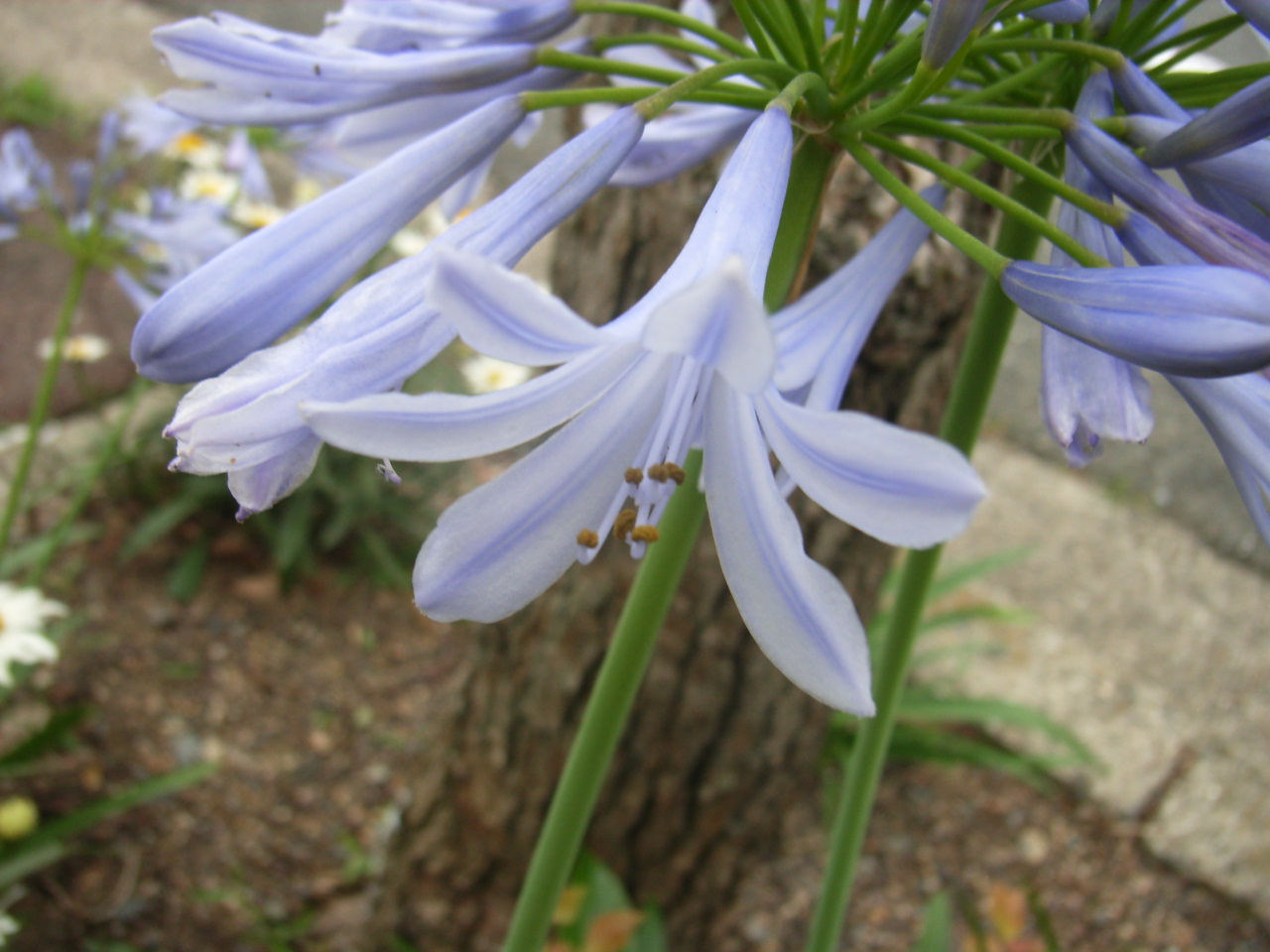
Agapanthus and purple lily are both perennial plants belonging to the genus Agapanthus in the family Amaryllidaceae. While they are unique in that they both bear numerous blue, funnel-shaped flowers, making it unlikely to confuse them, the misconception that "Agapanthus cultivated for ornamental purposes = purple lily" is widespread worldwide, and inaccurate descriptions are common in Japan as well. However, the Agapanthus cultivated for ornamental purposes is actually Agapanthus praecox, which is different from purple lily (Agapanthus africanus). Their native distributions are different, and their perianth segment lengths and flower colors also differ. It will likely take a long time to correct this misconception, but I hope that readers of this article will recognize that they are different species. This article will explain the classification and morphology of the genus Agapanthus.
What is Agapanthus lilyturf?
Agapanthus praecox, also known as Agapanthus, is a perennial plant native to South Africa that has been introduced to parts of the world and cultivated in Japan for ornamental purposes.
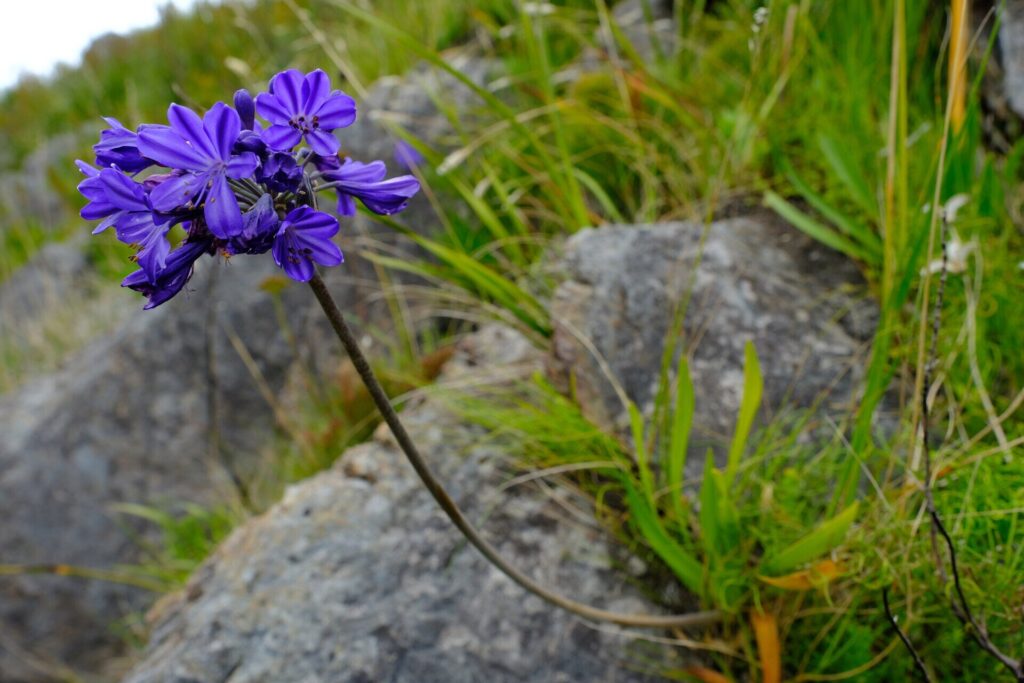
Agapanthus africanus, also known as purple lily orchid, is a perennial plant native to South Africa. Although it has been introduced to some parts of the world, it is generally difficult to cultivate and is rarely grown. It is almost never seen in Japan.
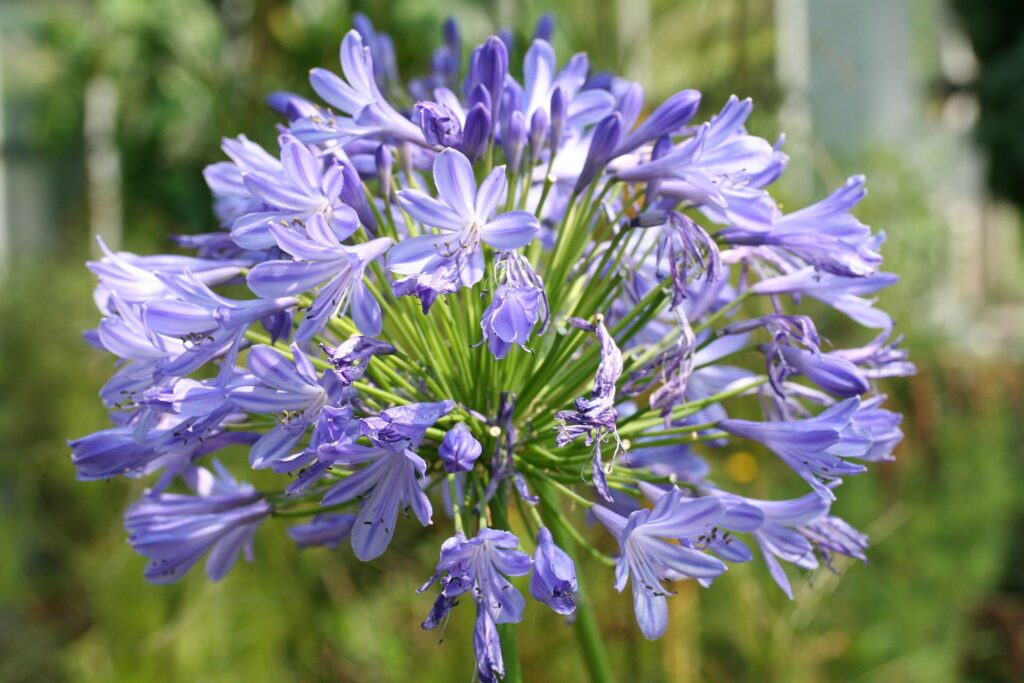
Both are perennial plants belonging to the genus Agapanthus in the Amaryllidaceae family. Their most distinctive feature is that they bloom from late May to early August, producing 20 to 30 blue flowers in umbel inflorescences, with funnel-shaped corollas and six deeply lobed tips.
This medicinal plant is widely used and highly valued in South African folk medicine (Younis et al., 2022). A somewhat unusual characteristic is that in its native habitat, it is known to flower after summer wildfires (Dwyer, 2022).
Since there are no similar groups, it's usually easy to identify them as belonging to the Agapanthus family, but they are often misunderstood by many people.
That means that "Agapanthus cultivated for ornamental purposes is not the same as purple lily."
Most gardening websites refer to "cultivated Agapanthus as purple lily," and the Japanese Wikipedia also states that "the most commonly cultivated species is Agapanthus africanus."
However, this is a complete lie. This is documented in Ylist, the most reliable list of Japanese names and scientific names, as well as in the Australian Botanical Guide and the English Wikipedia (Conran, 2005).
Agapanthus africanus, which is commonly known as Murasaki-kunshiran in Japanese, is actually far more difficult to cultivate and is not suitable as a garden plant. Murasaki-kunshiran can only be grown in rock gardens with well-drained, slightly acidic sandy soil. It is truly rare to find it cultivated in Japan.
The reason for this is unclear, but it may be related to the fact that the classification has been complicated and hybridization is easy (Sharaibi & Afolayan, 2017; Younis et al., 2022).
However, it seems reasonable to rename the globally common Agapanthus praecox as "purple lily orchid," but that would be confusing, so it doesn't seem likely to happen anytime soon.
What are the differences between cultivated Agapanthus and Clivia?
What are the specific differences between cultivated Agapanthus (Agapanthus praecox) and Clivia japonica?
First, although both Agapanthus praecox and Clivia japonica are distributed in South Africa, there is a difference in their distribution: Agapanthus praecox is found in the Eastern Cape (around Port Elizabeth), while Clivia japonica is found in the Western Cape (around Cape Town) (Zonneveld & Duncan, 2003).
These two species are distributed in isolation, so they do not interbreed in the wild.
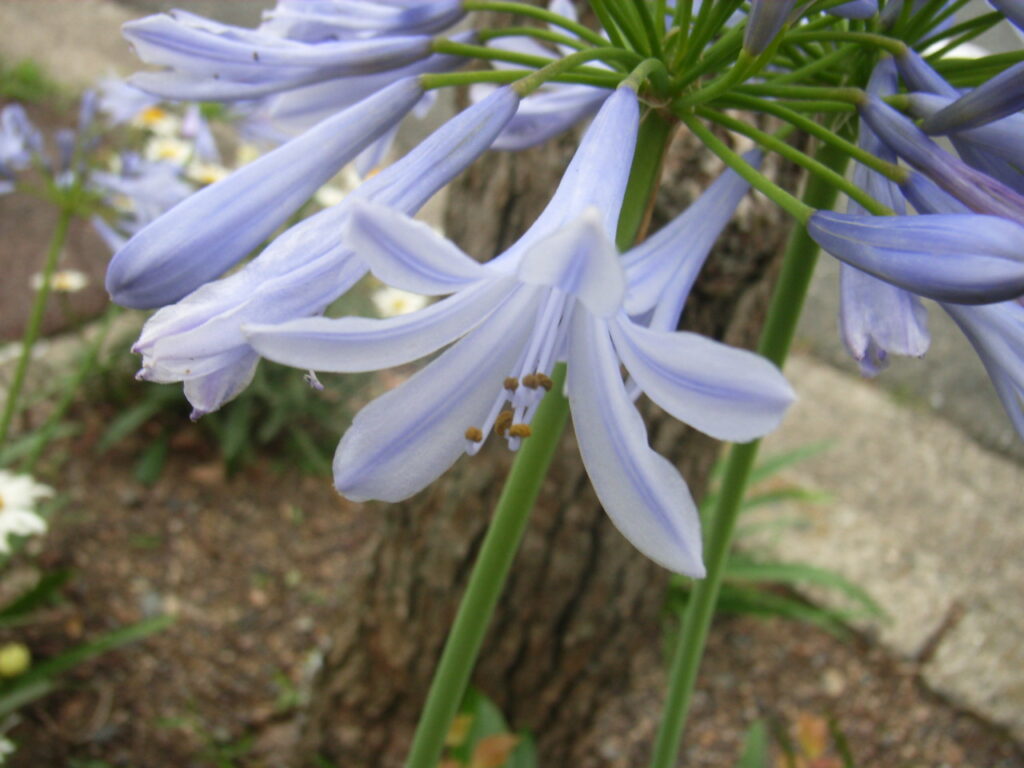
Morphologically, Agapanthus praecox has stamens that are almost the same length as the perianth segments and the perianth segments are a light blue color, while Clivia japonica has stamens that are shorter than the perianth segments and the perianth segments are a dark blue color (Conran, 2005).
Also, although it's not mentioned in the botanical guide, it seems that Agapanthus praecox has considerably more flowers per inflorescence.
However, although this is how it is described in botanical guides, it's important to note that in Agapanthus praecox, the stamens also curl upwards, so from certain angles, the stamens often appear shorter than the perianth segments. In fact, I suspect there are cases where the stamens are slightly shorter.
Additionally, some varieties of Agapanthus praecox have white flowers.
However, you can assume that almost all agapanthus you see in Japan are Agapanthus praecox. There's a possibility that some hybrids of the Agapanthus genus might be mixed in, but that's not well understood.
Although two subspecies of Agapanthus praecox are known, the cultivated variety is considered to be Agapanthus praecox ssp. orientalis, which has flowers less than 5 cm long.
References
Conran, J. 2005. Agapanthaceae. In: R. Spencer (Ed.), Horticultural Flora of South-eastern Australia: The identification of garden and cultivated plants (Vol. 5 Flowering plants. Monocotyledons). University of New South Wales Press, Sydney. ISBN: 9780868408323, https://hortflora.rbg.vic.gov.au/taxon/adac1424-5340-11e7-b82b-005056b0018f
Dwyer, J. 2022. Agapanthus praecox ssp. orientalis: Agapanthus, African lily. Australian Garden History 33(4): 25-27. https://www.jstor.org/stable/27390707
Sharaibi, OJ, & Afolayan, AJ 2017. Micromorphological characterization of the leaf and rhizome of Agapanthus praecox subsp. praecox Willd.(Amaryllidaceae). Journal of Botany 2017(1): 3075638. https://doi.org/10.1155/2017/3075638
Younis, NAM, Gomaa, AA, Ibrahim, AH, Abdelkader, MS, & Desoukey, SY 2022. The genus Agapanthus: A review of traditional uses, pharmacological and phytochemical attributes. South African Journal of Botany 150: 1168-1183. https://doi.org/10.1016/j.sajb.2022.09.029
Zonneveld, BJM, & Duncan, GD 2003. Taxonomic implications of genome size and pollen color and vitality for species of Agapanthus L'Heritier (Agapanthaceae). Plant Systematics and Evolution 241: 115-123. https://doi.org/10.1007/s00606-003-0038-6