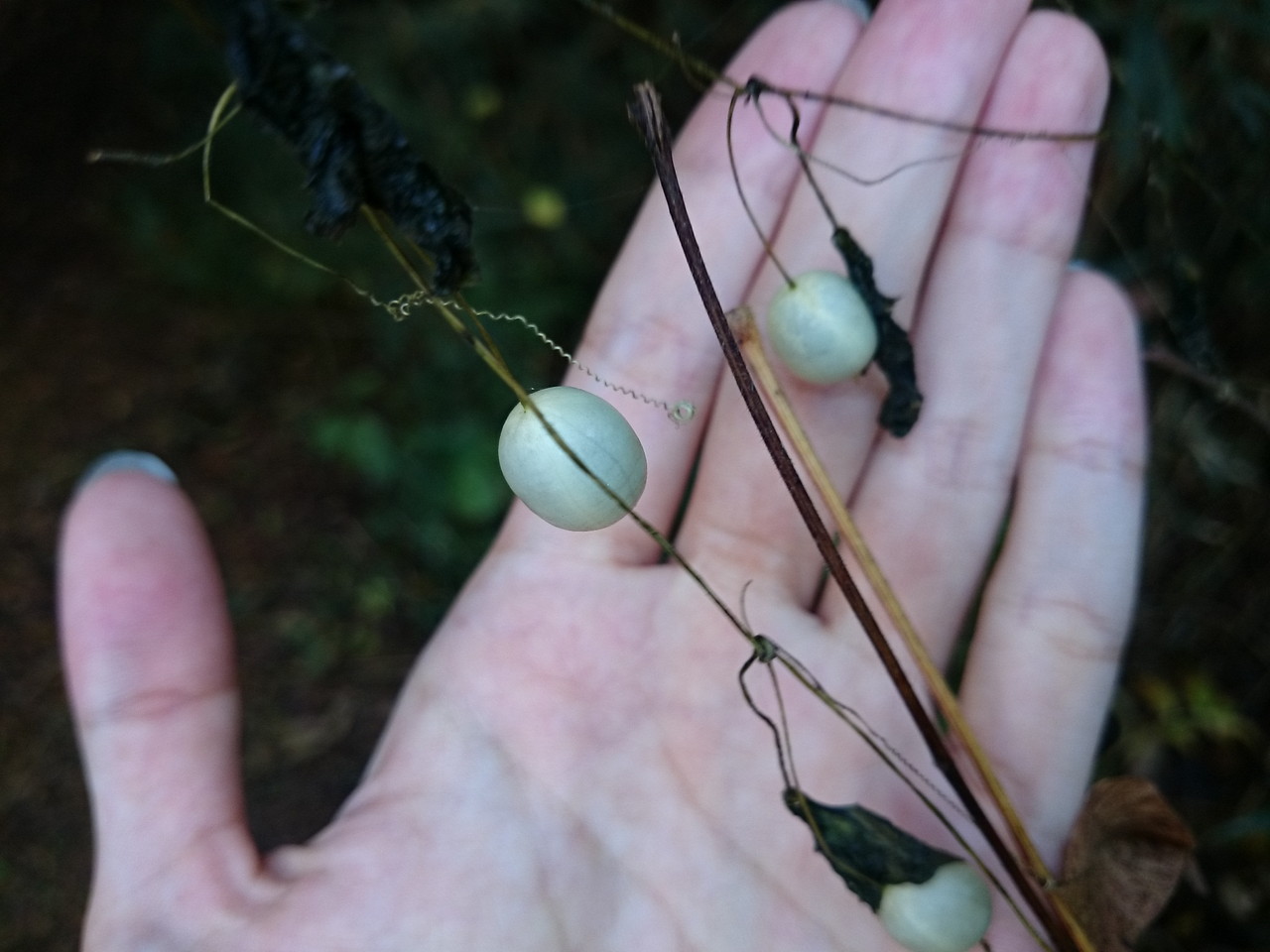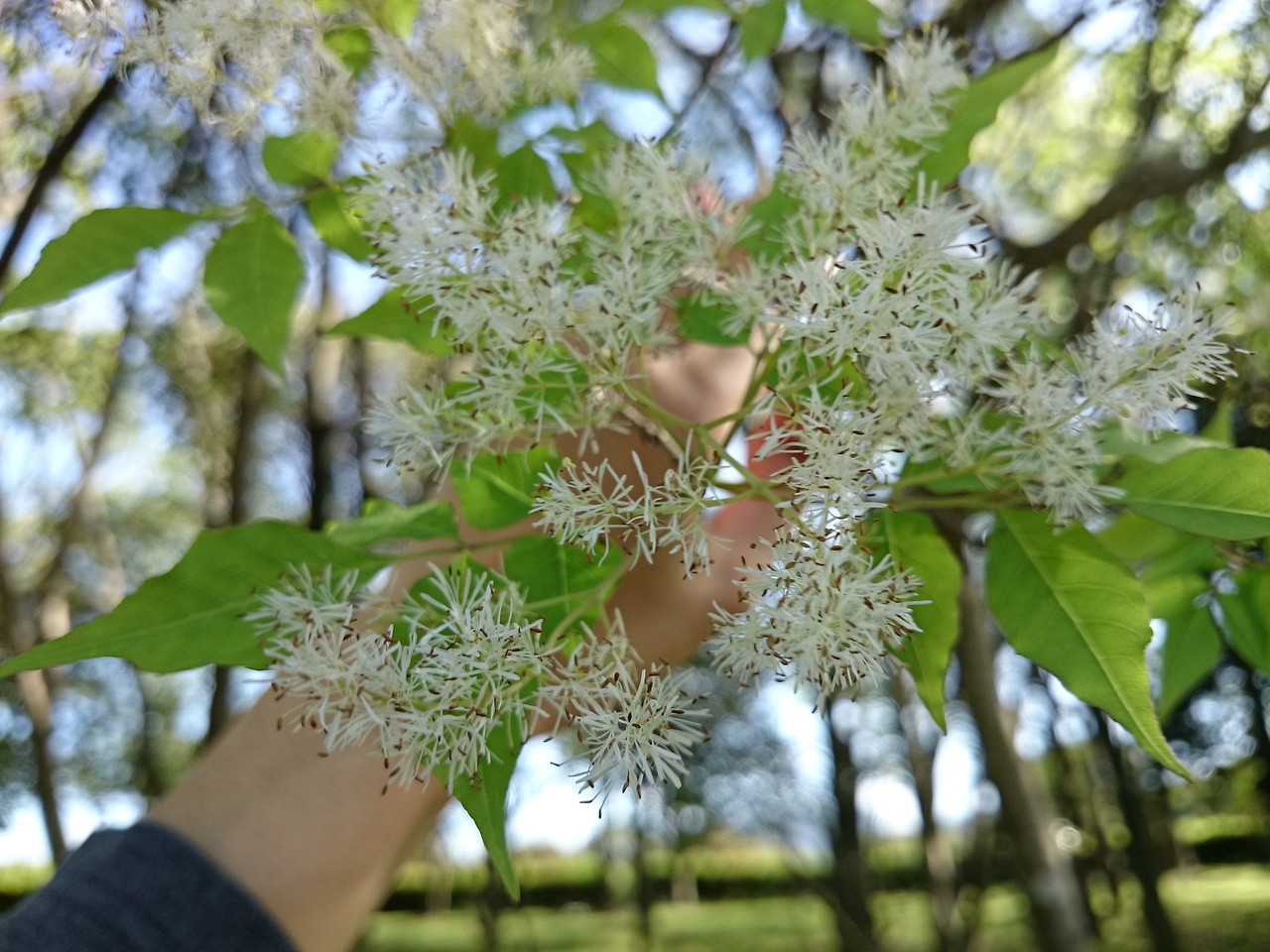
Fraxinus lanuginosa, Fraxinus sieboldiana, and Fraxinus sieboldiana all belong to the Fraxinus genus of the Oleaceae family. They are very similar in that they have odd-pinnately compound leaves, and their leaf and flower shapes are particularly similar compared to other Fraxinus species. Therefore, it can be difficult to distinguish between them. They can be distinguished from Fraxinus japonica and Fraxinus umbellata by the presence or absence of a corolla on the leaflets. Fraxinus lanuginosa, Fraxinus sieboldiana, and Fraxinus sieboldiana can be roughly distinguished by the presence and number of serrations on the leaflets. Fraxinus lanuginosa is used for baseball bats, but there is also the problem of declining populations. The flowers are characterized by white, frilly corollas and are mainly visited by beetles, but they also employ a unique pollination method of wind pollination. The fruit is a flattened winged fruit that spreads widely in the wind, dispersing the seeds. This article will explain the classification, pollination ecology, and seed dispersal of Fraxinus lanuginosa, Fraxinus sieboldiana, and Fraxinus sieboldiana.
- What are Fraxinus lanuginosa, Fraxinus sieboldiana, and Fraxinus japonica?
- What are the differences between Japanese ash (Fraxinus sieboldiana) and Japanese ash (Fraxinus lanuginosa)?
- What are the differences between Fraxinus lanuginosa, Fraxinus sieboldiana, and Fraxinus japonica?
- What are the differences between varieties of Japanese ash (Fraxinus lanuginosa)?
- How can Japanese ash trees (Fraxinus lanuginosa) be used?
- What is the structure of a flower?
- How is pollination done?
- What is the structure of the fruit?
- What are the seed dispersal methods?
- References
What are Fraxinus lanuginosa, Fraxinus sieboldiana, and Fraxinus japonica?
Fraxinus lanuginosa, also known as Aodamo, is a deciduous small tree distributed in Hokkaido, Honshu, Shikoku, and Kyushu. It typically grows in mountainous areas such as chestnut and beech zones, and does not grow in plains or at low elevations (Kanagawa Prefecture Flora Survey Association, 2018). There are several theories about the origin of its Japanese name, including that the bark turns greenish-blue after rain, and that the water turns bluish after soaking the branches in water for a while. Some people have even confirmed that it emits fluorescent light (Hirono, 2010), but this may simply refer to the green color of the bark when it is peeled off.
Fraxinus sieboldiana, also known as round-leaved ash, is a deciduous shrub or small tree distributed in Hokkaido, Honshu, Shikoku, and Kyushu. It is most commonly found in low mountains from hills to coastal areas, and prefers to grow on dry, rocky ridges.
Fraxinus apertisquamifera, also known as mountain ash, is distributed in central Honshu and Shikoku. It grows in deep mountain areas, appearing at even higher altitudes than Fraxinus lanuginosa, and is a deciduous small tree mainly found in beech forest zones.
Both belong to the genus Fraxinus in the family Oleaceae, and are very similar in that they have odd-pinnately compound leaves. In terms of finer morphology, they also share similarities such as the absence of stalks in the leaflets (though short stalks may occasionally appear), having white flowers with corollas, and having calyxes that are merely minute disc-shaped at the tip of the fruit stalk with only a few teeth. Therefore, it can sometimes be difficult to distinguish between them.
What are the differences between Japanese ash (Fraxinus sieboldiana) and Japanese ash (Fraxinus lanuginosa)?
Besides the three species mentioned above, the genus Fraxinus includes many other species. Representative examples include Fraxinus sieboldiana, Fraxinus griffithii, and Fraxinus lanuginosa. What are the differences between these species?
In Fraxinus lanuginosa, Fraxinus sieboldiana, and Fraxinus japonica, the leaflets are sessile, with only occasional short stalks. They have white flowers with a corolla, and the calyx is merely a tiny, disc-shaped structure with a few teeth at the tip of the fruit stalk.
On the other hand, in ash and Japanese ash, the leaflets usually have stalks (albeit short), the flowers lack a corolla, and the calyx is cup-shaped with teeth or lobes, persistent in fruit, and has four teeth.
The Japanese ash tree (Fraxinus griffithii) has corollas on its flowers, but its leaflets have stalks.
The petioles of the leaflets, in particular, can be observed at any time except winter, making them an important characteristic.
In addition, while Japanese ash and Manchurian ash have leaflets with almost no petioles, Japanese ash can be distinguished from Japanese ash by the fact that the leaflets are clearly wider horizontally, and Manchurian ash can be distinguished by the fact that the leaflets extend in a tail-like manner.
What are the differences between Fraxinus lanuginosa, Fraxinus sieboldiana, and Fraxinus japonica?
The three species Fraxinus lanuginosa, Fraxinus sieboldiana, and Fraxinus japonica are basically distinguished by the shape of their leaves, but this distinction can sometimes be difficult (Kanagawa Prefecture Flora Survey Association, 2018; Hayashi, 2019).
Firstly, in Fraxinus lanuginosa, the leaflets are entire and have no serrations, whereas in Fraxinus lanuginosa and Fraxinus sieboldiana, the leaflets have serrations. Also, in Fraxinus lanuginosa, the leaflets at the base become smaller and rounder.
Regarding Fraxinus lanuginosa and Fraxinus sieboldiana, the difference is that Fraxinus lanuginosa has 3 to 5 (up to 7) leaflets (1 to 3 pairs of leaflets arranged horizontally), while Fraxinus sieboldiana has 7 to 9 leaflets (3 to 4 pairs of leaflets arranged horizontally).
These two species can generally be distinguished by the number of leaflets, but there may be overlaps in the number of leaflets even within the descriptions, and since Fraxinus lanuginosa can occasionally have five leaflets, it may be difficult to distinguish them depending on their condition.
The most reliable way to distinguish between the two species is by their winter buds. In Fraxinus lanuginosa, the winter buds are closed and covered with coarse hairs, while in Fraxinus sieboldiana, the bud scales of the winter buds are open, revealing dense brown hairs on the inside. Roughly speaking, Fraxinus sieboldiana's winter buds are clearly darker brown and have a more complex structure, making them easily recognizable.
The period during which you can observe them is limited, but try to check if possible. Also, from what I can see from the leaf photos, Fraxinus lanuginosa seems to have sharper serrations.
As mentioned above, the altitude at which they inhabit increases in the order of Fraxinus lanuginosa < Fraxinus lanuginosa < Fraxinus sieboldiana. This point will also be a significant clue.
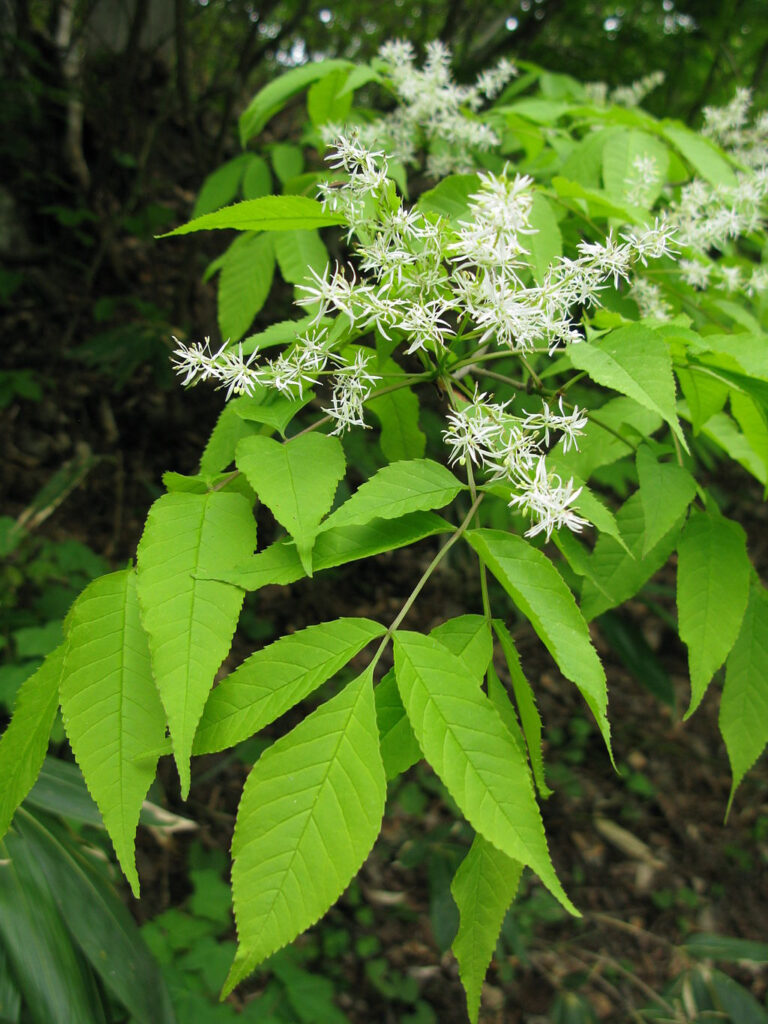
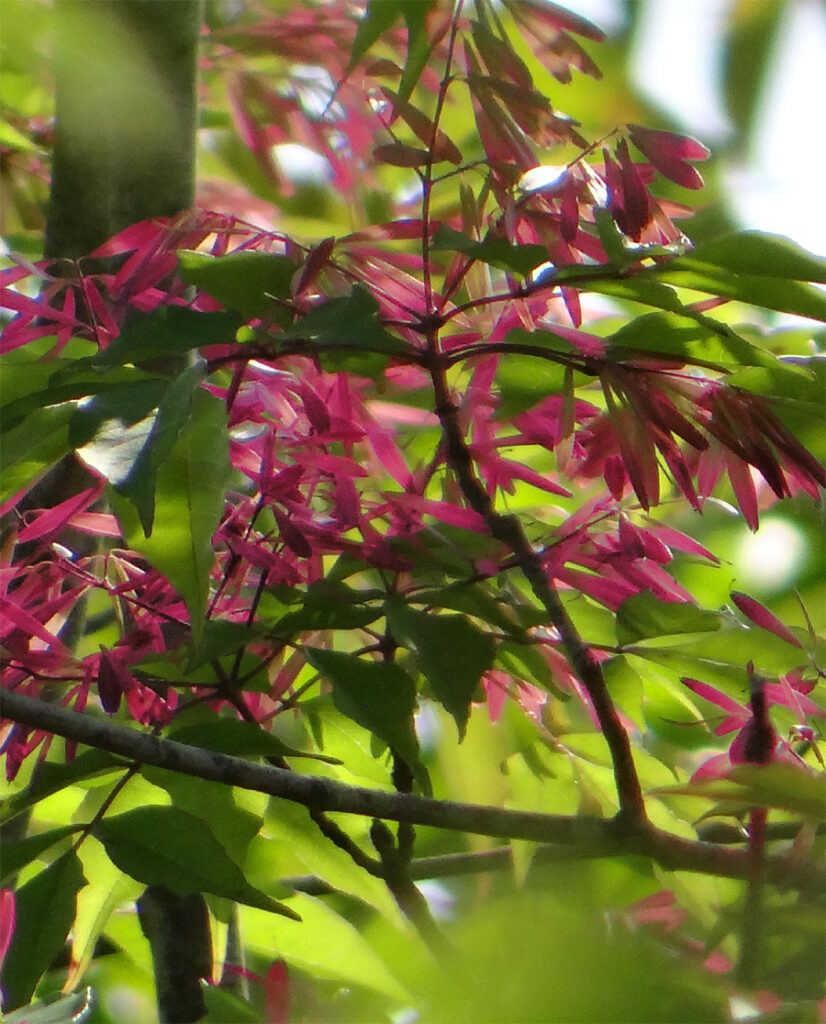
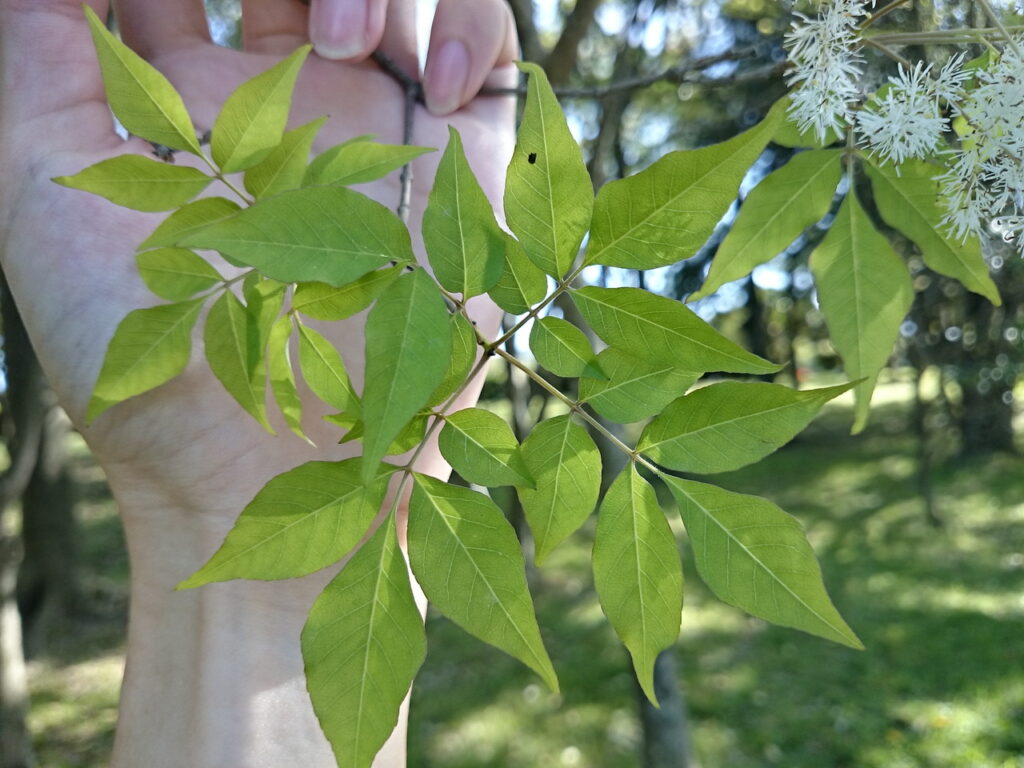
Fraxinus apertisquamifera
— Nuumu (@Celastrus91st) November 20, 2021
In Suwa City, Nagano Prefecture / Suwa District, Nagano Prefecture. The most distinctive feature is the shape of the bud scales, but once you understand the leaf shape tendencies, it becomes almost impossible to distinguish it from other species based on the leaves alone. pic.twitter.com/S6ns5c4PUg
What are the differences between varieties of Japanese ash (Fraxinus lanuginosa)?
Three varieties of Japanese ash (Fraxinus lanuginosa) are known.
Fraxinus lanuginosa f. serrata is a variety with nearly hairless undersides to its leaves and young branches. It is also known as Kobano-toneriko.
Fraxinus lanuginosa is a variety with hairy undersides to its leaves and young branches, while its upper surfaces are hairless. It is also known as hairy Fraxinus lanuginosa.
Fraxinus lanuginosa f. veltina is a variety in which the upper and lower surfaces of the leaves, as well as the young branches, are all covered in hairs.
How can Japanese ash trees (Fraxinus lanuginosa) be used?
One notable use of Japanese ash (Fraxinus lanuginosa) is that, as a type of ash wood, it has been used in Japan as a material for wooden baseball bats. This is because Japanese ash wood has durability and a moderate degree of flexibility. Japanese ash trees that grow in Hokkaido, in particular, were ideal for making baseball bats.
However, despite being a tree that takes a long time to grow, it has been consumed in large quantities without much planned reforestation, making it difficult to ensure a stable supply (Hasegawa, 2011). This is a prime example of the lack of consideration for "sustainable development" and "nature conservation."
In addition, Fraxinus lanuginosa and Fraxinus sieboldiana are sometimes planted as garden trees or park trees.
What is the structure of a flower?
The genus Fraxinus is known for having various hybridization systems, including androdioecious (having only male and hermaphroditic flowers on separate plants), polygamous (having both male and female flowers on separate plants), and dioecious (having only male and female flowers on separate plants). The three species introduced here are all androdioecious. Dioecious hybridization is a rare hybridization system among angiosperms, as it involves individuals that produce only male flowers and individuals that produce only hermaphroditic flowers.
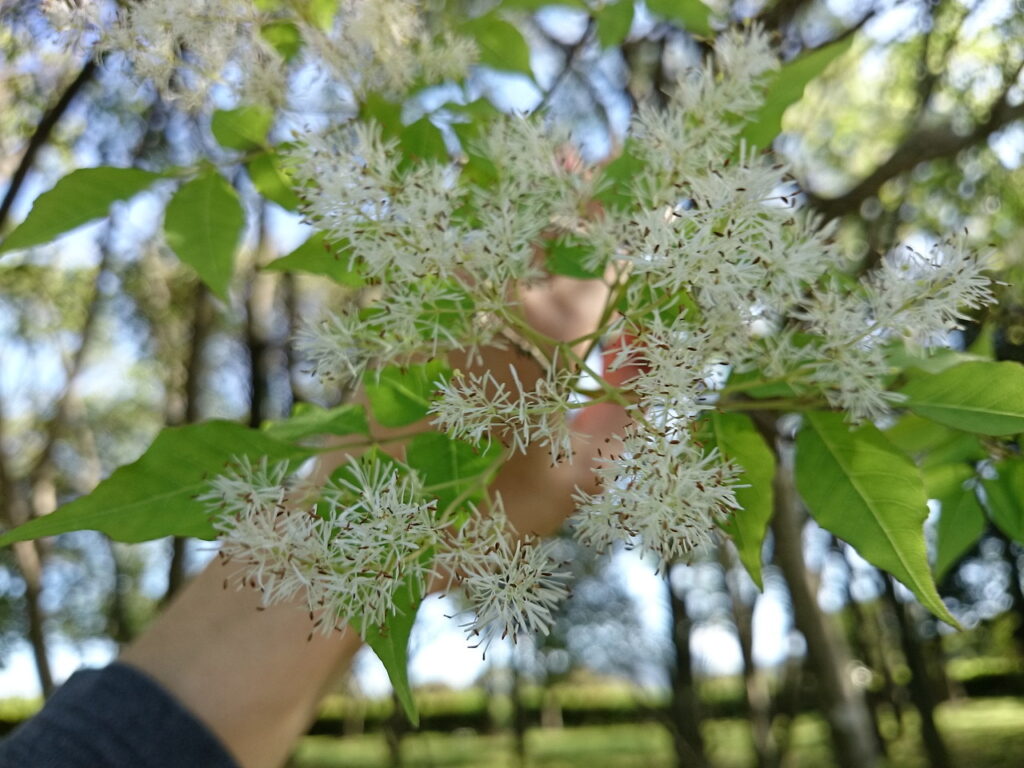
While some varieties have a corolla and others do not, the three species introduced here have a white, slender, four-lobed corolla. Their appearance gives them a delicate, frilly look. The flowers also have a faintly sweet fragrance.
Japanese ash (Fraxinus lanuginosa) blooms from April to May. It bears numerous small white flowers in conical inflorescences at the tips of its branches. The corolla is narrowly divided into four lobes.
Fraxinus lanuginosa flowers from April to May. It produces numerous white flowers in conical inflorescences at the tips of new branches. The inflorescences are covered with glandular hairs. The corolla is 4-lobed, with linear lobes 6-7 mm long. Male flowers have two stamens, while hermaphroditic flowers have one pistil and two stamens.
Fraxinus lanuginosa flowers in May. It bears conical inflorescences at the tips of new branches. The flowers are white, and the corolla is four-lobed and linear.
How is pollination done?
Interestingly, the genus Fraxinus also exhibits a diverse pollination system, utilizing three methods of pollination: insect pollination, wind pollination, and ambophily (Wallander, 2001; 2013).
In a hybrid wind-pollinated species, both insect and wind pollination are employed.
Fraxinus lanuginosa is thought to be bipolative, both by wind and insects (Wallander, 2001), and its pollinating insects have been studied through actual observations in Japan (Ishida and Hiura, 1994). According to this study, although the total number of individuals is small, 7 individuals of the order Coleoptera, 7 individuals of the order Diptera (flies, Syrphidae), and 1 individual of the genus Bumblebee were identified. Among them, the beetles were observed feeding on pollen within the inflorescence and were estimated to stay within the inflorescence longer than the hoverflies and flies. Therefore, it is reasonable to conclude that pollination is mainly by beetles. This is very similar to the general tendency of pollinating insects of white, broad-petaled flowers. Furthermore, since pollen was confirmed in pollen trap surveys, it is certain that wind pollination also occurs.
While it is believed that Fraxinus lanuginosa and Fraxinus sieboldiana are insect-pollinated, actual research is insufficient, and wind pollination may also occur (Wallander, 2001).
On the other hand, for example, the ash tree has completely lost its corolla and relies solely on wind pollination. This shows that diverse evolution has occurred even within the same genus.
What is the structure of the fruit?
All members of the genus Fraxinus have a common fruit: a winged fruit that is flattened from front to back and contains one seed.
The winged fruits of the Japanese ash tree (Fraxinus lanuginosa) are oblong, 2-3 cm long, and hang downwards.
The samaras of Fraxinus lanuginosa are oblanceolate, 2-2.7 cm long and 4-5 mm wide, and hang downwards.
The winged fruits of Fraxinus lanuginosa are 2.5-3 cm long and 5 mm wide, narrowly oblanceolate in shape, and hang downwards.
What are the seed dispersal methods?
As can be inferred from their morphology, the genus Fraxinus commonly disperses its seeds by wind (Fukuyama, 1997; Uenoyama et al., 2005). The drooping, flattened winged fruits are carried far away by the wind.
Although the fruits of Fraxinus lanuginosa do not exhibit dormancy, removing the pericarp and exposing the seeds promotes germination, indicating that the pericarp has a germination-delaying effect (Koyama et al., 2008). This germination delay is thought to be a mechanism to prevent premature germination in the autumn.
References
Fukuyama, Kenji. 1997. Influence of tree hosts on the parasitic distribution of *Fraxinus sieboldiana* in young *Fraxinus lanuginosa* plantations. Journal of the Japanese Society of Applied Entomology and Zoology 41(2): 105-107. https://doi.org/10.1303/jjaez.41.105
Hasegawa, Shoichi. 2011. A Powerful Reportage on the "Aodamo" Tree: The Day Ichiro's Bat Disappears. Shufunotomo Co., Ltd., Tokyo. 191pp. ISBN: 9784072742983
Hayashi, Masayuki. 2019. Tree Leaves: Expanded and Revised Edition - Identifying 1300 Species Through Real-Life Scans. Yama-kei Publishers, Tokyo. 824pp. ISBN: 9784635070447
Ishida, Kiyoshi and Hiura, Tsutomu. 1994. Reproductive Ecology of Fraxinus lanuginosa (II) - Pollination Characteristics -. Proceedings of the Hokkaido Branch of the Japanese Forestry Society 42: 61-63. https://doi.org/10.24494/jfshb.42.0_61
Kanagawa Prefecture Flora Survey Association. 2018. Kanagawa Prefecture Flora 2018 (Electronic Edition). Kanagawa Prefecture Flora Survey Association, Odawara. 1803pp. ISBN: 9784991053726
Koyama, Hiromasa; Nagaoka, Ayano; and Takahashi, Norio. 2008. Germination delay by the pericarp of Fraxinus lanuginosa fruit and its mechanism. Journal of the Japanese Forestry Society 90(2): 97-102. https://doi.org/10.4005/jjfs.90.97
Uenoyama, Yuya; Okazaki, Junko; and Nanami, Satoshi. 2005. Population structure and reproductive success of the dioecious Fraxinus lanuginosa (Oleaceae). Abstracts of the Annual Meeting of the Ecological Society of Japan 52: 314. https://doi.org/10.14848/esj.ESJ52.0.314.0
Wallander, E. 2001. Evolution of wind-pollination in Fraxinus (Oleaceae) – an ecophylogenetic approach [Doctoral dissertation, Goteborg University]. ISBN: 9789188896377, https://www.researchgate.net/publication/259931859
Wallander, E. 2013. Systematics and floral evolution in Fraxinus (Oleaceae). Belgische Dendrologie Belge 2012: 38-58. ISSN: 1377-4506, http://www.oleaceae.info/publications/Wallander2013.pdf
Hirono, Ikuo. 2010. Does water really turn blue with the branches of the Japanese ash tree? Wood Play 47. Wooden Notebook. https://kinomemocho.com/kiasobi_aodamo.html