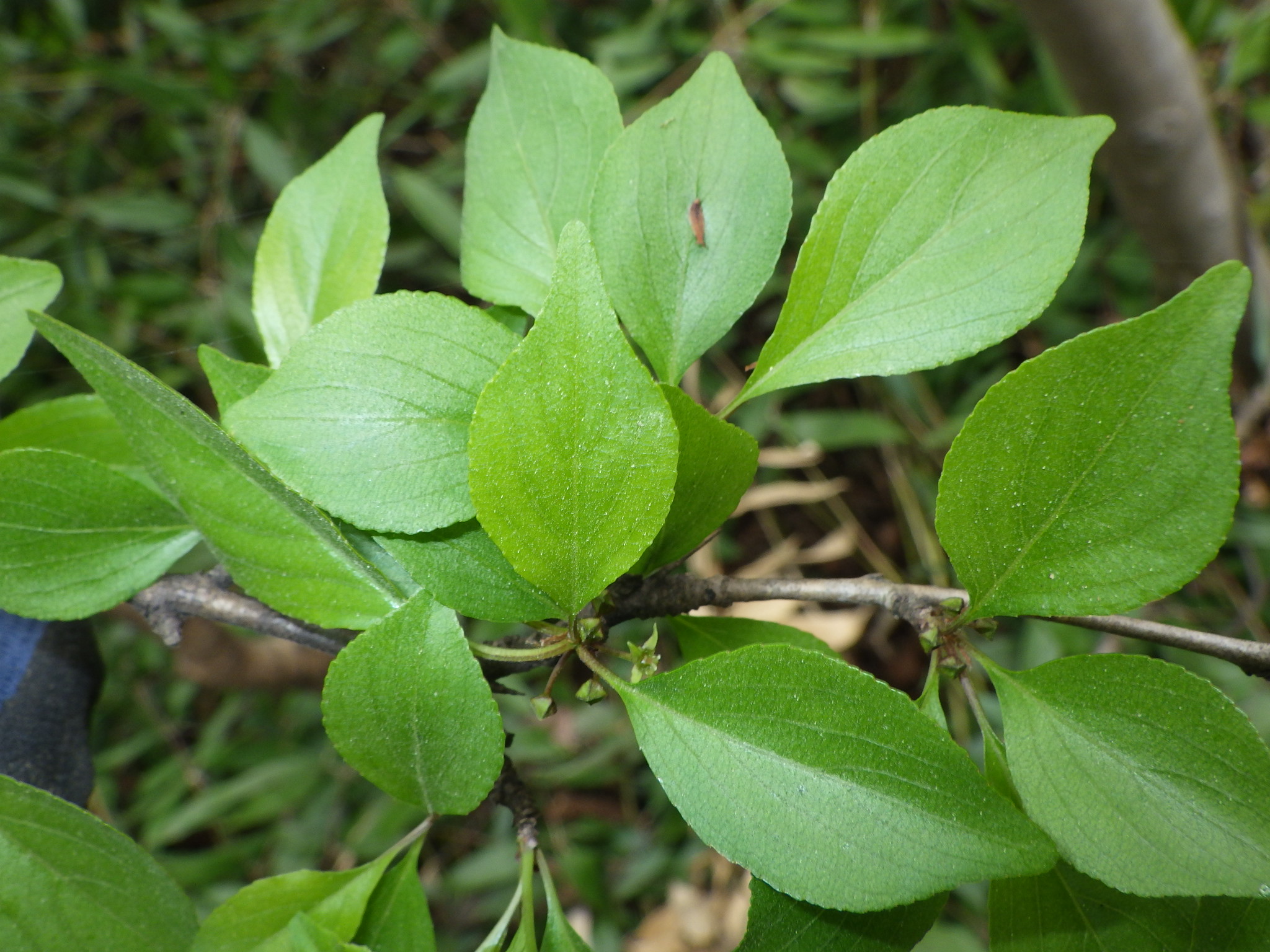
Solanum lyratum, Solanum sulphureum, Solanum holosteoides, and Solanum jasminoides all belong to the Solanaceae family and are four species that share the characteristic of being "climbing plants." The basic structure of their flowers and fruits is the same, so these four species are often confused. However, these four species have clear differences. Solanum jasminoides and Solanum sulphureum are completely different species. This can be determined by examining the hairs on the stem and the shape of the leaves. The flowers are sympetalous and have yellow, perforated anthers like a banana. The fruit is a berry. This article will explain the classification and morphology of climbing Solanum species.
- What are Japanese honeysuckle, mountain dappled, round-leaved dappled, and crescent-leaf nightshade?
- What are the differences between Solanum lyratum, Solanum sulphureum, Solanum holosteoides, and Solanum jasminoides?
- Are there any other similar species?
- What is the structure of a flower?
- What is the structure of the fruit?
- References
What are Japanese honeysuckle, mountain dappled, round-leaved dappled, and crescent-leaf nightshade?
Solanum lyratum, also known as Japanese honeysuckle, is a climbing perennial herb that grows at the edges of forests and is distributed in Hokkaido, Honshu, Shikoku, Kyushu, and the Ryukyu Islands in Japan; as well as in Korea, China, and Southeast Asia (Kanagawa Prefecture Flora Survey Association, 2018).
Solanum japonense, also known as Yamahoroshi, is a climbing perennial herb distributed in Hokkaido, Honshu, Shikoku, and Kyushu in Japan; as well as in Korea and China, growing in forest edges and within forests (Kadota et al., 2013).
Solanum maximowiczii, also known as round-leaved holly, is a climbing perennial herb distributed in Honshu (west of the southern Kanto region), Shikoku, Kyushu, and the Ryukyu Islands of Japan, growing in evergreen broad-leaved forests and valleys at the foot of mountains (Ohashi et al., 2017).
Solanum laxum, also known as climbing nightshade, is a perennial vine distributed in southeastern Brazil, Argentina, and the La Plata River estuary in Uruguay, growing in Atlantic coastal forests, Norfolk Island forests, riparian forests, and open forest edges (Brazil Flora G., 2023). It is widely cultivated as an ornamental plant in both temperate and subtropical regions worldwide, including Japan, and has naturalized and become naturalized in places like Australia and New Zealand.
All four species belong to the Solanaceae family, specifically the Solanum genus, and are characterized by their "climbing" growth habit. Their basic flower and fruit structures are the same.
Regarding *Solanum lyratum*, *Solanum lyratum*, and *Solanum sarmentosum*, they can be said to belong to a similar group of wild species. They also share the characteristic of having corollas that sometimes curve backward.
Furthermore, the plant Solanum jasminoides is sometimes called "Yamahoroshi" in horticulture as an alternative name, making the two species easily confused. Distinguishing them based solely on their leaves seems difficult.
What are the differences between Solanum lyratum, Solanum sulphureum, Solanum holosteoides, and Solanum jasminoides?
However, these four species have clear differences. Solanum jasminoides and Solanum sarmentosum are also completely different species.
First, since Solanum lyratum, Solanum sulphureum, and Solanum holosteoides are wild species, and Solanum jasminoides is a cultivated species, it's safe to assume that Solanum jasminoides is not commonly found in the wild in Japan.
We will also consider morphological differences.
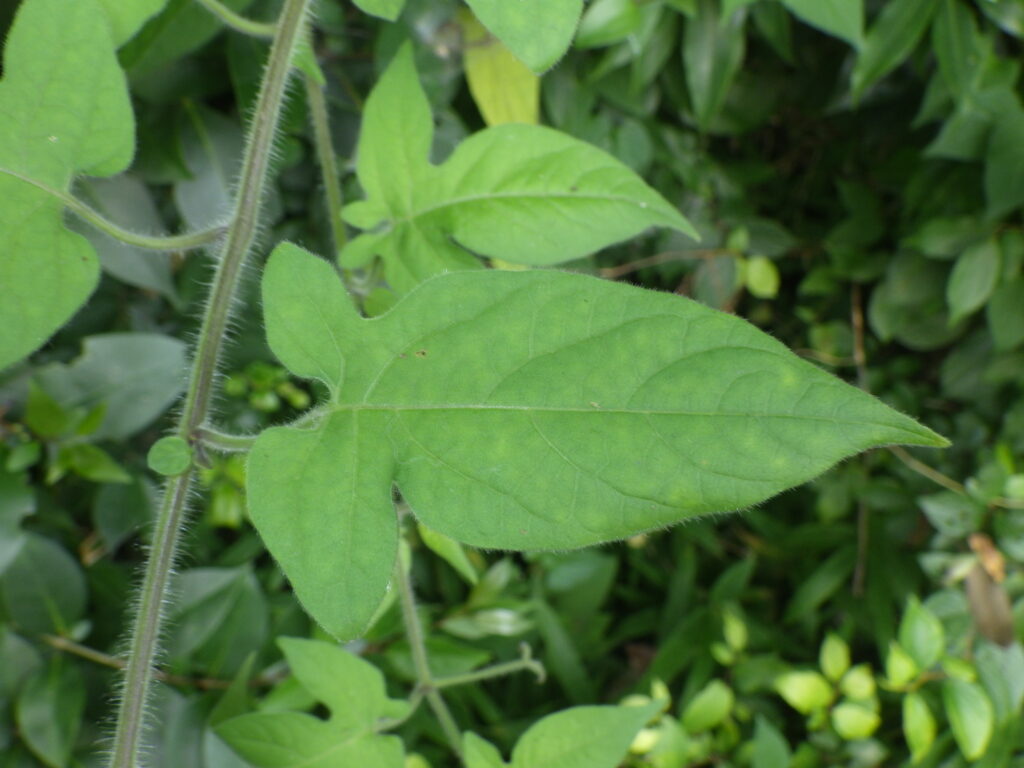
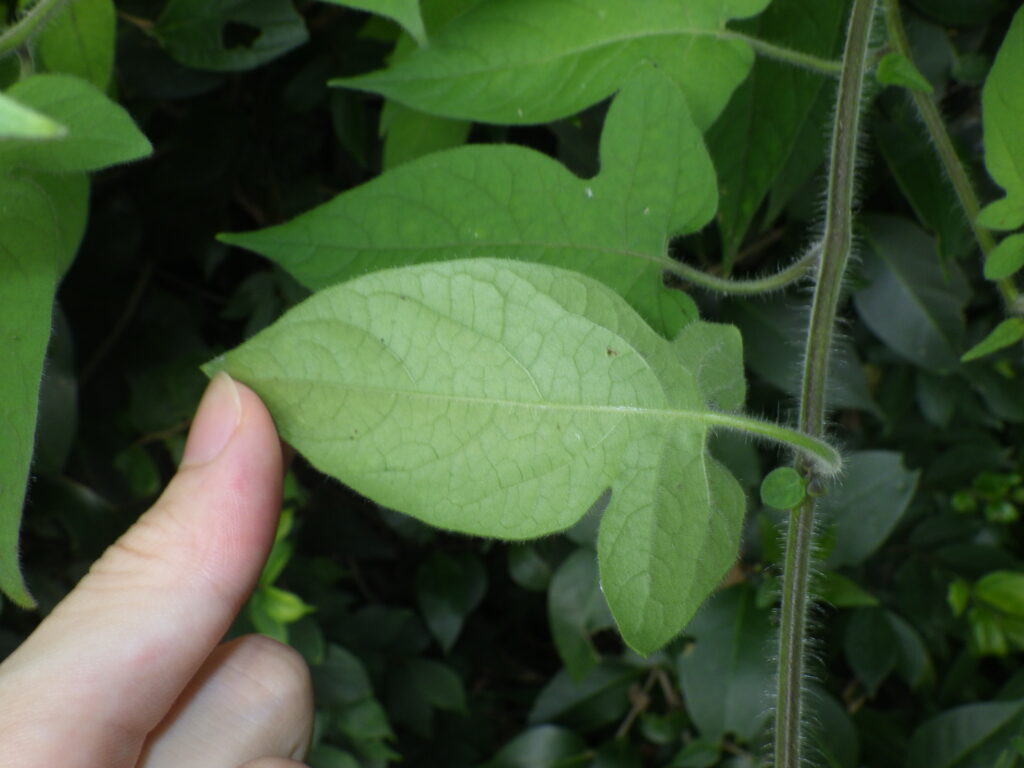
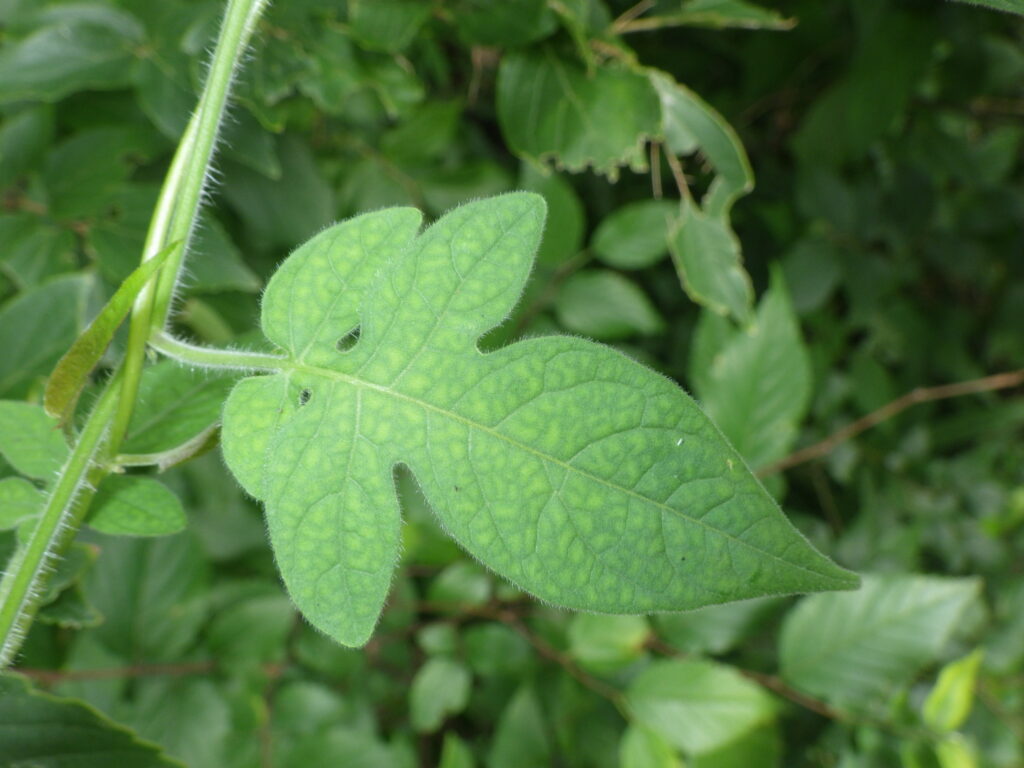
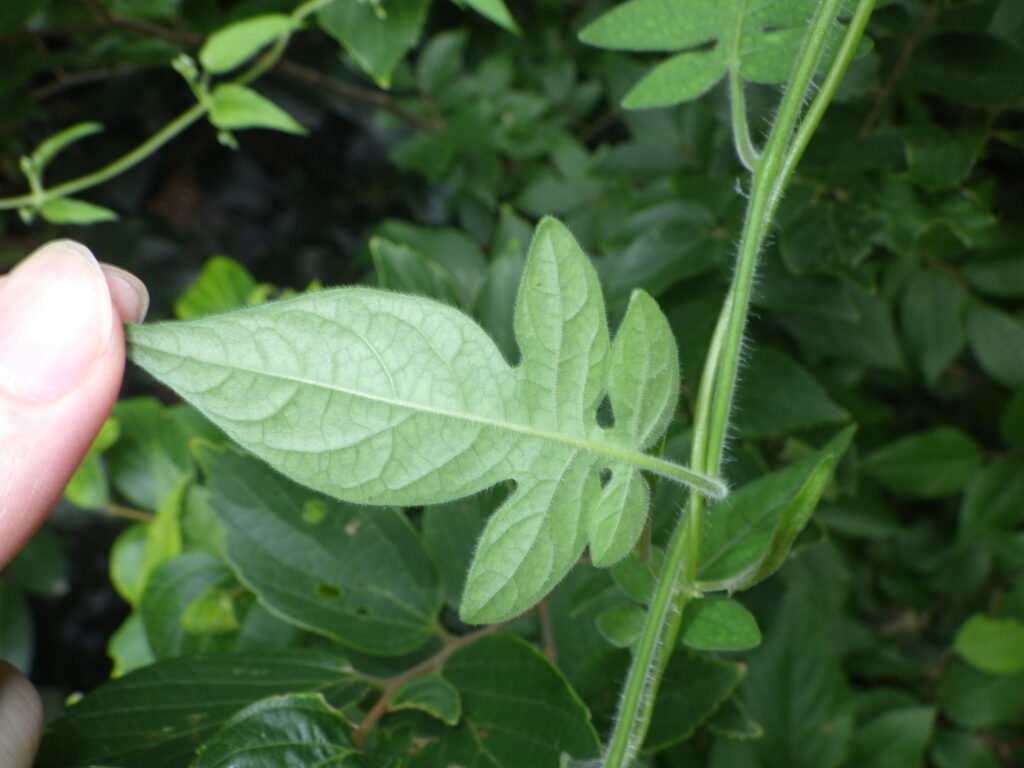
Firstly, in Solanum lyratum, the stem is densely covered with glandular hairs of varying lengths, whereas in Solanum sarmentosum, Solanum holosteoides, and Solanum jasminoides, the stem is either hairless or has only a few soft hairs.
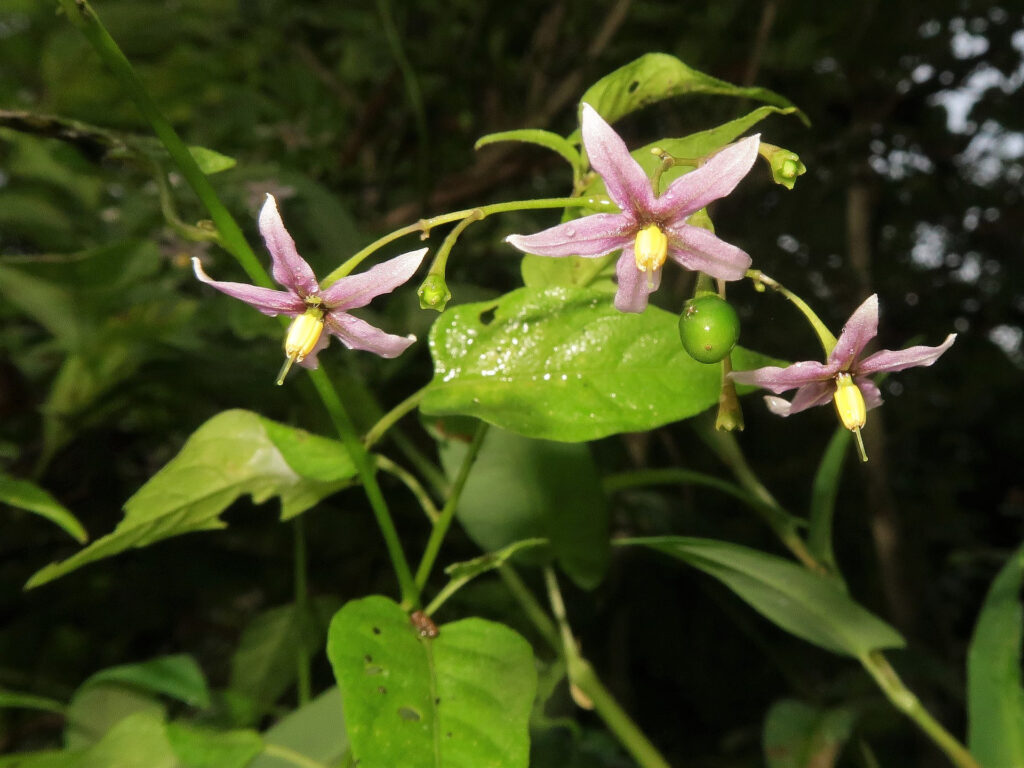
Regarding the remaining three species, the differences are as follows: in Solanum sarmentosum and Solanum holosteoides, the corolla is deeply incised, the lobes sometimes curve backward, and the color is purple with a yellowish-green inner throat; in Solanum jasminoides, the corolla is shallowly incised, the lobes do not curve backward, and the color is entirely white to pale purple.
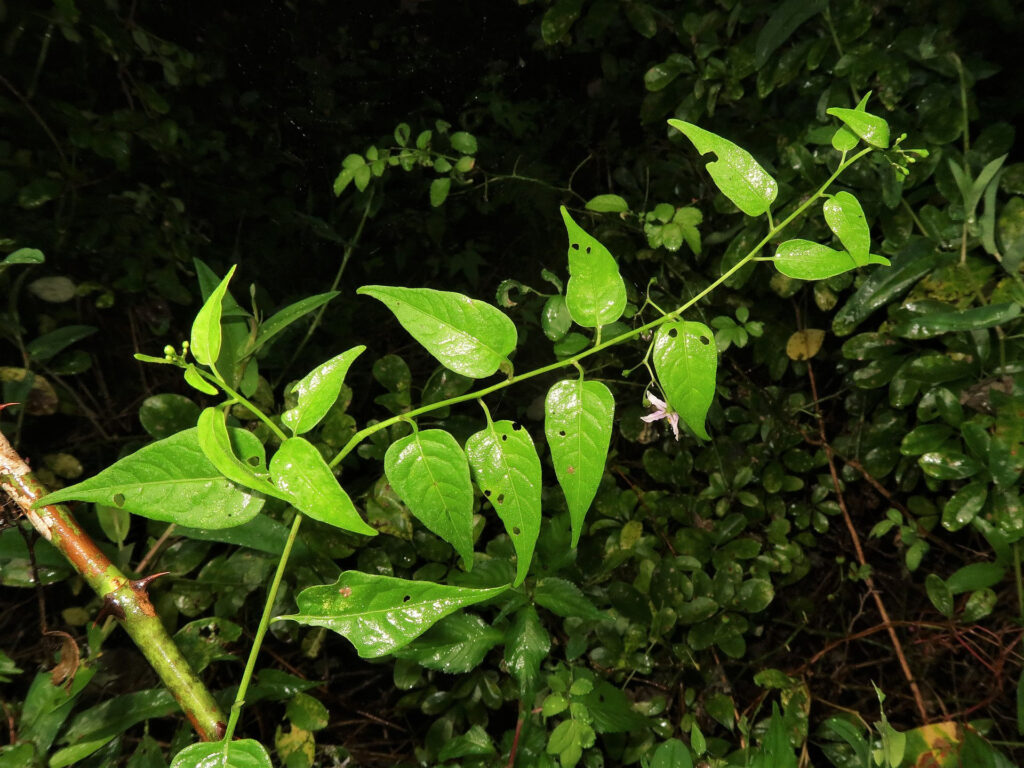
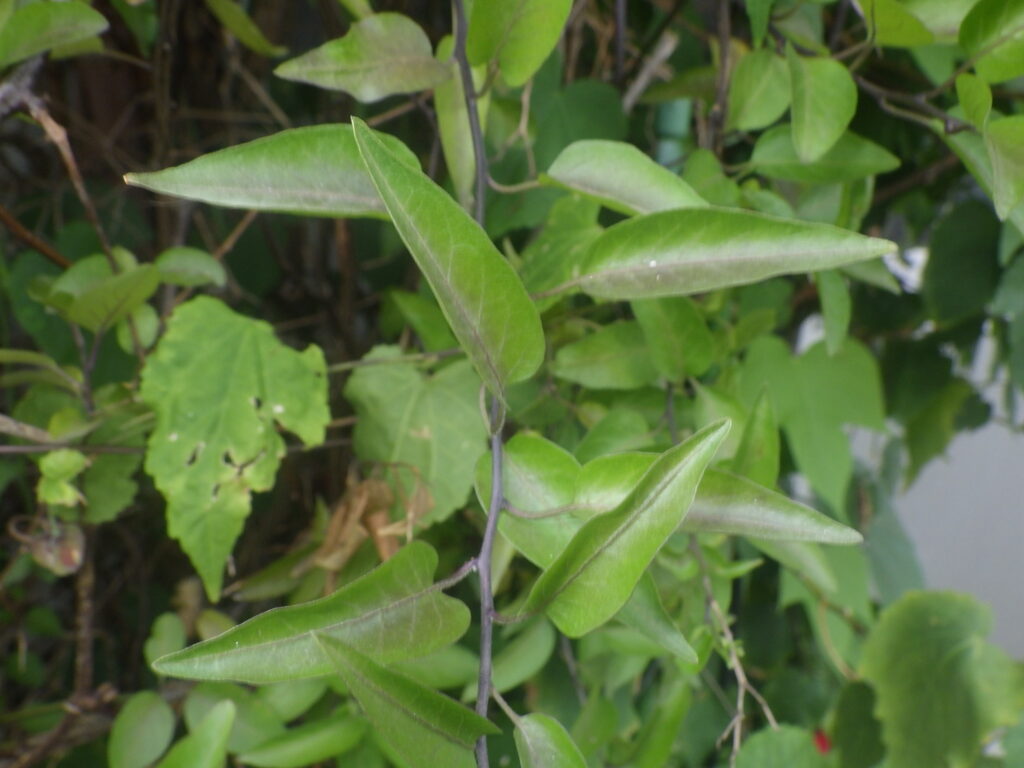
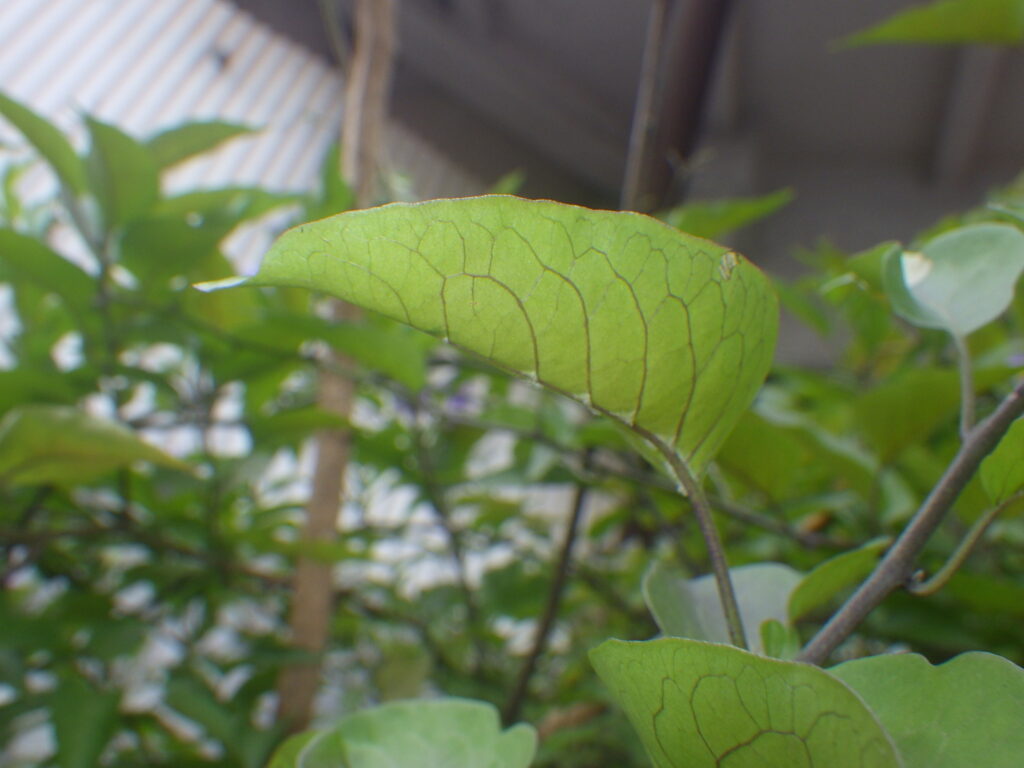
Distinguishing between Solanum sarmentosum and Solanum holosteoides is the most difficult, but in Solanum sarmentosum, the leaves are ovate or ovate-lanceolate, with a heart-shaped, rounded, or truncate base, and entire, wavy, or serrated margins, sometimes 3-5 lobed near the base, while in Solanum holosteoides, the leaves are elliptical or ovate-lanceolate, with a wedge-shaped base that flows into the petiole, and are entire and undivided.
There are many distinguishing features, but the shape of the base of the leaf blade is probably the easiest to identify. The Japanese name "Marubanohoroshi" (round-leaved holly) certainly describes a characteristic feature, but it's important to note that even Yamahoroshi can have entire, undivided margins.
Other differences include the fact that in Solanum sarmentosum, the upper surface of young leaves has distinct hairs and the inner surface of the flower throat is dark purple, while in Solanum sarmentosum, the upper surface of young leaves has scattered dot-like projections and the inner surface of the flower throat is green.

Are there any other similar species?
The Solanum genus includes many other species, but the number of climbing herbaceous plants is limited.
For those who want to know the difference between Solanum species with upright stems and those with woody stems, please see our other article.
What is the structure of a flower?
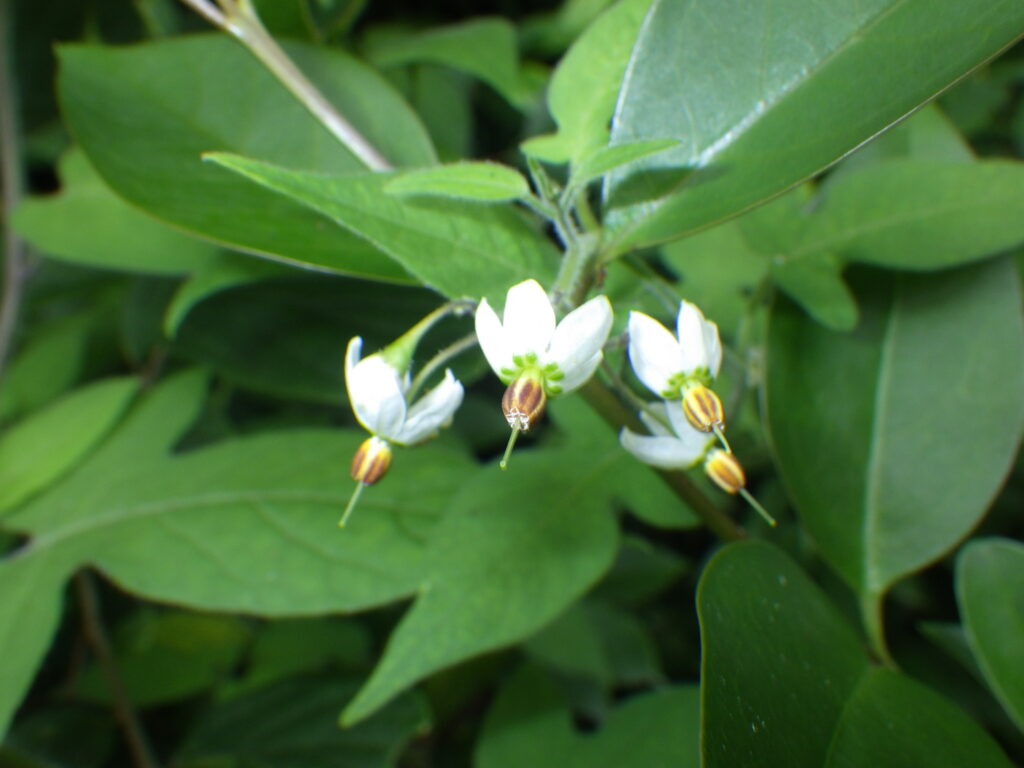
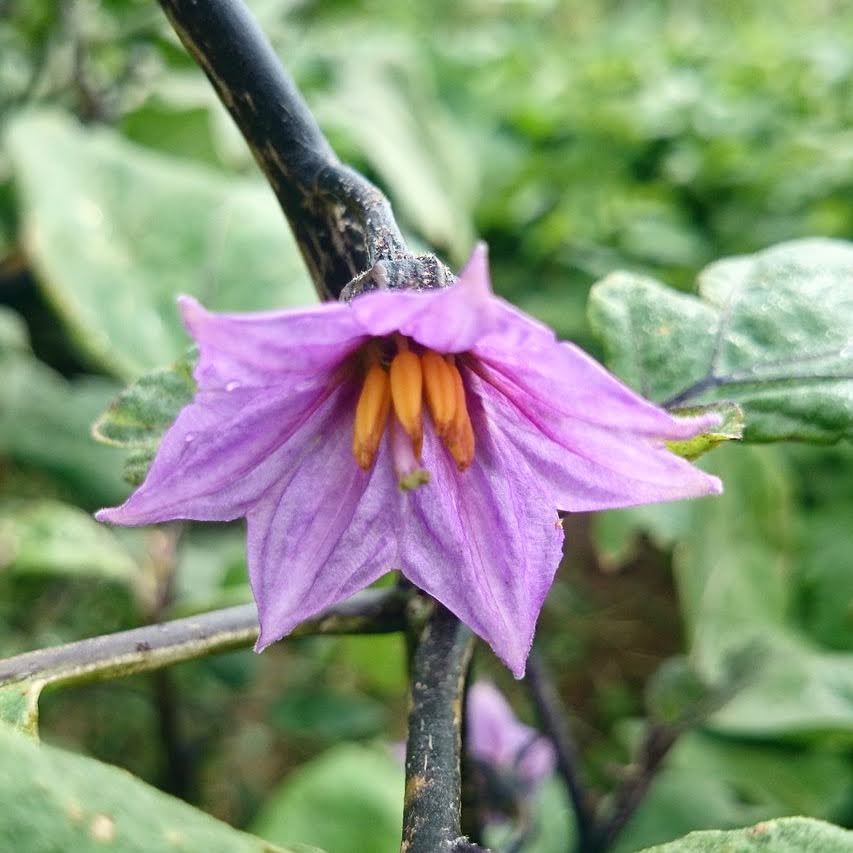
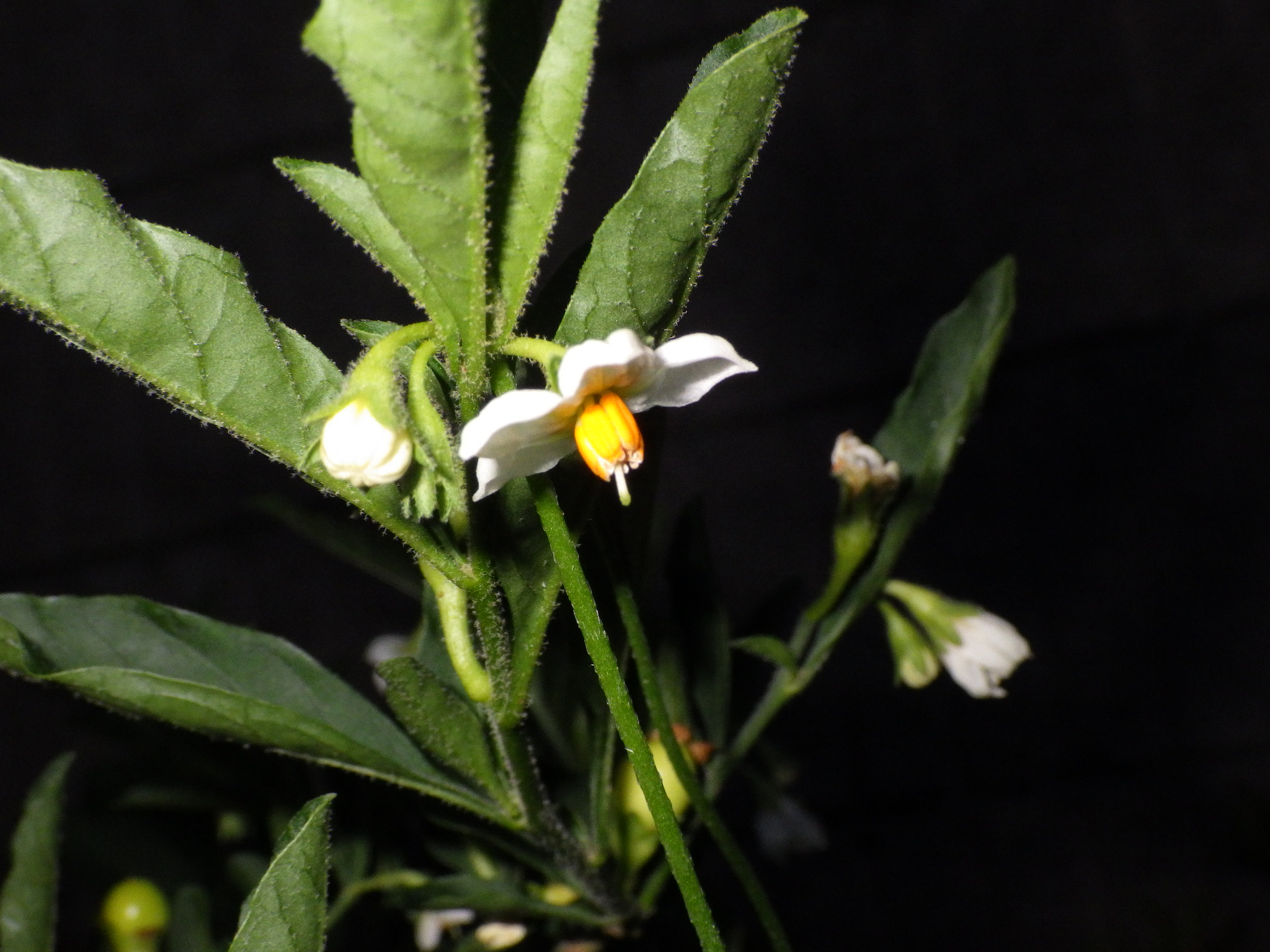
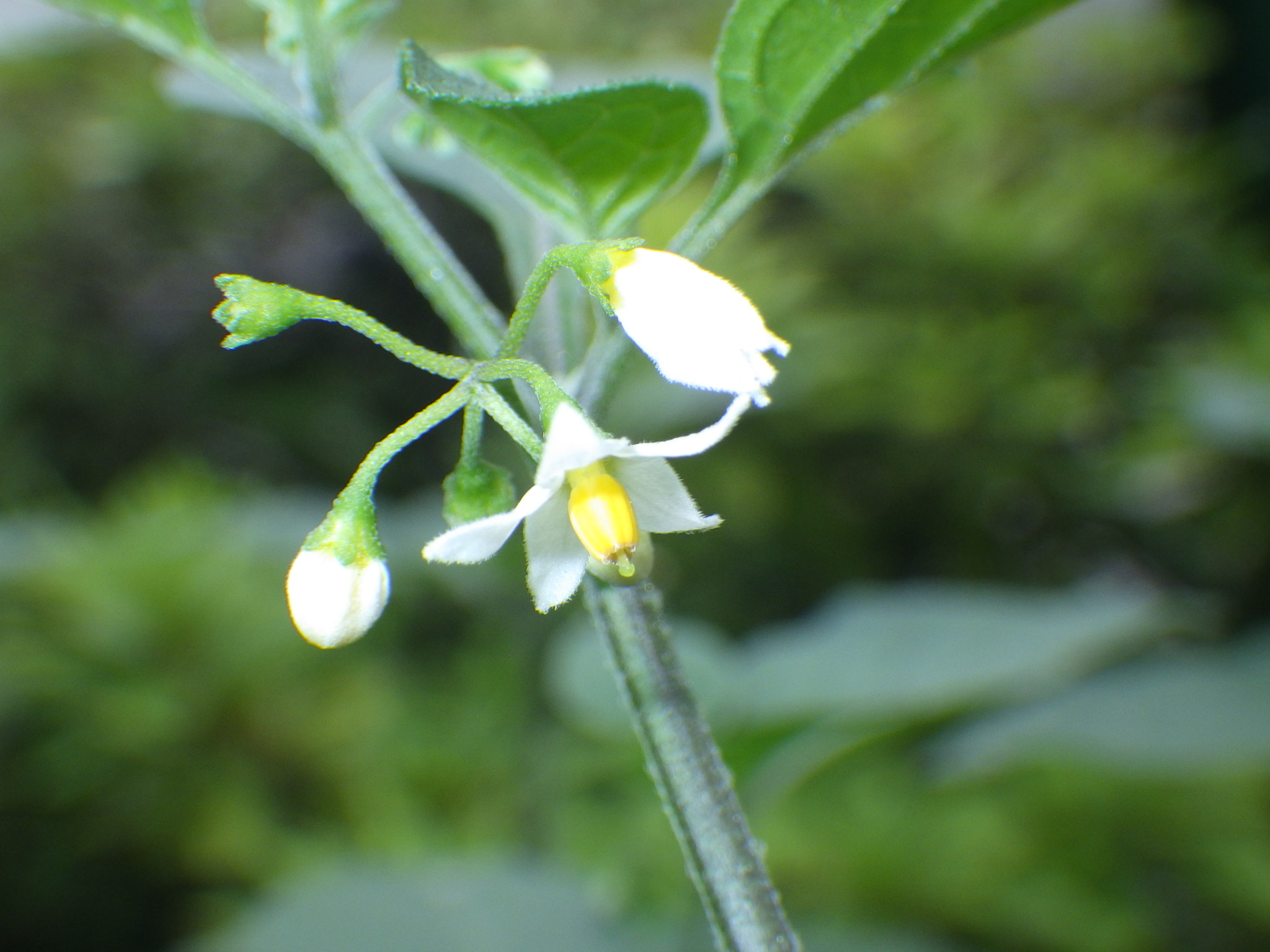
Flowers of the Solanum genus are all fused-petal flowers, and this is true for all four species. In particular, the stamens have a distinctive feature common to all species in the Solanum genus.
This is because the anthers, which are the pollen-containing parts of the stamen, are large and conspicuous, and these anthers taper to a point with a small hole. Such anthers are called "porous anthers" (Shimizu, 2001).
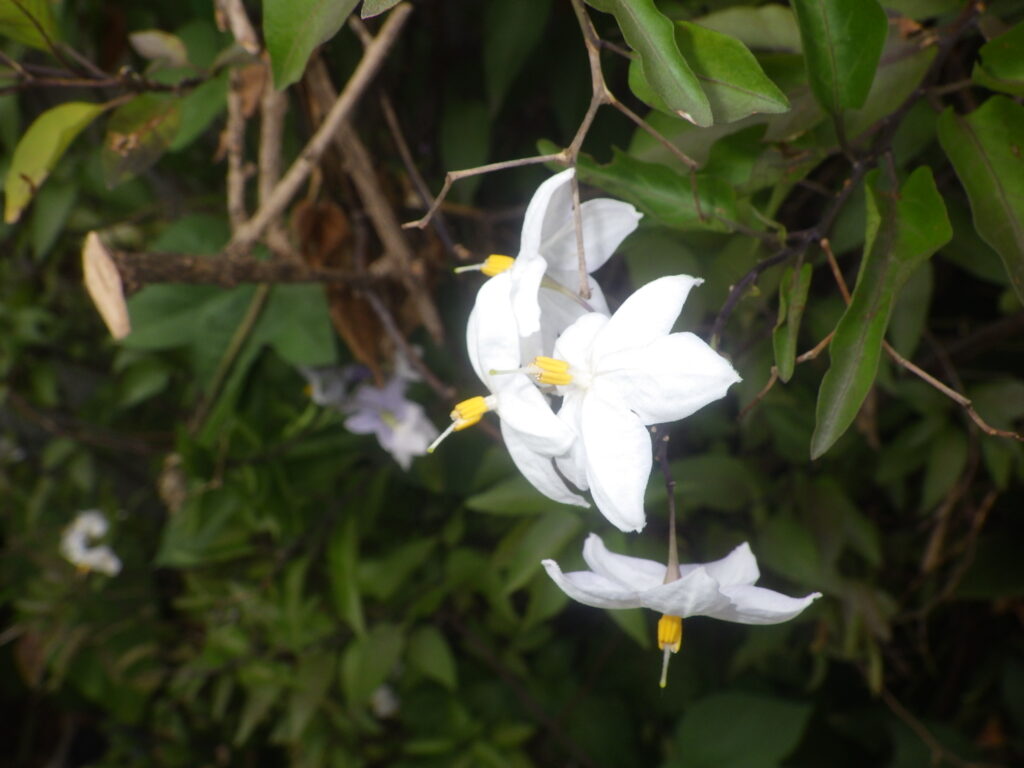
Japanese honeysuckle (Solanum lyratum) blooms from August to September. Numerous flowers are borne in cymose inflorescences. The corolla is white, about 1 cm in diameter, deeply divided into five lobes, with the lobes curving backward. There are five stamens, with thick, short filaments. The anthers are yellow.
Solanum sarmentosum flowers from July to September. It bears sparsely branched cymose inflorescences with several flowers, originating from the opposite side of the leaves or partway up the stem. The calyx is saucer-shaped and has five lobes at the tip. The pedicels thicken slightly below the calyx. The corolla is pale purple, deeply five-lobed, and about 1 cm in diameter. Initially, it spreads flat, but later each lobe curves strongly backward. There are yellowish-green glands at the base of the lobes, and the inner surface of the throat is dark purple. There are five yellow stamens, clustered in the center of the flower and erect. The anthers are oblong, about 3 mm long, and surround the pistil.
Solanum sieboldii flowers from August to September. It produces sparsely branched cymose inflorescences from the middle of the stem or from the opposite side of the leaves. The calyx is saucer-shaped and shallowly 5-lobed. The corolla is pale purple, deeply 5-lobed at the tip, about 1 cm in diameter, with a yellowish-green inner surface of the throat, and the lobes strongly curve backward when open. The anthers are oblong, not tapering at the tip, and about 3 mm long.
Solanum jasminoides flowers from June to October. The inflorescence is terminal or laterally attached, over 5 cm long, and branches many times, although usually only 2-3 times, bearing up to 50 flowers, and is hairless. The calyx is 1-1.5 mm, conical to slightly flattened. The corolla is 1.8-2.2 cm in diameter, white or pale purple, star-shaped, and split about halfway down to the base, with lobes 7-9 x 5-6 mm, spreading out flat when in bloom. The anthers are 3.5-4 mm long and oval-shaped.
What is the structure of the fruit?
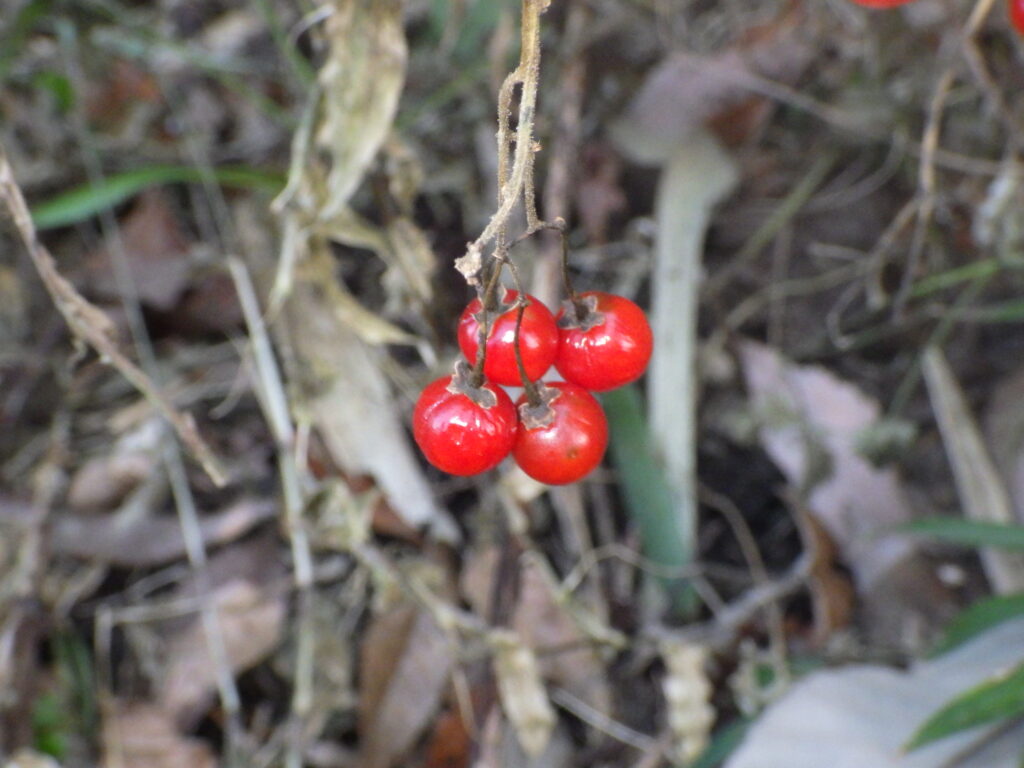
These four species, like other members of the Solanum genus, have berries.
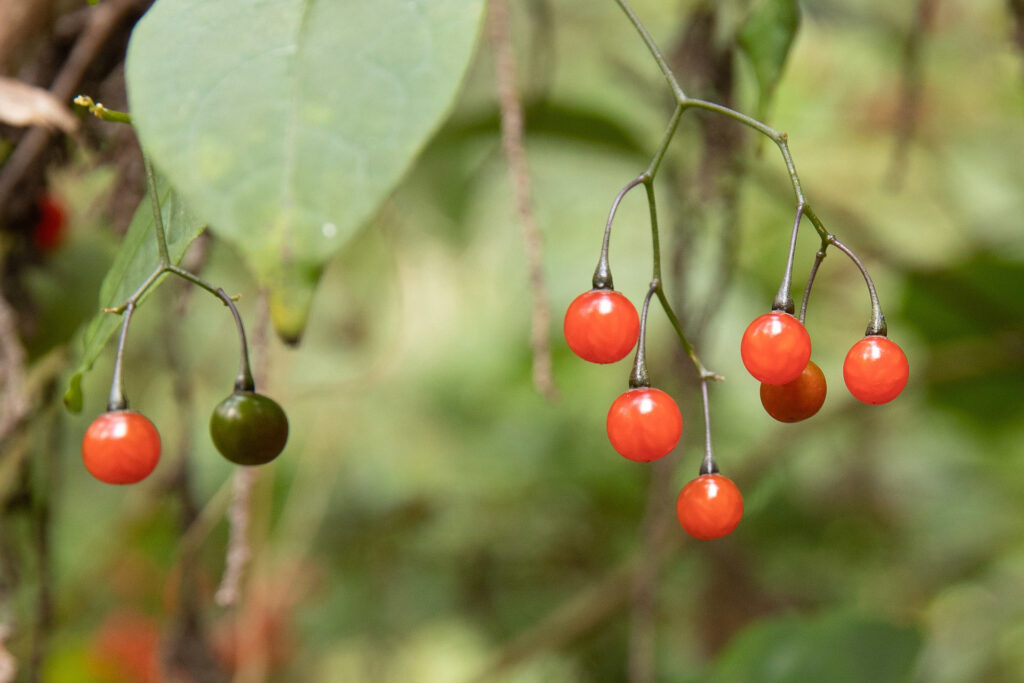
The berries of the Japanese honeysuckle are spherical, about 8 mm in diameter, and ripen to a reddish color.
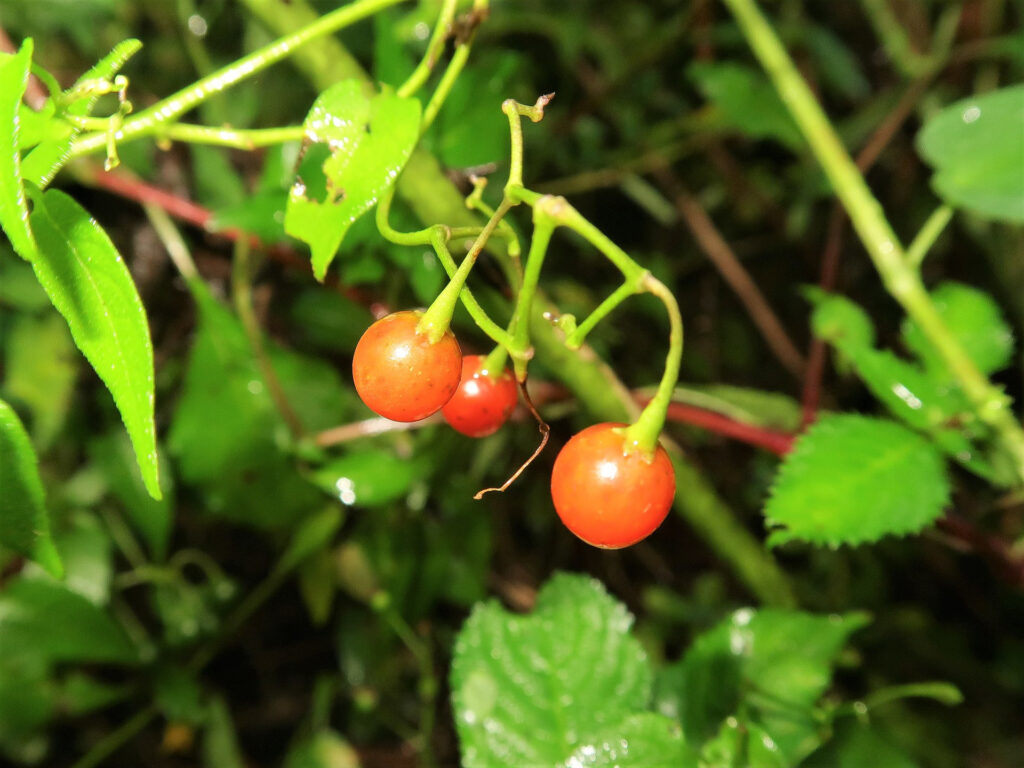
The berries of Solanum sarmentosum are spherical, 6-7 mm in diameter, and occasionally oval-shaped, ripening to red in the autumn. The seeds are approximately 2 mm in diameter.
The berries of Solanum sieboldii are spherical, turning red when ripe, and measuring 7-10 mm in diameter. The seeds are approximately 3 mm in diameter.
The berries of Solanum jasminoides are spherical, about 1 cm in diameter. When ripe, they turn dark purple, and the pericarp is thin and glossy. Each fruit contains 10 to 20 seeds, each about 3 x 2.5 mm, flattened, kidney-shaped, light brown, and has a surface with fine pores.
References
Brazil Flora G. 2023. Brazilian Flora 2020 project. Version 393.387. Instituto de Pesquisas Jardim Botanico do Rio de Janeiro. https://doi.org/10.15468/1mtkaw
Kadota, Y., Nagata, Y., & Azegami, N. 2013. Flowers Blooming in the Mountains (Revised and Expanded New Edition). Yama-kei Publishers, Tokyo. 616pp. ISBN: 9784635070218
Kanagawa Prefecture Flora Survey Association. 2018. Kanagawa Prefecture Flora 2018 (Electronic Edition). Kanagawa Prefecture Flora Survey Association, Odawara. 1803pp. ISBN: 9784991053726
Ohashi, Hiroyoshi; Kadota, Yuichi; Murata, Hitoshi; Yonekura, Koji; and Kihara, Hiroshi. 2017. Wild Plants of Japan (Revised New Edition, Vol. 5: Convolvulaceae to Caprifoliaceae). Heibonsha, Tokyo. 760pp. ISBN: 9784582535358
Shimizu, Takemi. 2001. Illustrated Dictionary of Botanical Terms. Yasaka Shobo, Tokyo. xii, 323pp. ISBN: 9784896944792