Basil, sweet basil, holy basil, and lemon basil all belong to the Ocimum genus of the Lamiaceae family, are native to Asia, and share the common characteristic of having edible leaves. Therefore, many people may not know the differences in their shapes and uses. While "basil" can refer to all members of the Ocimum genus or specifically to Ocimum basil (sweet basil), the others refer to individual species. Each has differences at the "species" level, not just "variety" level, and these differences are reflected in the shape of the flowers and leaves. Historically, there are differences in how basil, holy basil, and lemon basil are used, but considering only current uses in Japan, basil is used in Italian cuisine, holy basil in dishes like gapao rice, and lemon basil in ethnic stir-fries. The flowers are labiate, and the fruits are small nuts. This article will explain the classification, morphology, and uses of the Ocimum genus.
What are basil, sweet basil, holy basil, and lemon basil?
The term "basil" generally refers to a group of plants belonging to the genus Ocimum in the Lamiaceae family, or to a single plant called Ocimum basil (sweet basil).
Ocimum basilicum, commonly known as basil or sweet basil, is a perennial plant native to South Asia, Southeast Asia, and Australia (though it is treated as an annual in Japan as it cannot survive winter there) (RBG Kew, 2023). It is cultivated worldwide for medicinal and culinary purposes, including in Japan, where it is primarily used in Italian cuisine. Hereafter, it will be referred to simply as basil.
Ocimum tenuiflorum, commonly known as holy basil or gapao, is a perennial plant native to South Asia, Southeast Asia, and Australia (though it is treated as an annual in Japan as it cannot survive the winter). It is cultivated in India and Thailand for medicinal and culinary purposes. It is also sometimes cultivated in Japan.
Lemon basil (Ocimum x africanum) is a hybrid of basil (commonly known as Ocimum basil) and American basil (commonly known as Ocimum americanum). It is a perennial plant (though it cannot survive winter in Japan, so it is treated as an annual) native to tropical and subtropical Africa, South Asia, Southeast Asia, and Australia. It is also cultivated in Japan.
All of them belong to the genus Ocimum in the Lamiaceae family, are native to Asia, and have edible leaves. Therefore, many people may not know the differences in their shape or uses.
What are the differences in shape between basil, holy basil, and lemon basil?
On gardening websites, holy basil and lemon basil are sometimes featured alongside basil varieties such as Genovese basil, bush basil, and cinnamon basil.
However, it's important to understand that basil, holy basil, and lemon basil are biologically very different species that do not crossbreed in nature and exhibit significant variation. The term "variety" in biological terms refers to something that has been improved by humans or has slight variations in form.
Biologically, one key difference is that the base of the filaments of the posterior stamens in basil and lemon basil are tooth-like, whereas in holy basil they are toothless (Wu & Raven, 1994).
However, this part is not visible from the outside, and the flowers are usually removed, so it may not be very practical.
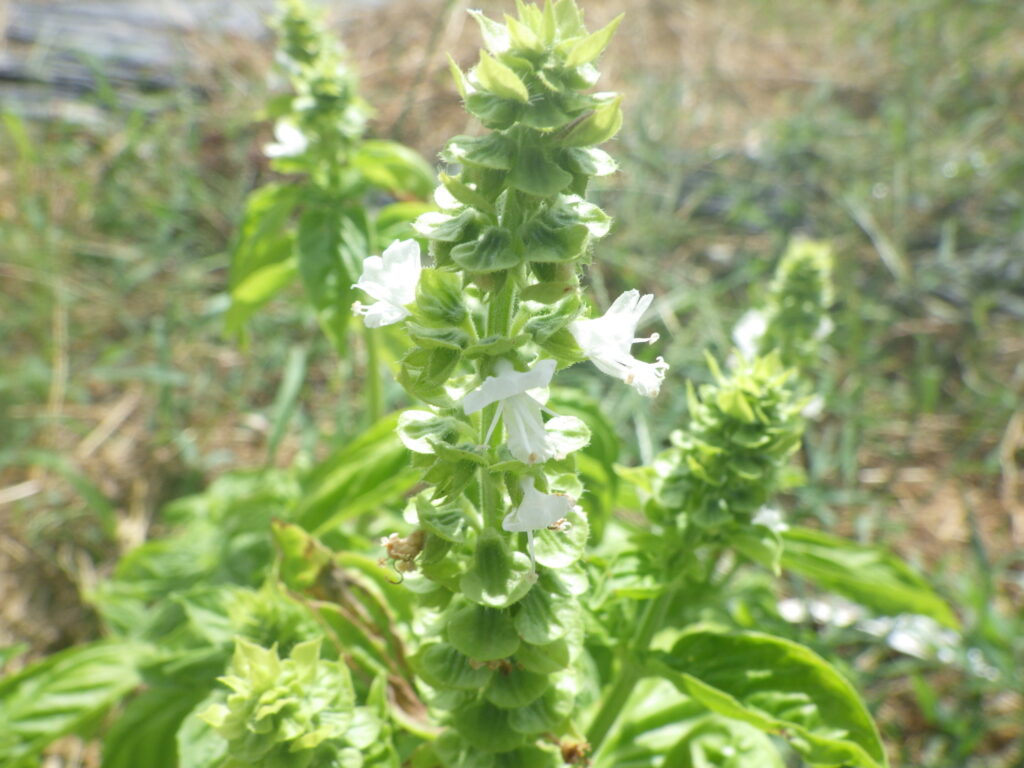
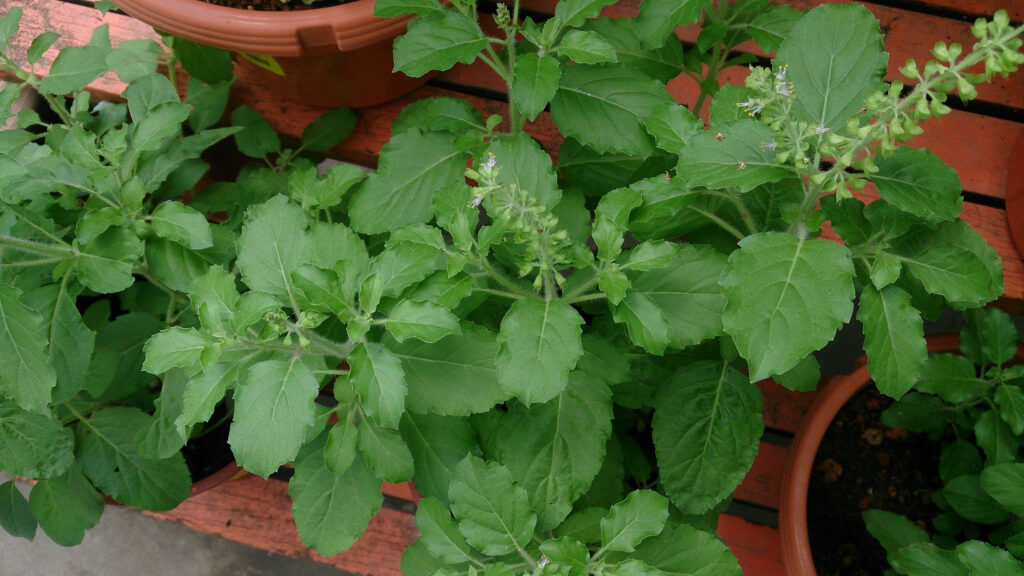
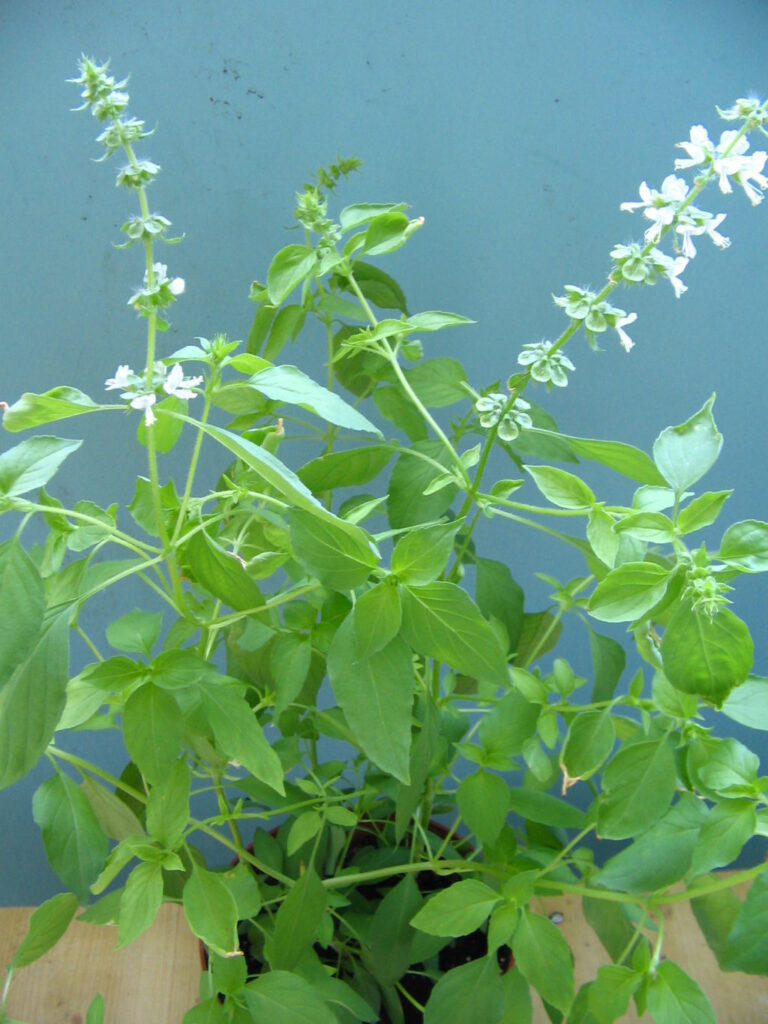
There are other differences in the flowers as well. While the corollas of basil and lemon basil are white, those of holy basil are primarily white but have reddish parts, giving them an overall pink appearance.
While there is considerable variation in the leaves and this doesn't always apply, basil and lemon basil often have low serrations that are nearly entire, whereas holy basil has low serrations that are clearly visible.
Holy basil is characterized by the presence of long hairs on its leaf stalks. However, there are known varieties of basil that also have long hairs. But these are rare in Japan, so this can also be considered a significant distinguishing feature.
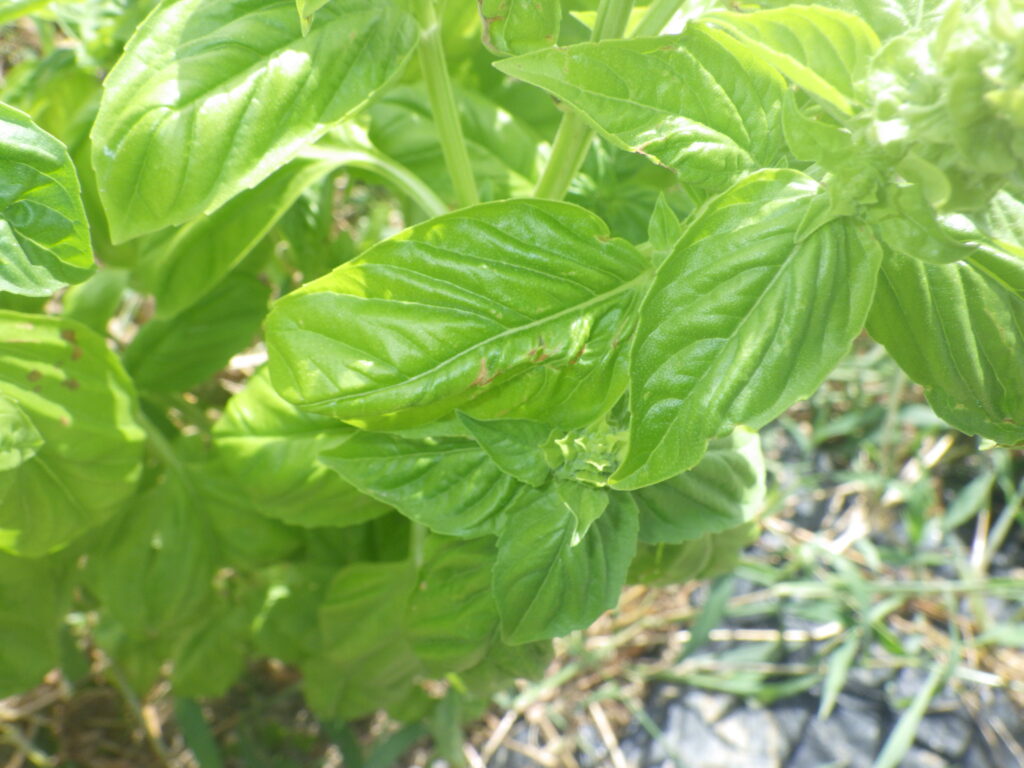
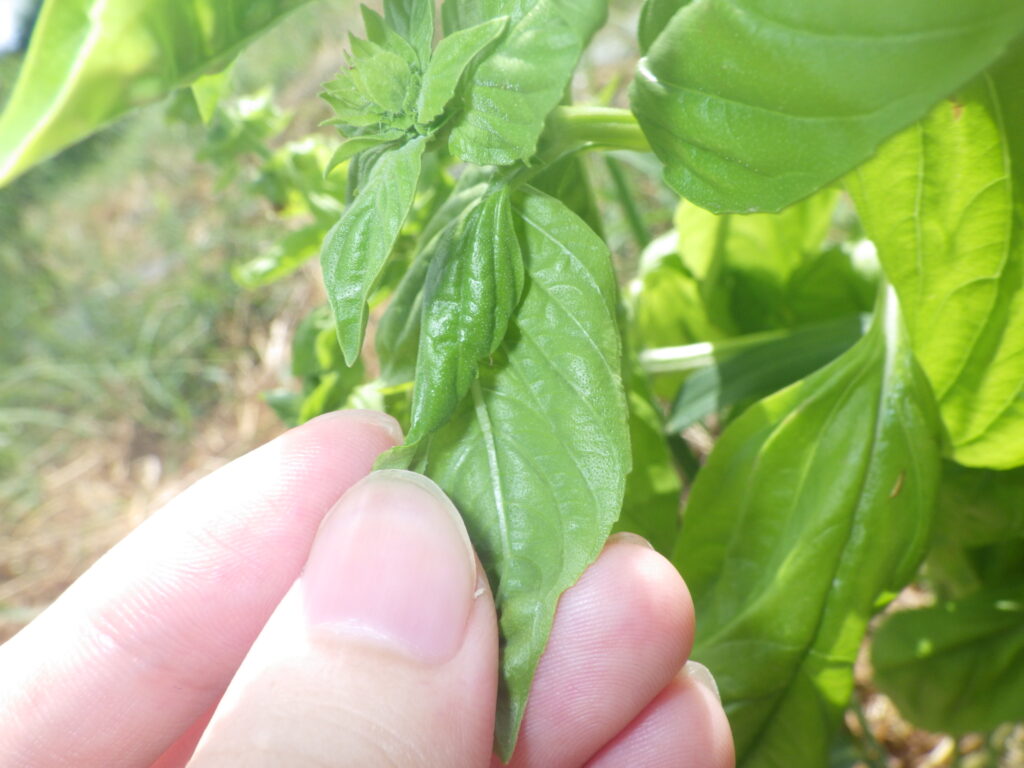
The main difference between basil and lemon basil is that basil leaves are usually glossy, with raised veins and a tendency to curl upwards, while lemon basil leaves are generally less glossy, have less pronounced veins, and do not curl upwards. However, there may be slight variations depending on the variety.
As the name suggests, lemon basil has a lemon flavor, which isn't a physical characteristic, but it can be a clue to distinguish it from other varieties.

What are the differences in how basil, holy basil, and lemon basil are used?
There are considerable historical differences in how they are used.
Although basil is native to Asia, it was already used by the ancient Egyptians and Greeks, and is now used all over the world. Initially, it was mainly used in rituals and for medicinal purposes, but now its uses in cooking have expanded. In Japan, it was originally introduced from Qing Dynasty China as a medicinal herb, but now it is more commonly used in Italian dishes such as pasta, pizza, salads, and pesto.
In terms of taste, it has a refreshing and sweet aroma, and when you put it in your mouth, you feel a slight spiciness after the sweetness.
On the other hand, holy basil is used only in its native Asia. In India, it is used as medicine in Ayurveda, and in Thailand, it is used as a food ingredient (herb) in stir-fries and curries. In Japan, it is perhaps best known in gapao rice. It is also sometimes used to make tea.
In terms of taste, it is said to have a strong aroma, with a spicy kick and a refreshing, minty sensation. The difference from basil is that it lacks a sweet aroma and is spicier.
Lemon basil is widely cultivated from Africa to Asia and is used in Arabic, Indonesian, Filipino, Laotian, Malay, Persian, and Thai cuisine. In Japan, there don't seem to be any particularly specific uses for it, but it is often used in stir-fries and salads.
As the name suggests, it has a lemon flavor.
What is the structure of a flower?
Like many members of the mint family, the genus Ocimum (basil) commonly has labiate flowers. Labiate flowers have a tubular corolla that is divided into two lobes at the tip, resembling lips.
When cultivating this plant, if you allow it to flower, the leaves and stems will harden and the flavor will deteriorate. Therefore, if you are growing it to harvest the leaves, you will need to remove the flowers at the appropriate time.
Basil flowers from July to September. The dense inflorescence is 10-20 cm long and minutely pubescent, while the whorled inflorescence is minutely pubescent or densely pubescent, with the same at the apex. The bracts are sessile, oblanceolate, 5-8 mm long, with a tapering base, ciliate margins, and an acute apex, and are colored. The pedicels are about 3 mm long in flower and less than 5 mm long in fruit. The calyx is campanulate, about 4 mm long and 3.5 mm wide, hairy on the outside and pubescent on the throat of the inside, with a tube about 2 mm long. The central calyx tooth of the upper lip of the calyx is widest, about 2 mm long and 1 mm wide, nearly orbicular, concave, and minutely apex. The lateral teeth are broadly ovate, about 1.5 mm long, and acute at the apex. The calyx teeth of the lower lip of the calyx are lanceolate, about 2 mm long, spine-like at the apex, and ciliate. The calyx persists in fruit, and its veins are prominent. The corolla is purplish or the upper lip is white, with fine hairs on the outside of the expanded part. The corolla tube is about 3 mm long. The upper lip is broad, about 3 mm long and 4.5 mm wide, 4-lobed, and almost flat. The lower lip is purple, about 6 mm long. The stamens are separate, slightly protruding, the two posterior ones are toothed, and have fine hairs at the base.
Holy basil flowers from June to August. It bears dense spikes or panicles 6-8 cm long. The involucral bracts are sessile and heart-shaped, about 1.5 x 1.5 mm, with sharp tips, and the pedicels are 1-1.5 cm long. The pedicels are about 2.5 mm long. The sepals are whorled, 2.5 mm long, and covered with soft hairs, and the corolla tube is about 1.5 mm long. The serrations in the middle of the upper lip are broadly elliptical and abruptly pointed, while the lateral serrations are broadly triangular, shorter and more pointed than the serrations on the lower lip, and the serrations on the lower lip are lanceolate with pointed tips. The corolla is white to reddish, about 3 mm long, slightly raised, and sparsely covered with soft hairs. The upper lip is ovate, less than 1 x 2.5 mm, and the lower lip is oblong and flattened, about 1 x 0.6 mm. The stamens protrude slightly. The base of the posterior filaments is hairy.
Lemon basil flowers from July to September. Its flowers are very similar to those of regular basil.
What is the structure of the fruit?
The fruits of the Ocimum genus are all small nuts. These nuts are small, non-splitting nuts in which a hard, woody pericarp encloses a single seed. They absorb moisture when wet. The Japanese name "mebouki" (meaning "basil") is said to have originated from the fact that when the fruit absorbs moisture, it quickly becomes covered in a jelly-like substance, which was useful for removing debris from the eyes.
Basil nuts are dark brown, oval-shaped, about 2.5 mm long and 1 mm wide, and have concave glandular dots.
The nutlets of holy basil have a brown, ovate ovary, measuring approximately 1 x 0.7 mm, and are dotted with concave glands.
References
RBG Kew. 2023. The International Plant Names Index and World Checklist of Vascular Plants. Plants of the World Online. http://www.ipni.org and https://powo.science.kew.org/
Wu, ZY, & Raven, PH (Eds.). 1994. Flora of China (Vol. 17 Verbenaceae through Solanaceae). Science Press, Beijing, and Missouri Botanical Garden Press, St. Louis. 342pp. ISBN: 9780915279241