plant

Sponsored Link
plant

What are the differences between Bupleurum falcatum and Bupleurum chinense? We'll explain how to distinguish between similar species! Why are they used in traditional Chinese medicine? Why are they endangered? Do flies come to the flowers to lick the nectar?

Bupleurum falcatum and Bupleurum chinense are both yellow-flowered plants belonging to the Apiaceae family that grow in sunny grasslands, so it can be difficult to distinguish between them. The difference lies in whether the base of the stem leaves clasps the stem or not. While it may not be possible to distinguish them by the shape of the flowers, there are differences in the shape of the involucral bracts...
plant

What are the differences between trumpet vine and American trumpet vine? What are the differences between it and bellflower? We'll explain how to distinguish between similar species! Is it really non-toxic and actually poisonous?! Did they follow separate evolutionary paths in the Old World and the New World?!

The trumpet vine (Campsis grandiflora), American trumpet vine (Campsis radicans), and bellflower (Campsis lanceolata) are three species of climbing horticultural plants native to North America, commonly used as garden trees and for landscaping. Distinguishing between them is easy if they are flowering; if that's not possible, you'll need to examine the underside of the leaves closely, although the differences are minimal...
plant

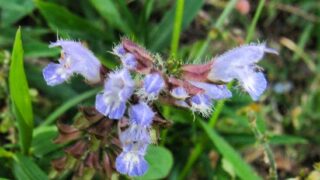
What are the differences between *Salvia japonica*, *Salvia japonica*, *Salvia japonica*, and *Salvia japonica var. alpina*? We'll explain how to distinguish between similar species! Did the flowers fit snugly onto the bees, leading to successful pollination?

Salvia japonica, Salvia japonica, Salvia japonica in autumn, and Salvia japonica in mountain are all members of the Salvia genus, known as wildflowers of Japan, but their similar names can sometimes lead to confusion. These similarly named Salvia species can be distinguished by carefully observing the structure of their corollas, stamens, and leaves...
plant

What are the differences between Spiraea thunbergii and Prunus serrulata? We'll explain how to distinguish between similar species! Is the claim that they're related to Sen no Rikyu a myth? What role do the green parts of the flowers play?

Spiraea thunbergii and Prunus serrulata are native to China, and Spiraea thunbergii in particular is commonly cultivated in tea gardens and ordinary gardens in Japan. Prunus serrulata is also cultivated, though less frequently. These two species can be reliably distinguished by the serrations on their leaves, and they can also be distinguished by their flowers...
plant

What are the differences between Adenophora triphylla, Adenophora fukushimaensis, and Campanula punctata? We explain how to distinguish between similar species! Did the blue flowers only produce nectar at night?! An unexpected adaptation that belies their appearance.

Adenophora triphylla, Adenophora fukushimaensis, and Campanula punctata are representative Japanese herbaceous plants that grow in forest edges and other areas, bearing numerous purple flowers. All belong to the Campanulaceae family, genus Adenophora, and are similar in that they grow in forests and bear downward-facing purple flowers, which can sometimes make them difficult to distinguish. However...
plant

What are the differences between *Syzygium rufinerve*, *Syzygium rufinerve* (Javan syrup), and *Syzygium rufinerve*? We'll explain how to distinguish between similar species! Do birds visit the bushy flowers? And can they even form fruit without pollination?!

Myrtus communis, also known as rose apple or adek, is a plant belonging to the Myrtaceae family, genus Myrtus, and is well-known for its entire leaves and edible fruit. While you might see it in botanical gardens or in Okinawa, it's a tropical plant, so it's rarely seen in mainland Japan, and many people don't know how to distinguish it from other plants...
plant

What are the differences between Mitsumata and Ganpi? We'll explain how to distinguish between these similar species! Why is Mitsumata used as the raw material for Japanese banknotes? Do flowers require insects with long mouths to thrive?

Both Mitsumata and Ganpi belong to the Thymelaeaceae family and are used to make washi (Japanese paper). Their flowers are quite similar in shape. However, despite being in the same family, Mitsumata and Ganpi belong to different genera, and a closer examination of their flowering periods and inflorescence shapes reveals various differences. Ganpi was the first to be used for washi...
plant

What are the differences between Erythrina variegata, Erythrina crista-galli (American Erythrina), and Coral Tree? We explain how to distinguish between similar species! Is it an invasive species in Okinawa? Why is it Okinawa's prefectural flower? Did the Erythrina genus evolve its pollination strategy using hummingbirds in the New World?

The three species of Erythrina variegata (Deigo), Erythrina variegata (American Erythrina), and Coral Tree (Erythrina crista-galli) are relatively common in Japan and are cultivated for ornamental purposes. They are sometimes confused with each other because they have red flowers and trifoliate compound leaves. While the leaves are very similar, careful observation of the leaflet shape, thorns, and petioles is important...
plant

What are the differences between *Cirsium japonicum*, *Cirsium nipponicum*, and *Cirsium nipponicum*? We explain how to distinguish between similar species! Did the flowers release pollen in response to touch?

Thistle (Cirsium japonicum), field thistle (Cirsium nipponicum), and American thistle (Cirsium nipponicum) all belong to the genus Cirsium, and these three species are representative of those found in populated and urban areas. All three have reddish-purple flowers, and their leaves differ in shape between basal and stem leaves, and they are very thorny. The genus Cirsium is extremely diverse in Japan, and accurate identification...
plant

What are some species similar to the winged bean (Psopogon pedunculosa)? What are its nutritional benefits? Is it poisonous? Is it true that its origin is unknown? Does the flower cleverly utilize both self-pollination and cross-pollination?

While winged beans are not very familiar to Japanese people, they are widely cultivated in equatorial countries with high temperatures and humidity, and can also be found in Okinawa and the Ogasawara Islands. Similar species are found only in Africa, and there are basically no species in Japan that are confused with winged beans. They are primarily used for food and are rich in nutrients...
Sponsored Link