Ficus microcarpa (Akou) and Ficus benghalensis (Gajumaru) are known as two "strangler figs" in southern Japan, characterized by their drooping aerial roots and the formation of syconium receptacles. Ecologically, they are similar, and it can be difficult to distinguish between them. However, there are significant differences in leaf veins and leaf length between Akou and Gajumaru. There are also differences in how they extend their aerial roots. Ecologically, while Akou is indeed a "strangler fig," it can also grow independently. On the other hand, Gajumaru appears quite aggressive, attempting to strangle other trees even after strangling them. So where are the flowers of these two species? At first glance, Akou and Gajumaru produce what appear to be "fruits," leading you to believe they don't have flowers. However, these "fruit-like" structures are called syconium receptacles, and the actual flowers are hidden inside. Only one specific species of dwarf wasp visits these receptacles. This flower doesn't simply pass on pollen and nectar to insects; instead, it provides its female flowers as food for the larvae of fig wasps, which attract adult female wasps to lay their eggs. Meanwhile, the banyan tree and the fig tree complete pollination during the wasp's migration. This kind of relationship is widely observed in the fig genus and represents co-evolution. After pollination, the syconium transforms into a fruit sac, and then the seeds are dispersed by birds or fruit bats. This article will explain the classification, life history, pollination ecology, and seed dispersal of the banyan tree and the fig tree.
- Two species found in southern Japan that produce drooping aerial roots and syconia.
- What is the difference between a Ficus microcarpa and a banyan tree?
- Are there any other similar types?
- Was the banyan tree a opportunistic "strangler fig"?
- Is the banyan tree's method of "strangling" more intense than that of the fig tree?
- Is it true that banyan trees like the Japanese Ficus microcarpa and the Ficus regia don't have flowers?
- How do banyan trees like the fig tree and the Ficus microcarpa pollinate using dwarf wasps?
- The "obligate pollination symbiosis" system common to the fig genus
- The flower receptacle transforms into a fruit receptacle, and the seeds are dispersed by birds and bats.
- References
- Source
Two species found in southern Japan that produce drooping aerial roots and syconia.
Ficus superba, also known as Akou, is an evergreen tree distributed along the coasts of Shikoku, Kyushu, and the Ryukyu Islands in Japan, as well as from Southeast Asia to southern China. It grows in lowland tropical rainforests and on rocky areas and outcrops of limestone where other plants have difficulty growing (Tsuchiya & Miyagi, 1991; Otani, 2020). One theory about its Japanese name is that its small red fruit resembles a baby ("ako" in the Wakayama and Kochi dialects).
The banyan tree , Ficus microcarpa, is also known as the banyan tree (Yōju). It is distributed in the southwestern islands of Japan, south of Yakushima and Tanegashima; southern China; Taiwan; Bhutan; India; Sri Lanka; Nepal; Southeast Asia (Malaysia; Myanmar; Thailand; Vietnam); New Guinea; and northern Australia. It is an evergreen tree that grows in mountainous and lowland areas. One theory about its Japanese name is that it is a corrupted form of the word "karumaru," meaning "to entangle" or "to get tangled," referring to the appearance of its trunk and aerial roots.
Both belong to the fig genus of the Moraceae family and are distributed in southern Japan. They are similar in that they have three prominent veins at the base of their leaves, hang down aerial roots, and produce round, swollen organs called receptacles. In addition, unlike other fig species in Japan such as Ficus erecta, both are monoecious, meaning they have both male and female flowers on the same plant.
What is the difference between a Ficus microcarpa and a banyan tree?
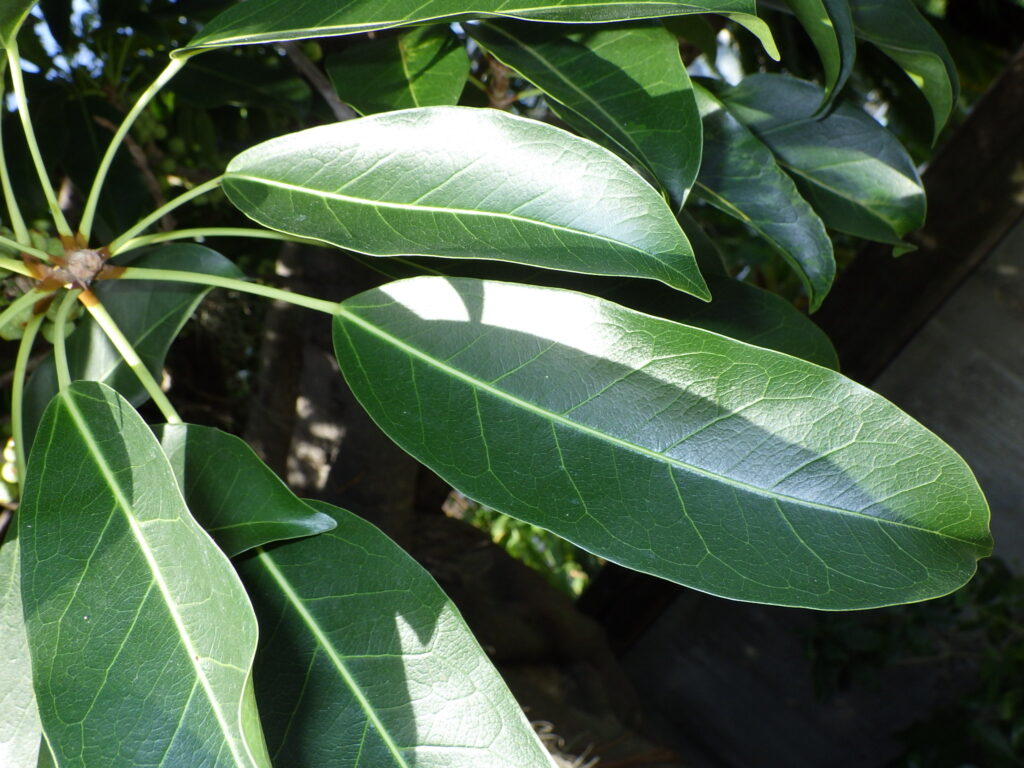
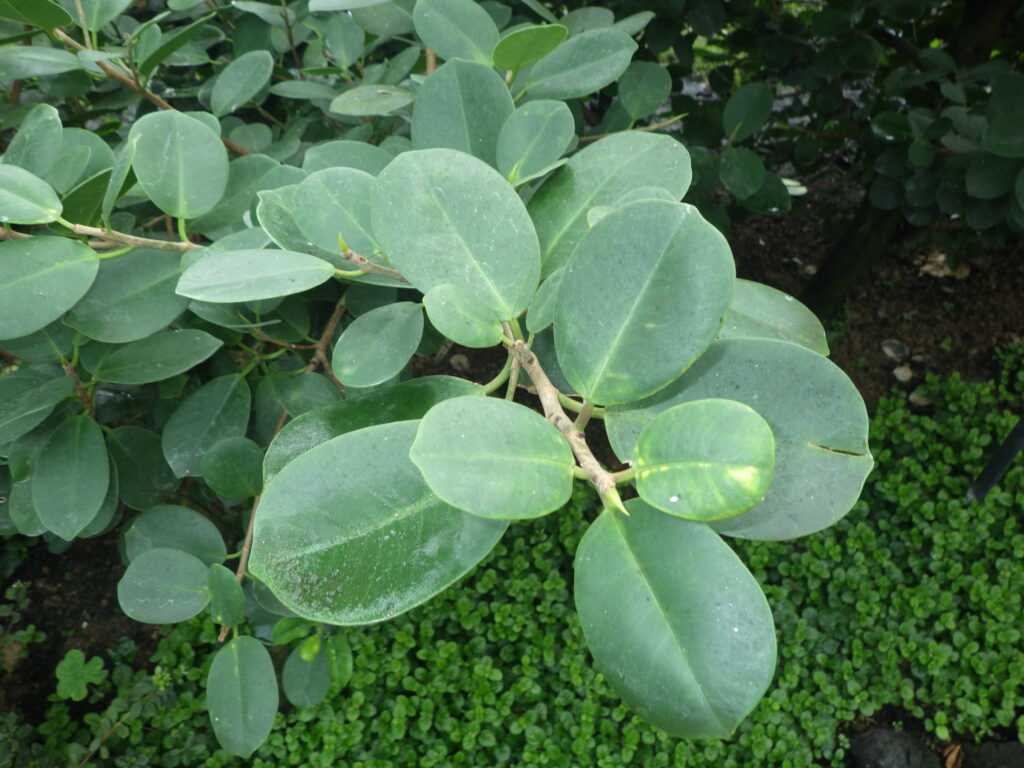
However, there are significant differences in leaf shape between the Ficus microcarpa and the banyan tree (Hayashi, 2014).
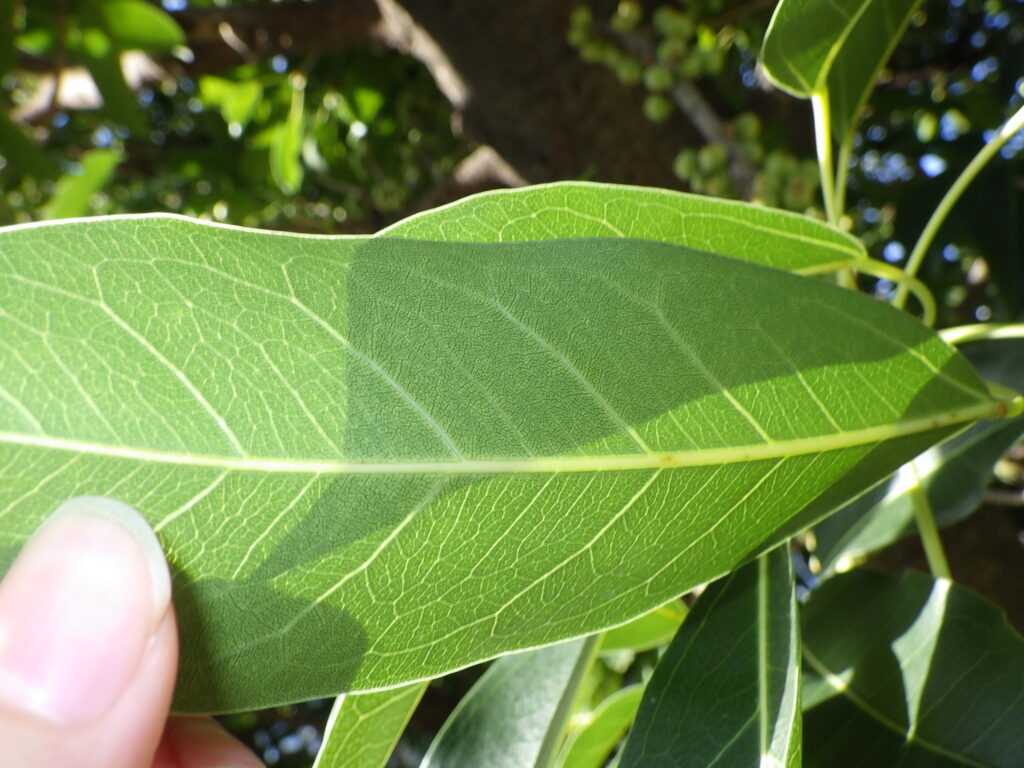
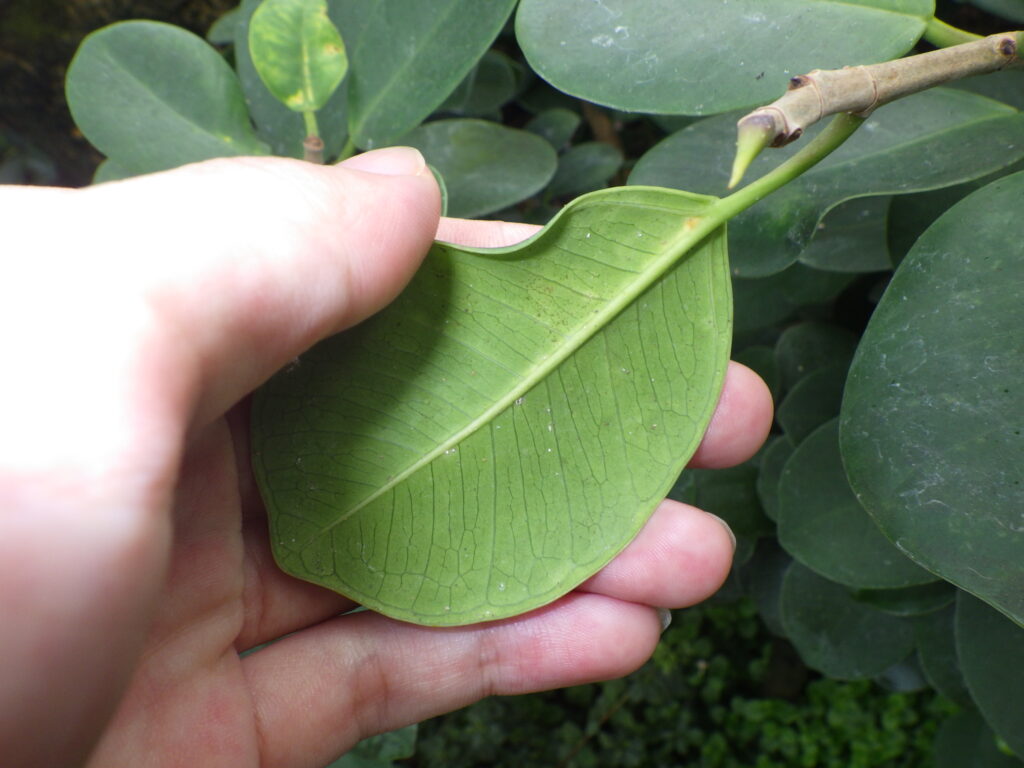
In the Ficus microcarpa (Ako), the lateral veins are clearly visible throughout the leaf, with few parts growing at an obtuse angle from the main vein, and countless parts growing in a reticulate pattern. In contrast, in the Ficus benghalensis (Gajumaru), the lateral veins are faint and inconspicuous, there are many parts growing at an obtuse angle from the main vein, and the reticulate pattern is hardly visible.
In short, the Ficus microcarpa (Akou) has finer, more detailed leaf veins that can be seen.
In Ficus microcarpa, the three-veined pattern is clearly visible on both the upper and lower surfaces of the leaf, but in Ficus benghalensis, it may not be prominent on the upper surface of the leaf, but is clearly visible on the lower surface.
Furthermore, while the leaf blades of the Ficus microcarpa are long, measuring 10-20 cm and the petioles 2-7 cm, the leaf blades of the Ficus benghalensis are short, measuring 4-10 cm and the petioles 1-2 cm.
There are also differences in how they develop their aerial roots.
While the banyan tree (Ficus microcarpa) often extends long, octopus-tentacle-like aerial roots from low places and creeps along rocks, the Japanese banyan tree (Ficus serrata) usually hangs down thin, string-like aerial roots from high places.
Let's confirm the above.
In addition, Taiwan is also known for a variety of banyan tree called Ficus microcarpa f. crassifolia, which has particularly round leaves.
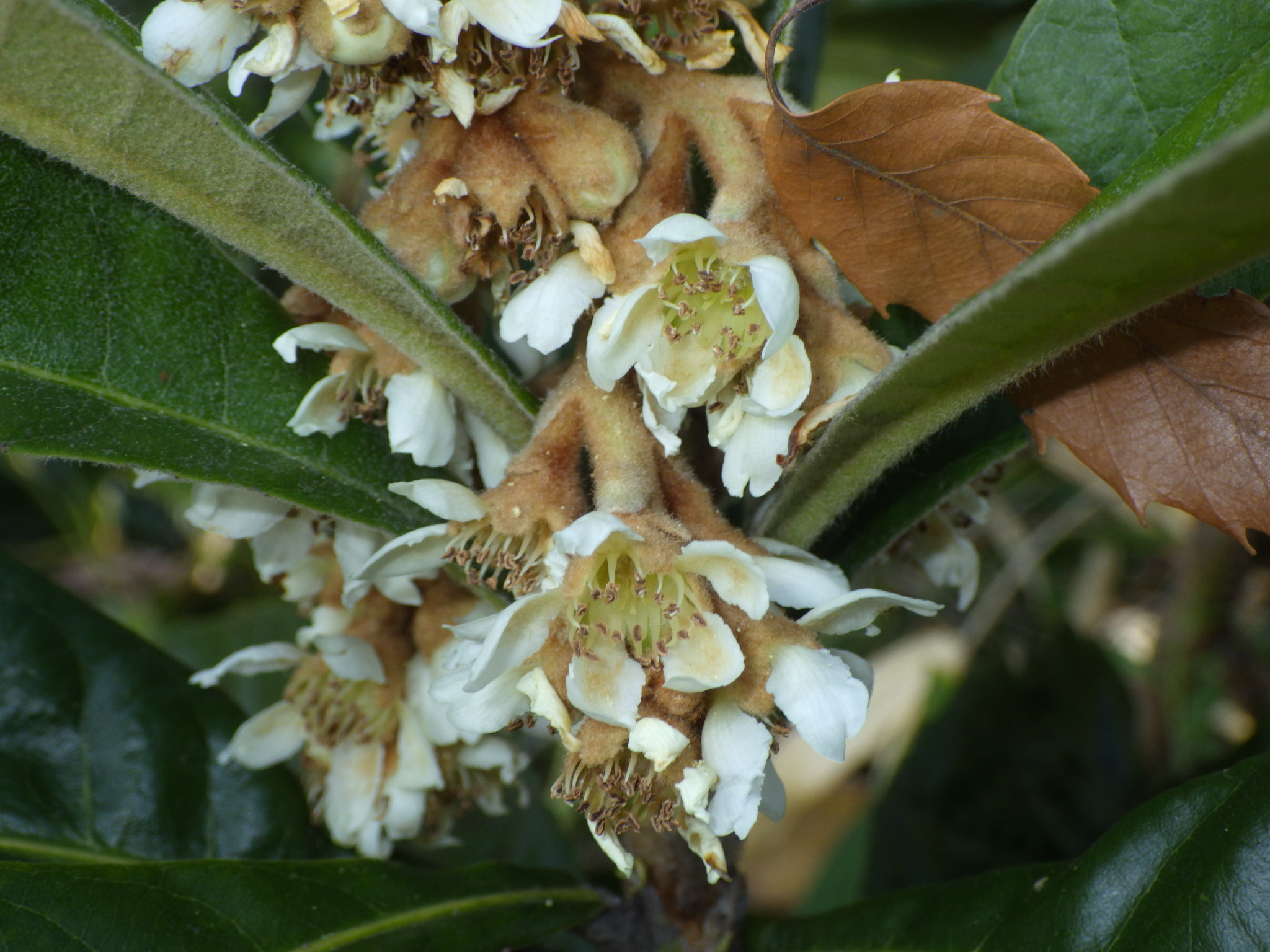
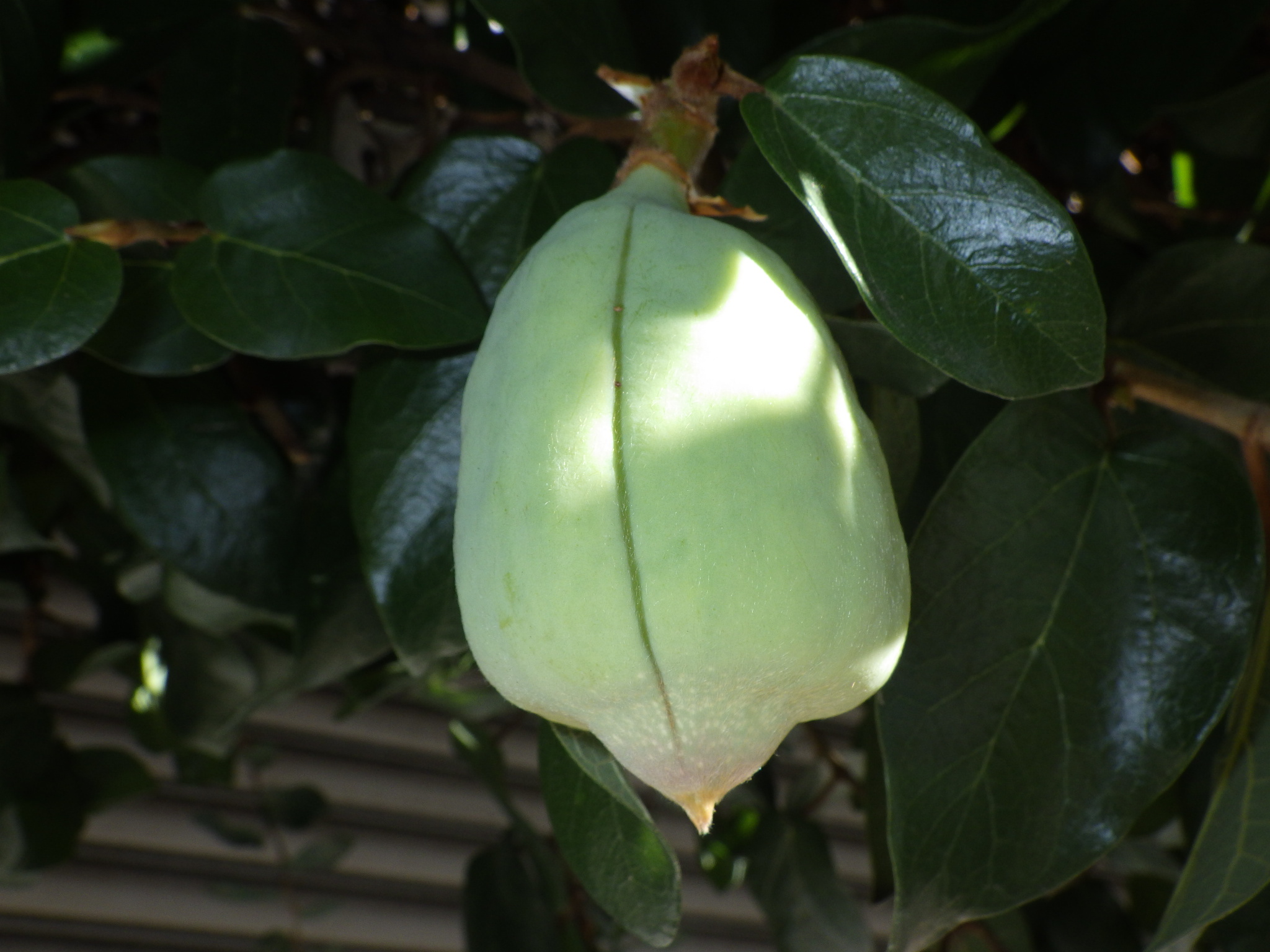
While there are many other known species in the fig genus, such as Ficus erecta, the species found on the Japanese mainland can be distinguished from the two species mentioned above by the fact that the base of the leaves is shallowly indented or the veins on the underside of the leaves are three-dimensional.
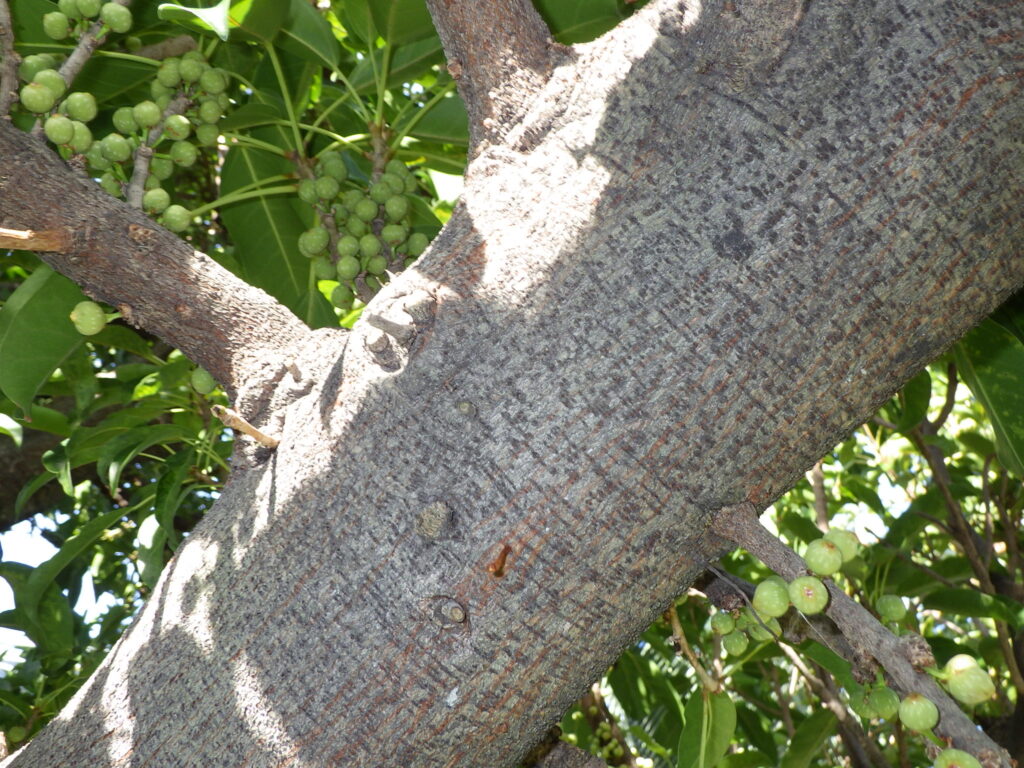
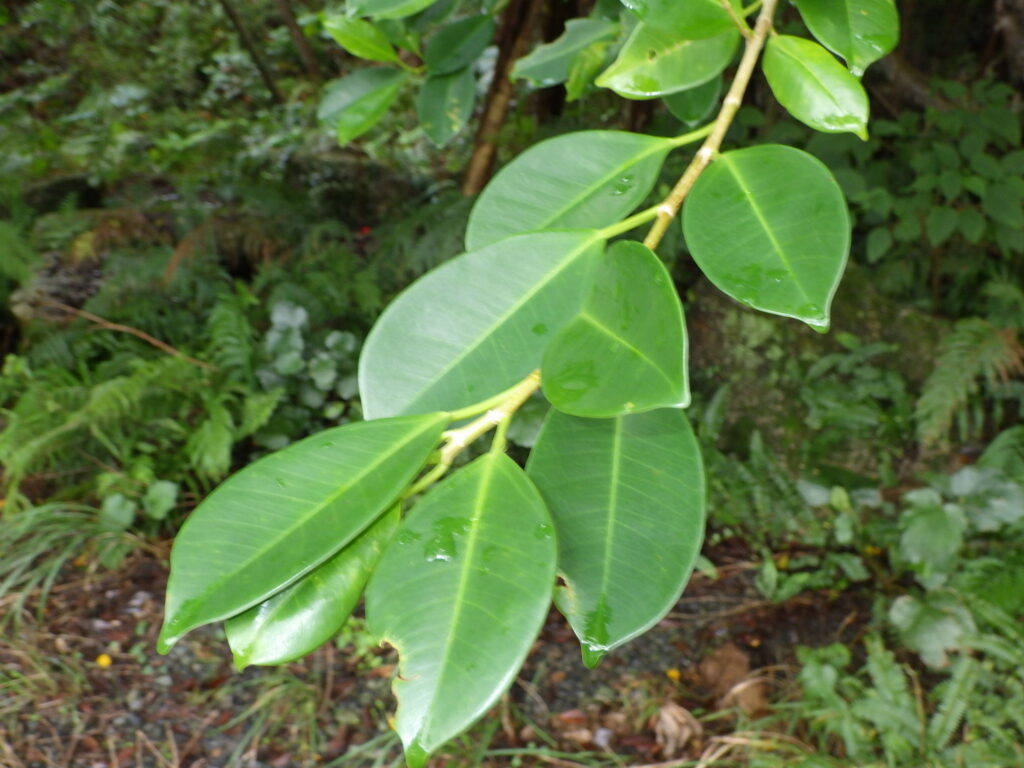
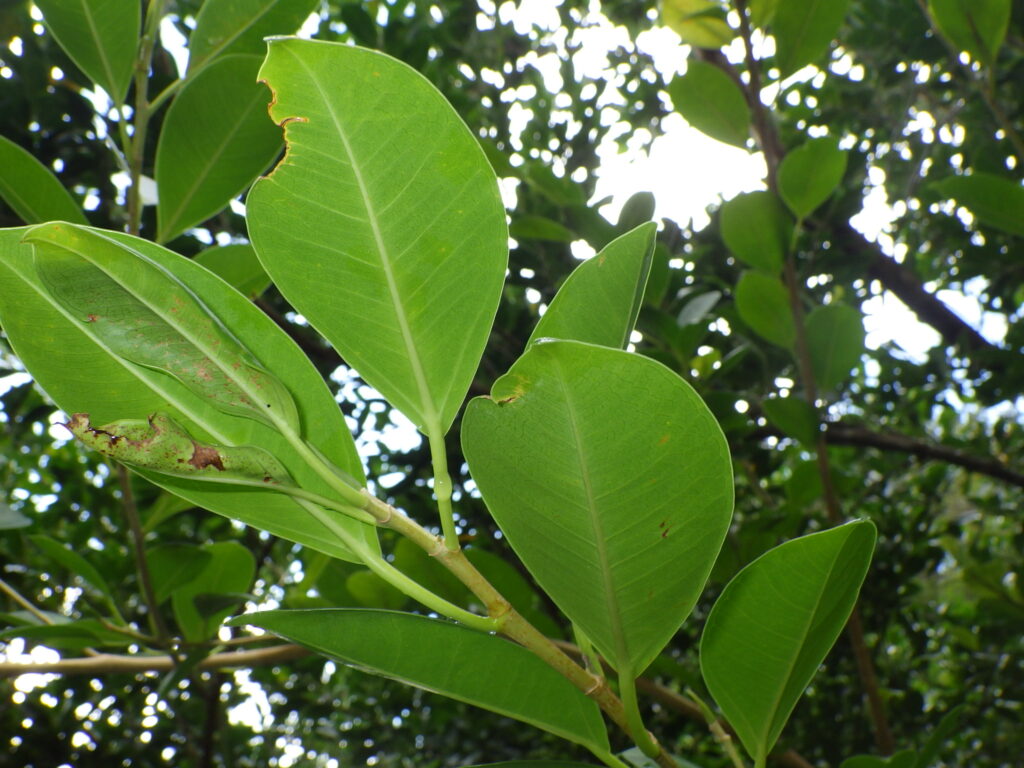
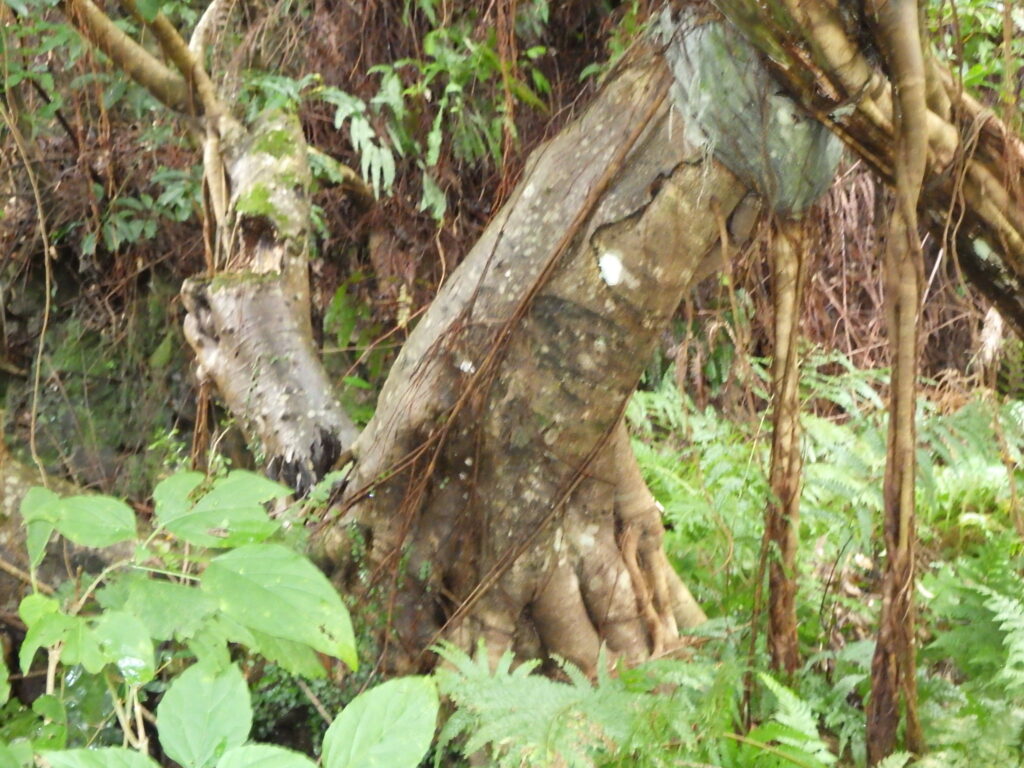
Are there any other similar types?
The fig genus includes many species, so it's necessary to distinguish between them. Please see the separate article for more details.
Was the banyan tree a opportunistic "strangler fig"?
The banyan tree is often called the "strangler fig." Why is that?
After the fruits of the banyan tree are eaten by birds and other animals while they are still in the tree, the seeds are excreted in their droppings and fall into the base of branches or hollows in the trunks of trees such as the Japanese red tree and palm trees. The seeds germinate and become epiphytic, extending aerial roots downwards until they reach the ground (Tsuchiya and Miyagi, 1991; Otani, 2006).
From here, it grows thicker and thicker aerial roots, eventually covering the parent tree and, incredibly, killing it. For this reason, it is sometimes called the "strangler fig."
One way it differs from other plants is that its roots are completely exposed above ground, and it grows downwards. However, unlike mistletoe and similar plants, it doesn't steal nutrients; rather, it physically takes away areas that are more suitable for photosynthesis.
Furthermore, this does not mean that all individuals "strangle" their prey. Some individuals that are fortunate enough to grow in suitable locations such as Yakushima and the Ryukyu Islands, where the roots do not dry out easily and there is moisture along streams, climb onto rock faces, and sometimes concrete retaining walls, to obtain sunlight.
Is the banyan tree's method of "strangling" more intense than that of the fig tree?
The banyan tree is also a "strangler fig" (Maeshiro, 1988). Therefore, in the same way as the fig tree, it falls into the base of branches or hollows in the trunk of a tree, germinates and takes root, extends aerial roots downwards, and strangles the parent tree.
However, unlike the banyan tree, the Ficus microcarpa produces prop roots (aerial roots that support the roots) (Katanoda and Ohno, 1999).
In the early stages of the banyan tree, the aerial roots play a role called "adhesive aerial roots," which germinate, attach to the trunk, grow downwards, and constrict the parent tree (Maeshiro, 1988).
However, as the tree ages, the aerial roots increase in the number of "pillar-type aerial roots," and their role changes. In other words, after strangling the parent tree, they increase the number of aerial roots that cling to the ground, stone walls, or limestone like pillars, so that the tree can survive even if the parent tree's trunk is damaged or rots.
Furthermore, in the case of the banyan tree, there is another pattern of strangulation that differs from that of the fig tree.
Unlike the banyan tree (Ficus microcarpa), the banyan tree (Ficus microcarpa) has thin, string-like aerial roots that hang down from high places. These are called "suspending aerial roots" and they emerge from the attached or supportive aerial roots once they have grown to a certain extent.
If a tree is directly beneath aerial roots, it will be entangled and strangled to death. Since this strangulation occurs after the tree has grown to a certain extent, it could be considered quite cruel.
Putting all this information together, it seems that the banyan tree (Ficus microcarpa) is an opportunistic "strangler fig," while the Ficus microcarpa (Gajumaru) is a stronger, absolute "strangler fig."
Is it true that banyan trees like the Japanese Ficus microcarpa and the Ficus regia don't have flowers?
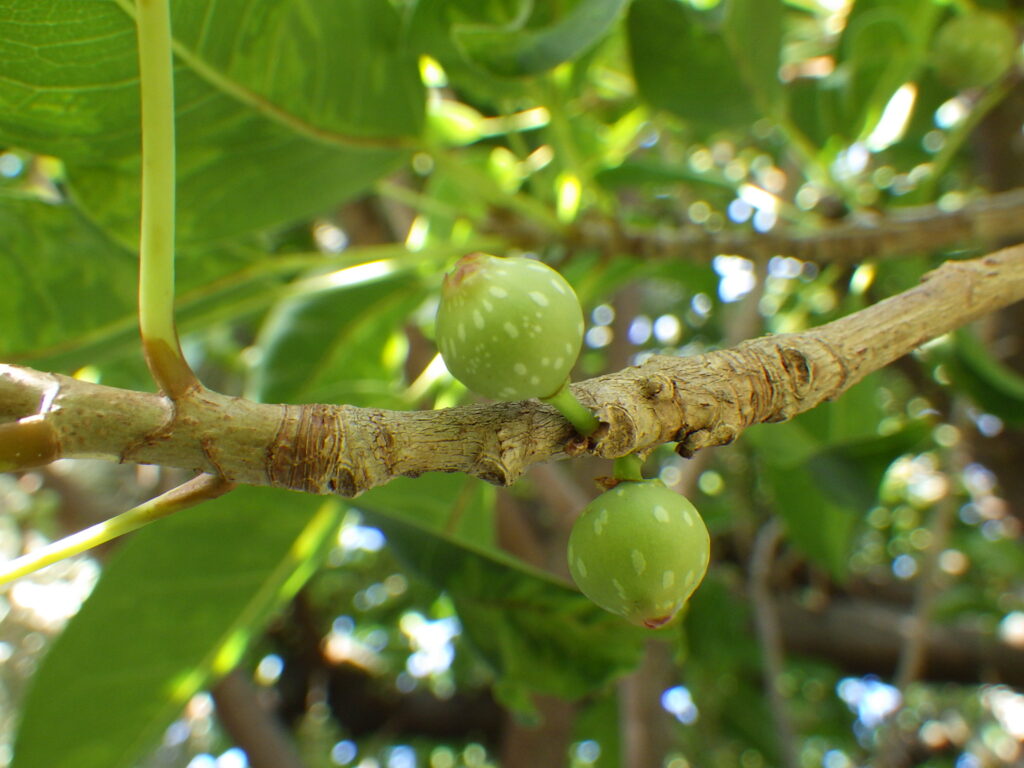
At first glance, you won't find the "flowers" that we usually see on banyan trees like the Ficus microcarpa. Instead, round, swollen parts that resemble "fruits" appear directly on the plant and can be seen for an extended period.
This is a characteristic common to the fig genus. The fig also shares this characteristic, and its name is written with the kanji characters for "flowerless fruit," which comes from the fact that it appears to produce fruit without flowering.
So, do fig trees really not have flowers and just produce fruit directly?
Years of research by scientists have shown that this is not the case.
The part that resembles a fruit is called a "syconium" (or "syconium inflorescence"), and it is known that it "blooms" inside even in summer and the dead of winter.
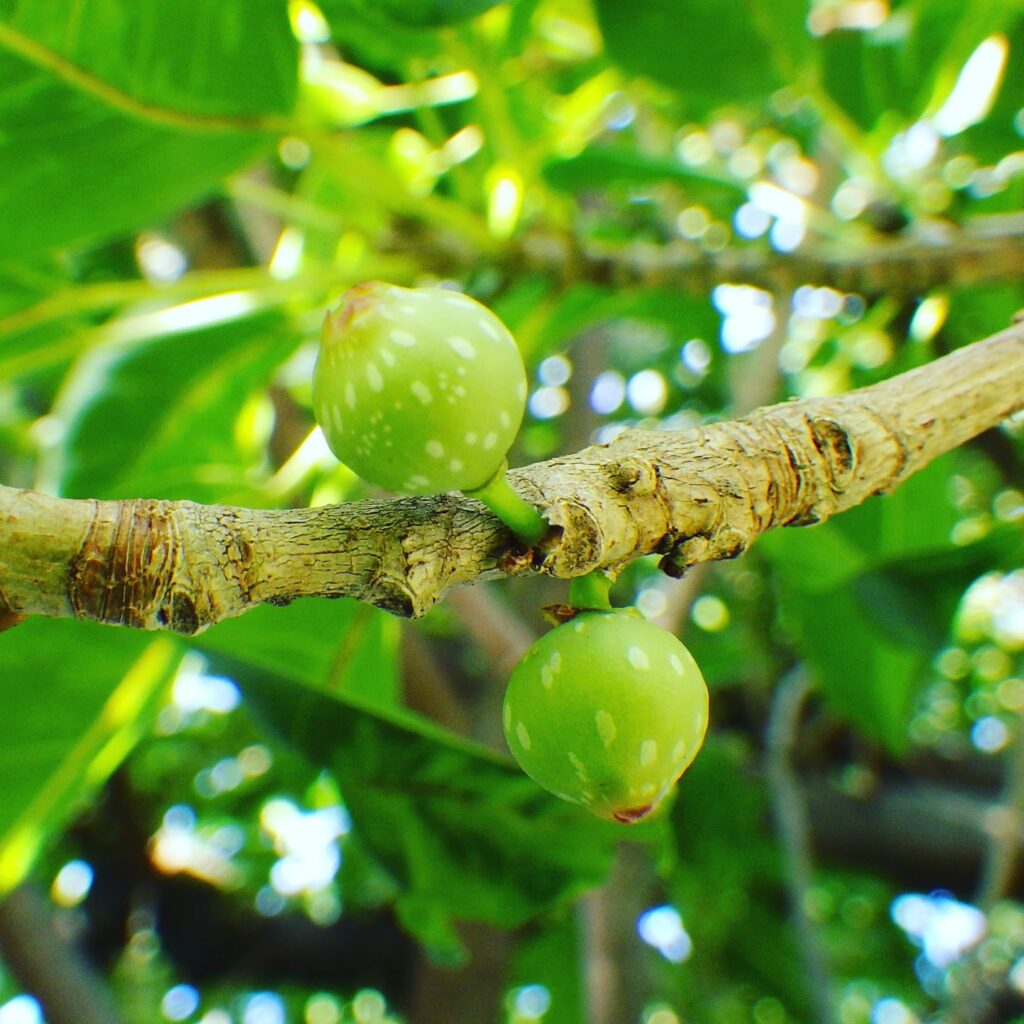
This becomes clear when you actually cut the flower receptacle in half and examine its interior.
Inside, you can find pollen released from the stamens and ovules, which are precursors to seeds. If it were a fruit, you wouldn't be able to observe these things.
Both the banyan tree (Ficus microcarpa) and the Japanese Ficus (Ficus sieboldii) produce syconia year-round in the wild, but they become particularly numerous from around springtime. Since the syconia grow directly on the trunk, they are called "cauliflory."
Inside, it produces male and female flowers, waiting for insects. But are there really any insects that would come to such an invisible flower?
Years of research have revealed that the only insects that visit these flowers are Platyscapa ishiiana in the case of the Ficus microcarpa and Eupristina verticillata in the case of the Ficus benghalensis.
This type of symbiotic relationship involving almost one-to-one pollination is called "obligatory pollination symbiosis."
How do banyan trees like the fig tree and the Ficus microcarpa pollinate using dwarf wasps?
Let's look at the specific process of pollination (Otani, 2020; Borges, 2021).
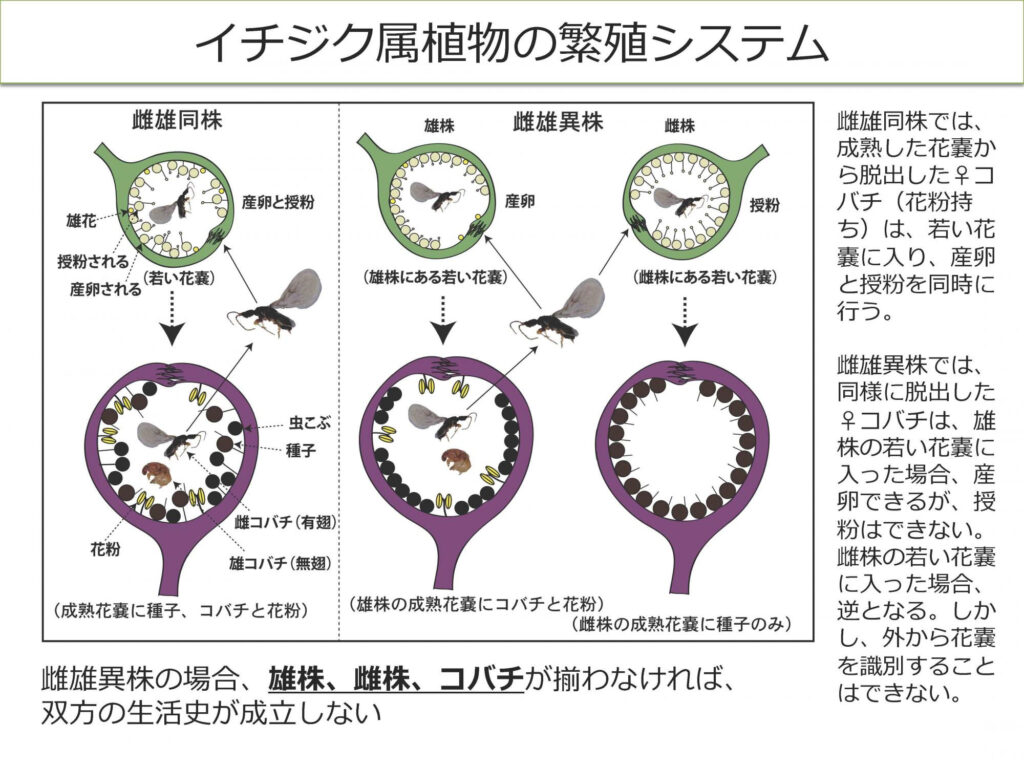
Banyan trees like the fig tree and the Ficus microcarpa form syconium, and each syconium initially produces female flowers (female phase). Female parasitic wasps visit these female flowers. However, they don't come to find food like nectar or pollen, as is common with other pollinating insects. The female parasitic wasps visit the syconium with the purpose of laying eggs in the female flowers to feed their larvae. When these female parasitic wasps leave another syconium, they have pollen on their bodies. The reason for this will become clear later.
The tip of the flower receptacle has tiny holes, through which female wasps fly in and enter the receptacle. At this time, the female wasps have pollen from other individuals on their bodies, so they pollinate the female flowers, and the banyan or fig tree is successfully pollinated.
The female wasp lays her eggs in the female flower and then dies. Female wasps hatch from fertilized eggs, and male wasps hatch from unfertilized eggs.
One to several months later, the hatched parasitic wasp larvae will feed on the female flowers. Female flowers contain ovules, which are precursors to seeds, making them a very nutritious and excellent food source.
By the way, you might think that this would mean that even the pollinated female flowers would be eaten, but female flowers are produced with the understanding that they will be eaten, and extra sterile ones are produced to serve as food for the larvae of the parasitic wasps.
In this way, the grown parasitic wasps mate inside the flower receptacle. Usually, multiple female parasitic wasps are present, so there is generally no need to worry about inbreeding.
On the syconium side of banyan trees like the fig tree (Ficus microcarpa) and Ficus benghalensis, the male flowers bloom around the time the larval stage of the parasitic wasps becomes adults (male phase). When the female parasitic wasps become adults, they emerge from the syconium, receiving pollen from the male flowers and flying away. It's a very well-designed cycle. On the other hand, the males have vestigial wings and spend their entire lives inside the syconium where they were born.
The female parasitic wasps that escape will then invade another syconium that is bearing a female flower. This cycle is necessary, which is why they need to produce syconiums all year round.
By the way, what happens if a female parasitic wasp invades a syconium while it is producing male flowers? Male and female syconiums are almost indistinguishable in appearance.
While it's not fully understood in the case of Ficus microcarpa and Banyan trees, in closely related species, the female parasitic wasp is unable to lay eggs and dies without leaving any offspring. Although it appears to be a highly symbiotic relationship, a closer look reveals that it's not necessarily a win-win situation.
However, in the case of banyan trees and fig trees, newly emerged adults are able to escape, so perhaps they are also able to escape.
The "obligate pollination symbiosis" system common to the fig genus
The nearly one-to-one obligate pollination symbiosis practiced by Ficus microcarpa and Banyan trees is widely observed in the Ficus genus and the Ficus parasitic family, and is known to promote co-evolution (Azuma et al, 2003; Azuma et al, 2010).
Co-evolution refers to the phenomenon where, in conjunction with the diversification of species in one taxonomic group, species in another taxonomic group also diversify in a coordinated manner.
It's difficult to explain how this relationship came about, but it's thought to have originated in tropical regions with abundant resources and no distinct seasons, which may have been a major advantage for obligate pollination symbiosis.
Specifically, the following arrangements apply to the different types of products in Japan.
- Fig (Ficus carica) vs. Fig wasp (Blastophaga psenes)
- Ficus erecta vs. Blastophaga nipponica (Ficus erecta wasp)
- Ficus septica vs. Ceratosolen bisulcatus
- Ficus benguetensis vs. Ceratosolen cornutus
- Giant Ficus pumila vs. Giant Ficus Wasp Wiebesia pumilae
- Ficus thunbergii vs. Wiebesia sp.
- Ficus irisana vs. Kradibia commuta (Ficus irisana wasp)
- Ficus ampelas vs. Kradibia sumatrana (Ficus ampelas vs. Ficus sumatrana)
- Ficus virgata vs. Liporrhopalum philippinensis
These absolute pollination symbiotic systems are maintained in much the same way, but there are a few slight differences.
Unlike other fig species in Japan, such as the Japanese Ficus microcarpa (Ficus erecta), the Japanese banyan tree (Ficus mongolica) and the Japanese fig (Ficus canaliculata) are monoecious, meaning they undergo pollination as described above. However, most other fig species are dioecious (having separate male and female plants).
Therefore, there are male and female plants, and pollination occurs in a similar but slightly different way than described above.
The flower receptacle transforms into a fruit receptacle, and the seeds are dispersed by birds and bats.
After pollination, the mature flower receptacle transforms into a fruit receptacle. This is the same fruit that is commonly known as the "fig fruit" that is eaten.
Since the flowers were located inside the syconium, the actual fruit must be located inside the fruit sac.
The fruit sacs of both the banyan tree and the fig tree ripen to a yellow or pale pink color.
Generally, fig species with red pods are eaten by monkeys and birds with well-developed color vision, while fig species with green pods tend to emit an odor and are eaten by most other mammals, including bats (Harrison et al., 2012). In either case, the seeds are dispersed via animal feces.
In the case of banyan trees such as the Japanese fig (Ficus microcarpa) and the Ficus mongolica, it is said that their seeds are dispersed by birds, as evidenced by the change in their color.
It is also known that Yakushima macaques like it (Otani, 2005).
However, other studies have shown that birds and monkeys are not the only ones that eat these fruit sacs. Fruit bats, which primarily feed on nectar and fruit, also eat the fruit sacs and play an important role in seed dispersal (Miyagi and Takahara, 2000).
Studies conducted in the Southwest Islands have confirmed that all four species of flying foxes—the Erabu flying fox, the Orii flying fox, the Yaeyama flying fox, and the Daito flying fox—feed on the fruit sacs of the Ficus microcarpa and the banyan tree.
The fruit sacs of the Ficus microcarpa and Banyan tree are a form of "cauliflorous fruit" that develops from cauliflorous flowers. Therefore, they are attached closely to the trunk or branches. It is generally believed that cauliflorous fruit has the effect of making it easier for animals such as fruit bats to eat the fruit (in this case, the fruit sac) by perching on the trunk or sturdy branches (Van der Pijl, 1961).
Considering their ecology, this seems to apply well to the Ficus microcarpa and the banyan tree as well.
However, a study conducted by an American research group presents a different view (Harrison et al., 2012). They examined numerous species of the fig subgenus Sycomorus and statistically investigated the correlation between fruit-eating animals and the arrangement of the fruit capsules (whether they are cauliflorous or not). Their results showed no correlation. On the other hand, they found a correlation with flowering period, nutritional status, and habitat preference.
I'm not sure if the same thing applies to the subgenus Urostiguma, which includes both the banyan tree and the Ficus microcarpa, but it might not be that simple.
Nevertheless, the fact that their fruits are cauliflorous was a very important factor in supporting the survival of many species of fruit bats.
References
Azuma, H., Harrison, RD, Nakamura, K., & Su, ZH 2010. Molecular phylogenies of figs and fig-pollinating wasps in the Ryukyu and Bonin (Ogasawara) islands, Japan. Genes & Genetic Systems 85(3): 177-192. https://doi.org/10.1266/ggs.85.177
Higashi, Koji; Su, Zhihui; and Nakamura, Keiko. 2003. Co-evolution of the genus Ficus and fig wasps. Mathematical Sciences 479: 78-83. ISSN: 0386-2240, https://www.saiensu.co.jp/search/?isbn=4910054690538&y=2003
Borges, RM 2021. Interactions between figs and gall-inducing fig wasps: adaptations, constraints, and unanswered questions. Frontiers in Ecology and Evolution 9: 685542. https://doi.org/10.3389/fevo.2021.685542
Harrison, RD, Rønsted, N., Xu, L., Rasplus, JY, & Cruaud, A. 2012. Evolution of fruit traits in Ficus subgenus Sycomorus (Moraceae): to what extent do frugivores determine seed dispersal mode?. PloS One 7(6): e38432. https://doi.org/10.1371/journal.pone.0038432
Hayashi, Masayuki. 2014. 1100 Tree Leaves Identified Through Real-Life Scans. Yama-kei Publishers, Tokyo. 759pp. ISBN: 9784635070324
Katanoda, Itsuro & Ohno, Teruyoshi. 1999. Wildflowers of the Ryukyu Archipelago from Amami: A Gift from the Sun. Nanpo Shinsha, Kagoshima. 221pp. ISBN: 9784931376212
Maeshiro, T., Nakasuga, T., & Baba, S. 1988. On the morphology of aerial roots of Ficus microcarpa. Proceedings of the Kyushu Branch of the Japanese Forestry Society 41: 87-88. ISSN: 0919-6412, http://jfs-q.jp/kfr/41/bin090907172135009.pdf
Miyagi, Tomoaki and Takahara, Kenji. 2000. On the plants of Sueyoshi Park and the food plants of the large bat. Bulletin of the Okinawa Prefectural Museum 26: 47-84. https://okimu.jp/userfiles/files/page/museum/issue/bulletin/kiyou26/26-4.pdf
Otani, T. 2005. Characteristics of medium-sized mammals as seed dispersers of berries—mainly using Japanese macaques as an example—. Nagoya University Journal of Forest Science 24: 7-43. https://doi.org/10.18999/nagufs.24.7
Otani, T. 2006. Life history of the strangler banyan tree. Forests and Forestry of Kyushu 78: 1-3. ISSN: 1346-5686, http://www.ffpri-kys.affrc.go.jp/kysmr/data/mr78.pdf
Otani, Tatsuya. 2020. The lives of *Ficus microcarpa* and *Epipactis thunbergii* in the northernmost distribution zone. *Understanding the Forests of Shikoku* 33: 2-3. ISSN: 1348-9747, https://www.ffpri.affrc.go.jp/skk/documents/sm33.pdf
Tsuchiya, Makoto & Miyagi, Koichi. 1991. Nature Observation on Southern Islands. Tokai University Press, Tokyo. xix, 194pp. ISBN: 9784486011590
Van der Pijl, L. 1961. Ecological aspects of flower evolution. II. Zoophilous flower classes. Evolution 15(1): 44-59. https://doi.org/10.2307/2405842
Source
This article is a significantly expanded version of one included in the following book.