Tradescantia virginiana (also known as Tradescantia japonica or Tradescantia erythrorhizon) and Tradescantia monadelphia are members of the Tradescantia genus that were cultivated in horticulture for ornamental purposes and are now rapidly becoming naturalized. Perhaps because the naturalized species originally had various forms, their morphology is diverse. In current classification, Tradescantia japonica and Tradescantia erythrorhizon are distinguished by the shape of the leaves, the underside of the leaves, and the presence or absence of fruit. Tradescantia monadelphia has particularly large leaves. However, there are also species that do not fit this classification, and since research is insufficient, it may not be necessary to force a distinction. Their reproduction methods also vary, with some species reproducing vegetatively, which explains the rapid spread of concern, but they also appear to reproduce by seeds through flowers. However, the flowers do not secrete nectar, and the most conspicuous white filaments in the flower structure are thought to deceive insects into thinking they are a foothold for eating pollen. The fruit is a capsule and is probably dispersed by gravity. This article will explain the classification, pollination ecology, and seed dispersal of the Commelina species.
- Three herbaceous plants native to South America that are spreading in Japan
- What are the differences between *Tradescantia virginiana*, *Tradescantia verna*, and *Tradescantia fluminensis*?
- Is there a possibility of a third variety existing?
- While vegetative reproduction through cloning was the primary method, was pollination also occurring?
- Are the white filaments meant to deceive the insect by making them appear as a foothold for eating pollen?
- Are the fruits capsules dispersed by gravity?
- References
- Source
Three herbaceous plants native to South America that are spreading in Japan
Tradescantia fluminensis, native to South America, was introduced as an ornamental plant and has since naturalized worldwide. In Japan, it was imported in the early Showa period and has become naturalized (Shimizu et al., 2001; CABI, 2019). In its native habitat, it grows in tropical rainforests and damp, shady places such as roadsides and gardens. In areas where it has naturalized, it is a perennial herb that can grow in damp, shady places such as gardens, parks, embankments, riverbanks, and former forest areas (Barreto, 1997).
Tradescantia fluminensis is said to be divided into two varieties in Japan: Nohakatakarakusa and Midorihakatakarakusa. The kanji characters for it are "常盤露草".
Of these, there is no proper scientific name for Tradescantia fluminensis. Tradescantia fluminensis (in the narrow sense) is considered to be a green-leaved variety of the horticultural cultivar 'Tricolor' or 'Laekenensis'. The Japanese name "Hakata Karakusa" comes from the fact that the striped pattern of the variegated leaves resembles Hakata-ori (Hakata pattern).
Tradescantia fluminensis 'Viridis' is considered to be a variant of Tradescantia 'Variegata' with green leaves. Its Japanese name is written in kanji as "緑博多唐草".
Furthermore, Tradescantia virginiana (the scientific name in Japan) is a horticultural plant, Tradescantia fluminensis 'Alvovittata', that has lost its variegation. Although it is treated as a separate species in Japan, Tradescantia virginiana is considered a synonym of Tradescantia fluminensis internationally (Pellegrini, 2018). Following this, Tradescantia virginiana also lacks a proper scientific name.
Both belong to the genus Tradescantia in the family Commelinaceae. Unlike the species that bear purple flowers, these have white flowers, but they are extremely similar and difficult to distinguish.
What are the differences between *Tradescantia virginiana*, *Tradescantia verna*, and *Tradescantia fluminensis*?
First, regarding the difference between *Tradescantia pseudocamellia* and *Tradescantia verna*, there are discrepancies between descriptions in Japanese literature and those found on the internet.
Based on the literature (Uemura et al., 2015; Kanagawa Prefectural Flora Survey Association, 2018), the difference between the two is that *Tradescantia pseudocamellia* has ovate, relatively small leaves with a purplish tint on the underside and produces fruit, while *Tradescantia verna* has slightly larger leaves with a green underside and does not produce fruit.
However, according to the internet, there is a difference in that the stems, flower stalks, and undersides of the leaves of *Tradescantia pseudocamellia* are tinged with purple, while the entire plant is almost entirely green.
I would of course recommend that everyone identify them using literature, but, although this might be counterproductive, it's debatable whether the differences are significant enough to warrant classification. However, differences in breeding methods may be important.
There may be a source document that served as the basis for the information found on the internet, so if you know of one, please let me know.
The difference between Tradescantia virginiana (Tradescantia japonica and Tradescantia erythrosora) and Tradescantia fluminensis is that in Tradescantia virginiana, the leaves are 2-6 cm long, the hairs on the edges are barely visible to the naked eye, and the hairs on the back of the calyx are less than 0.5 mm long, while in Tradescantia fluminensis, the leaves are 7-12 cm long, the hairs on the edges are visible to the naked eye, and the hairs on the back of the calyx are about 1 mm long.
These are very minor details, but please check the above when observing.
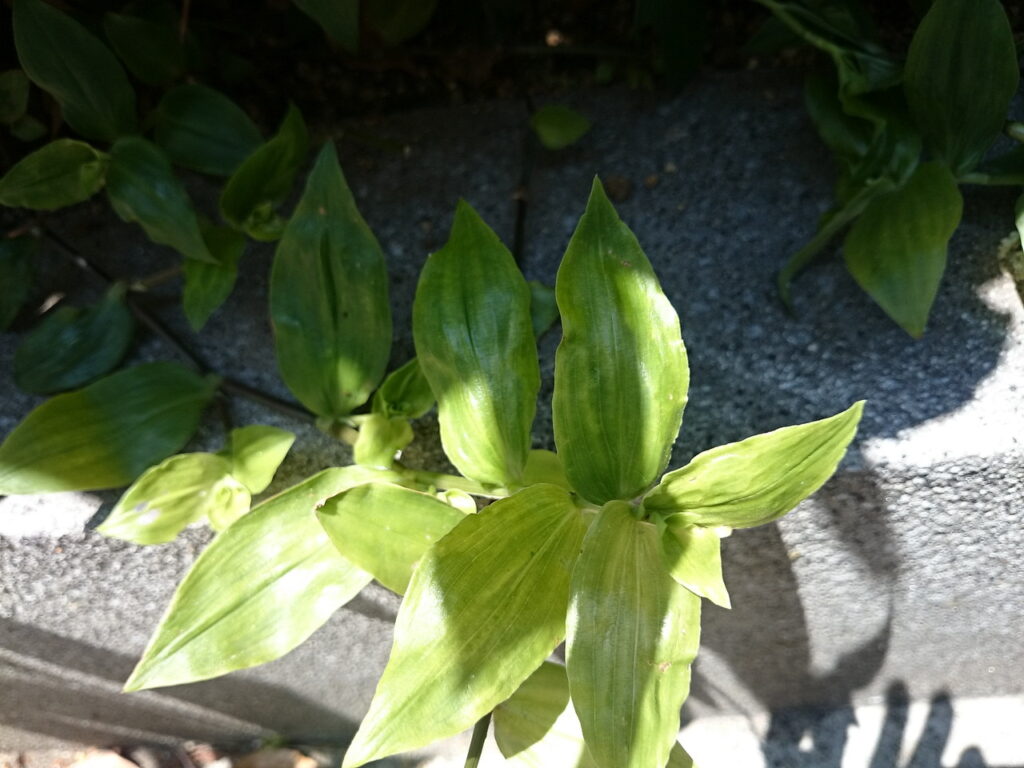
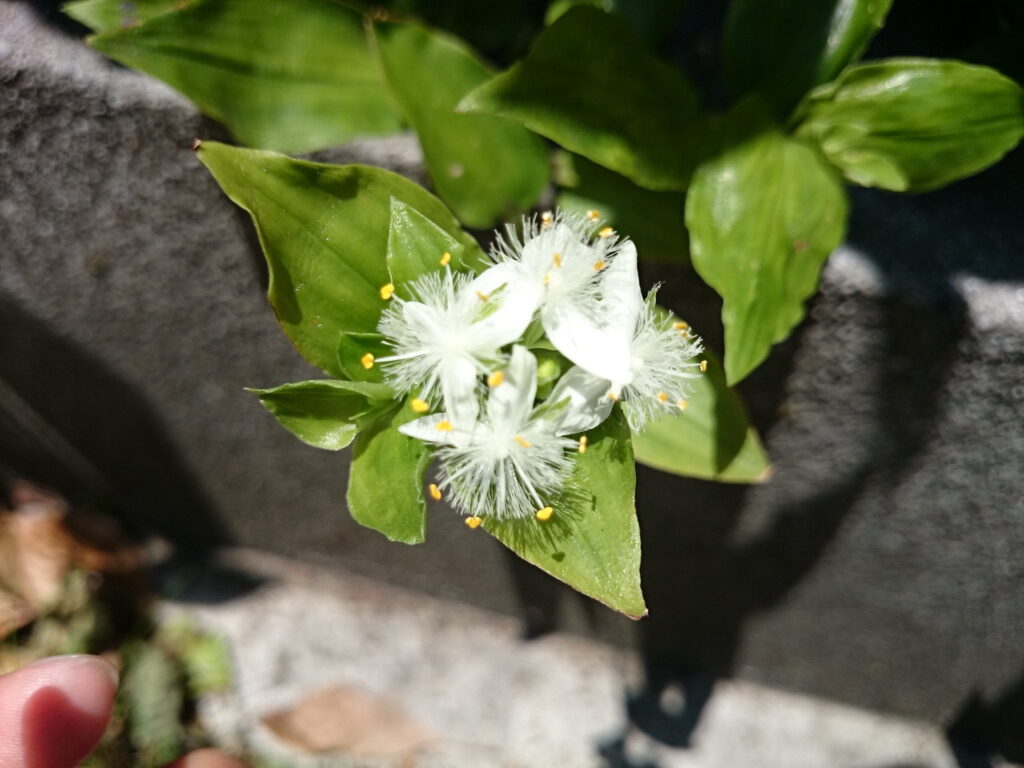
Is there a possibility of a third variety existing?
However, it seems that there are populations that do not fit into this classification.
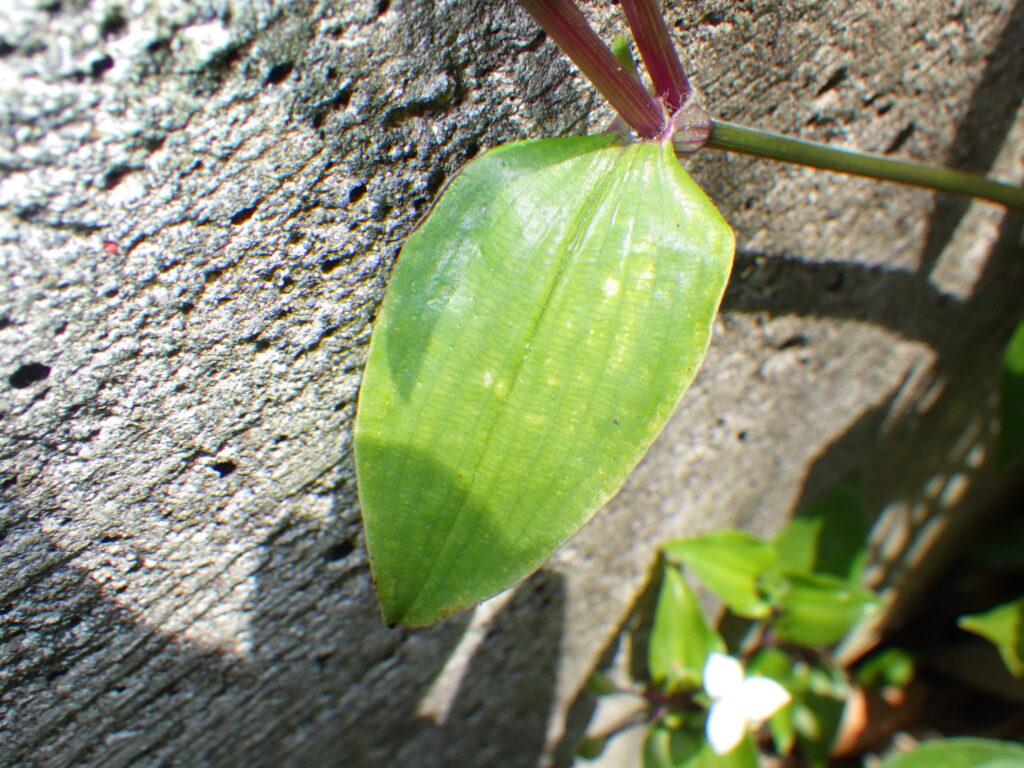
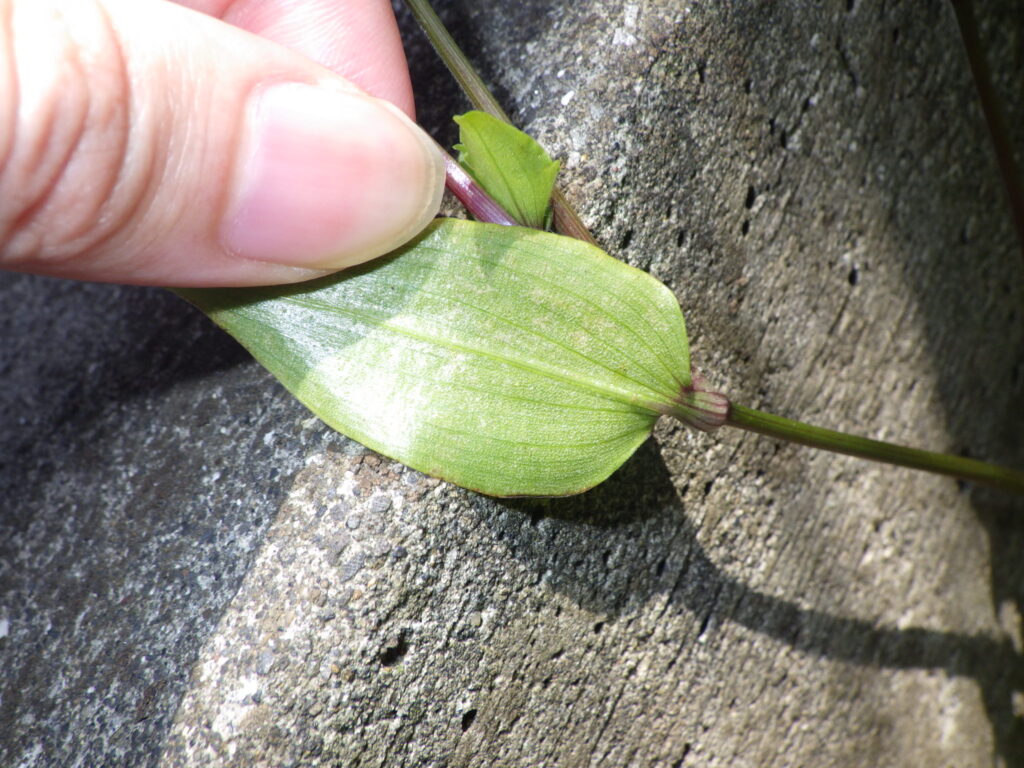
Many websites on the internet identify individuals of Tradescantia virginiana with purple flower stalks and stems, rather than purple undersides of the leaves, as Tradescantia japonica, and I previously understood it that way and posted my photos here accordingly.
However, as mentioned above, two of the literatures I consulted use the underside of the leaf as the reference point and do not mention the pedicel or stem (Uemura et al., 2015; Kanagawa Prefectural Flora Survey Association, 2018). Furthermore, since the underside of the leaves of this population is green, according to the literature it would be classified as *Tradescantia japonica*, while according to the internet it would be unclassifiable.
Therefore, there may be a third variety of Tradescantia virginiana with red flower stalks and stems, and green undersides to its leaves. Alternatively, it might be a variation within Tradescantia virginiana. I hope for future research that will provide clearer identification.
Note that in 'Ylist', the scientific name for *Tradescantia mundula* is given as * Tradescantia mundula*, while *Tradescantia fluminensis* is given as * Tradescantia fluminensis *.
However, upon further investigation of the original paper (Pellegrini, 2018), it was found that, unlike Tradescantia fluminensis, Tradescantia mundula has bristles on its stem, irregular or irregular bristles on its leaves, the underside of its leaves is partially wine-red, the leaf blade is papery, and its petals are flat.
The photograph taken by the author, showing "red flower stalks and stems, and green undersides of leaves," does not meet the criteria and therefore does not appear to be Tradescantia mundula.
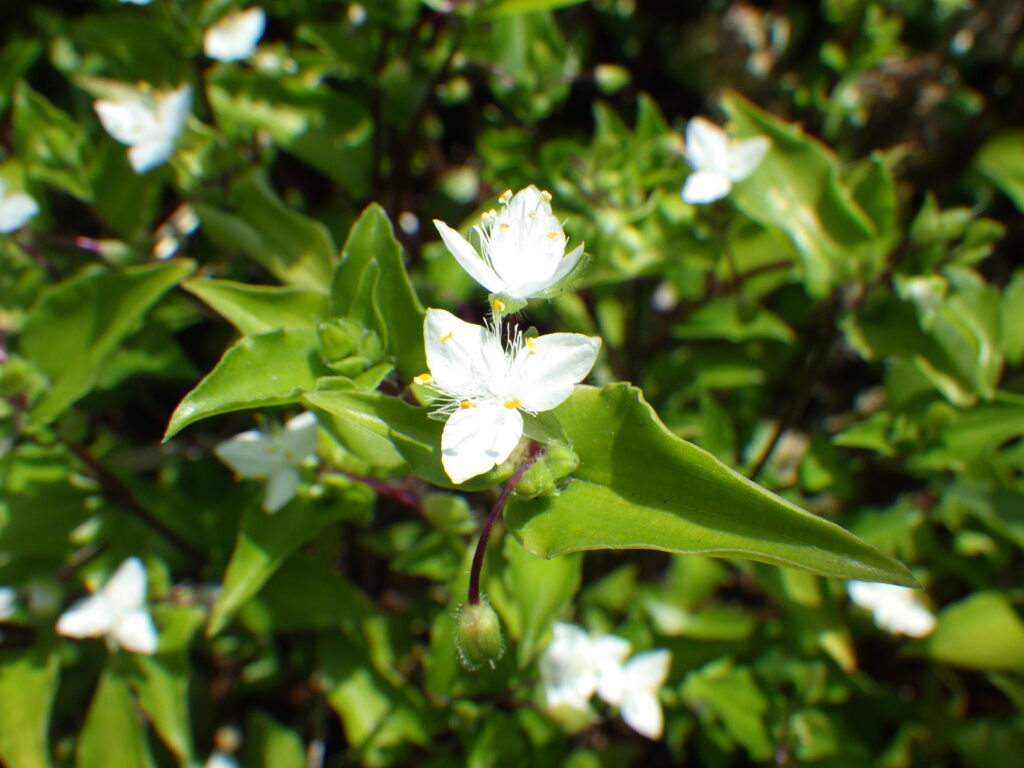
While vegetative reproduction through cloning was the primary method, was pollination also occurring?
Since it has been confirmed that wild specimens of Tradescantia virginiana reproduce solely through vegetative reproduction (a mechanism by which the individual's body divides to create clones) in New Zealand and Australia (CABI, 2019), it is possible that the same is true in Japan.
Vegetative reproduction occurs when stems are carried by water currents, or when they attach to horticultural waste, soil, vehicles, or lawnmowers discarded by humans (Dugdale et al., 2015). They also spread by attaching stems to large animals such as cattle, chickens, deer, and wallabies.
The stem fragments are highly resistant to drought and can survive for a year without contact with roots or soil. Furthermore, they can survive in seawater for up to 48 hours, suggesting that they may be spreading from riverbanks to nearby coastal areas via estuaries.
The rapid increase in their distribution area in recent years is likely largely due to this breeding method.
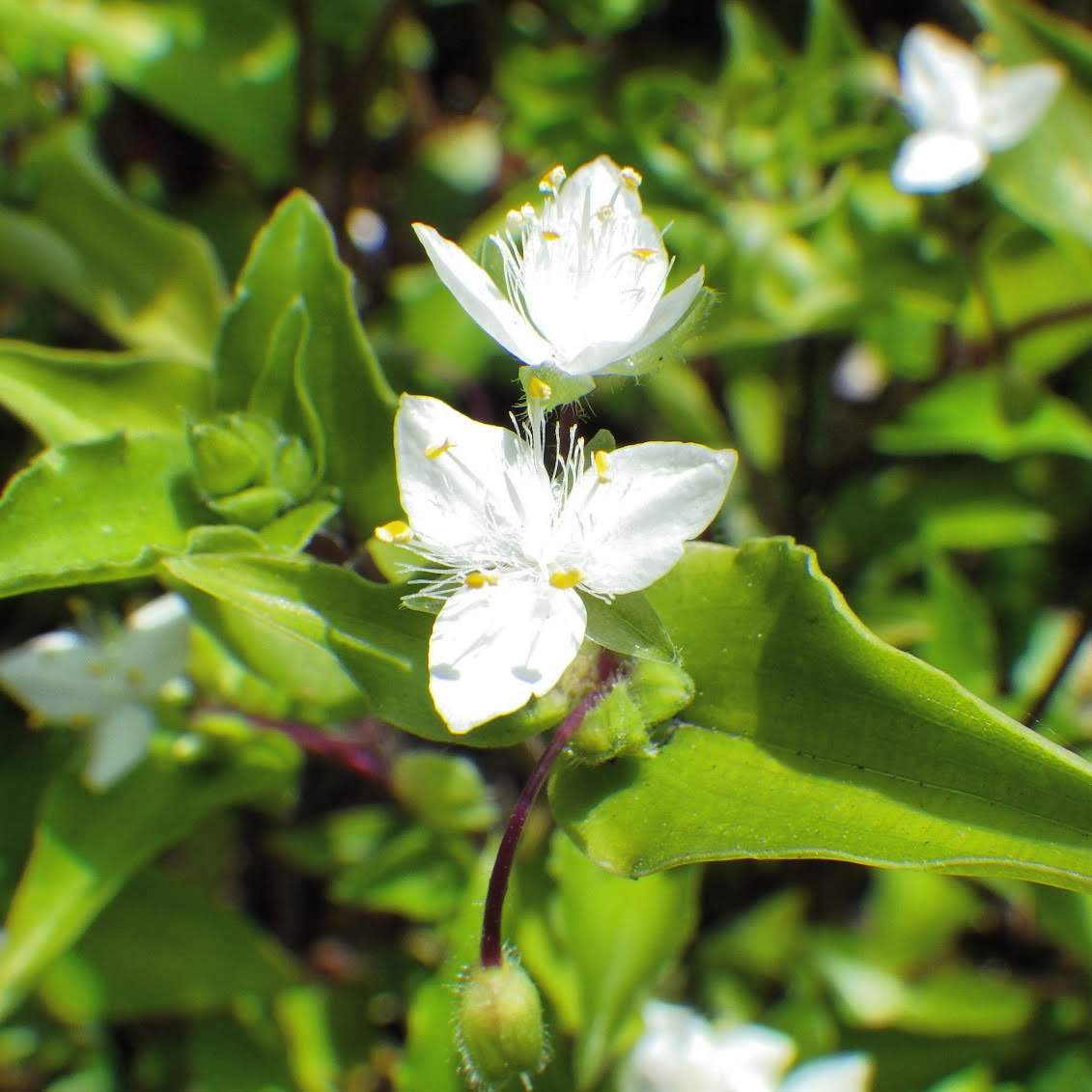
However, at least in its native habitat, pollination by insects does occur. The flowering period is from April to August, and from spring to summer, flowers consisting of three white petals bloom (Shimizu et al., 2001), with countless white filaments (hair-like structures) growing in the center.
In Japanese populations, it is highly likely that *Tradescantia japonica* reproduces by seed.
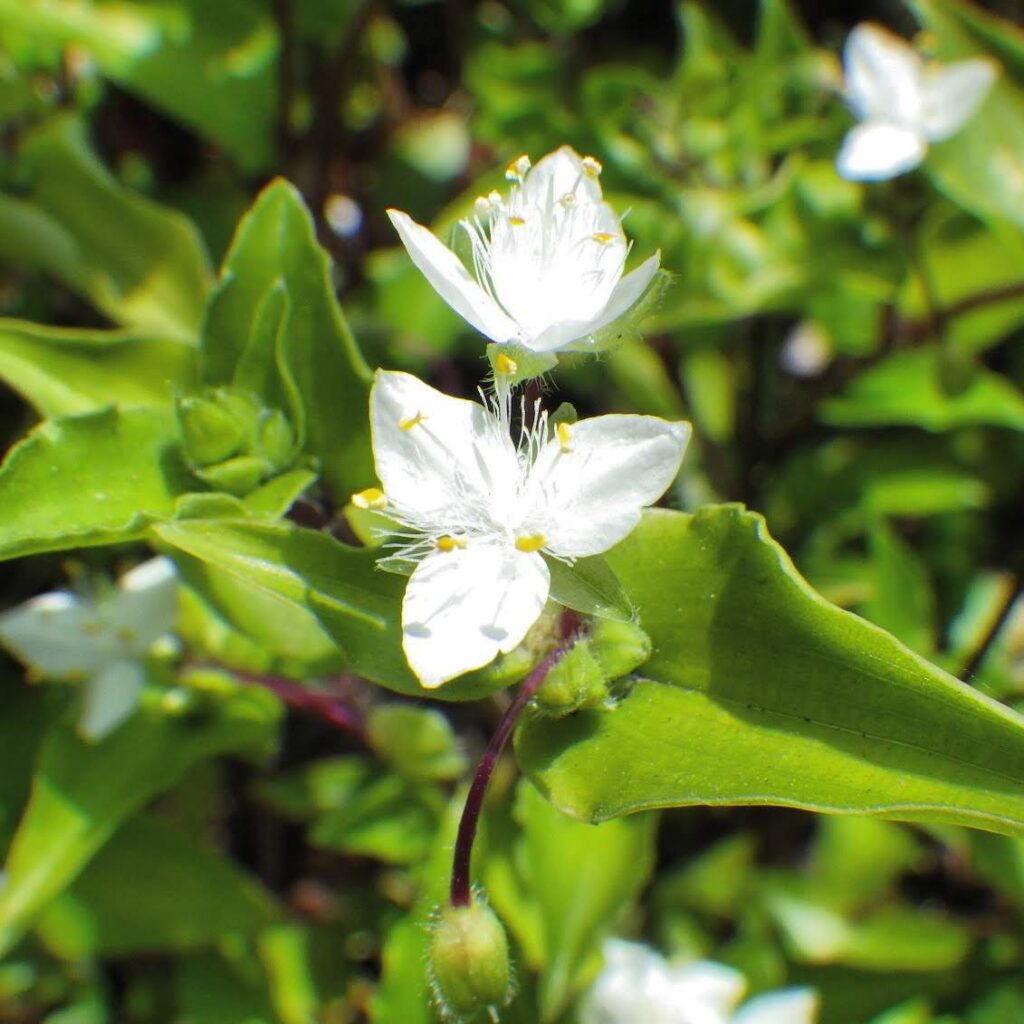
Are the white filaments meant to deceive the insect by making them appear as a foothold for eating pollen?
At first glance, white flowers might seem like ordinary flowers, providing insects with nectar and pollen as rewards.
However, members of the Commelinaceae family have no nectar and produce only small amounts of pollen, and it is thought that they attract insects by tricking them in various ways depending on the group (Faden, 1985; 1992; Evans et al., 2003).
It is said that members of the Tradescantia genus, including Tradescantia japonica, attract insects by conspicuously deceiving them with these white filaments (Faden, 1992). Hoverflies and small bees that visit these flowers seem to find them easy to eat because they have a foothold for feeding on pollen.
Did that make sense to you easily? It was a little hard for me as a human to understand, but besides being conspicuous from a distance, there's also the possibility that the white filaments are used to disguise the quantity of stamens. In other words, the filaments are "mimicking" the stamens. If we think from the insect's perspective, we might see various aspects of it.
While many other species in the same genus have purple flowers, it's unusual that the flowers of the Tradescantia species are white. It's still not well understood how this affects the types of insects that visit them.
Are the fruits capsules dispersed by gravity?
The fruit is a capsule (CABI, 2019). It is oval-shaped, has three chambers, and contains (1 to) two seeds per chamber. The seeds are gray to black and have a row of depressions.
Because Tradescantia species primarily reproduce vegetatively, their seeds have not received much attention, and I have not found any literature describing their seed dispersal methods. However, given the simple structure of their fruits and seeds, it is highly likely that they are dispersed by gravity or slight wind. A paper describing the related species Tradescantia hirsuticaulis also states that it "lacks a special seed dispersal mechanism" (Godt & Hamrick, 1993).
References
Barreto, RC 1997. Levantamento das espécies de Commelinaceae R. Br. nativas do Brasil [Doctoral dissertation, Universidade de São Paulo]. https://repositorio.usp.br/item/000933455
CABI. 2019. Tradescantia fluminensis (wandering Jew). CABI Compendium. https://doi.org/10.1079/cabicompendium.54389
Dugdale, TM, McLaren, DA, & Conran, JG 2015. The biology of Australian weeds 65. ' Tradescantia fluminensis ' Vell. Plant Protection Quarterly 30(4): 116-125. https://search.informit.org/doi/abs/10.3316/informit.786874506183856
Evans, TM, Sytsma, KJ, Faden, RB, & Givnish, TJ 2003. Phylogenetic Relationships in the Commelinaceae: II. A Cladistic Analysis of rbcL Sequences and Morphology. Systematic Botany 28(2): 270-292. ISSN: 0363-6445, https://doi.org/10.1043/0363-6445-28.2.270
Faden, RB, 1985. Commelinaceae. In: RMT Dahlgren, HT Clifford, & PF Yeo (Eds.), The Families of the Monocotyledons (pp. 374-460). Springer Verlag. ISBN: 9783540136552, https://doi.org/10.1007/978-3-642-61663-1
Faden, RB 1992. Floral attraction and floral hairs in the Commelinaceae. Annals of the Missouri Botanical Garden 79(1): 46-52. ISSN: 0026-6493, https://doi.org/10.2307/2399808
Godt, MJW, & Hamrick, JL 1993. Genetic diversity and population structure in Tradescantia hirsuticaulis (Commelinaceae). American Journal of Botany 80(8): 959-966. https://doi.org/10.1002/j.1537-2197.1993.tb15318.x
Kanagawa Prefecture Flora Survey Association. 2018. Kanagawa Prefecture Flora 2018 (Electronic Edition). Kanagawa Prefecture Flora Survey Association, Odawara. 1803pp. ISBN: 9784991053726
Pellegrini, M. O. 2018. Wandering throughout South America: Taxonomic revision of Tradescantia subg. Austrotradescantia (DR Hunt) M. Pell.(Commelinaceae). PhytoKeys 104: 1-97. https://doi.org/10.3897%2Fphytokeys.104.28484
Shimizu, K., Morita, H., & Hirota, S. 2001. Illustrated Guide to Naturalized Plants of Japan: 600 Species of Plant Invaders (Revised). National Rural Education Association, Tokyo. 553pp. ISBN: 9784881370858
Uemura, Shuji; Katsuyama, Teruo; Shimizu, Norihiro; Mizuta, Mitsuo; Morita, Hirohiko; Hirota, Shinichi; and Ikehara, Naoki. 2015. Illustrated Guide to Naturalized Plants of Japan: 500 Species of Plant Invaders (Revised and Expanded Edition, Vol. 2). National Rural Education Association, Tokyo. 595pp. ISBN: 9784881371855
Source
This article is a significantly expanded version of a piece originally published in the following book.