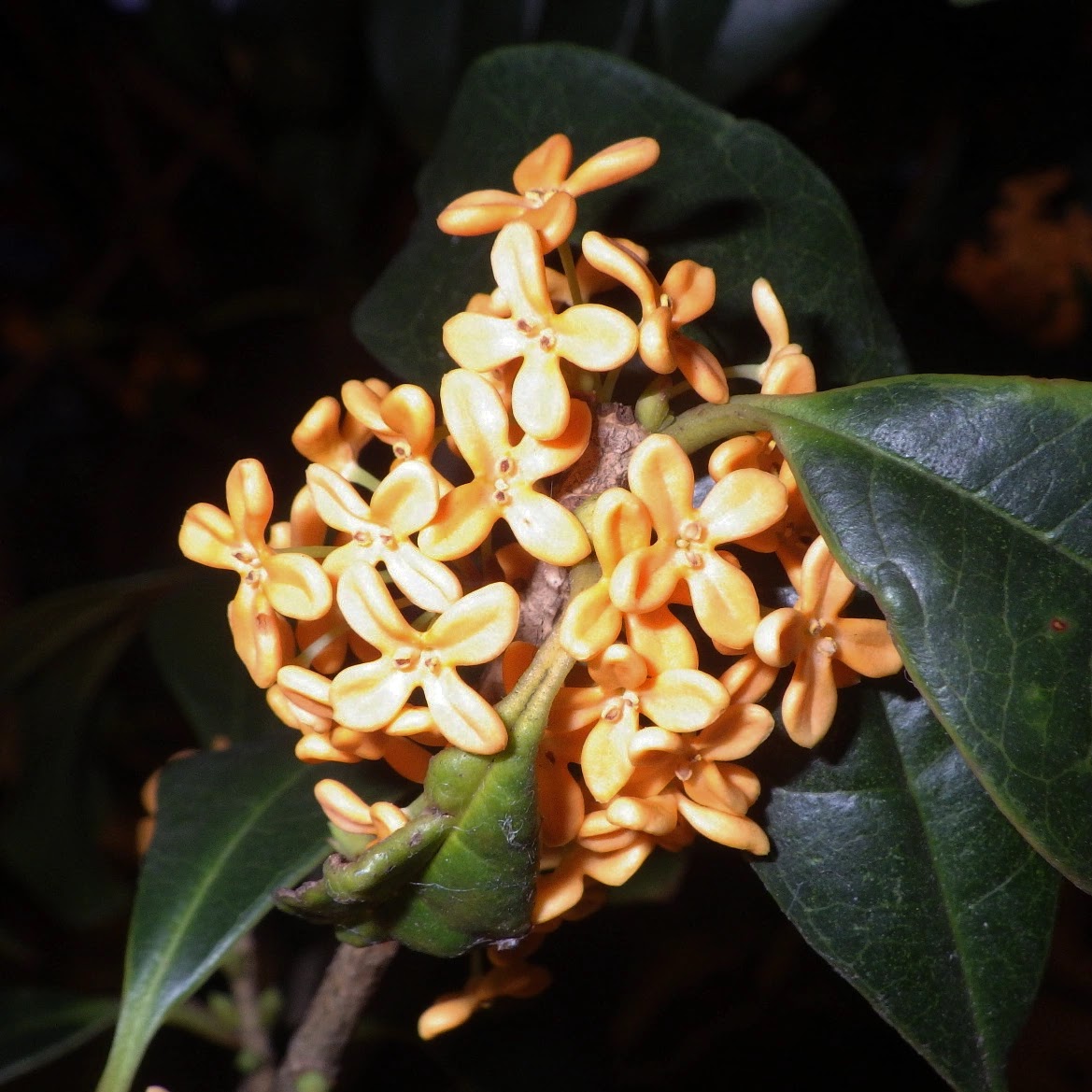
Osmanthus fragrans is a dioecious evergreen small tree generally said to be native to China. It is frequently written that only male plants were introduced to Japan. However, in recent years, it has been thought that this is probably not true and that the plants are actually a clonal population selected in Japan. Unfortunately, no one has yet verified this. The fragrance of its flowers has become a symbol of autumn in Japan, but what role does this scent play in the natural world? Several studies suggest that butterflies dislike this scent, while flies and bees like it. There is a good reason for this. However, in reality, the scent of Osmanthus fragrans is not useful because only male plants exist, and it must have been useful when its ancestors reproduced as dioecious plants. This article will explain the evolution and pollination ecology of Osmanthus fragrans.
Is it a lie that "only male plants were brought in during the Edo period"?
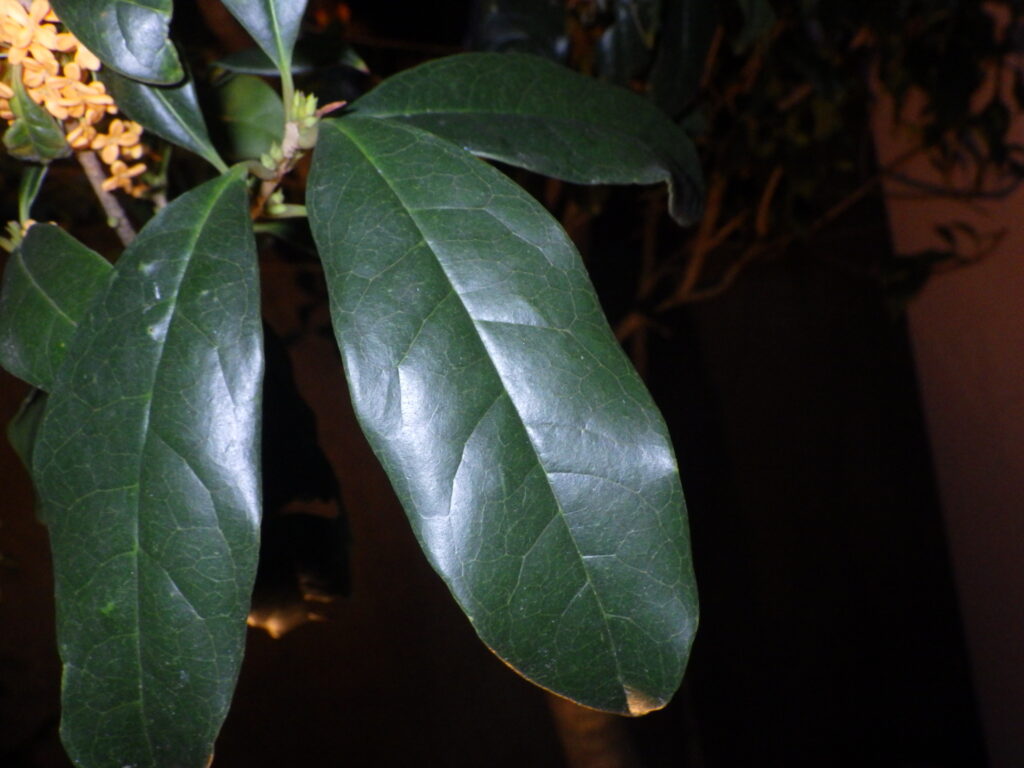
Osmanthus fragrans var. aurantiacus f. aurantiacus, also known as sweet osmanthus, is a dioecious (having separate male and female trees) evergreen small tree native to China (Mogi et al., 2003). It is a very common plant in landscaping from Tohoku to Kyushu. It belongs to the Oleaceae family.
This tree is often said to be native to China, with only male plants being introduced to Japan during the Muromachi or Edo period. Therefore, it does not produce seeds and propagates only through cuttings or layering. Consequently, it does not produce fruit.
However, it is not actually known whether this is the true history (Miyauchi, 2019). If you think about it, if that were the case, shouldn't more effort have been put into obtaining seeds? Based on this, the view that yellow-flowered individuals were cultivated as clones of Osmanthus fragrans var. aurantiacus f. thunbergii, a species that grows wild in Japan and produces slightly yellowish flowers.
It hasn't been actually confirmed by research yet. Despite being so familiar, even its exact origin is still not well understood.
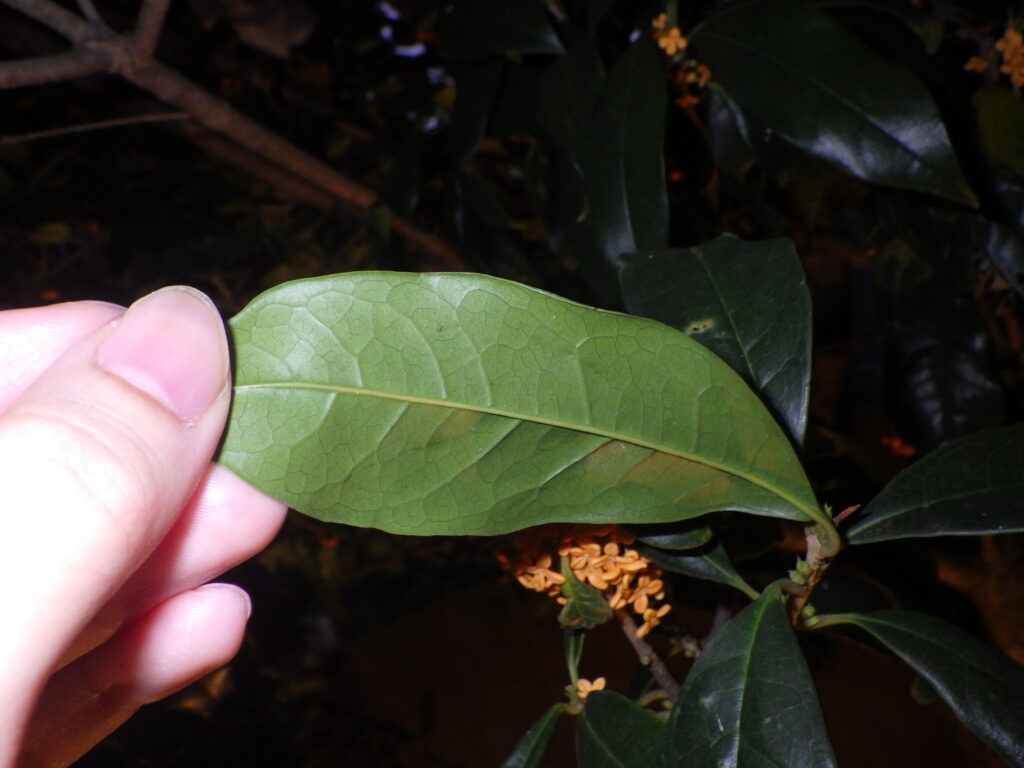
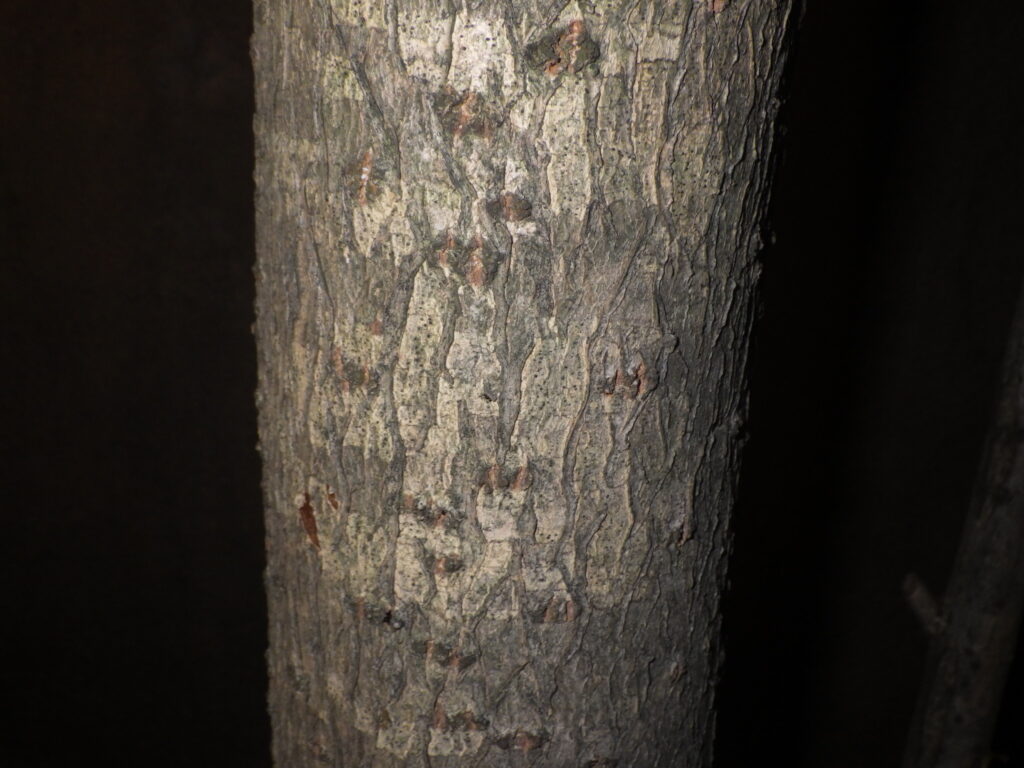
Butterflies dislike the scent of osmanthus flowers.
The flowers bloom from late September to early October, accompanied by a strong fragrance, and are often seen as a signal of the changing seasons, making them beloved by many.
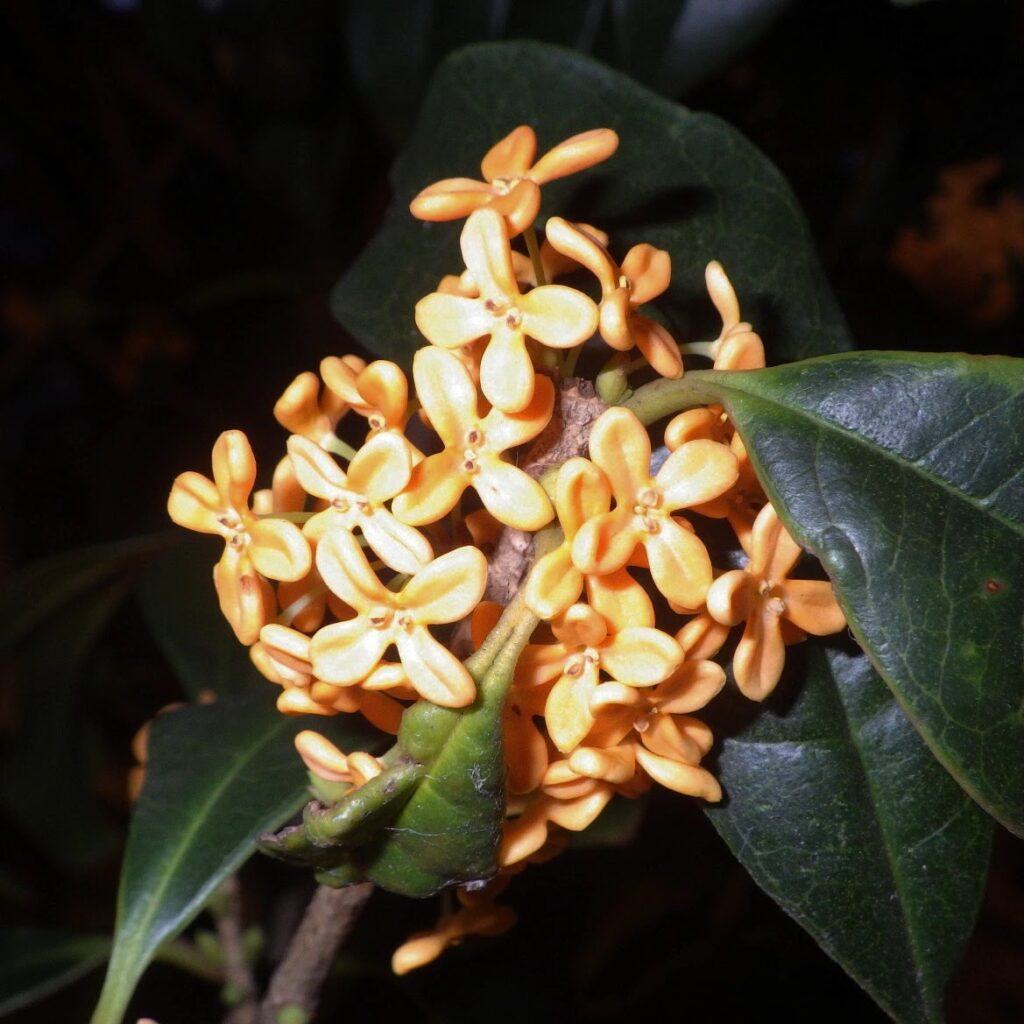
They bloom all at once over a short period of about one to two weeks, and each flower is small, blooming in large clusters in the leaf axils (Yamazaki, 2019). But what purpose does such a strong scent serve in nature?
There have been studies that investigated this scent, identifying the main components of the fragrance and also determining whether cabbage white butterflies are attracted to it (Ômura et al., 2000; Ômura, 2006). The results showed that cabbage white butterflies repel the main components of this fragrance.
In China, bees and hoverflies visit flowers.
If that's the case, what kind of insects are visiting this flower? In reality, despite its fragrance, you rarely see any insects visiting it, do you?
Observations in China and Japan have shown that honeybees and hoverflies visit these flowers, albeit in small numbers (Ômura et al., 2000; Negoro, 2009). This suggests that the flowers may deter butterflies such as cabbage whites, which only steal nectar with their long proboscises and do not contribute to pollination (i.e., nectar robbing), and instead attract bees and hoverflies, which are also abundant in the autumn. The small size of the flowers and short spurs are also well-suited to these species that lick up nectar with their short proboscises.
Since it's a clone, does the flower have no meaning in the first place?
I've explained the insects that visit this flower, but as mentioned above, the color of this flower is artificially created. Furthermore, since only male plants exist, the flower only produces stamens, which would be useless in nature, wouldn't it?
You're probably right; it wouldn't be useful with osmanthus!
However, since the ancestors of this species, Osmanthus fragrans var. fragrans and its ancestor Osmanthus fragrans var. fragrans, have similar scents and flower shapes, it is thought that they were useful in ancient times. However, the scent of Osmanthus fragrans var. fragrans is weaker than that of Osmanthus fragrans var. fragrans, so it is possible that a special change occurred during the development of Osmanthus fragrans var. fragrans. Further comparisons between Osmanthus fragrans var. fragrans and Osmanthus fragrans var. fragrans may reveal even more interesting findings.
It's strange to think that humans also enjoy the scent that flies love. The unique scent of osmanthus has a history of being used to mask toilet odors, which has led to mixed opinions among humans, and it seems there are mixed opinions in the insect world as well!
References
Miyauchi, Yasuyuki. 2019. Cultural History of Trees (12): Osmanthus fragrans. Bulletin of the Institute for Horticultural Culture, Keisen University. Horticultural Culture 14: 63-68. ISSN: 1882-5044, http://id.nii.ac.jp/1294/00001046/
Mogi, T., Takahashi, H., Katsuyama, T., & Ishii, E. 2003. Flowers Blooming on Trees: Sympetalous Flowers, Monocotyledons, Gymnosperms. Yama-kei Publishers. Tokyo, 719pp. ISBN: 9784635070058
Negoro, Takashi. 2009. Survey of flower-visiting insects at Kojō Park in Takaoka City, and comparison of survey results at 11 locations in Toyama Prefecture. Research Report of the Toyama City Science Museum 32: 39-60. ISSN: 1882-384X, http://repo.tsm.toyama.toyama.jp/?action=pages_view_main&active_action=repository_view_main_item_detail&item_id=899&item_no=1&page_id=13&block_id=82
Omura, Takashi. 2006. Foraging behavior and olfactory information substances in adult butterflies. Comparative Physiology and Biochemistry 23(3): 134-142. ISSN: 0916-3786, https://doi.org/10.3330/hikakuseiriseika.23.134
Ômura, H., Honda, K., & Hayashi, N. 2000. Floral scent of Osmanthus fragrans discourages foraging behavior of cabbage butterfly, Pieris rapae. Journal of Chemical Ecology 26(3): 655-666. ISSN: 0098-0331, https://doi.org/10.1023/A:1005424121044
Yamazaki, Seiko. 2019. A Comprehensive Illustrated Guide to Planting Plans by Tree Type, Revised Edition. Exknowledge. Tokyo, 203pp. ISBN: 9784767826257