This article contains a draft of the report titled "Record of visits to flowers by *Pseudoflavoena erythrorhizon* in Kyoto Prefecture," which was published in the following journal.
Citation method: Ikeda, Kenichi. 2020. A record of flower visits by *Pseudofusiliformis* in Kyoto Prefecture. *Gekkan Mushi* 598: 48. ISSN: 0388-418X
This article was written with the intention of being the first ecological report on *Pseudofujiroatsuba*, a species of concern listed in the Kyoto Prefecture Red Data Book.
There may be minor changes in wording, but the cited references remain the same. For more accurate information, please refer to the journal.
What is the false white moth? Distribution in Japan.
Adrapsa subnotigera Owada, 1982 is known to be distributed in Honshu (Tokai region and Kii Peninsula), Shikoku, Kyushu, the Ryukyu Islands, and internationally in Taiwan and southern China (Owada, 2011). Kyoto Prefecture has been considered the northern limit of its distribution (Kyoto Prefectural Government, Planning and Environment Department, Environmental Planning Division, 2002), but in recent years, it has also been recorded in Ibaraki Prefecture (Hayashi et al., 2012) and Chiba Prefecture (Saito, 2015). It is listed as a species of concern in the Kyoto Prefectural Red Data Book (Kyoto Prefectural Government, Natural Environment Conservation Division, 2015), and although there are records such as in the Ashiu Experimental Forest of Kyoto University (Inoue and Kamogashira, 2001), it is thought that there are not many records.
The author's discovery details and visit records.
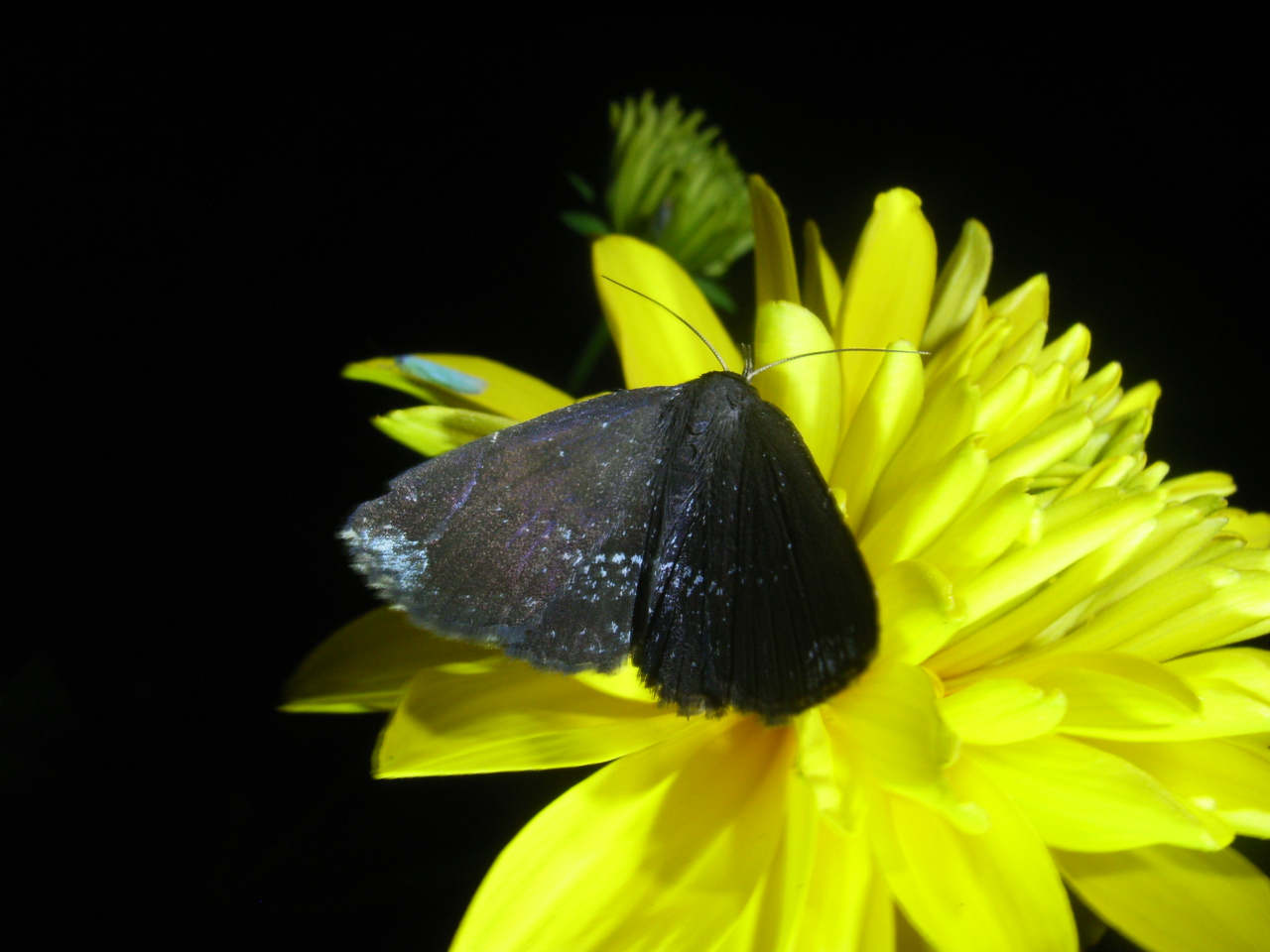
On July 8, 2014, at approximately 9:30 PM, I photographed a false white moth (Rudbeckia laciniata L. 'Hortensis') visiting a flower in a vacant lot near a private house in Aza Amabe-shita, Maizuru City, Kyoto Prefecture, and I report this observation here.
1 ex. (Photo), Amabe-shimo, Maizuru City, Kyoto Prefecture, 8 July 2014, photographed by the author.
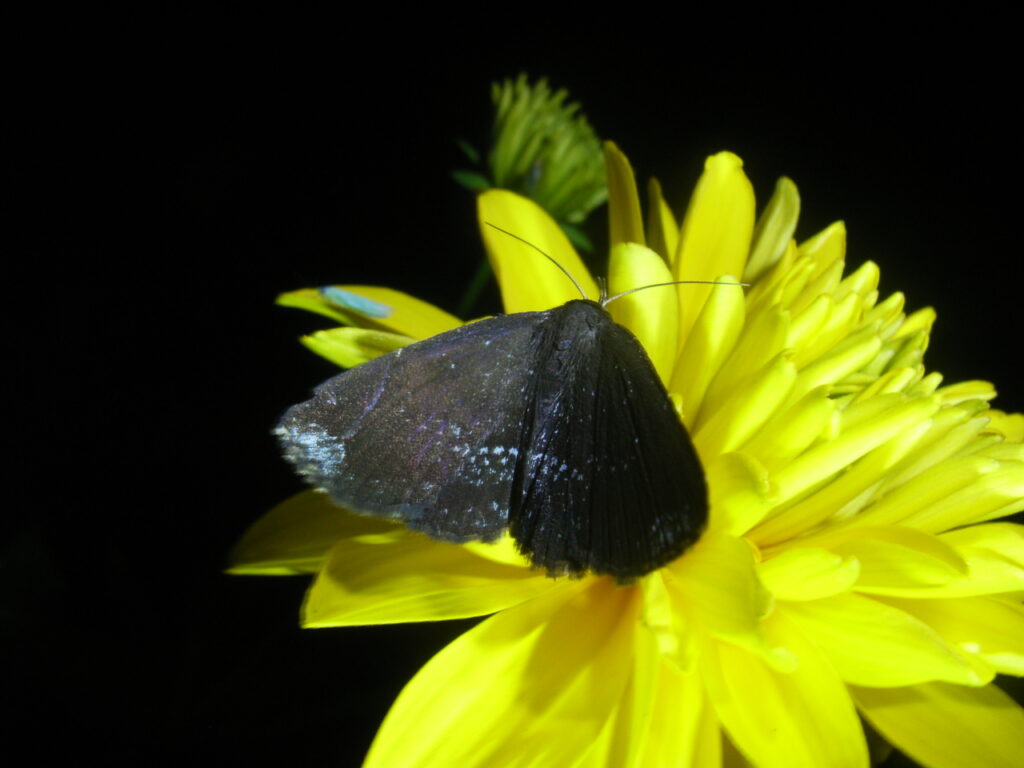
The ecology of this species is unknown (Kyoto Prefecture Natural Environment Conservation Division, 2015), and it is believed that there are no known records of it visiting flowers. However, *Rudbeckia laciniata* is a variety of *Rudbeckia laciniata* and is designated as a specified invasive alien species (Ministry of the Environment, last updated 2018). In this record, *Rudbeckia laciniata* is thought to be either cultivated for ornamental purposes or has become naturalized, and is not thought to be the original flowering site. Nevertheless, it is well known that moths, including *Noctuidae*, visit flowers at night (Ikenoue and Kanai, 2010), and it is possible that this species also visits similar flowers at night.
References
Hayashi, Keiji, Sato, Kazuaki, and Suzuki, Raita, 2012. Lepidoptera (Moths). Ibaraki Prefectural Museum of Nature Comprehensive Survey Report 2011: Trends in Insects and Other Invertebrates in Ibaraki Prefecture: 59-62. Museum Park Ibaraki Prefectural Museum of Nature, Bando. https://www.nat.museum.ibk.ed.jp/assets/data/materials/research/sougou/Insect12.pdf
Ikenoue, Toshiyuki and Kanai, Hiroo, 2010. Nocturnal moth flower-visiting activity. Journal of the Japanese Society of Plant Science 85.4: 246-260. https://doi.org/10.51033/jjapbot.85_4_10230
Soji Inoue and Yoshio Kamogashi, 2001. Moths of the Ashiu Experimental Forest, Kyoto University. Abstracts of the 48th Annual Meeting of the Lepidopterological Society of Japan: 31.
Owada, Mamoru, 2011. Noctuidae, Carinae subfamily. In: Kishida, Yasunori (ed.), Standard Illustrated Guide to Japanese Moths III: 221-235. Gakken Educational Publishing, Tokyo.
Kyoto Prefectural Government, Planning and Environment Department, Environmental Planning Division, 2002. Kyoto Prefecture Red Data Book 2002, Volume 1. Kyoto Prefectural Government, Planning and Environment Department, Environmental Planning Division, Kyoto.
Kyoto Prefectural Government, Natural Environment Conservation Division, 2015. Kyoto Prefecture Red Data Book 2015, Volume 1. Kyoto Prefectural Government, Natural Environment Conservation Division, Kyoto.
Ministry of the Environment, last updated 2018. List of Specified Invasive Alien Species. https://www.env.go.jp/nature/intro/2outline/list.html
Saito, Osamu, 2015. Collection of *Pseudofushiroatsuba* and *Velvet Cutworm* in the Kiyosumi Mountain Range. Insects of Boso Peninsula 56: 60.