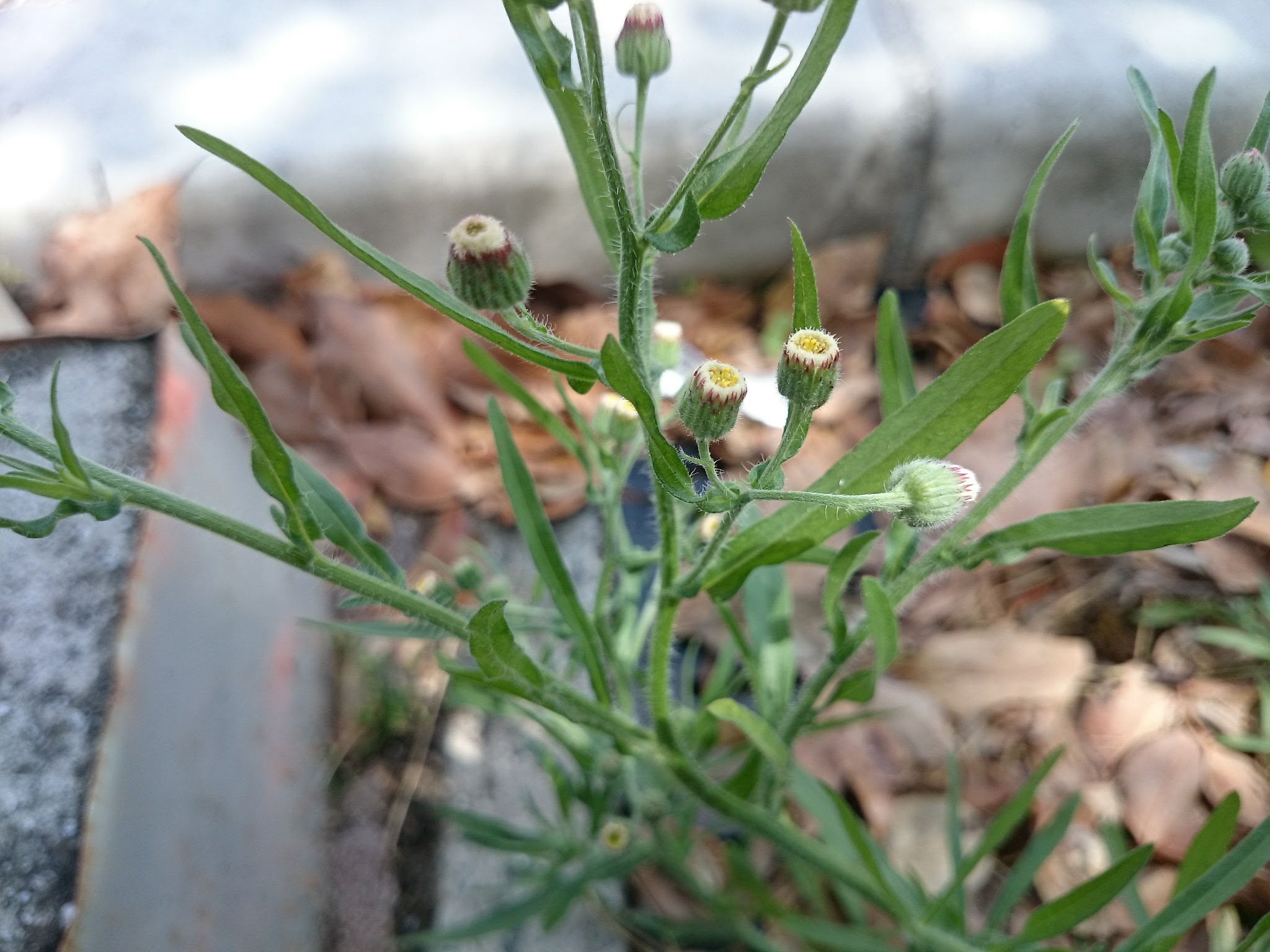
Erigeron annuus, Erigeron scoparius, Erigeron cantoniensis, and Erigeron cantoniensis are all members of the Asteraceae family, genus Erigeron, and are annual to biennial herbs that spread from the Americas to the rest of the world. In Japan, they are frequently found in dry fields and urban areas. It may be difficult to distinguish them at first, but you can definitely differentiate them by checking the height of the stem, the condition of the hairs, and the size of the involucre. They bear flower heads typical of the Asteraceae family, but the corolla of the ray florets is reduced. The fruit is an achene with a pappus. This article will explain the classification and morphology of Erigeron annuus, Erigeron cantoniensis, Erigeron cantoniensis, and Erigeron cantoniensis.
What are Erigeron annuus, Erigeron strigosus, Erigeron philadelphicus, and Erigeron philadelphicus?
Erigeron bonariensis, also known as wild horseweed, is an annual to biennial herb native to South America that has spread throughout the world (Hayashi et al., 2013; Kanagawa Prefecture Flora Survey Association, 2018). It was introduced to Japan around the mid-Meiji period and is more commonly found in urban environments than Erigeron annuus, growing in areas with high soil temperatures and plenty of dry gravel. It does not grow in rural environments.
Erigeron sumatrensis, also known as giant horseweed, is a plant native to South America that has spread throughout the world as an annual or biennial. It was introduced to Japan during the Taisho era and grows in fields, urban vacant lots, and other similar locations.
Erigeron canadensis, also known as dwarf mugwort, is native to North America and is an annual to biennial plant that grows along roadsides and in wastelands throughout Japan.
Erigeron pusillus, also known as hairless dwarf mugwort, is native to North America. In Japan, it was discovered in Shingu City, Wakayama Prefecture in 1926. It is common in western Japan and is an annual to biennial herb found in warmer, drier environments than Erigeron annuus (Shimizu et al., 2001; Kanagawa Prefecture Flora Survey Association, 2018).
All of these plants belong to the genus Asteraceae (Asteraceae family) and are annual to biennial herbs that have spread from the Americas to the rest of the world. In Japan, they are commonly found in dry fields and urban areas.
Among the Aster genus, it shares many similarities, such as having small ray florets that are only slightly longer than the involucral bracts, and flower heads that are 3 mm in diameter. Because of its inconspicuous appearance, distinguishing it from other species can be difficult until you become familiar with it.
What are the differences between Erigeron annuus, Erigeron philoxeroides, Erigeron strigosus, and Erigeron strigosus?
To understand the differences between *Erigeron annuus*, *Erigeron philoxeroides*, *Erigeron strigosus*, and *Erigeron strigosus* var. *hirsuta*, it is necessary to examine the finer details (Yoshioka and Kusakabe, 2018; Kanagawa Prefecture Flora Survey Association, 2018).
First, as the name suggests, they can be broadly divided into two groups.
In contrast to Erigeron annuus and Erigeron philoxeroides, the stems are densely covered with fine and coarse hairs, and the involucre is large, measuring 4-5 mm in length. In contrast, Erigeron annuus and Erigeron annuus have stems that are covered only with coarse hairs or are hairless, and the involucre is small, measuring 3.5-4 mm in length.
It's difficult to see the hairs clearly, but the involucre (the bracts unique to the Asteraceae family that protect the inflorescence, essentially the overlapping leaf-like structures below the flower) is clearly smaller in *Erigeron annuus* and *Erigeron annuus*.
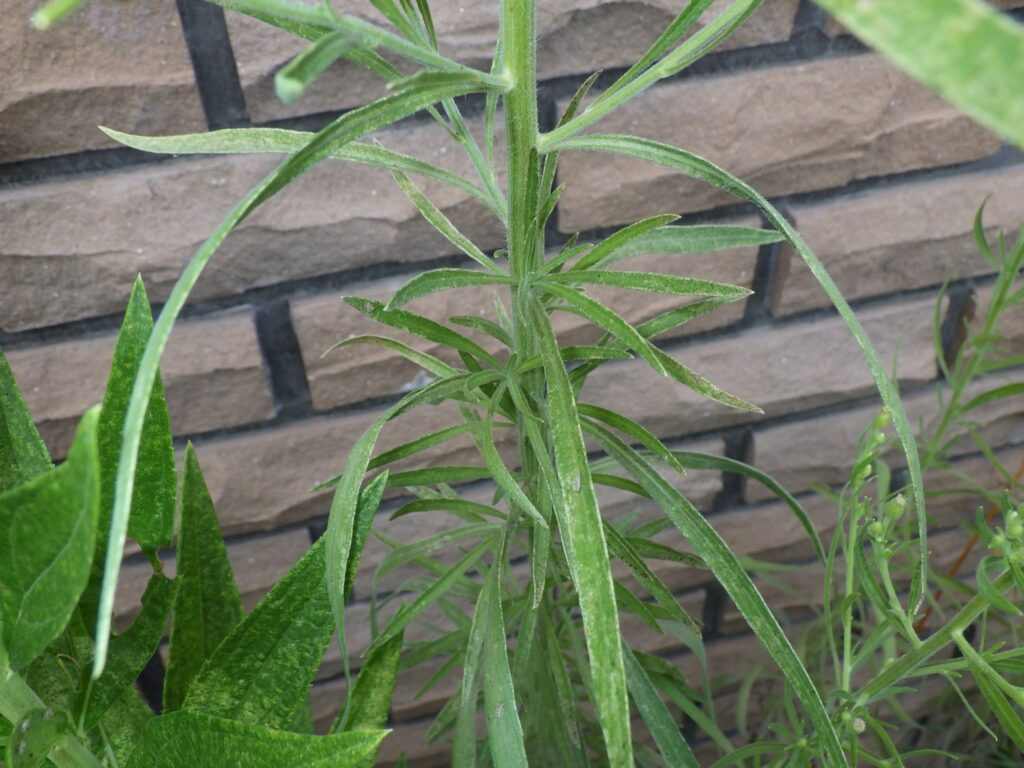
Regarding Erigeron annuus and Erigeron philoxeroides, Erigeron annuus has a relatively short main stem, 30-50 cm tall, and its involucre is barrel-shaped, while Erigeron philoxeroides has a main stem, 100-180 cm tall, about the height of a person, and its involucre is ovate to short tubular.
Regarding Erigeron annuus and Erigeron annuus var. spp., Erigeron annuus has hairy stems and involucral bracts, the upper ends of the involucral bracts are not purple, the flowers grow from the bottom of the inflorescence branches upwards, and the leaves have 2 to 4 pairs of serrations. In contrast, Erigeron annuus var. spp. has hairless stems and involucral bracts, purple spots on the upper ends of the involucral bracts, the flowers grow only at the tips of the inflorescence branches, and the leaves have almost no serrations.
Checking these points should allow you to distinguish them for sure.
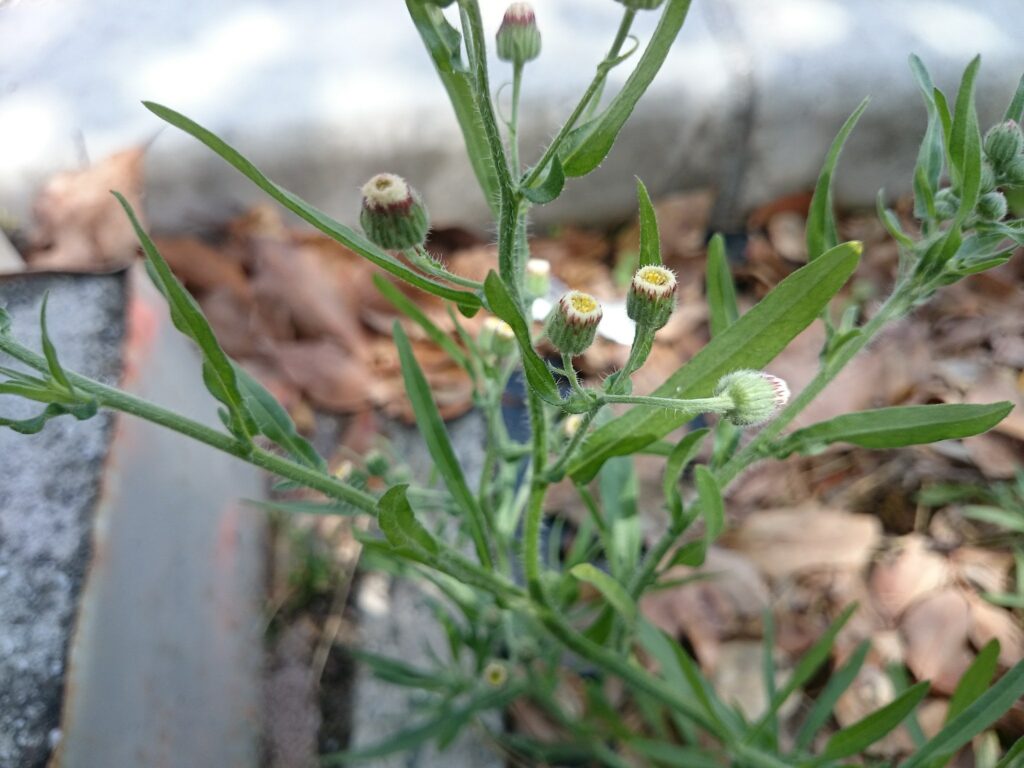
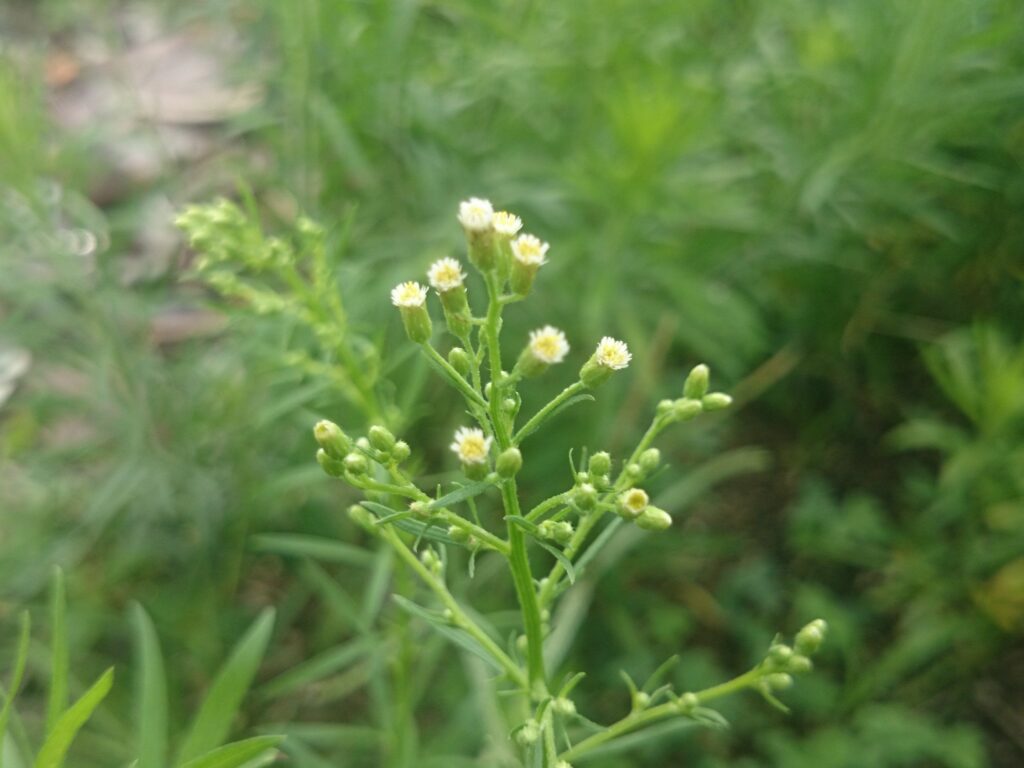
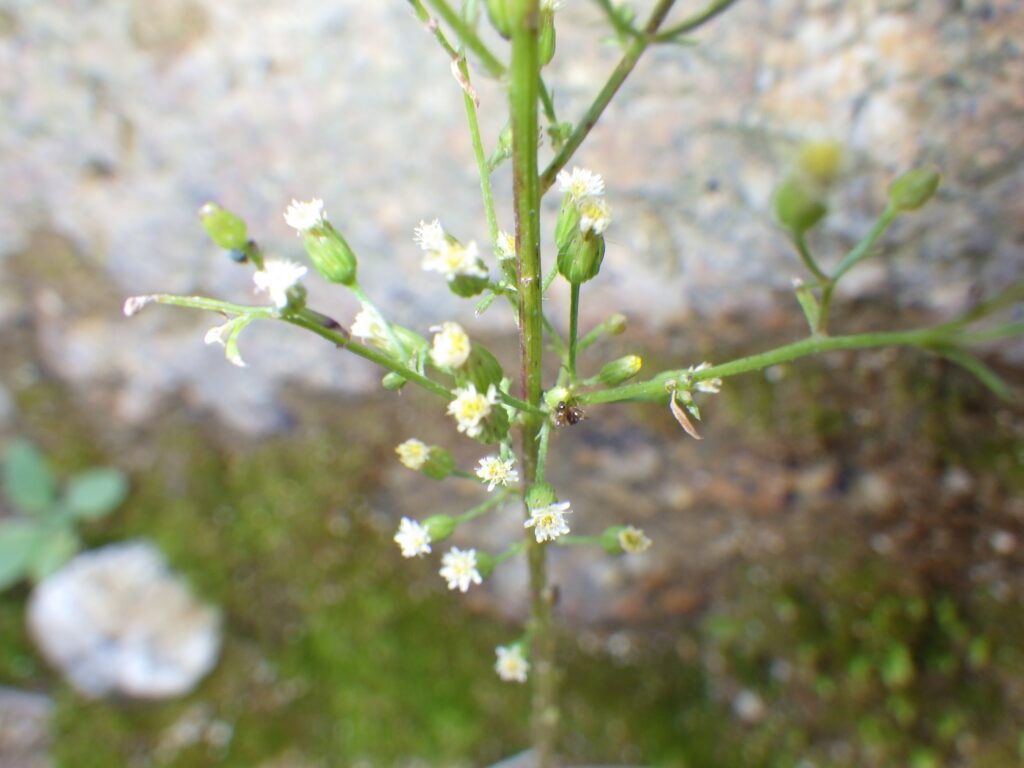
What is the structure of a flower?
Like many plants in the Asteraceae family, the genus Asteraceae produces "flower heads" (capitulum inflorescences). Flower heads are commonly found in the Asteraceae family and are inflorescences (arrangements of flowers) that are clusters of flowers. As evidence of this, each flower has the structure of stamens and pistils, and is sometimes specifically called a "flora." Most people refer to flower heads as "flowers," but they are actually different.
The small flowers of the Asteraceae family consist of two types: "ray florets," which have a corolla that extends widely to one side, and "disc florets," which have a tubular corolla. The combination of these florets varies depending on the species of Asteraceae, but all four of these species have ray florets. However, the corolla is extremely small. This is in contrast to other members of the same genus, Erigeron annuus, such as Erigeron philadelphicus and Erigeron strigosus.
The flowering period for Erigeron annuus is from April to June. The flower heads are arranged in a raceme, are spherical, and have an involucre 5 mm long. There are many ray florets, but they are very small and inconspicuous.
Erigeron annuus (Japanese horseweed) flowers from July to October. It bears numerous small flower heads in a conical shape at the top of the stem. The flower heads are about 5 mm long. The ray florets have small ligules and are almost invisible, hidden by the involucre. The involucre is ovate or short tubular.
Erigeron annuus flowers from August to October. It bears numerous small flower heads in a conical shape at the top of the stem. The flower heads are about 3 mm in diameter. Numerous white ray florets are arranged around the tubular florets. The ray florets are small but clearly visible. The involucre is tubular. The involucral bracts are pale green and linear, arranged in 3 to 5 rows.
Erigeron annuus, also known as 'Kenashihimemukashiomogi', flowers from summer to autumn. The branches bearing inflorescences are sparse, and the lower branches do not have capitulum flowers. The involucral bracts of the capitulum are hairless and have dark purple spots at the top.
What is the structure of the fruit?
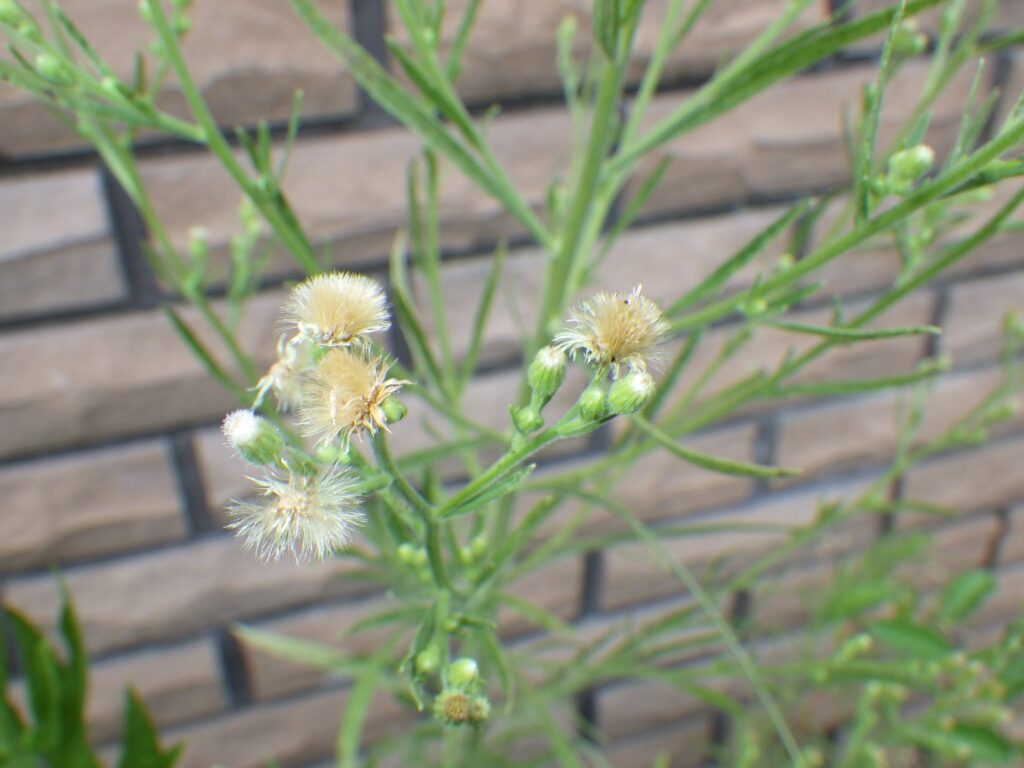
The fruit, common to the genus Asteraceae, is an achene, like many other members of the Asteraceae family. The achene has a hard, membranous pericarp that dries out when ripe and contains one seed in each chamber. Although this achene is sometimes called a "seed," strictly speaking, it is a fruit. Inside this achene is the "seed," or "seed."
The achenes of *Erigeron annuus* are about 1.5 mm long. The pappus is in a single row and is reddish-brown.
The achenes of *Erigeron annuus* are about 1.5 mm long, and the pappus is 4 mm long.
The achenes of *Erigeron annuus* are about 1 mm long. The pappus is light brown and about 2.5 mm long.
References
Hayashi, Yasaka, Kadota, Yuichi, and Hirano, Takahisa. 2013. Yamakei Handy Illustrated Guide 1: Wildflowers (Revised and Expanded New Edition). Yama-kei Publishers, Tokyo. 664pp. ISBN: 9784635070195
Kanagawa Prefecture Flora Survey Association. 2018. Kanagawa Prefecture Flora 2018 (Electronic Edition). Kanagawa Prefecture Flora Survey Association, Odawara. 1803pp. ISBN: 9784991053726
Shimizu, K., Morita, H., & Hirota, S. 2001. Illustrated Guide to Naturalized Plants of Japan: 600 Species of Plant Invaders (Revised). National Rural Education Association, Tokyo. 553pp. ISBN: 9784881370858
Yoshioka, Toshihito & Kusakabe, Chika. 2018. *Erigeron annuus* and *Conyza canadensis*: Survival strategies as nomadic species. *Grass and Greenery* 10: 44-53. ISSN: 2185-8977, https://doi.org/10.24463/iuws.10.0_44

