cultivation

Sponsored Link
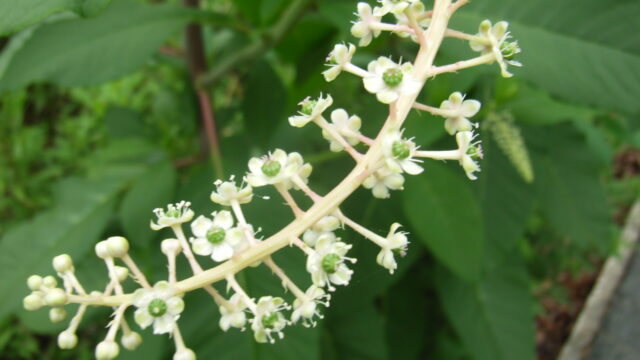
07.2830 American Pokeweed Flower plant

What are the differences between Japanese pokeweed (Phytolacca americana), American pokeweed (Phytolacca americana var. japonica), and round pokeweed (Phytolacca americana var. japonica)? How do they differ from burdock (Phytolacca americana)? We'll explain how to distinguish between similar species! Even though it's highly poisonous to humans, birds are unaffected!?

Japanese pokeweed (Phytolacca americana), American pokeweed (Phytolacca oleracea), and round pokeweed (Phytolacca oleracea) all belong to the Phytolaccaceae family and genus Phytolacca. Their names come from the fact that their fleshy, thick roots resemble those of burdock (Philadelphia arvensis), and they are characterized by their entirely poisonous nature and dark purple berries. However, the three species are often confused...
07.3327.1 Himetamasango flower plant

What are the differences between *Tama coral* (winter coral) and *Himeta coral*? An explanation of how to distinguish between similar species.

Both Solanum sieboldii (winter coral) and Solanum nigrum belong to the Solanaceae family and are cultivated extensively for ornamental purposes because they produce attractive, round, red, ripe fruits (berries) in winter. However, in Japan, it is not always possible to properly distinguish between the two varieties, Solanum sieboldii and Solanum nigrum...
07.1932 Boehmeria japonica fruit plant

What are the differences between Boehmeria japonica, Boehmeria nivea, Ramie, and Urtica dioica? An explanation of how to distinguish between similar species.

Boehmeria japonica, Boehmeria nivea, Ramie, and Urtica dioica all belong to the Urticaceae family and share the characteristic of having leaves with fine veins and serrations. They are common herbaceous plants that grow in mountains and fields. Boehmeria japonica and Ramie are also well-known for their use as fibers. However, the classification of the Urticaceae family is complex...
07.0539.c Allium thunbergii flower plant

What's the difference between *Hatake-nira* and *Nira-modoki*? An explanation of how to distinguish between similar species.

Both Allium spectabile and Allium sibiricum belong to the genus Allium in the Amaryllidaceae family. Although they are introduced species in Japan, they are now very common, growing in places like between concrete blocks along roadsides. However, they are extremely often confused. To distinguish between these two species, it's necessary to examine their leaves and flowers. Regarding the flowers...
07.3731 *Rurimizokakushi* flower plant

What are the differences between Lobelia, Lobelia chinensis, and Lobelia sessilifolia? An explanation of how to distinguish between similar species.

Lobelia (also known as blue-flowered bellflower), Lobelia sessilifolia, and Lobelia sessilifolia are characterized by their blue flowers, typical of the Campanulaceae family, and their bilaterally symmetrical blossoms. They are commonly cultivated in gardens, especially in horticulture. However, image searches often lead to confusion between these species...
07.3283 Corydalis (Calystegia soldanella) flower plant

What are the differences between morning glory, small morning glory, beach morning glory, and European morning glory? An explanation of how to distinguish between similar species.

Morning glory, small morning glory, beach morning glory, and European morning glory are all climbing perennial plants belonging to the Convolvulaceae family. They are relatively small compared to other members of the Convolvulaceae family and are easy to find. Morning glory and small morning glory, in particular, twine around street trees and fences even in urban areas, blooming in countless numbers...
07.3353 Purple lilac flower plant

What are the differences between lilac, syringomyelia, and dwarf lilac? We'll explain how to distinguish between similar species! What exactly is a "dwarf lilac"?

Lilac, syringa, and dwarf lilac all belong to the genus Syringa in the Oleaceae family. Their flowers bloom in clusters in spring, covering the upper parts of the trees and creating a very attractive appearance, so they are often cultivated as ornamental plants in gardens. However, some people may not know the differences between them....
07.3864.a Winter Cosmos Yellow Cupid Flower Head plant

What's the difference between winter cosmos and cosmos? We'll explain how to distinguish between similar species! And did you know that Bidens pilosa is actually a different species?!

Winter cosmos (also known as winter cosmos) is cultivated in horticulture for ornamental purposes and is a valuable plant for gardening because it blooms in winter, from September to December. At first glance, some people might confuse it with cosmos because their names are similar. However, by examining the bracts, flowers, and fruits...
07.2340.a Tibouchina urvilleana (flower) plant

What's the difference between Tibouchina japonica and Tibouchina urvilleana? An explanation of how to distinguish between similar species.

Both Tibouchina urvilleana and Tibouchina urvilleana belong to the Melastomataceae family. Tibouchina urvilleana, in particular, is well-known and, although a southern species, is relatively cold-hardy and commonly cultivated in Honshu. In horticulture, Tibouchina urvilleana is sometimes simply called "Tibouchina," which can cause confusion...
07.3768 Goldenrod (Solidago altissima) flower heads plant

What are the differences between goldenrod, autumn goldenrod, and mountain goldenrod? How do they differ from other goldenrod species? This article explains how to distinguish between similar species.

Goldenrod (Solidago altissima), autumn goldenrod (Solidago virgaurea), and mountain goldenrod (Solidago virgaurea var. japonica) all belong to the genus Solidago in the Asteraceae family, and are representative perennial plants that bloom with small yellow flowers (more accurately, flower heads) in autumn. Goldenrod, in particular, is well-known because it proliferates rapidly in some regions...
Sponsored Link