ecology

Sponsored Link
07.0225.a Amazon Water Chestnut (Scaled upper surface of leaf) Seed Plant Encyclopedia

[Seed Plant Encyclopedia #045] What are the species of the Hydrocharitaceae family? Photo list

The family Hydrocharitaceae consists of annual or perennial aquatic plants that grow in freshwater or saltwater. Their morphology is extremely diverse. The base of the leaves often forms a leaf sheath, containing 2 to 10 or more small scales. They are monoecious or dioecious, with inflorescences...
07.0119 Magnolia flowers Seed Plant Encyclopedia

[Seed Plant Encyclopedia #028] What are the species of the Magnoliaceae family? Photo list

The Magnoliaceae family consists of evergreen or deciduous woody plants. The leaves are simple and alternate. The perianth segments are separate and whorled, exhibiting triperality. The stamens and pistils are numerous and arranged spirally. Approximately 300 species across two genera are known in the temperate and subtropical regions of Asia and America, with 7 species in one genus found in Japan...
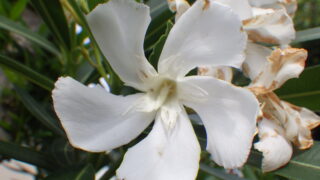
07.3248 Oleander white flower type flower plant

How dangerous is the poison in oleanders? Why are they a symbol of peace in Hiroshima? The oleander flower, which doesn't secrete nectar, mimics an endangered species!?

Oleander is a common ornamental tree found in various locations throughout Japan, such as in parks and as street trees. However, it originally thrives in the Mediterranean and Southeast Asia. While there are various theories, it's said that 5 to 15 leaves are a lethal dose, and although extremely rare, there have been reports of poisoning in Japan. Furthermore, the smoke from burning oleander is also toxic...
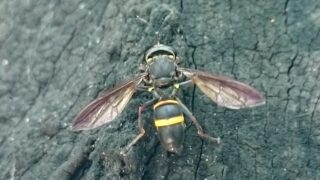
Monoceromyia Pleuralis Male Adult Edited animal

Do the bee-like hoverflies sting? An explanation of the mysterious life cycle and potential harm of this fly that feeds on tree sap.

Are you familiar with the hoverfly known as the false bee hoverfly? At first glance, it looks exactly like a bee, but hoverflies are actually a type of fly, so they won't sting you and are harmless. Its bright colors are thought to be a form of mimicry. Although it's actually a type of hoverfly...
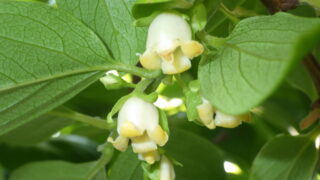
07.2904 Persimmon tree (male flower) plant

What are the differences between persimmon (Diospyros kaki), Japanese persimmon (Diospyros serrata), and mountain persimmon (Diospyros margaritacea)? We'll explain how to distinguish between similar species! Where are they native to? What's the difference between astringent and sweet persimmons? What insects visit the flowers? Who eats them in nature?

The Japanese persimmon (kaki) has been cultivated in Japan since ancient times and is a fruit and plant strongly associated with Japanese culture. While closely related species exist, the Japanese persimmon is easily distinguishable by the size of its fruit. However, when distinguishing by leaves alone, it resembles the Japanese dwarf persimmon (Diospyros kaki), the Ryukyu dwarf persimmon (Diospyros ryukyuensis), and the evergreen persimmon (Diospyros kaki), and subtle differences...
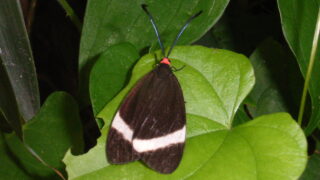
13.30384 Firefly moth, female, adult animal

A thorough explanation of the species, toxins, and harmful effects of moths in the Zygaenidae family! What secrets are hidden behind their vibrant colors?

The Zygae family, exemplified by species like the firefly moth and the bamboo grass moth, is known for its bright, diurnal colors. But do you know why they have such striking colors? It turns out they possess a powerful poison that produces cyanide, and these colors serve as a "warning signal"...
07.3030 Mountain Azalea Flower 1 plant

What's the difference between mountain azaleas and rhododendrons? We'll explain how to distinguish between similar species! Research has revealed that bumblebees are also essential for flowers that are supposedly specialized in attracting butterflies!

The Japanese azalea (Rhododendron kaempferi) is a representative species of wild azalea in Japan, while the Japanese azalea (Rhododendron molle) is famous for being poisonous. Both belong to the Rhododendron genus of the Ericaceae family and are representative species of red wild azaleas, so you might get them confused. However, you can distinguish them by checking the shape of their leaves and how the flowers are arranged. These two species...
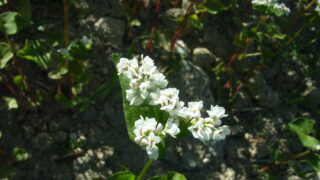
07.2698 Buckwheat buds plant

What are the differences between buckwheat (soba), Tartary buckwheat (Tartary buckwheat), and Shakuchiri buckwheat (Shakuchiri buckwheat)? We explain how to distinguish between similar varieties! Is buckwheat's origin in mountainous regions? Why do Japanese people eat it as noodles? Are honeybees the only insects that visit its flowers?

Buckwheat, Tartary buckwheat, and Japanese buckwheat are all species that can be found in Japan, either cultivated or naturalized. Buckwheat, in particular, is indispensable to Japanese people as a noodle dish, but few people can distinguish between these three species as plants. These three species differ in the way their flowers grow, the shape of their fruits, etc.
13.19339 *Peach-legged Longhorn Beetle* (male, adult) Edited animal

Why are the thighs of the longhorn beetle *Thumbelina japonica* so thick? A surprising evolutionary adaptation for subduing females and the truth about "sexual conflict."

Are you familiar with the insect known as the "peach-thicked longhorn beetle"? It gathers on flowers from spring to early summer and is one of the most commonly found insects in Honshu, belonging to the family Cerambycidae. Its most distinctive feature is its thick hind legs. I wondered why this was the case...
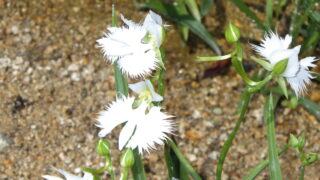
07.0386 Egret Orchid Flower plant

What species resembles the egret orchid? The flowers are visited by hawk moths! And not only that, tiny insects called thrips also play an important role in pollination! What is the "Egret Orchid Legend"?

The egret orchid (Habenaria radiata) is a perennial plant that inhabits slightly damp areas and is a popular choice for gardening. Unfortunately, due to the decline of its wetland habitat and illegal harvesting, it is listed as near-threatened on the Ministry of the Environment's Red List. There are many closely related species, and many that share the name "egret orchid," but this particular species has a flattened stem resembling a heron...
Sponsored Link