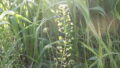
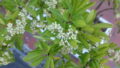
Ilex rotunda, Ilex crenata, Ilex serrata, and Ilex serrata all belong to the Ilex genus of the family Aquifoliaceae. They not only grow in evergreen broad-leaved forests but are also frequently seen planted in parks and gardens, making them extremely familiar and common evergreen trees in Japan. Because they all share thick leaves and beautiful red fruits, distinguishing them can often be difficult. You can generally distinguish them by carefully observing the leaves, but checking the flowers and fruits will give you a more definitive answer. This article will explain the classification and morphology of the Ilex genus.
What are Ilex rotunda, Ilex crenata, Ilex serrata, and Ilex serrata?
Ilex rotunda, also known as Kurogane-mochi or Kurogane-mochi, is an evergreen tree that grows in warm temperate hilly broad-leaved forests. It is distributed in Honshu (Kanto region, west of Fukui Prefecture), Shikoku, Kyushu, and the Ryukyu Islands in Japan; as well as in Korea, southeastern China, Taiwan, Vietnam, and Laos.
Ilex integra, also known as the Japanese holly (mochi tree or holly tree), is an evergreen tree that grows in broad-leaved evergreen forests and is distributed in Honshu (west of the southern Tohoku region), Shikoku, Kyushu, and the Ryukyu Islands in Japan; as well as in Korea, southeastern China, and Taiwan.
Ilex pedunculosa, also known as winter holly, is an evergreen tree distributed in Honshu (west of Niigata Prefecture and the Kanto region), Shikoku, Kyushu, and Yakushima in Japan; as well as in China and Taiwan, growing in dry forests and forest edges in mountainous areas.
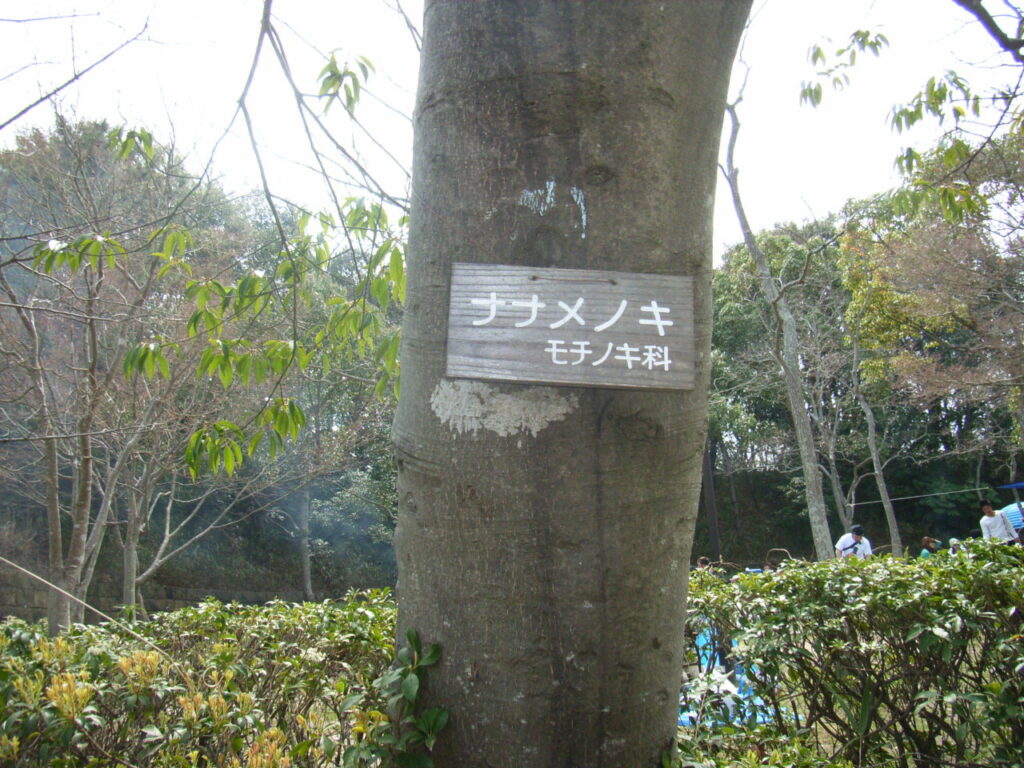
Ilex chinensis, also known as the long-fruited tree or seven-fruited tree, is distributed in Honshu (west of the Tokai region), Shikoku, and Kyushu in Japan. It is an evergreen tree that grows in dry broad-leaved evergreen forests and Japanese red pine forests along the coast and in low mountains.
All of these trees belong to the genus Ilex in the family Aquifoliaceae. They not only grow in evergreen forests but are also frequently seen planted in parks and gardens, making them extremely familiar and common evergreen trees in Japan. The bright, beautiful red, spherical fruits they bear in winter are also a reason for their popularity.
Morphologically, they share many similarities, such as having thick, glossy leaves characteristic of evergreen trees, and producing red, spherical fruits as mentioned above. They are dioecious (having separate male and female plants).
Additionally, although not a characteristic of the plant itself, the larvae of the fly Asteralobia soyogo can form strange lumps called galls on the buds, which can be a good distinguishing feature from other species (Tokuda et al., 2004). These are called holly galls, soyogo galls, and seven-leaved galls, respectively.
However, distinguishing between these four species is quite difficult, and the lack of distinctive leaf features further complicates the process.
What are the differences between Ilex rotunda, Ilex crenata, Ilex serrata, and Ilex serrata?
Distinguishing between these four species solely by their leaves is quite difficult, but we will introduce them in a way that makes it as easy as possible (Hayashi, 2019).
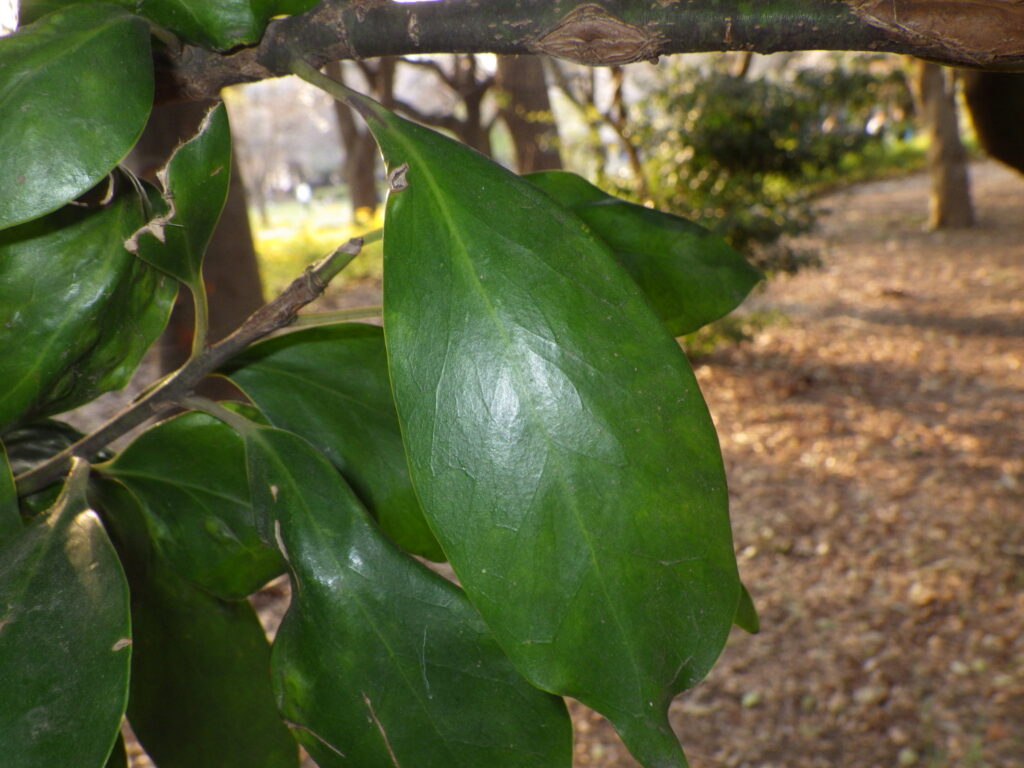
First, there is a difference in that mature leaves of Ilex rotunda, Ilex crenata, and Ilex serrata do not have serrations, while mature leaves of Ilex crenata have low serrations.
However, be aware that young trees of Ilex rotunda, Ilex crenata, and Ilex serrata may also have serrated edges. It is important to check several leaves.
While it might be possible to identify these four species even as young trees by carefully consulting a plant encyclopedia, I will omit that detail here to avoid making it too complicated.
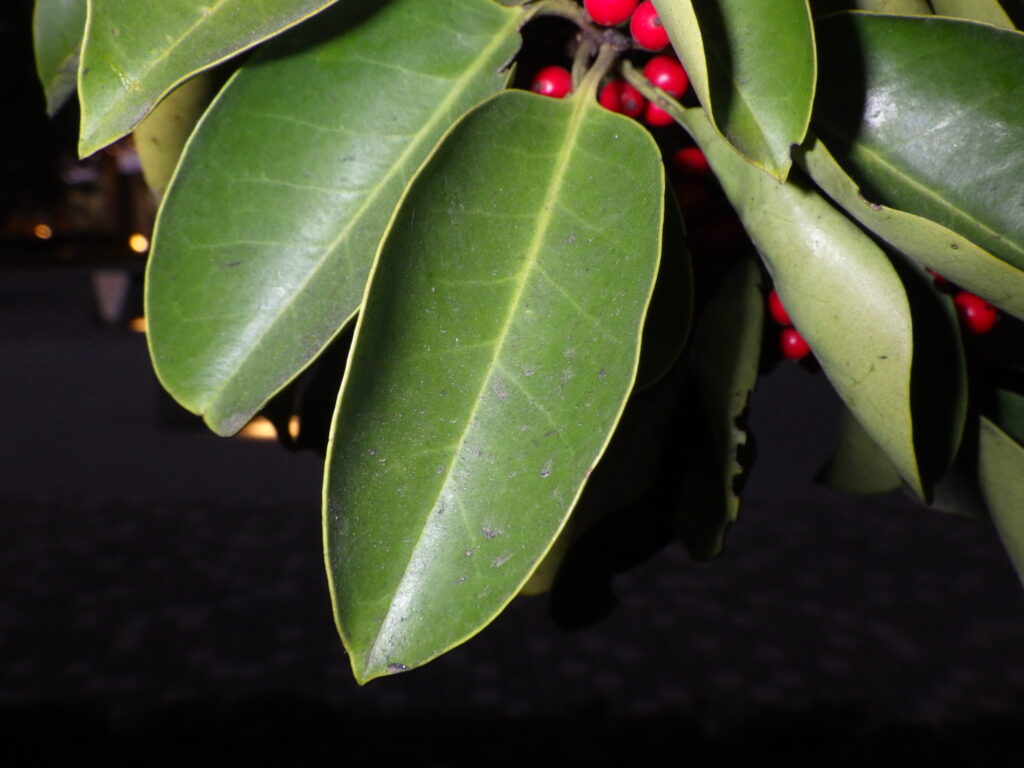
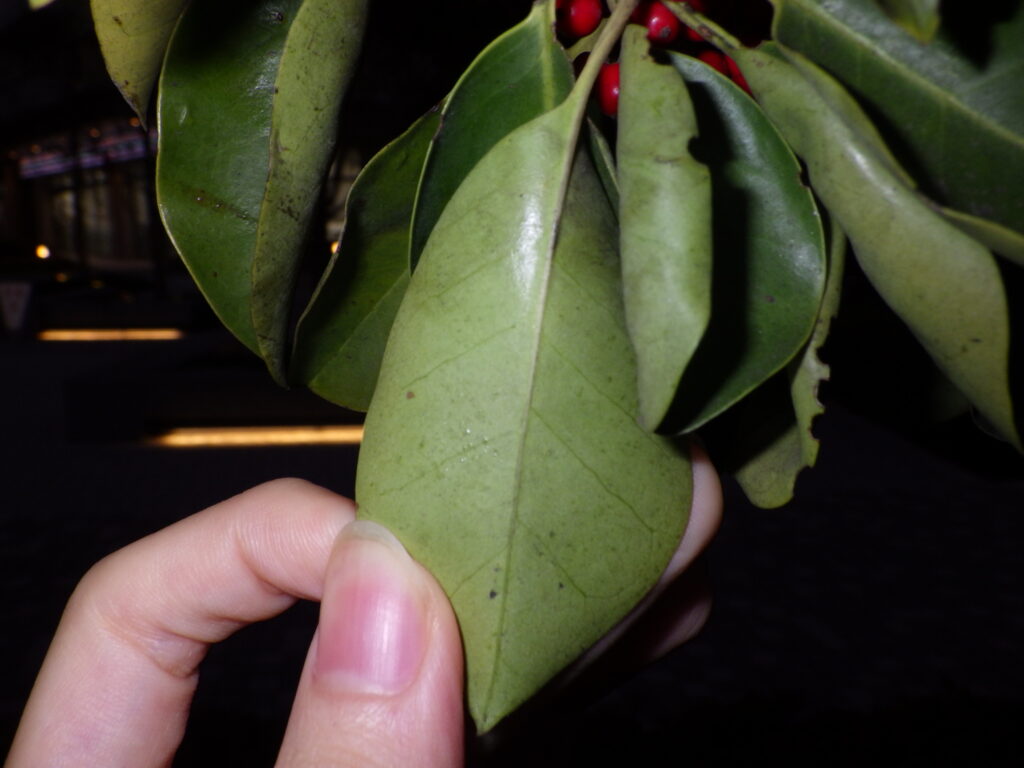
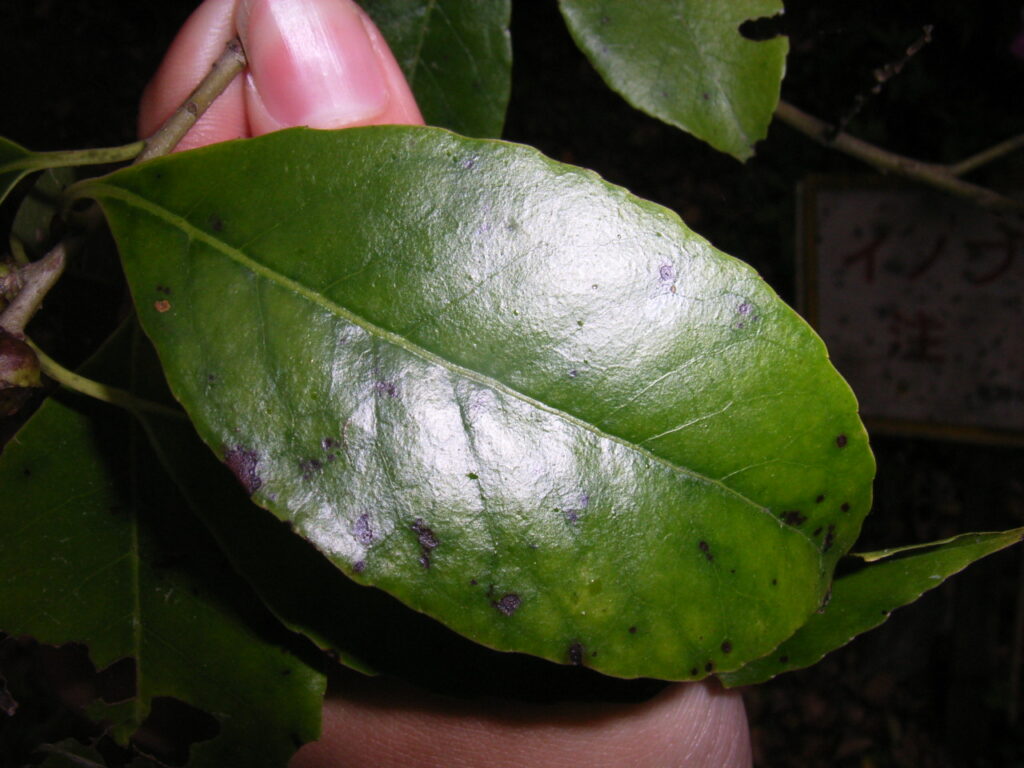
Regarding the remaining three species, the difference is that the leaf veins of Ilex rotunda and Ilex crenata can be seen with the naked eye, while the leaf veins of Ilex crenata are quite difficult to see with the naked eye.
Furthermore, while the leaf tips of Ilex rotunda and Ilex crenata are pointed, those of Ilex integra, although they do protrude, are rounded.
Regarding Ilex rotunda and Ilex crenata, Ilex rotunda has less wavy leaves, and the color of the midrib when viewed from the underside is green to slightly yellowish, while Ilex crenata has much more pronounced wavy leaves, and the color of the midrib when viewed from the underside is bright yellow. Also, Ilex rotunda grows to be about the same size as Camellia japonica.
I think you can distinguish them to some extent based on the above. Up until now we have only focused on the leaves, but if there are flowers that bloom in early summer (June-July) or fruits that grow in autumn-winter, you can make a more definitive identification.
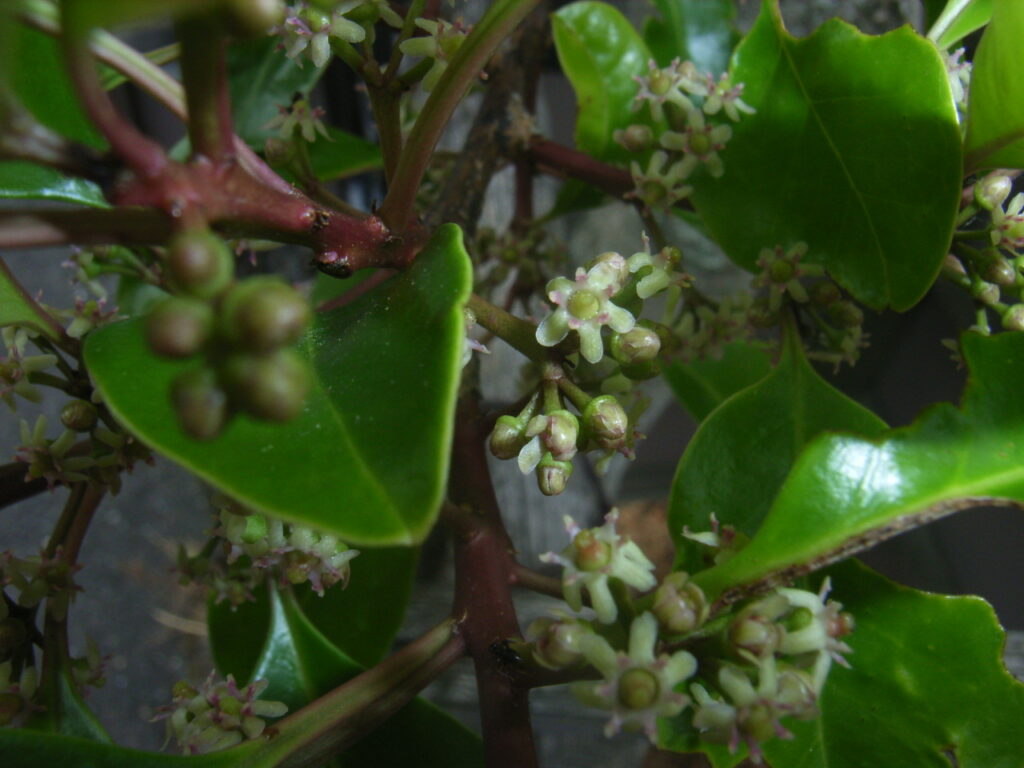
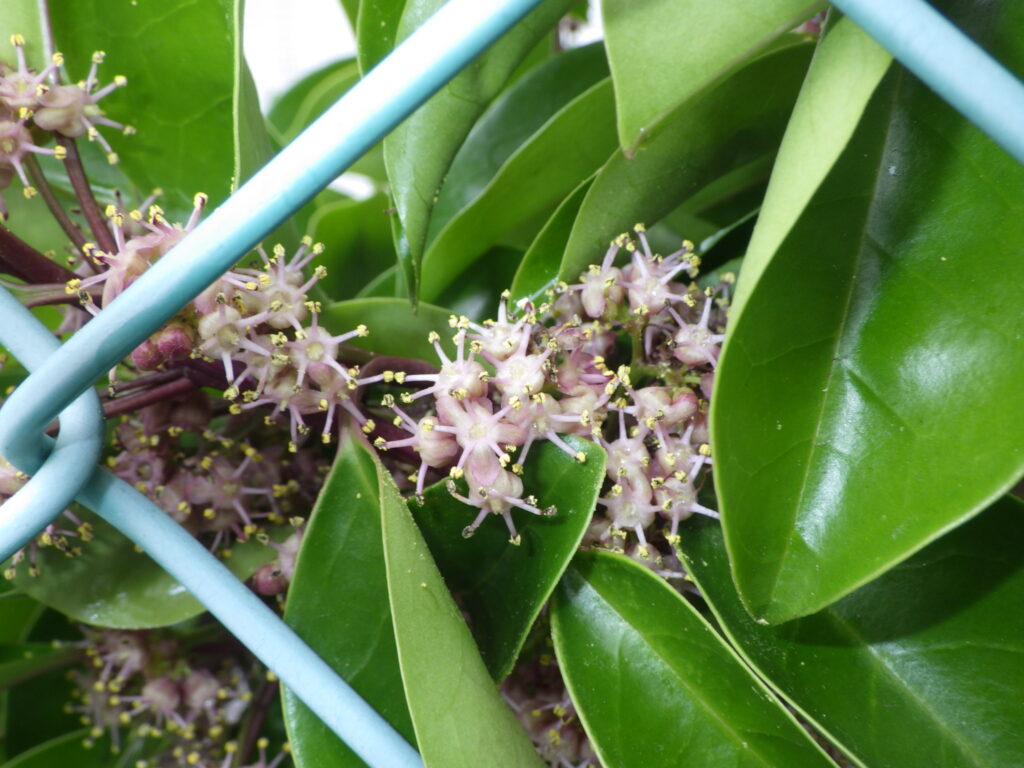
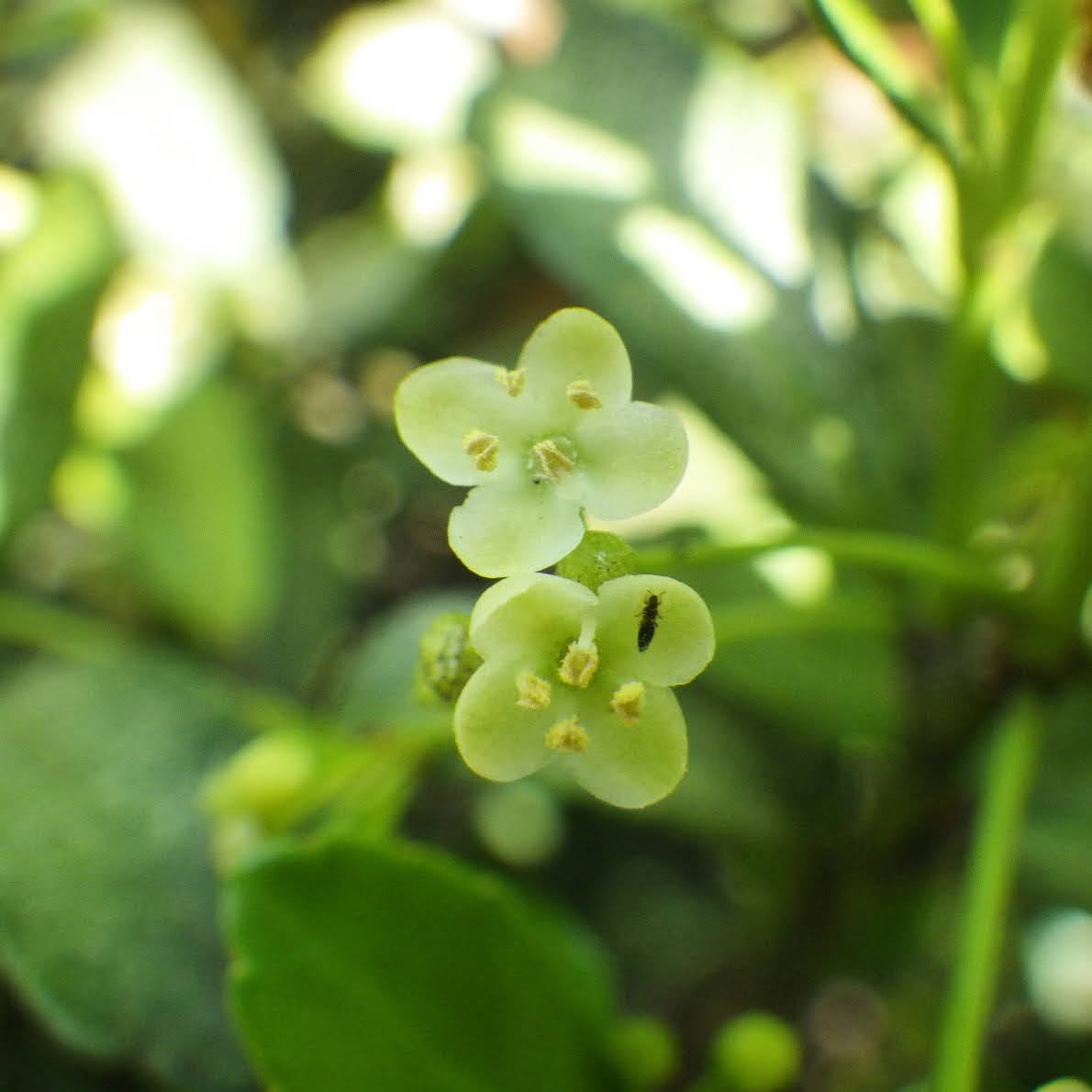
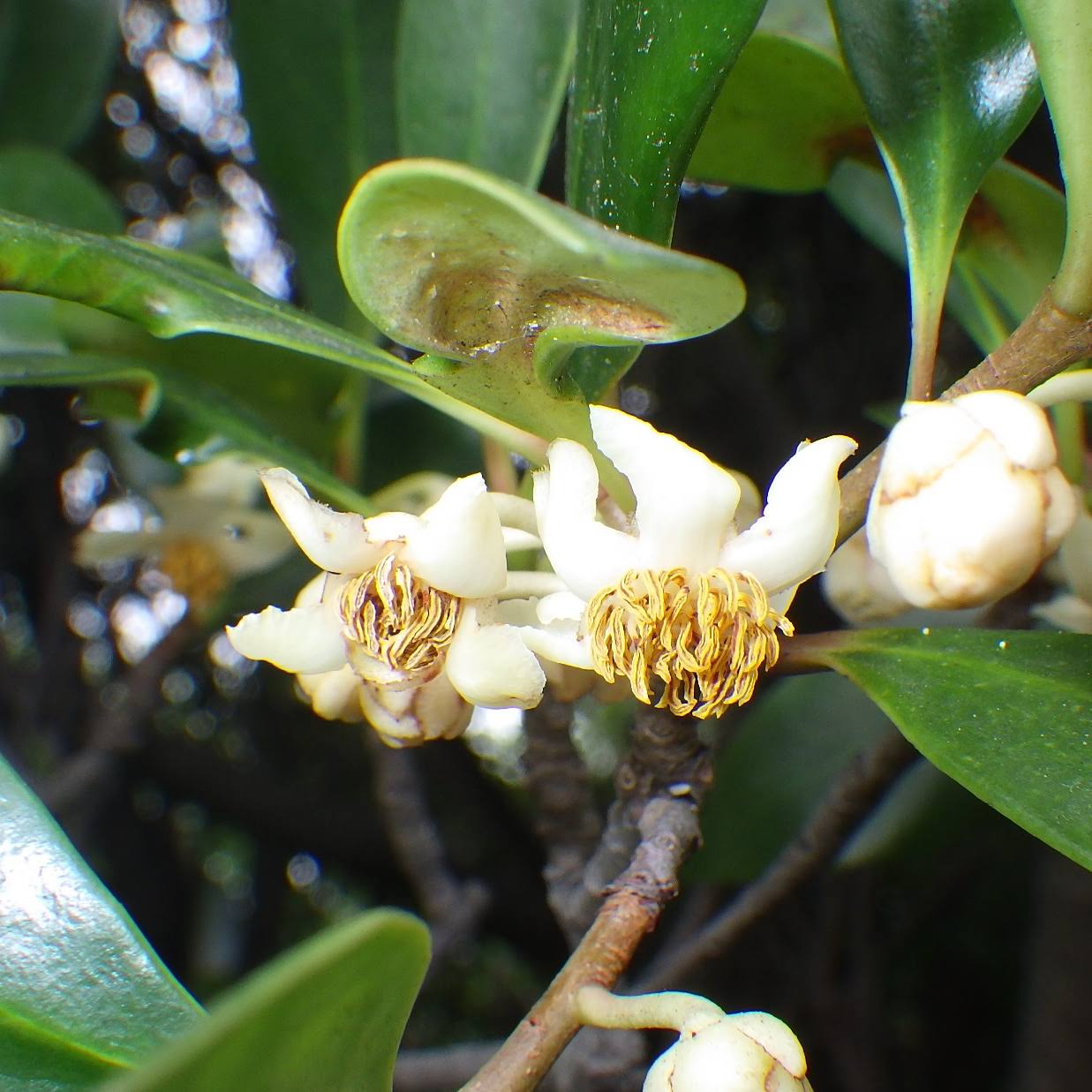
Regarding the flowers, there is a difference in that the Japanese holly (Ilex crenata) has four petals, while the Japanese holly (Ilex rotunda), Japanese holly (Ilex crenata), and Japanese holly (Ilex serrata) have five petals.
Furthermore, the petals of Ilex rotunda are green and the stamens are slightly reddish, the petals of Ilex crenata are white, and the petals of Ilex serrata are a vibrant purple.
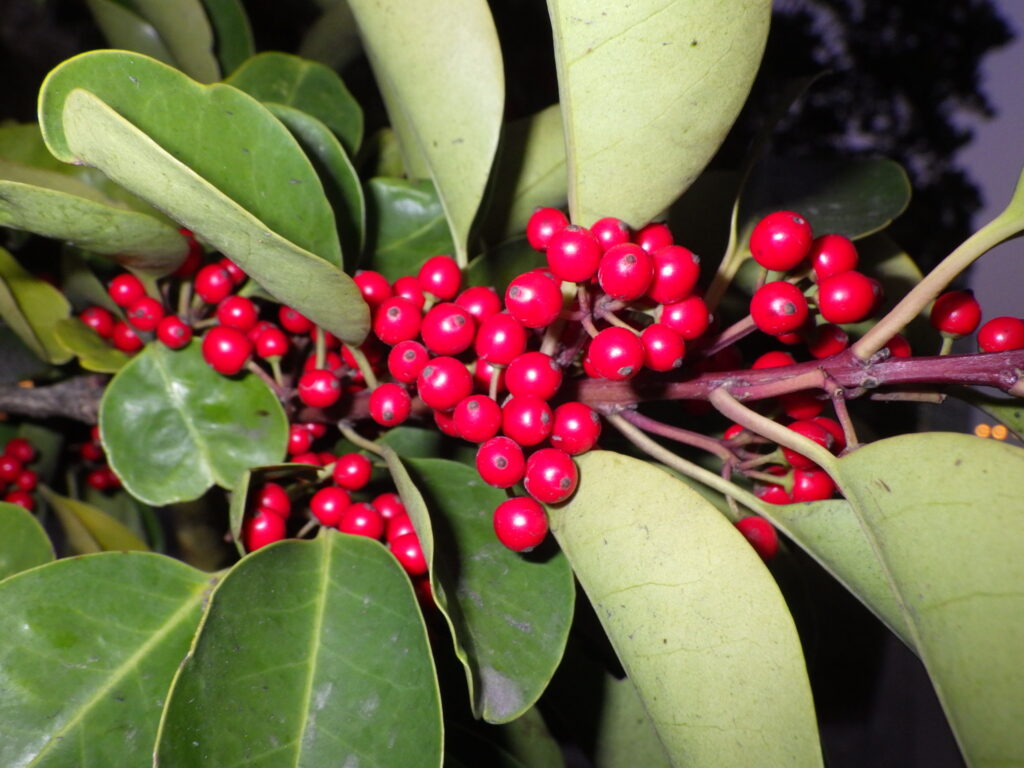
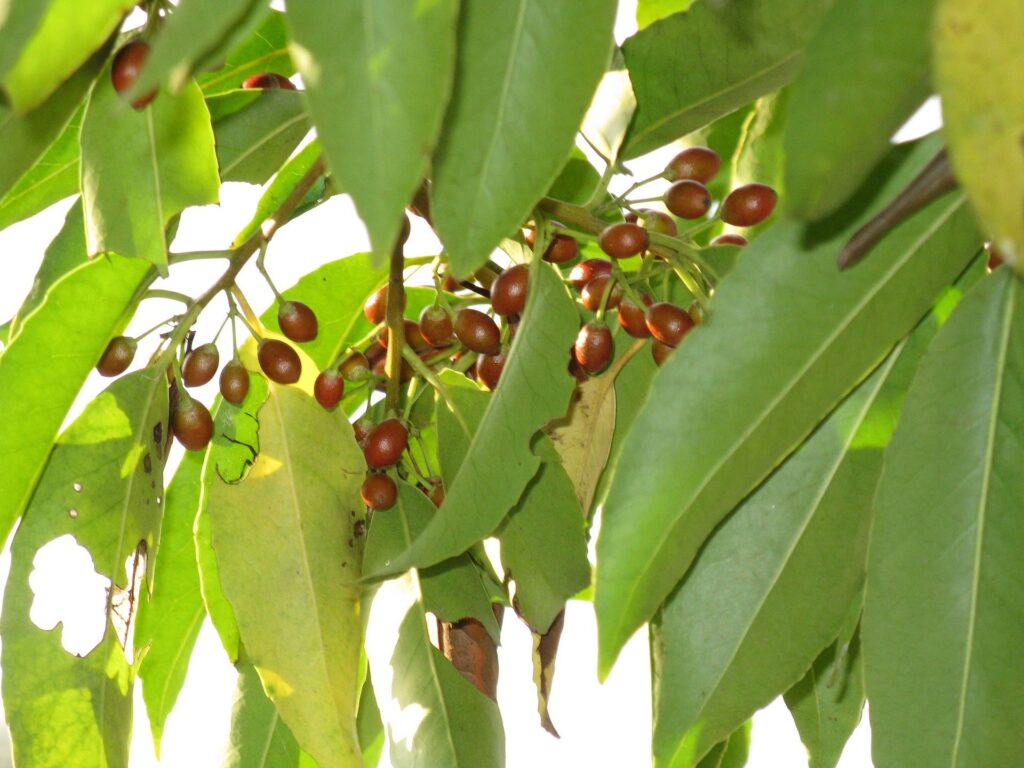
Regarding the fruits, they are all bright red and quite similar, but Ilex crenata can be reliably distinguished. In Ilex rotunda, Ilex crenata, and Ilex serrata, the fruits are clustered together in umbels with short pedicels, forming a mass, but in Ilex crenata, the fruits are solitary and have very long pedicels.
The fruits of the Japanese laurel (Ilex crenata) can sometimes be somewhat oblong. One theory suggests that the name "Japanese laurel" is a corruption of "long fruit tree."
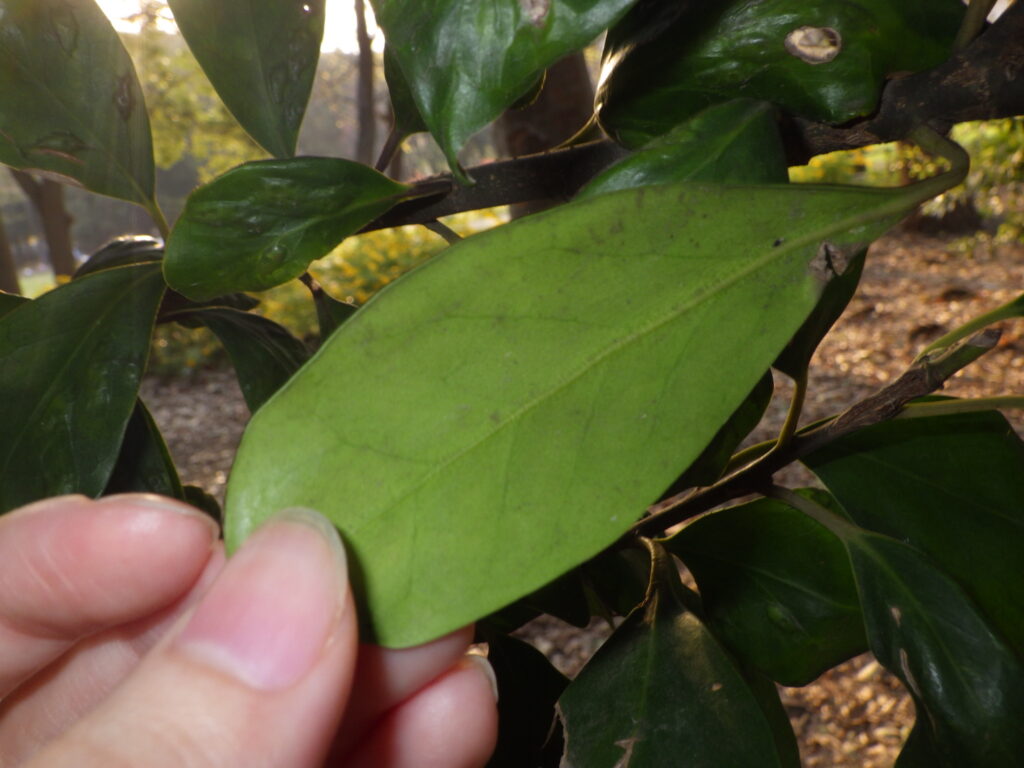
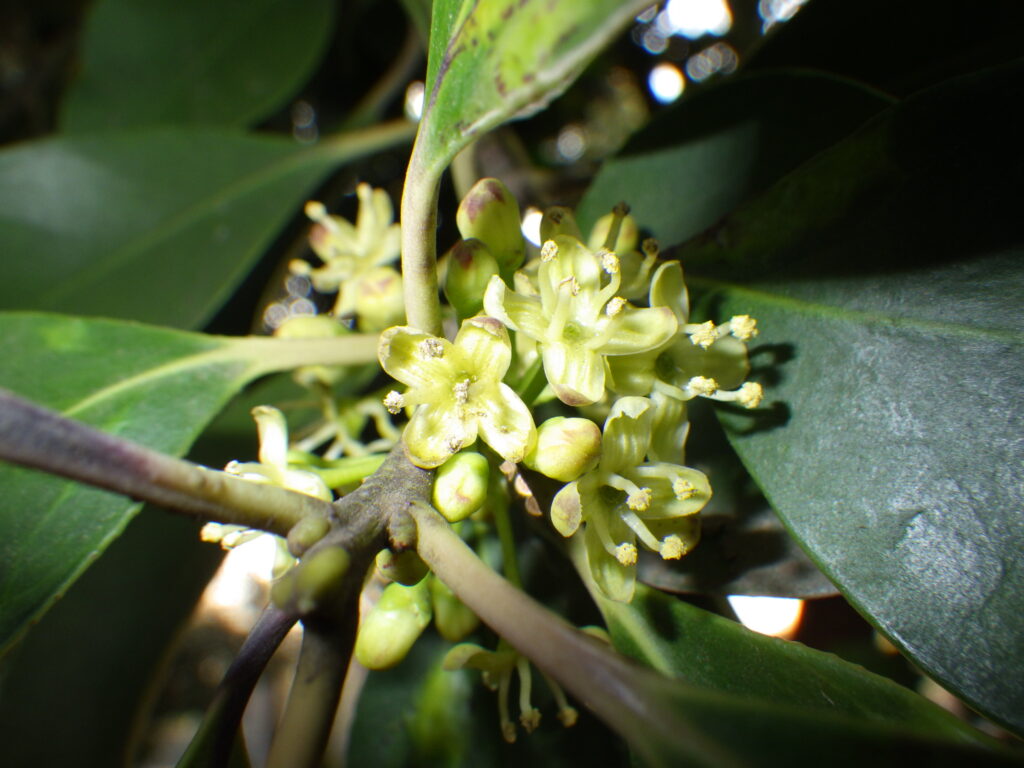
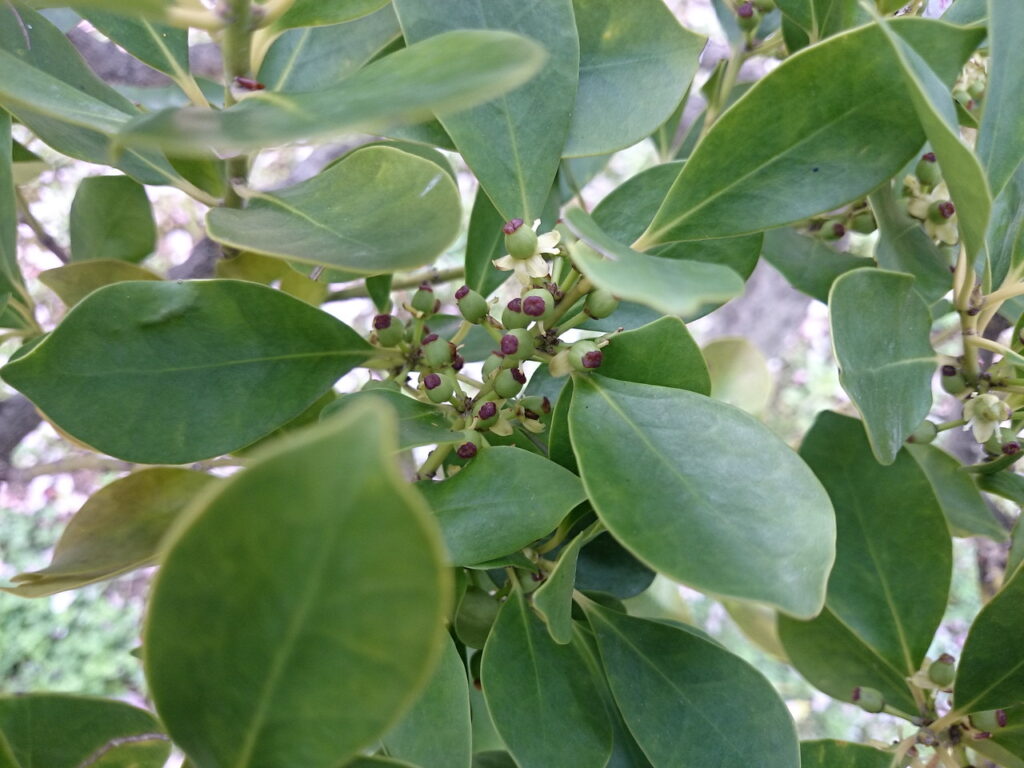
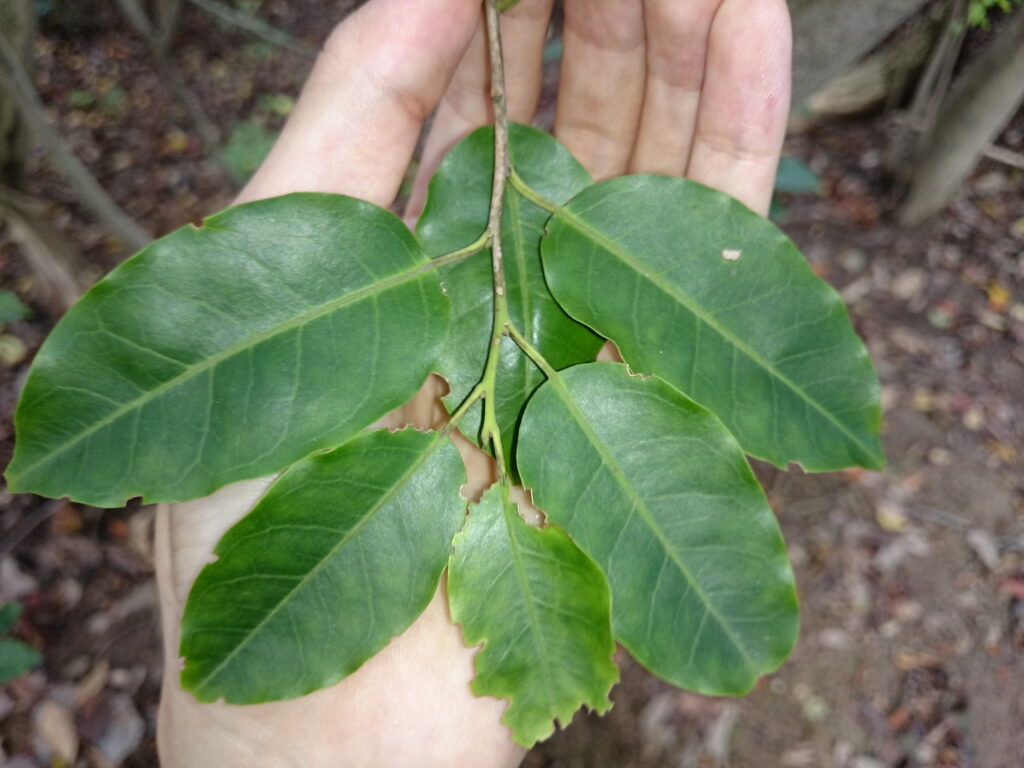
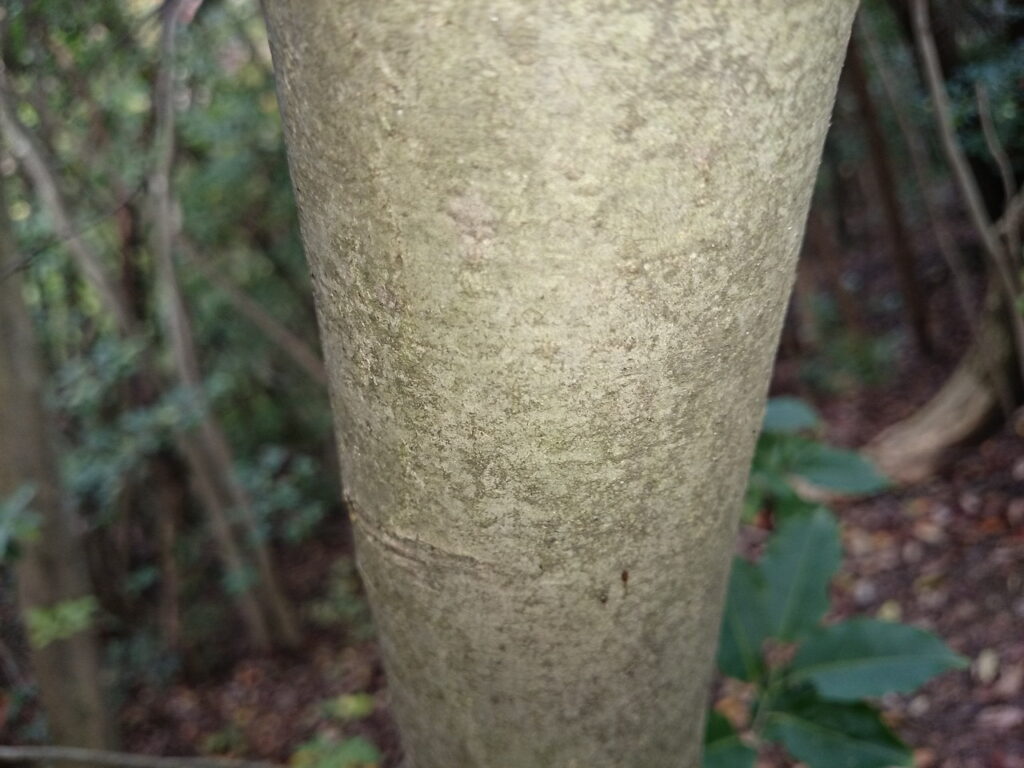
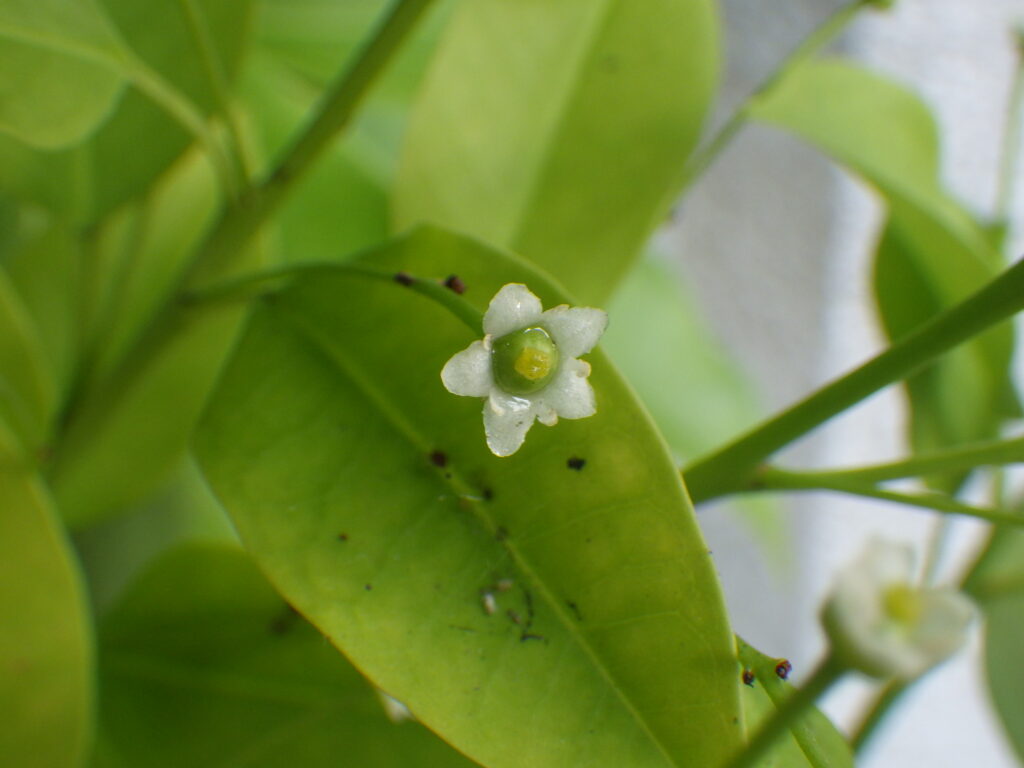
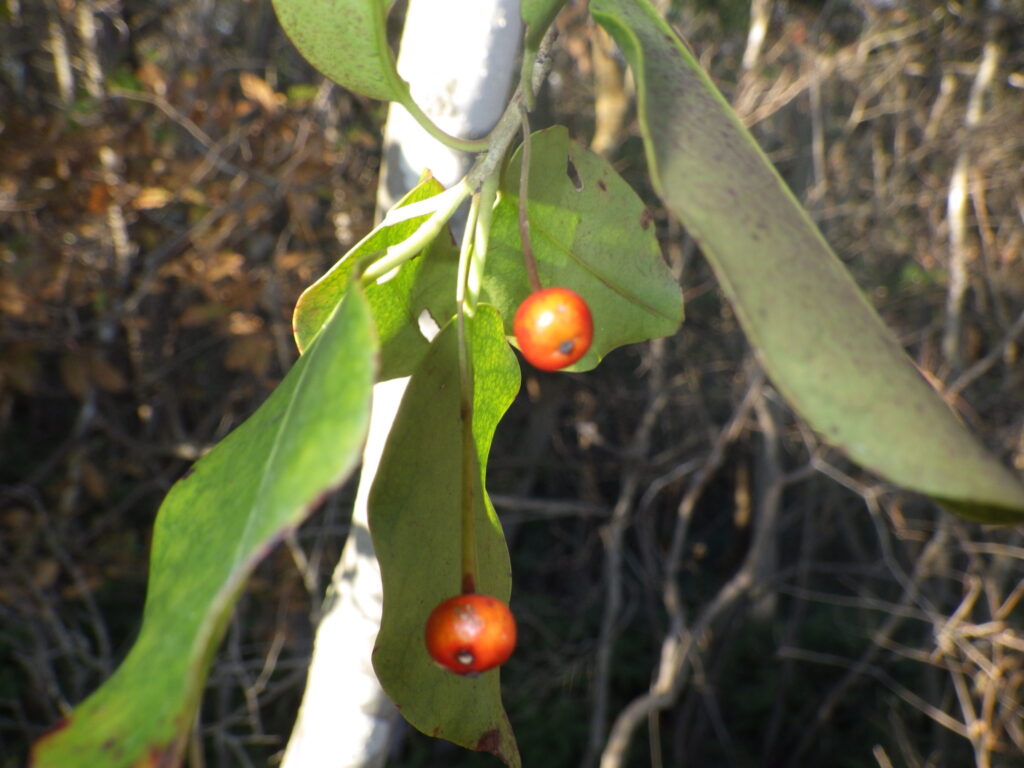
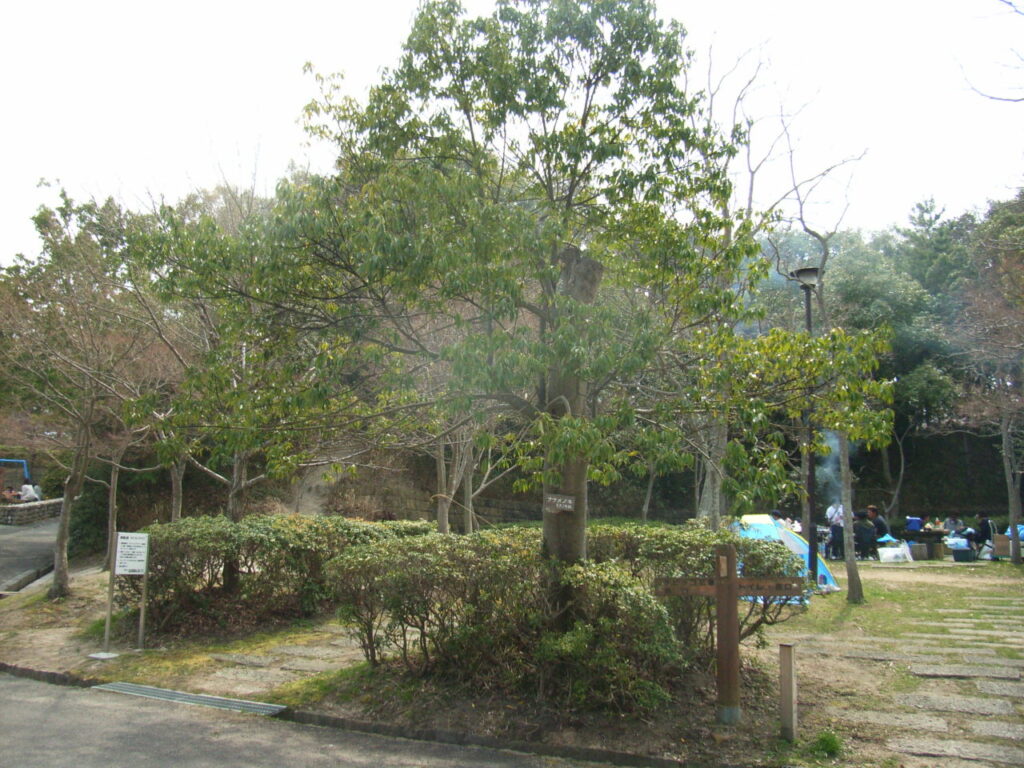
Are there any other similar species?
There are 30 known species of Ilex genus in Japan, and it's impossible to list them all here, but only a limited number of species resemble the four species introduced here.
Similar species to the Japanese holly (Ilex crenata) include Ilex leucoclada and Ilex goshiensis. Ilex leucoclada is a shrub with longer leaves than the Japanese holly, while Ilex goshiensis is a stockier, smaller species. Ilex leucoclada is a species of Japanese holly that has adapted to the snowy climate of the Sea of Japan side of the country, and is considered one of the "Sea of Japan side elements."
Another species that bears fruit in a similar way to Ilex serrata is Ilex sugerokii var. sugerokii, but unlike Ilex serrata, it has serrations on the top half of its leaves.
Japanese holly (Ilex crenata) is a very common species of the genus Ilex, but its leaves are quite small and don't resemble those of other plants.
For information on how to distinguish between Ilex crenata (Japanese holly) and other plants with entire leaves, please see our separate article.
References
Hayashi, Masayuki. 2019. Tree Leaves: Expanded and Revised Edition - Identifying 1300 Species Through Real-Life Scans. Yama-kei Publishers, Tokyo. 824pp. ISBN: 9784635070447
Tokuda, M., Tabuchi, K., Yukawa, J., & Amano, H. 2004. Inter-and intraspecific comparisons between Asteralobia gall midges (Diptera: Cecidomyiidae) causing axillary bud galls on Ilex species (Aquifoliaceae): species identification, host range, and mode of speciation. Annals of the Entomological Society of America 97(5): 957-970. ISSN: 0013-8746. https://doi.org/10.1603/0013-8746(2004)097[0957:IAICBA]2.0.CO;2