evolution

Sponsored Link
plant

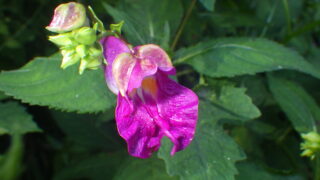
What are the differences between Impatiens textorii, Impatiens noli-tangere, and Balsam? We explain how to distinguish between similar species! While the flowers are supposed to be exclusively for bumblebees, many other insects also sneak onto them! The competition between Impatiens textorii and Impatiens noli-tangere was fierce!

Impatiens textorii, Impatiens noli-tangere, and Balsam are three species with boat-shaped flowers. At first glance, all three flowers look similar, and Impatiens textorii and Impatiens noli-tangere are particularly alike, as they sometimes inhabit the same wetlands. However, they can be distinguished by carefully observing the overall hairs and the color and shape of the flowers. Also, just looking at the leaves...
animal

The rare spider *Euphyllia japonica*, which preys on its victims by spinning silk from its mouth, can be found in your home!

When you imagine a spider, how do you picture it producing silk? A common misconception is that it produces silk from its mouth. In reality, spiders have organs called "spinnerets" on their abdomen from which they produce silk. Spiders typically don't produce silk from their mouths...
history

The "Yamakawa World History Q&A" app is incredibly convenient because you can memorize anytime, anywhere! It's a new era of studying.

Hello everyone, did you know that there's an app called "Yamakawa One-Question-One-Answer World History" that contains all the questions from the book "Yamakawa One-Question-One-Answer World History"? Yamakawa One-Question-One-Answer World History Developer: Imagineer Co.,Ltd. ¥610 posted with AppReach Recently I've been using this...
plant

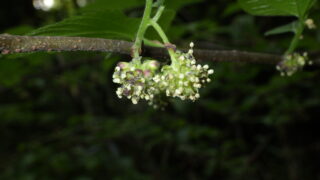
What are the differences between *Broussonetia papyrifera* and *Broussonetia kozoa*? Do *Broussonetia papyrifera* flowers burst open? What is the history of *Broussonetia papyrifera*? Are its fruits edible?

Both *Broussonetia papyrifera* and *Broussonetia erythrorhizon* have been used as paper since ancient times, and *Broussonetia papyrifera* can still be found in familiar green spaces today. However, some literature suggests that the distinction between these two species is not very clear, and they have historically been confused with each other. However...
plant

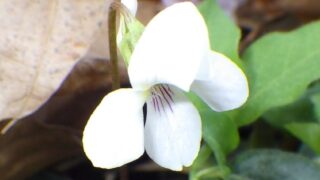
What are the differences between Viola higoensis and Viola enzanensis? Both species skillfully utilize "open flowers" and "closed flowers" depending on the environment!

Viola higoensis and Viola enzanensis are members of the Viola genus that inhabit relatively natural areas. They differ significantly from other Viola species in their finely divided leaves, but their flower shapes are almost identical, making them somewhat difficult to distinguish. Morphologically, Viola higoensis has leaves divided into five lobes...
plant

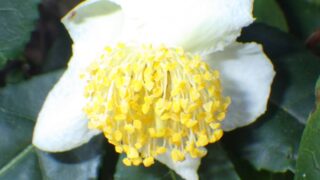
Why is black tea preferred over green tea in the UK? Are flies the only ones that visit tea plant flowers?

Tea plants contain essential nutrients like catechins and caffeine, making them an indispensable beverage in Japan, enjoyed both at home and on the go. As you may know, its origin lies in China, and it's a species not native to Japan. However, even in China, wild varieties haven't been confirmed, which is puzzling...
plant

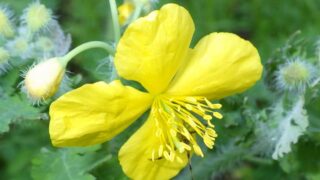
What are the differences between Greater Celandine and Japanese Kerria? We'll explain how to distinguish between similar species! Are they poisonous? Why do Greater Celandine flowers bloom at an angle?

Both *Chelidonium majus* and *Cornus kousa* are wild species of the poppy family, composed of four yellow petals, so it can be difficult to distinguish between them. Their leaves can be differentiated by the presence or absence of serrations on the leaflets, and their flowers are almost identical, but there are differences in the arrangement of the inflorescence and the shape of the stamens and pistils...
plant

What are the differences between Aucuba japonica, Aucuba japonica var. serrata, and Aucuba japonica var. japonica? We explain how to distinguish between similar species! Only fungus gnats were visiting the inconspicuous flowers!? Only bulbuls were eating the fruit!?

Aucuba japonica is distributed in evergreen broad-leaved forests of East Asia and is a very common plant in Japan, even in urban areas, where it's rare to go a day without seeing it. Several varieties of Aucuba japonica are known, and they are often classified into Aucuba japonica (in the narrow sense), Aucuba japonica var. nangokuensis, and Aucuba japonica var. dwarf. The differences between them are not easily discernible from their names alone...
plant

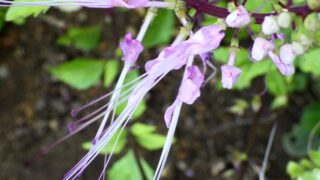
What species resembles *Cat's Whiskers* (Kumiskuching)? We'll explain how to distinguish them, and reveal that butterflies specialize in visiting the flowers! What are the effects of Kumiskuching tea?

*Cat's Whiskers* (Kumiskuching) is a popular ornamental horticultural plant in Japan, known for its long stamens. In Okinawa, it's called *Kumiskuching* and is sometimes used to make *Kumiskuching* tea. Several closely related species exist within the same genus, but they don't resemble each other very much. Japan...
plant

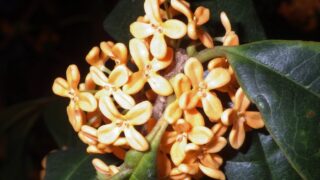
Is it a lie that only male osmanthus plants were introduced to Japan? Are there insects that dislike its unique scent?

Osmanthus fragrans is a dioecious evergreen small tree generally said to be native to China. It is frequently stated that only male plants were brought to Japan. However, in recent years, it has been thought that this is likely not true, and that the trees are actually a clonal population selected in Japan...
Sponsored Link