evolution

Sponsored Link
Seed Plant Encyclopedia

[Seed Plant Encyclopedia #004] What are the species of the Ephedra family? Photo list

The Ephedraceae family generally consists of shrubs, sometimes vines, and rarely small trees. It includes only the genus Ephedra. It is distributed across southwestern North America, southern Europe, northern Africa, southwestern and central Asia, northern China, and western South America, and is widely found in arid regions. Temperate regions...
plant

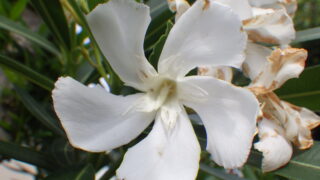
How dangerous is the poison in oleanders? Why are they a symbol of peace in Hiroshima? The oleander flower, which doesn't secrete nectar, mimics an endangered species!?

Oleander is a common ornamental tree found in various locations throughout Japan, such as in parks and as street trees. However, it originally thrives in the Mediterranean and Southeast Asia. While there are various theories, it's said that 5 to 15 leaves are a lethal dose, and although extremely rare, there have been reports of poisoning in Japan. Furthermore, the smoke from burning oleander is also toxic...
plant

What are the differences between persimmon (Diospyros kaki), Japanese persimmon (Diospyros serrata), and mountain persimmon (Diospyros margaritacea)? We'll explain how to distinguish between similar species! Where are they native to? What's the difference between astringent and sweet persimmons? What insects visit the flowers? Who eats them in nature?

The Japanese persimmon (kaki) has been cultivated in Japan since ancient times and is a fruit and plant strongly associated with Japanese culture. While closely related species exist, the Japanese persimmon is easily distinguishable by the size of its fruit. However, when distinguishing by leaves alone, it resembles the Japanese dwarf persimmon (Diospyros kaki), the Ryukyu dwarf persimmon (Diospyros ryukyuensis), and the evergreen persimmon (Diospyros kaki), and subtle differences...
animal

What are the species of moths in the family Zygaenidae? Are they poisonous? Are they harmful? What is the purpose of their bright colors?

The Zygae family, exemplified by species like the firefly moth and the bamboo grass moth, is known for its bright, diurnal colors. But do you know why they have such striking colors? It turns out they possess a powerful poison that produces cyanide, and these colors serve as a "warning signal"...
plant

What's the difference between mountain azaleas and rhododendrons? We'll explain how to distinguish between similar species! Research has revealed that bumblebees are also essential for flowers that are supposedly specialized in attracting butterflies!

The Japanese azalea (Rhododendron kaempferi) is a representative species of wild azalea in Japan, while the Japanese azalea (Rhododendron molle) is famous for being poisonous. Both belong to the Rhododendron genus of the Ericaceae family and are representative species of red wild azaleas, so you might get them confused. However, you can distinguish them by checking the shape of their leaves and how the flowers are arranged. These two species...
animal

What kind of dragonfly is a "red dragonfly"? Why does it turn red? Why does the common skimmer dragonfly turn blue? Two scientific reasons have been revealed. It turns out it's actually "sunscreen"!?

The "red dragonfly" is a creature so familiar to Japanese people that it even has its own children's song. The group commonly referred to as "red dragonfly" is a general term for dragonflies whose males turn red. Taxonomically, it's not a single group but rather a collective term for several separate groups, such as the Sympetrum and Scarlet Skimmer genera.
plant

What are the differences between buckwheat (soba), Tartary buckwheat (Tartary buckwheat), and Shakuchiri buckwheat (Shakuchiri buckwheat)? We explain how to distinguish between similar varieties! Is buckwheat's origin in mountainous regions? Why do Japanese people eat it as noodles? Are honeybees the only insects that visit its flowers?

Buckwheat, Tartary buckwheat, and Japanese buckwheat are all species that can be found in Japan, either cultivated or naturalized. Buckwheat, in particular, is indispensable to Japanese people as a noodle dish, but few people can distinguish between these three species as plants. These three species differ in the way their flowers grow, the shape of their fruits, etc.
animal

Why are the "thighs" of the longhorn beetle *Tetragnatha japonica* so thick? Was it an evolutionary adaptation to hold down females?! Recent research reveals clues in closely related species! A scientific approach to "sexual conflict."

Are you familiar with the insect known as the "Peach-thick Longhorn Beetle"? It gathers on flowers from spring to early summer and is one of the most commonly seen longhorn beetles in Honshu. Its most distinctive feature is its thick hind legs. Have you ever wondered why this is the case...?.
plant

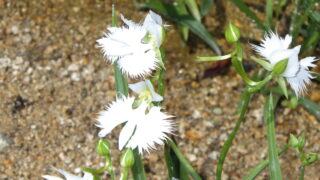
What species resembles the egret orchid? The flowers are visited by hawk moths! And not only that, tiny insects called thrips also play an important role in pollination! What is the "Egret Orchid Legend"?

The egret orchid (Habenaria radiata) is a perennial plant that inhabits slightly damp areas and is a popular choice for gardening. Unfortunately, due to the decline of its wetland habitat and illegal harvesting, it is listed as near-threatened on the Ministry of the Environment's Red List. There are many closely related species, and many that share the name "egret orchid," but this particular species has a flattened stem resembling a heron...
animal

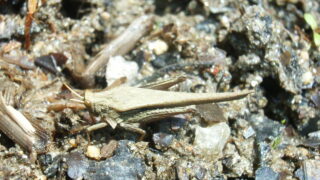
The spines on the spiny grasshopper, which inhabits wetlands, are actually a defense mechanism to protect itself from frogs! A rational defense strategy combined with feigning death!

Are you familiar with the grasshopper known as the spiny grasshopper? It's a relatively common creature in Honshu, especially in rice paddies. Surprisingly, this species has been found to protect itself from predation by frogs through a combination of two mechanisms: spines on its body and a behavior called feigning death...
Sponsored Link