form

Sponsored Link
plant

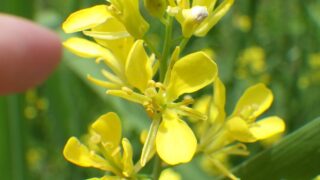
What are the differences between mustard greens, rapeseed, European rapeseed, and black mustard? How do their uses differ? Why did they evolve to be spicy? Brassica plants, essential for Japanese mustard and salad oil, have increased fruit production thanks to insect visits!

Brassica napus, rapeseed, European rapeseed, and black mustard are four species of yellow flowers that bloom in spring and belong to the Brassicaceae family. Their flower shapes are almost identical, and their habitats are also nearly the same. Furthermore, there are many closely related species, making identification extremely confusing. This complexity is such that even researchers sometimes misidentify them. Recent research has revealed...
plant

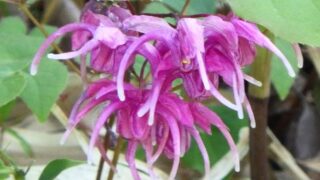
What are the differences between Epimedium grandiflorum and Epimedium sempervirens? What are the different species in the Epimedium genus? Why do the flower shapes and colors differ depending on the species? What kinds of insects visit the flowers?

Both Epimedium grandiflorum and Epimedium sempervirens are wild species famous for their anchor-shaped flowers, and are also known as cultivated varieties due to their unique flower shapes. Because the differences are so subtle when focusing solely on flower shape, distinguishing them can be difficult. They rarely coexist in nature...
plant

What are the differences between Clerodendrum trichotomum, Clerodendrum sibiricum, Clerodendrum humile, and Clerodendrum sibiricum? We'll explain how to distinguish between similar species! Do the leaves really smell? Do the flowers rely on both moths and butterflies for pollination?

Clerodendrum trichotomum, named for the foul odor of its leaves, is a tree distributed in East Asia. Several varieties and closely related species are known. These can be distinguished mainly by the length of the stamens on the flowers and the amount and shape of the hairs on the leaves. While the leaves do have an odor, not everyone finds it smelly; some people may find it unpleasant...
plant

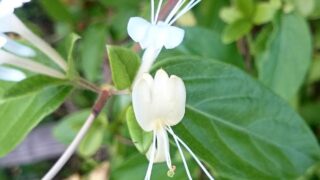
What are the differences between honeysuckle, dwarf honeysuckle, beach honeysuckle, and golden honeysuckle? We'll explain how to distinguish between similar species! Why do their flowers have different shapes? Why do some bloom in the evening?

Japanese honeysuckle (Lonicera japonica) is the most common species in Japan, frequently found both in the wild and in gardens. Several closely related species are known, and four species—Japanese honeysuckle (Lonicera japonica), Japanese honeysuckle (Lonicera japonica var.
plant

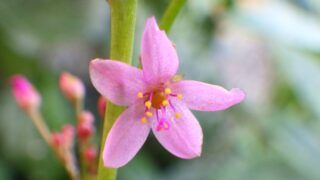
What are the differences between Portulaca grandiflora and Portulaca triangularis? How to distinguish between similar species! Where is it native? Why is it called "three o'clock grass"? There were hardly any insects visiting the flowers! Is it true that the fruit "bursts open" to scatter the seeds?

Portulaca grandiflora and Portulaca triangularis are two species of Portulaca grandiflora that produce pink flowers. Both are found in Japan as invasive species, either as cultivated plants or through escaped growth. Both species are native to the Americas. These two species differ in many ways, including the arrangement of the inflorescence, the presence or absence of ridges on the flower stalk, the size of the petals, and the shape of the stigma...
plant

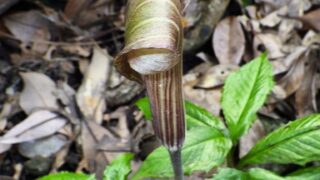
What are the differences between Arisaema ringens, Arisaema serratum, and Arisaema serratum? The flowers have a terrifying life cycle: they trap fungus gnats for pollination! Are the fruits a favorite of birds?

Arisaema ringens, Arisaema serratum, and Arisaema serratum are representative species within the Arisaema genus. The Arisaema genus is extremely similar in shape, making it a difficult group to distinguish. Frankly speaking, distinguishing between species in the Arisaema genus is extremely difficult. Even in terms of classification, regional variations...
plant

What's the difference between Enokigusa and Enoki? We'll explain how to distinguish between similar species! What are Nagaba Enokigusa and Velvet Enokigusa? These unassuming flowers are pollinated in two ways!?

While *Enokigusa* (Japanese hackberry) is a common species found along roadsides and in fields in flat areas, those unfamiliar with it may easily confuse it with the Japanese hackberry (*Enoki*), as its name suggests. Although they share some similarities, such as leaf veins, serrations, and pointed tips, their classifications are fundamentally different, with a major difference being whether they are herbaceous or woody plants...
plant

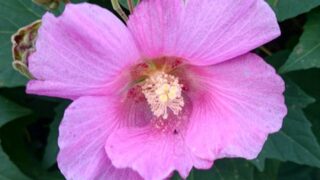
What are the differences between Hibiscus mutabilis (Fuyou) and Hibiscus sakishimaensis? We explain how to distinguish between similar species! Do slight differences in flower shape affect pollination strategies?

Both Hibiscus mutabilis and Hibiscus sakishimaensis belong to the Hibiscus genus of the Malvaceae family. They produce large, beautiful flowers, and when naturalized, they both grow in disturbed locations, making them difficult to distinguish. The difference can be achieved by carefully observing the leaves and stellate hairs. There are also slight differences in flowering period and flower color. Flowers...
plant

What are the differences between foxglove (Digitalis) and comfrey? We'll explain how to distinguish between similar species! Are they poisonous? Did foxglove flowers undergo unique evolution in America?

Digitalis (foxglove) and comfrey are two well-known poisonous horticultural species native to Europe. Their leaves are very similar; the upper leaves lack petioles, while the lower leaves have petioles and wings (where the leaf blade extends onto the stem). Comfrey, once edible, was often mistaken for digitalis...
plant

What are the differences between Monotropa uniflora, Monotropa uniflora var. alba, and Monotropa japonica? We explain how to distinguish between similar species! Why did they lose photosynthesis? What insects visit the flowers? Cockroaches are responsible for seed dispersal!?

Monotropa uniflora, Monotropa uniflora var. japonica, and Monotropa uniflora are three plant species that grow in the dark forest floor where photosynthesis has been lost. They lack normal leaves, instead having reduced scale-like leaves. They have only stems and flowers, and their entire bodies are white due to the absence of chlorophyll. They are known as mycoheterotrophic plants, but the distinction is not always clear...
Sponsored Link