evolution

Sponsored Link
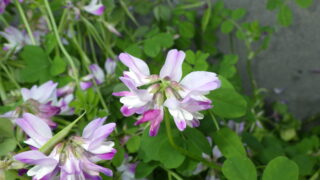
07.3476 Scutellaria flower plant

What are the differences between *Tatsunamisou*, *Kobano-tatsunamisou*, *Okata-tatsunamisou*, and *Namikisou*? We explain how to distinguish between similar species! Do bees like the flowers? And are raindrops important for the fruit?!

Scutellaria indica, Scutellaria baicalensis, Scutellaria japonica, and Scutellaria verna all belong to the genus Scutellaria in the Lamiaceae family. They are often confused in horticulture, and because they frequently grow in forest edges and on the forest floor, their large, swollen corollas are similar in shape, making them difficult to distinguish by observation alone. The genus Scutellaria includes...
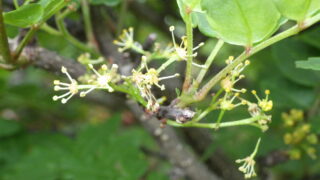
07.2401 Japanese pepper (Zanthoxylum piperitum) male flower plant

What are the differences between Japanese pepper (Zanthoxylum piperitum), Chinese pepper (Zanthoxylum sibiricum), and Japanese pepper (Zanthoxylum ailanthoides)? We'll explain how to distinguish between similar species! What are their uses? What insects visit the flowers? Birds apparently love the seeds because they don't find them spicy!?

Japanese pepper (Zanthoxylum piperitum), Japanese sansho, and Japanese sansho are common species in Japan, and Japanese pepper in particular remains an essential ingredient in cooking today. All belong to the genus Zanthoxylum in the Rutaceae family, and are very similar in that they have many thorns all over the plant and odd-pinnately compound leaves consisting of an odd number of leaflets. Japanese pepper has a distinctive aroma...
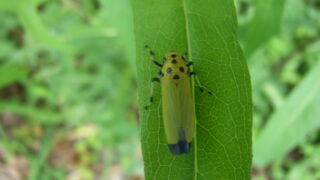
13.04002 *Tsumaguro-ooyokobai* (adult) animal

What are the different species of leafhoppers? How do they differ from planthoppers? Are they harmful? What do they eat? Did they communicate through "vibrations"? What is the role of their body color?

Leafhoppers are a general term for the family Cicadellaceae, a group of insects distributed worldwide that primarily inhabit the stems and leaves of herbaceous plants. At least 20,000 species have been described globally, and currently, 190 genera and 576 species are known in Japan, making them a highly diverse and thriving group. A close relative is the planthopper...
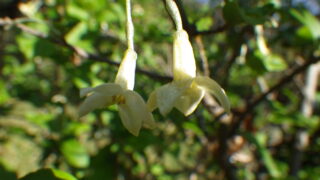
07.1847 Elaeagnus multiflora flower plant

What are the differences between autumn olive, summer olive, Chinese olive, and white olive? Can they be eaten raw? Is the "sparkle" on the leaves to prevent drying? What insects visit the flowers? Are the sweet and sour fruits very popular in nature?

Autumn olive, summer olive, Chinese olive, and white olive are all members of the Elaeagnus genus in the Elaeagnaceae family. They can be found in various locations throughout Japan, including rivers, coastlines, and forests. Their leaves are covered in shimmering stellate or scale-like hairs, and they produce pale yellow flowers consisting only of a cylindrical calyx tube, lacking petals.
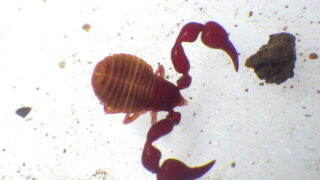
11.1825 Adult *Pseudoscorpion* (large parasitic insect), dorsal view animal

What are the species of pseudoscorpion? Are they found in Japan? How are they collected? What do they eat? What is the purpose of their crab-like "claws"?

Pseudoscorpions are a small species of arachnid that inhabit inconspicuous places such as crevices in leaves and rocks, under stones and tree bark, and in decaying trunks. They are distinguished from scorpions by the absence of a long, spiny section on the metathorax (the tail of a scorpion). As of 2023, approximately 3,400 species have been identified worldwide, and they are also widespread in Japan...
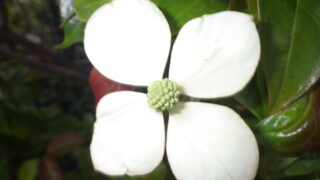
07.2851.a Cornus kousa flower plant

What are the differences between Cornus kousa, Cornus florida, and evergreen Cornus kousa? We'll explain how to distinguish between similar species! Various insects visit the flowers, but are there differences in their tendencies? There are two types of fruits: "drupe" and "aggregate fruit"!?

Cornus kousa, Cornus florida, and Cornus kousa var. serrata are three commonly planted trees with flowers featuring distinctive white bracts that resemble petals. Their white bracts are similar, and their leaf shapes are also alike, which can sometimes lead to confusion. However, these three species cannot be distinguished solely by leaf shape and color...
07.1617 Polygala japonica flower Seed Plant Encyclopedia

[Seed Plant Encyclopedia #155] What are the species of the Polygalaceae family? Photo list

All species of the Polygalaceae family found in Japan are herbaceous. The leaves are simple, alternate, and lack stipules. The flowers are bisexual and bilaterally symmetrical. There are 5 sepals. The petals are 5 in number, partially reduced or fused. There are 4 or 8 stamens, fused at the base. The ovary is superior and 2-chambered. The fruit is a capsule or drupe. [...].
07.1520 Astragalus flower Seed Plant Encyclopedia

[Seed Plant Encyclopedia #153] What are the types of legumes? Photo list

The Fabaceae family is a large family of vascular plants, second only to the Asteraceae and Orchidaceae families in terms of the number of species it contains. It includes many useful plants used for food and other purposes, and is deeply connected to human life. It includes herbs and woody plants ranging from annual to perennial, with many being climbing or possessing tendrils...
07.1363.a Hanachidakesashi flower Seed Plant Encyclopedia

[Seed Plant Encyclopedia #141] What are the species of the Grossulaceae family? Photo list

The family Grossulariaceae was previously classified under the Saxifragaceae family, but has been separated into the order Saxifragales. It consists of a single genus, Ribes, with approximately 150 species distributed in the temperate and subarctic regions of Eurasia, South America, and Northeast Africa. This article will discuss...
07.1349 Yuzuriha fruit Seed Plant Encyclopedia

[Seed Plant Encyclopedia #139] What are the species of the Daphniphyllaceae family? Photo list

The family Daphniphyllaceae consists of evergreen trees or shrubs. The leaves are densely arranged alternately at the tips of branches, narrowly oblong, and entire. The flowers are unisexual and dioecious, growing in axillary racemes. There are no petals, and the calyx has 3-6 sepals. There are 6-12 stamens. Because it has 2 carpels instead of 3, it is not related to Euphorbia...
Sponsored Link