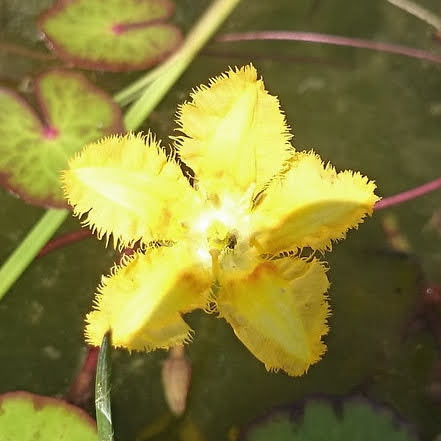
Nymphoides peltata, Nymphoides indica, and Nymphoides natans are three species of floating-leaved plants with round leaves that can be found in lakes and ponds in Japan. They are very similar, butNymphoides peltata and Nymphoides indica belong to the Menyanthaceae family, while Nymphaeaceae belongs to the Nymphaeaceae family, so they are completely different. If they have flowers, they can be easily distinguished, but even just looking at the leaves, it seems that they can be distinguished with considerable accuracy.Nymphoides peltata and Nymphoides indica are designated as near-threatened species in Japan due to the reclamation and renovation of ponds and reservoirs, as well as the progression of water pollution, while in some regions they are considered invasive alien species. The flowers have heterostylicity, with one type having long stamens and the other having long pistils, which prevents self-pollination. However, they also reproduce vegetatively to a considerable extent, and it seems that they use both seed reproduction and vegetative reproduction as needed.While it might seem that the flowers of Nymphoides peltata and Nymphoides indica play a supplementary role, they have evolved not to rely on specific insects for pollination, but rather to attract insects from a wide range of taxonomic groups.The fruitcapsuleThey use water for pollination, and the seeds survive unfavorable environmental conditions by being buried and dormant in the soil underwater. This article will explain the classification, pollination ecology, and seed dispersal of Nymphoides peltata and Nymphoides indica.
- Three species of floating-leaved plants with circular leaves found in lakes and ponds in Japan
- What are the differences between Nymphoides peltata, Nymphoides indica, and Nymphoides natans?
- Why did it become a near-threatened species?
- Why are there types with long stamens and types with long pistils?
- Did they use both seed propagation and vegetative propagation?
- Was the water lily a two-faced plant that attracted various insects for pollination?
- The water hyacinth is also a people-pleaser, but it seems to be having trouble with pollination...
- The fruits of Nymphoides peltata and Nymphoides indica are capsules, and the seeds are dispersed by water.
- References
- Source
Three species of floating-leaved plants with circular leaves found in lakes and ponds in Japan
Asaza (浅沙・阿佐佐) Nymphoides peltatum This perennial herb, with floating leaves, is widely distributed from Honshu, Shikoku, and Kyushu in Japan, to Korea and China, and across Eurasia, inhabiting relatively eutrophic lakes and ponds (Takagawa, 2006). Its status varies greatly depending on the region; in Japan, it is designated as Near Threatened (NT) on the Ministry of the Environment's Red List, and in Eastern Europe, it is an endangered species, while in North America and New Zealand, it is known as a harmful invasive alien species.
Gagabuta (mirror cover) Nymphoides indica This plant is distributed in Honshu, Shikoku, and Kyushu in Japan; as well as in Korea, China, Southeast Asia, Africa, and Australia. It is a perennial herb with floating leaves that grows in colonies in lakes and ponds (Satake, 1999). In Japan, it is listed as Near Threatened (NT) on the Ministry of the Environment's Red List.
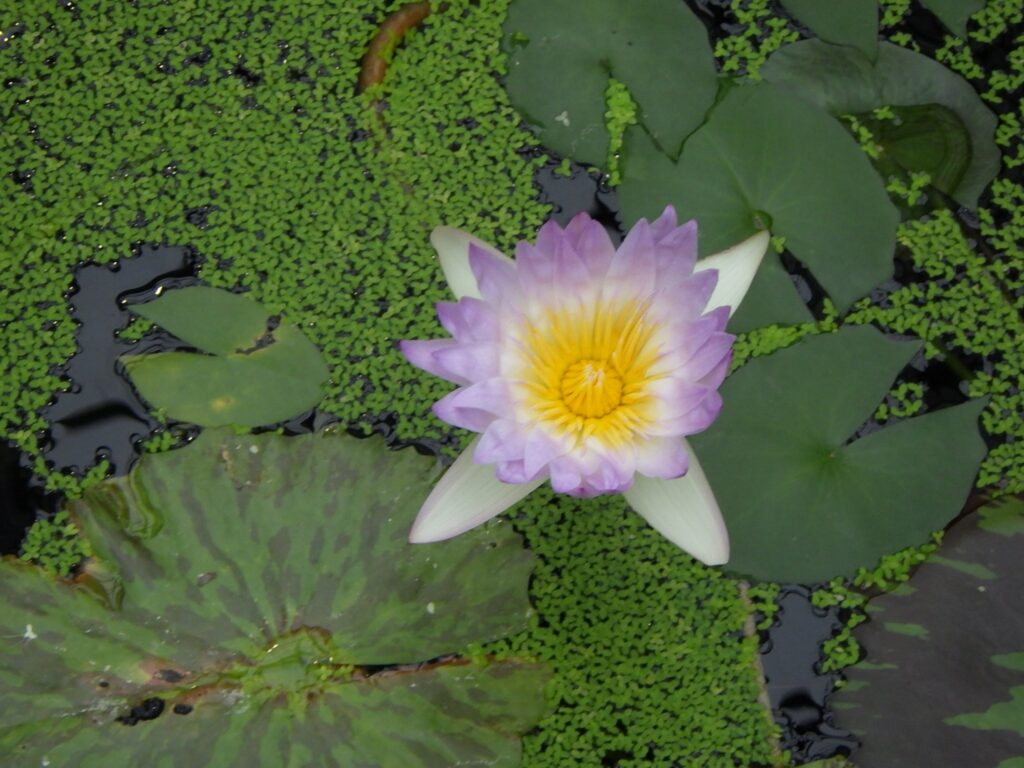
Water lilies (水蓮) are not a botanical term that refers to a specific species, but rather to the genus Nymphaea. Nymphaea This is a general term for water lilies. Among them, the term "water lily" is often used specifically to refer to cultivated varieties. They are widely distributed in temperate and tropical regions, with about 50 species known worldwide. Japan has only one species, *Hypericum tetrasperma*. Nymphaea tetragona While only the wild variety is known to exist, many cultivated varieties are actually found.
All of these are floating-leaved plants with round leaves that can be found in lakes and ponds in Japan. They are also cultivated in horticulture, and may be easily confused based on their leaves alone.
What are the differences between Nymphoides peltata, Nymphoides indica, and Nymphoides natans?
However, in terms of classification, Nymphoides peltata and Nymphoides indica belong to the Menyanthaceae family, while Nymphaeaceae belongs to the Nymphaeaceae family, so they are completely different.
That difference is most evident in the flowers.
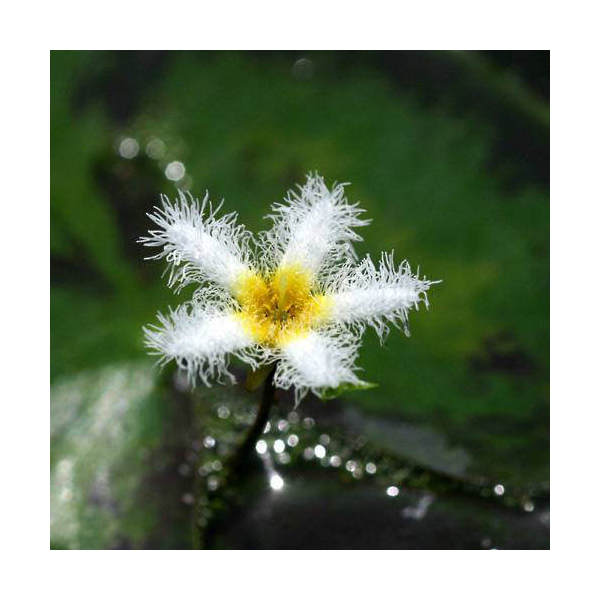
While Nymphoides peltata and Nymphoides indica have fused petals divided into five lobes with frills and thread-like decorations, Nymphaea species have separate petals with 4-5 sepals and numerous petals.
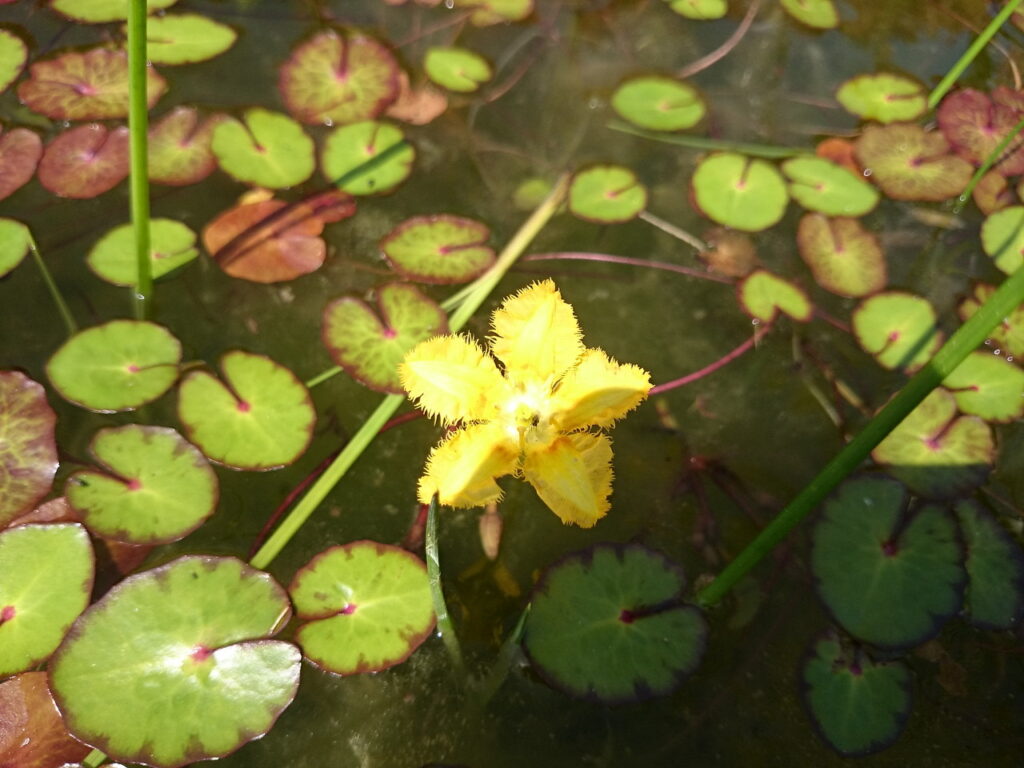
The difference between Nymphoides peltata and Nymphoides indica is that Nymphoides peltata has yellow flowers that are twisted, deeply divided into five lobes, and irregularly incised, while Nymphoides indica has white flowers with long, dense hairs on the inner surface and edges of the lobes.
If the flowers are in bloom, you won't mistake them for each other. However, depending on the time of year and location, you might be able to distinguish them by their leaves alone.
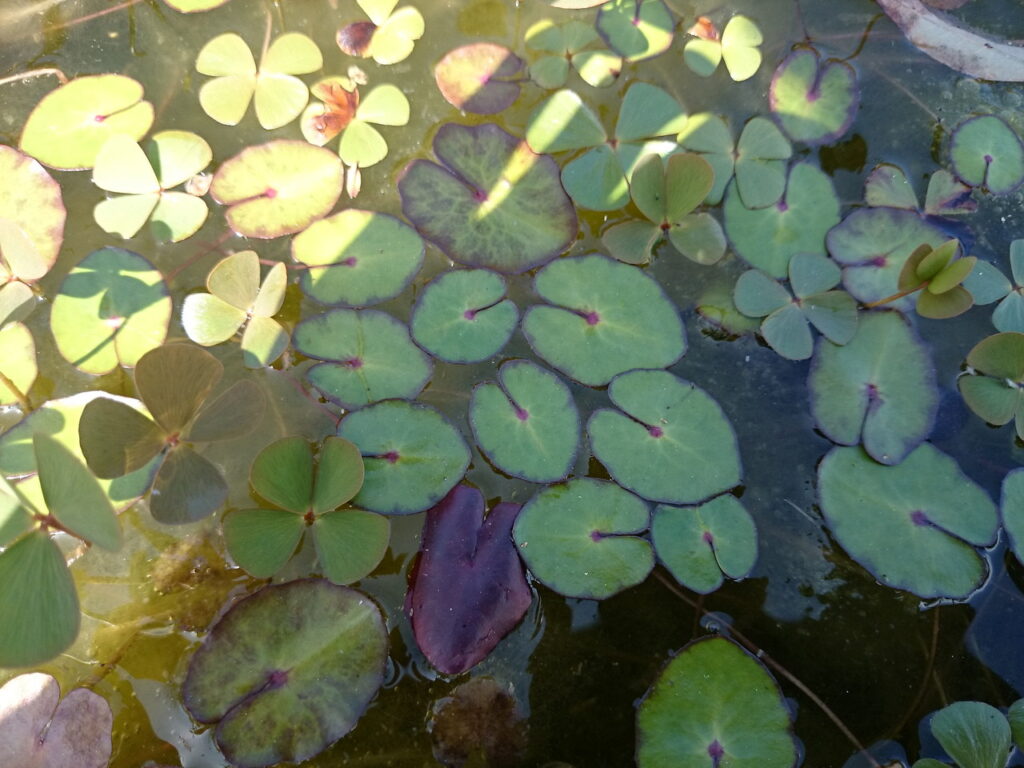
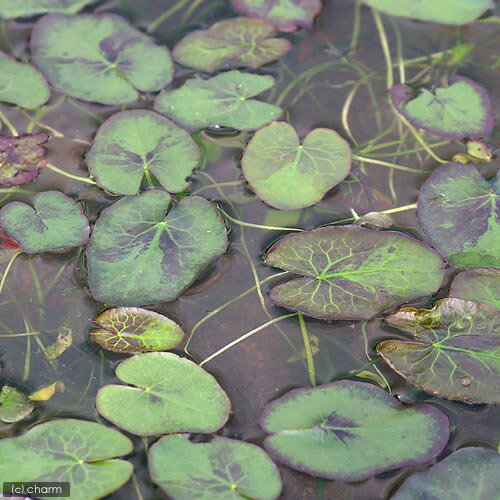
Regarding the differences in floating leaves, Nymphoides peltata and Nymphoides indica usually have leaves that are nearly ovate-circular with an ear-shaped base, while Nymphoides sanguinea generally have leaves that are nearly circular with a pointed, arrowhead-shaped base, often reminiscent of the Bandai Namco character "Pac-Man." Also, Nymphoides peltata and Nymphoides indica have entire leaf margins, but some Nymphoides varieties have wavy, serrated edges.
Furthermore, in Nymphoides peltata and Nymphoides indica, the veins are particularly white and conspicuous only in the center of the leaf, with the lateral veins being almost inconspicuous, whereas in Nymphaea species, fine lateral veins running throughout the leaf can be seen even from the outside.
The difference between Nymphoides peltata and Nymphoides indica is that in Nymphoides peltata, the base of the ear-shaped leaves is not very wide and the base of the petiole is reddish, while in Nymphoides indica, the base of the leaves is not very wide and the base of the petiole tends not to be reddish.
In terms of classification, there are differences between *Nymphoides peltata* and *Nymphoides indica*, where the upper leaves are opposite and the petioles are shield-shaped, while in *Nymphoides indica*, the leaves are alternate and the petioles are basifixed (Kanagawa Prefecture Flora Survey Association, 2018). However, it may be difficult to recognize these characteristics from the outside.
Why did it become a near-threatened species?
Why have plants like *Nymphoides peltata* and *Nymphoides indica* become near-threatened species?
The main cause is thought to be the reclamation and renovation of ponds and reservoirs, as well as the progression of water pollution, similar to the situation with many rare floating-leaved plants (Kyoto Prefectural Government Environmental Department, Natural Environment Conservation Division, 2015).
However, as will be discussed later, they have various reproductive methods and, as mentioned above, have become harmful invasive alien species in North America and New Zealand. There is still a lack of research into why these two species, which at first glance seem to have high reproductive capabilities, have become endangered.
Why are there types with long stamens and types with long pistils?
Nymphoides peltata flowers from June to September. The corolla is deeply divided into five lobes, 3-4 cm in diameter and 2.5-3 cm long, yellow, twisted, and irregularly notched, giving it a frilly appearance. The sepals are five in number and 9-13 mm long.
Nymphaea tetragona flowers from July to September. It produces numerous flowers in clusters at the nodes. The corolla is deeply five-lobed, about 1.5 cm in diameter, white, and densely covered with long hairs on the inner surface and edges of the lobes. The sepals are ovate, 4-6 mm long.
As described above, their flowering periods are quite close, but the shapes of their flowers are very different.
There's something a little unusual about the flowers of the water lily and the water hyacinth.
This means that there are individuals with long stamens and individuals with long pistils (Takagawa, 2006). Why is this the case?
This is thought to be a means of preventing self-pollination.This arrangement ensures that when insects visit the flowers, pollen from flowers with long stamens lands on the stigmas of flowers with long pistils, and vice versa.
This might be a little difficult to understand, but essentially, it means that the male and female sexes are spatially separated, and pollination occurs between plants with long stamens and plants with long pistils, but not between plants with long stamens or between plants with long pistils.
This characteristic is called "heterostyly" and can be found in a variety of plants.
The formation of heterostylicity is considered a rare phenomenon because it is genetically extremely complex (Watanabe, 2022). Furthermore, since it results in two distinct types, it effectively means that only half of the population can crossbreed. This is a significant disadvantage. Therefore, while it effectively prevents self-pollination, it remains a strategy for a minority group.
Did they use both seed propagation and vegetative propagation?
On the other hand, genetic analysis of Nymphoides peltata has shown that most of its natural habitats consist of only one or two clones, and that individuals with heterostylicity, which is necessary for seed production, grow only in Lake Kasumigaura in Ibaraki Prefecture, with only 61 individuals remaining in Japan (Uesugi et al., 2009).
Nymphoides peltata not only produces seeds through pollination, but also reproduces vegetatively by severing stolons. In Japan, where the population has declined, clonal reproduction may also be prevalent.
Subsequent studies have detected heterostylicity in Lake Inawashiro in Fukushima Prefecture and Lake Biwa in Shiga Prefecture, and have also shown that clonal populations exhibit genetic diversity (Fujii et al., 2015), suggesting that both methods are ultimately important means of reproduction.
Similarly, Nymphaea tetragona also reproduces vegetatively, forming banana-cluster-like buds at the base of the petiole.
Was the water lily a two-faced plant that attracted various insects for pollination?
What kinds of insects visit the flowers of the water lily (Nymphoides indica)?
Studies in Europe and Izunuma, Miyagi Prefecture, have shown that bees, especially bumblebees, are the main visitors (Takahashi et al., 2011). On the other hand, studies in Lake Kasumigaura, Ibaraki Prefecture, have shown that the common skipper butterfly is the primary visitor. Parnara guttataThis butterfly is considered important.Why do these differences occur?
Regarding the situation within Japan, the Common Skipper butterfly cannot survive the winter in Miyagi Prefecture, limiting its habitat, but it is commonly found west of the Kanto region. This difference seems to be the reason for the discrepancy.In other words, it seems that the important insects change depending on the surrounding environment, rather than the influence of the water lily flowers.。
Because the flowers of the water lily have a large, flat, saucer-shaped corolla, and thick stamens and pistils that are easily visible from the outside,もSo that you can understandThey are "generalists" that can accept various kinds of insects.Other aquatic flies, such as the shore fly, as well as common hoverflies and butterflies, have also been observed visiting the area. They may be able to adapt flexibly to their surrounding environment.
From a conservation perspective, it seems important to learn more about these kinds of interactions with animals.
The water hyacinth is also a people-pleaser, but it seems to be having trouble with pollination...
On the other hand, what kinds of insects visit Gagabuta?
According to research conducted in Hyogo and Okayama prefectures, several species of the genus *Parnara guttata* and *Parnara guttata* were found. Notiphila spp. *Eristalis japonica* Mesembrius flavicepsEuropean honeybee Apis mellifera- Rusty-colored carpenter bee Lasioglossum mutilum• Multiple species of the genus *Crocothemis* Bag Spp. came, and indeed a wide range of insects from the orders Lepidoptera, Diptera, Hymenoptera, and Coleoptera visited (Shibayama & Kadono, 2003).
It is thought that Nymphoides peltata, like Nymphoides indica, has evolved as a generalist plant.
However, these insects flew less than 20 cm from flower to flower and frequently performed cross-flower pollination. This means that, due to heterostylicity, the insects were not reaching individuals with different types of flowers. Therefore, it is thought that the plant's natural seed production capacity was reduced.
I don't know why this is happening, but it might be due to a decrease in the population size.
The fruits of Nymphoides peltata and Nymphoides indica are capsules, and the seeds are dispersed by water.
When Nymphoides peltata and Nymphoides indica flowers, they produce fruit. The fruit, common to all species in the Nymphoides genus, is a capsule.
The capsules of the water lily are oblong-ovate. The seeds are flattened and have columnar projections along the edges.
The capsules of *Nymphoides indica* are oval-shaped and 4-5 mm long. The seeds are broadly oval-shaped, glossy, and 0.8 mm long.
The method of seed dispersal for Nymphoides peltata is well understood. Because the seeds of Nymphoides peltata are covered with a volatile seed coat, they are buoyant and can be dispersed by water, even over long distances (Takagawa, 2006).
However, you might think that it would be difficult to move to a different river system under these circumstances.
In addition to this, it is said that "animal dispersal" also occurs, where the seeds of the water lily attach to waterfowl.
Furthermore, the seeds are dormant, forming a permanent soil seed bank. The seeds remain buried and dormant in the soil underwater. This means they won't force themselves to germinate when environmental conditions are unfavorable.
Experiments have shown that seed germination is promoted by cold-humidity treatment and variable temperature conditions, and inhibited in water with low oxygen partial pressure.This means that it germinates in a warm, dry, oxygen-rich environment. From this, it is presumed that it germinates and establishes itself in dry, bare ground environments in early spring.
This might be a bit surprising considering they normally live in water, but they also have a "terrestrial" form adapted to bare ground environments. It's strange that they are endangered despite appearing to be so adaptable.
References
Fujii, Shinji; Uesugi, Ryuji; and Yamamuro, Masumi. 2015. A follow-up study on the growth environment, flower type, escape status, and genetic diversity of *Nymphoides peltata*. Conservation Ecology Research 20(1): 71-85. https://doi.org/10.18960/hozen.20.1_71
Kanagawa Prefecture Flora Survey Association. 2018. Kanagawa Prefecture Flora 2018 (Electronic Edition). Kanagawa Prefecture Flora Survey Association, Odawara. 1803pp. ISBN: 9784991053726
Kyoto Prefectural Government, Department of Environment, Natural Environment Conservation Division. 2015. Kyoto Prefecture Red Data Book 2015 (Volume 2: Wild Plants and Fungi). Kyoto Prefectural Government, Department of Environment, Natural Environment Conservation Division, Kyoto. 611pp. https://www.pref.kyoto.jp/kankyo/rdb/index.html
Satake, Yoshisuke. 1999. Wild Plants of Japan (New Edition, Herbaceous Plants 3, Sympetalous Plants). Heibonsha, Tokyo. 259pp. ISBN: 9784582535037
Shibayama, Y., & Kadono, Y. 2003. Floral morph composition and pollen limitation in the seed set of Nymphoides indica populations. Ecological Research 18(6): 725-737. https://doi.org/10.1111/j.1440-1703.2003.00591.x
Takagawa, Shin-ichi. 2006. Conservation ecological study on the restoration of Nymphoides peltata populations using a soil seed bank. [Doctoral dissertation, University of Tokyo]. https://doi.org/10.15083/00004276
Takahashi, Mutsumi; Yoshida, Masayuki; Tamura, Masayoshi; Nakai, Shizuko; Shimada, Tetsuro; Yokoyama, Jun. 2011. Asaza growing in Izunuma (Nymphoides peltata (SG Gmel.) Kuntze) Pollinating insect fauna. Research Reports of Izunuma and Uchinuma 5: 5-11. ISSN: 1881-9559., https://doi.org/10.20745/izu.5.0_5
Uesugi, T., Nishihiro, J., & Washitani, I. 2009. Current status and genetic diversity of the endangered aquatic plant *Nymphoides peltata* population in Japan. Conservation Ecology Research 14(1): 13-24. https://doi.org/10.18960/hozen.14.1_13
Watanabe, Kenta. 2022. Current Ecological and Evolutionary Biological Perspectives on "Heterostyle." Okinawa National College of Technology Bulletin 16: 31-45. https://doi.org/10.51104/nitokinawacollege.16.0_31
Source
This article is a significantly expanded version of a piece originally published in the following book.

