Living things

Sponsored Link
plant

What's the difference between a banyan tree and a fig tree? Why is it called the "strangler fig"? Where are the flowers? Only one type of insect visits the flowers!? Where are the real fruits? It's an important food source for bats!?

The Japanese banyan tree (Ficus microcarpa) and the Japanese Ficus microcarpa (Ficus sylvestris) are known as two "strangler figs" in southern Japan, both producing drooping aerial roots and forming receptacles. Ecologically, they are similar, and it can be difficult to distinguish between them. However, there are significant differences in leaf venation and leaf length between the two. Also, regarding aerial roots...
plant

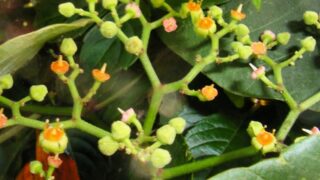
What are the differences between goji berries (Lycium chinense) and Elaeagnus umbellata (Elaeagnus umbellata)? Can they be eaten raw? How are they prepared? What kinds of insects visit the flowers?

Goji berries (Lycium chinense) and Elaeagnus umbellata (Elaeagnus umbellata) share the common characteristic of producing delicious red berries in the summer. However, their botanical characteristics are quite different. While the leaves and flowers are the most reliable way to distinguish between them, there are also differences in the fruit stalks. Goji berries can be eaten raw, but they have a "fishy smell...".
plant

What are the differences between Spiraea thunbergii, Spiraea cantoniensis, and Lycaena phlaeas? We explain how to distinguish between similar species! Did you know that flies surprisingly love the flowers of Spiraea thunbergii in gardens?

Spiraea thunbergii, Spiraea cantoniensis, and Spiraea thunbergii are representative species of the Spiraea genus in Japan, blooming with white flowers in spring. They are also cultivated for ornamental purposes. Distinguishing between them is relatively easy; you can quickly tell them apart by examining the inflorescence and flower shape. Their leaf shapes are also distinctive, so if you look closely, you can identify them even when they are not in bloom...
plant

What are the differences between sow thistle (Sonchus oleraceus), prickly sow thistle, autumn sow thistle, and narrow-leaved autumn sow thistle? An explanation of how to distinguish between similar species.

Sow thistle (Sonchus oleraceus), prickly sow thistle, autumn sow thistle, and narrow-leaved autumn sow thistle all belong to the Asteraceae family and are very commonly observed even in urban areas of Japan. Although their names are very similar, sow thistle and prickly sow thistle belong to completely different genera from autumn sow thistle and narrow-leaved autumn sow thistle. Therefore...
plant

There are differences between Phalaenopsis orchids and other similar species! We'll explain how to distinguish between them! Why are they so popular? What's their history? Did the flowers attach pollen clumps to the backs of insects?! But the species is unknown?

Phalaenopsis orchids are very popular in Japan as high-end potted plants and cut flowers. They are the number one orchid species in terms of both production volume and value. However, they are also known as "Phalaenopsis," which can be confusing. Biologically, however, the terms refer to different species, with Phalaenopsis being the "Phalae..." orchid.
plant

What are the differences between eggplant and nightshade? What is the origin and evolution of eggplant? Why is nightshade disliked? Does its flower pollinate by vibration? Why are nightshade fruits poisonous?

Both eggplant (Nasu) and nightshade (Nightshade japonica) share the name "eggplant" and have similar flower shapes, so those unfamiliar with them might confuse them. However, eggplant and nightshade are completely different species. Eggplant is a cultivated plant that does not grow wild and has no thorns, while nightshade is a wild plant...
plant

What are the differences between Nymphoides peltata, Nymphoides indica, and Nymphalis? We explain how to distinguish between similar species! Why are they endangered? Did Nymphoides peltata and Nymphoides indica survive through a strategy of pleasing everyone?

Nymphoides peltata, Nymphoides indica, and Nymphaea japonica are three species of floating-leaved plants with round leaves found in lakes and ponds in Japan. While they look very similar, Nymphoides peltata and Nymphoides indica belong to the Menyanthaceae family, while Nymphaea japonica belongs to the Nymphaeaceae family, making them completely different. They can be reliably distinguished by their flowers, but even just looking at the leaves can be quite telling...
plant

What are the differences between Zephyranthes candida, false saffron, and saffron? We'll explain how to distinguish between similar species! Why is it called "false"? In its native habitat, only beetles visited the flowers!?

Zephyranthes candida and false saffron are widely cultivated in gardens for ornamental purposes, but there may be some confusion regarding their Japanese names. The most significant difference is that the inner part of the perianth lobes of Zephyranthes candida is white, while that of false saffron is bright pink. False saffron is called "modoki" (meaning "false")...
plant

What are the differences between Ternstroemia gymnanthera, Pittosporum tobira, Rhaphiolepis indica, and Ilex crenata? We explain how to distinguish between similar species! Did you know that Ternstroemia gymnanthera is a rare species in the biological world, possessing both male and hermaphroditic flowers on separate plants? And that its fruit deceives birds?

Ternstroemia gymnanthera is an evergreen tree that grows in relatively dry areas near the coast and is quite popular as a garden tree. However, because its leaves are entire and have no serrations, it lacks distinctive features and is often confused with completely different species such as Pittosporum tobira, Rhaphiolepis indica, and Ilex crenata. However, in many cases, the color of the leaf stalks...
plant

What are the differences between *Gentiana scabrida* and *Gentiana scabrida*? We'll explain how to distinguish between similar species! Is it true that they have medicinal properties? *Gentiana scabrida* species change flower size and alter their pollination strategy depending on the environment!?

*Gentiana scabrida* and *Gentiana scabrida* are two species of plants native to Europe that bear pretty pink flowers, and they have become commonly seen in Japan in recent years. This has been the case since 1960. These two species can be distinguished by carefully observing their life forms, basal leaves, and corollas...
Sponsored Link